Cards in conversation · Lesson 2 of 6
One number, four suits
Read a number card by its rank first and its suit second, so that any Five or Nine tells you what kind of moment it is, and where.
Rank first, then suit
Every number card in the Minor Arcana answers two questions at once. The suit says where something is happening: in drive and desire for Wands, in feeling for Cups, in thought and speech for Swords, in body, work and money for Pentacles. The number says what kind of moment it is: a beginning, a pause, a test, a completion. Learn ten ranks and you hold forty cards in outline before you have memorised a single one.
Readers of Marseille-pattern decks developed this method out of necessity. Their number cards had no scenes, only a count of cups or coins set out in a pattern, so a reading had to come from rank and suit together. Olivia’s minors are full carved scenes, and the scenes matter. The number still sits under each picture, and it stops you reading forty cards as forty unrelated stories.
Ten steps from seed to load
The ladder runs in a rough arc. The Ace is the element offered whole and unformed, a seed not yet planted. Two brings a pair: a choice, a balance, something weighed. Three is first growth, when an idea takes a shape other people can see. Four builds a structure and settles into it.
Five breaks that settled square: something tests what Four built. Six restores a balance through exchange, giving and receiving. Seven steps back to assess, plan or imagine. Eight is movement and dedication, or its absence, the feeling of being held in place. Nine is the element at full intensity, near the end of its run. Ten is completion: the full load, carried or handed on.
Treat the ladder as a scaffold, not a dictionary. It tells you which question to ask of a card; the suit and the picture tell you how this card answers. The Nine of Cups and the Nine of Swords both show their element at full strength, and they feel nothing alike: one is contentment held close, the other a mind with no room left.
Four Fives, one disruption
Lay the four Fives side by side and the method becomes visible. On the Five of Wands, five barefoot youths lunge inward, long staves crossing above their heads, their faces calm and intent rather than angry: Fire tested as competing effort, many wills in one space. On the Five of Cups, a hooded figure bends its head low above three goblets lying on their sides, while two more stand upright further back and neither hand reaches toward any of them: Water tested as loss.
On the Five of Swords, a figure holding three swords turns back with a small, pleased smile toward two others, one with a hand pressed over the face, the other walking away with empty arms: Air tested as a quarrel someone has won. On the Five of Pentacles, two figures pass through snow beneath a tall window where no light shows, one of them leaning on crutches: Earth tested as material strain.
Each Five asks the same thing, what happens when a settled arrangement is shaken, and each suit shows where the shaking lands. Olivia’s card pages for all four Fives open their number sections with that shared idea before turning it toward their own element.
When a number repeats
When two or more cards in a spread share a number, read the number as the theme and the suits as the places it is happening. Two Fours might ask where you are building and where you are holding on. A Three of Cups beside a Three of Swords might ask what is being shared with others, and what hurt is asking to be named.
Weigh the pattern honestly. In a five-card spread, two number cards share a rank in roughly one draw in five; in a ten-card spread, more often than not. Three cards of one rank are rarer: about one draw in two hundred with five cards, about six in a hundred with ten. The rarer the repeat, the more attention it earns.
The Major Arcana join in by number too. The Hierophant is card V, and its own page reads it beside the minor Fives: one point added to the Emperor’s square of four. Some modern teachers also add a Major’s digits together, so Temperance, XIV, joins the Hierophant’s family of fives. Take these links as a teaching device, one lens among several, never a law.
Interactive
Practice: the deck laid out
Choose a number
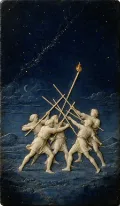 Five of Wands
 Five of Cups
 Five of Swords
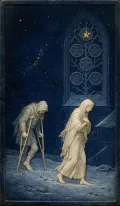 Five of Pentacles
The Fives: one idea met in Fire, Water, Air and Earth. What do they share, and what does each suit do with it?
Try this
- Open the card pages for the four Fives, read each number section, and copy the phrase that names how the disruption lands in that suit.
- Choose another rank, such as the Eights, and write one line per suit: what the number does, and where it lands.
- In your next spread of five or more cards, check for a shared number before you read any position.
- When a number repeats, write one question that names the theme once and each suit as a place it is happening.
- Pick a rank you drew this week, open its Major (Fours with The Emperor, Fives with The Hierophant) and read both number sections side by side.
To remember
- The number says what kind of moment it is; the suit says where it lands.
- Learn ten ranks once, and forty number cards arrive already in outline.
- A shared number earns attention in proportion to how rarely it happens by chance.