Major Arcana · V
The Hierophant
Tarot card meaning: upright, reversed and the symbols of the Olivia image
The Hierophant is knowledge passed from hand to hand: the teachings, rituals and institutions that hold what others learned, offered to you to understand, keep or question.
- Upright
- traditionteachingmentorshipshared ritualbelonginginherited wisdom
- Reversed
- rigid rulesempty ritualblind conformityreflexive rebellionself-made path
Upright
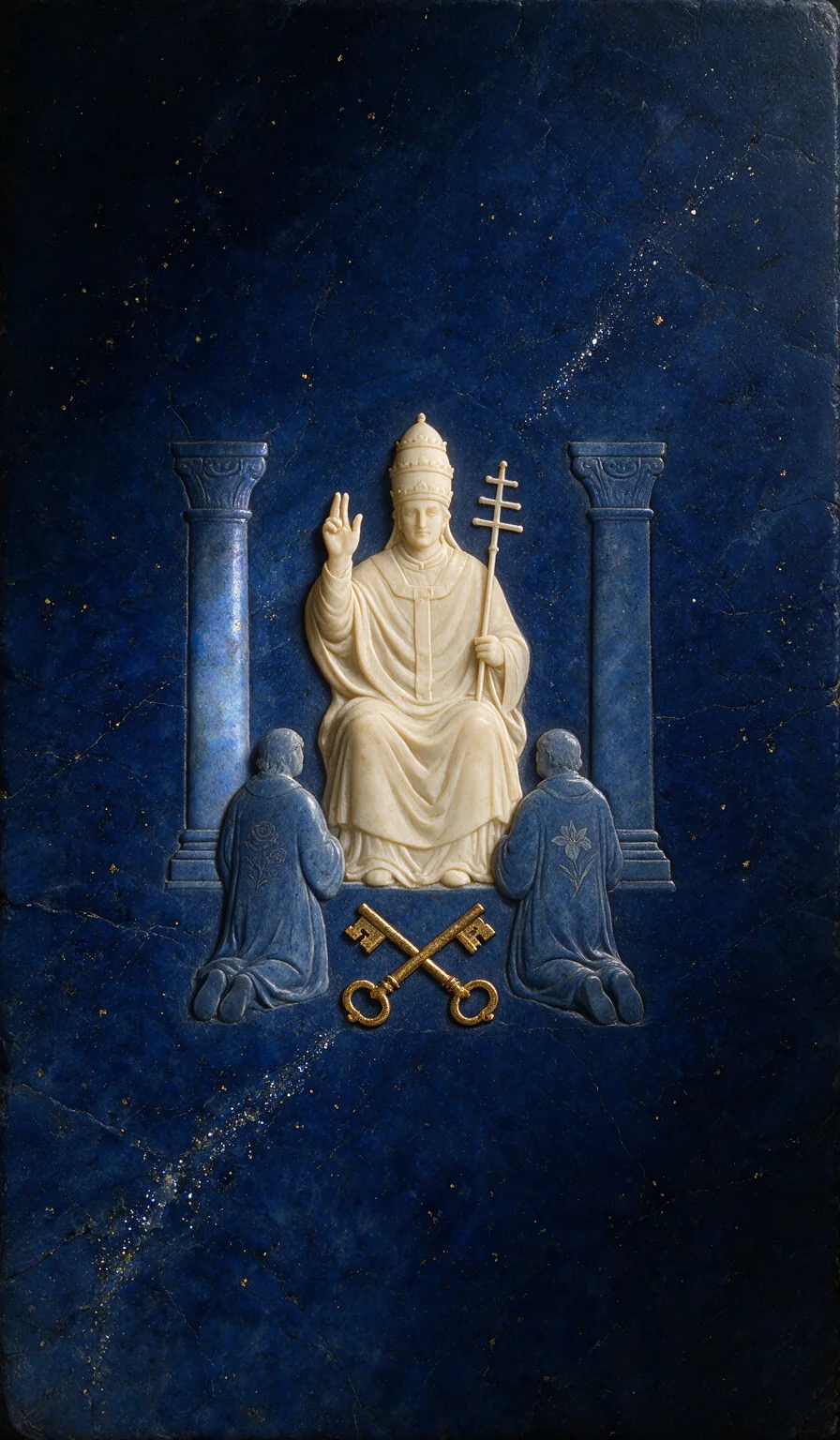
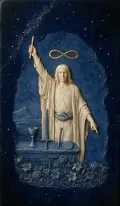
The Hierophant is the card of what is taught. In Olivia’s carving a single ivory figure sits between two lapis pillars, a three-tiered crown on the head, one hand raised in blessing, the other holding a staff topped with a triple cross. Below, two figures kneel with their backs to you, carved in the same blue stone as the pillars, so the students seem made of the institution itself while the teacher alone is ivory. Upright, the card draws attention to the structures that carry knowledge from one person to the next: a school, a craft, a faith, a family’s way of doing things.
Look at what lies between the kneeling figures: two keys crossed in gold, the only gold carving on the card. Keys open doors, but someone has to hand them over. The card can point to a season for learning inside a form rather than inventing one: finding a mentor, joining a practice, taking a course seriously, following a recipe exactly before you change it.
The Hierophant does not ask for obedience. It asks what a tradition is for, and whether you have understood it well enough to carry it. The raised hand here is a blessing, not a command; learning received in that spirit leaves your judgement intact.
Reversed
The Hierophant reversed can point to teaching that has hardened, or to a refusal to be taught at all. On one side is the rule followed because it has always been followed: a ritual kept after its meaning has gone, a qualification valued above the understanding it was meant to show, an authority no one questions any more. On the other is reflexive rebellion, which dismisses every tradition before finding out what it holds. Both leave the gold keys lying unused.
Reversed, the card can also turn inward: a time to write your own rule, practise a faith or craft in your own way, or look for a teacher who welcomes questions. Notice which inherited belief you are testing, and whether you are testing it or only reacting to it.
Read the image
Every element below is carved into this card. Scroll, hover or press a number to follow it on the image.
The three-tiered crown
What you seeA tall ivory tiara rises in three stacked tiers, each rimmed with a row of small raised points, and ends in a round knob. A soft cloth falls from beneath it on both sides, framing a calm, level face.
What it carriesThe triple crown comes from papal regalia and is commonly read as authority over three worlds: body, mind and spirit. It tells you this teacher holds an office, not only wisdom: knowledge that has been given a structure, a title and a place to be handed down from.
Follow this symbol through the deck ↗The hand raised in blessing
What you seeThe figure’s right hand, on your left, lifts to shoulder height, palm turned outward, index and middle fingers raised straight while the others fold down. The sleeve falls back from the wrist in heavy ivory folds.
What it carriesThis is the old sign of blessing and teaching from Christian art, and the traditional Hierophant makes the same gesture. It is a hand that speaks rather than seizes: authority offered outward, on behalf of something larger than the one who raises it.
Follow this symbol through the deck ↗The triple-cross staff
What you seeThe other hand, on your right, grips a slender ivory staff at waist height. At its head, three crossbars grow longer as they descend, capped by a small knob, with a rounded knop on the shaft below.
What it carriesThe three-barred papal cross appears in the Marseille Pope and in the Waite-Smith Hierophant alike, and is often read, like the crown, as rule across three worlds. Held upright and perfectly still, it marks the teacher as the keeper of a lineage rather than its inventor.
Follow this symbol through the deck ↗The layered vestments
What you seeA full ivory robe falls to the feet beneath a cape draped in deep folds over both arms. A V-shaped collar opens at the throat, and a narrow band runs straight down the chest to the lap.
What it carriesVestments make an office visible, and the hanging band recalls the stole or pallium clergy wear as a sign of their charge. The traditional image dresses the Hierophant in red; Olivia carves every layer in ivory, so the role and the person are made of one pale material.
Two lapis pillars
What you seeTwo blue columns stand at either side, carved in the lapis itself, with scrolled capitals and stepped bases. The left shaft catches more light than the right. No throne back is carved between them.
What it carriesPillars mark the threshold of a temple, and the traditional Hierophant sits between a grey pair that echoes the High Priestess’s. Here they stand well apart from the figure, framing an open space: the doorway of an institution, a place where knowledge is kept and entered.
Follow this symbol through the deck ↗The kneeler with roses
What you seeAt the lower left a figure kneels with back turned, carved in pale blue lapis. Two roses with leaves are incised in fine light lines across the robe’s back; the soles of both feet show beneath the hem.
What it carriesIn the traditional image the two ministers wear roses and lilies, the flowers of the Magician’s garden. The rose is commonly read as desire and love. Here the student carries it on the back: the longing that brings someone to a teaching, seen more clearly by others than by oneself.
Follow this symbol through the deck ↗The kneeler with a lily
What you seeAt the lower right a second pale blue figure kneels, back to you, facing the seated teacher. A single open lily on a long stem with slender leaves is incised in fine lines on the robe.
What it carriesThe lily is commonly read as purity of intention and clear thought, the rose’s partner. Two students, two temperaments: one who comes to learning through feeling, one through clarity. Both are carved in the same blue stone as the pillars, part of the structure in which they kneel.
Follow this symbol through the deck ↗The crossed gold keys
What you seeJust below the low ledge where the seated figure’s feet rest, two keys cross in an X, toothed bits pointing up and outward, round bows at the bottom. Apart from the pyrite flecks, they are the only gold on the card.
What it carriesCrossed keys are the emblem of Saint Peter; in papal heraldry one is gold and one silver, for heaven and earth. Olivia makes both gold, a material this deck uses sparingly. Commonly read as access to hidden knowledge, they lie here between the students: within reach, not yet taken up.
The number
The Hierophant is card five. In the Fool’s journey it follows the Empress at three and the Emperor at four, who give the world its body and its order; at five the traveller meets a teacher and learns that meaning, too, is handed down. Five breaks the settled square of four by adding one point, much as the minor fives bring friction into their suits. Here the added point is a question: what are the rules for? It asks you to learn a form well enough to understand it, then decide what you keep.
The tradition
In the Golden Dawn system the Hierophant bears the title “The Magus of the Eternal”. It is attributed to Vav, the Hebrew letter meaning nail or hook, and to Taurus, the fixed earth sign, on the sixteenth path of the Tree of Life, joining Chokmah and Chesed. “Hierophant” was the title of the priest who revealed the sacred rites at Eleusis; the Golden Dawn also gave it to the officer presiding over its initiations. Marseille decks call the card the Pope (Le Pape), with two tonsured clerics in the foreground; the Besançon pattern replaced the Pope with Jupiter. The Waite-Smith card of 1909 kept the triple crown, triple cross and crossed keys, all carved again here.
Love, work and self
- Love
- In love and close bonds, the Hierophant turns attention to the shared forms that hold a relationship: rituals, vows, family customs, the unspoken rules each of you brought from home. It can point to a wish for commitment, or for a public shape to give a private feeling. It can also show where a script inherited from others is quietly doing the choosing. Talk about which customs you each want to keep. With yourself, notice which of your own rules you follow out of care and which out of habit.
- Work
- In work and study, the Hierophant favours apprenticeship, qualifications and the slow learning of a discipline from people who know it well. It can point to a mentor, a training programme, an exam, or joining an organisation whose standards shape how you work. Learn the conventions properly before you bend them; that is how they become yours. With money matters, it leans towards established, well-understood approaches and qualified guidance over improvised shortcuts, while the decision remains yours.
- Self
- For your own growth, the Hierophant asks where your beliefs came from. Many were handed to you, like the keys laid below the teacher’s feet: by parents, schools, a religion, a culture. Some are still good keys and open real doors. Others belong to rooms you no longer live in. The card invites you to become a thoughtful student of your inheritance: to examine it, keep what holds, and give yourself a practice or ritual that is chosen rather than assumed.
In a spread
Read the card through each position before you look at Olivia’s version. A position is a question, and the same card answers each one differently.
The situation
What aspect of the situation deserves attention?
Olivia’s readingAt the heart of a question, the Hierophant suggests the matter turns on a tradition, a rule or an institution: what you were taught, who holds the keys, and whether you trust them.
What complicates it
What tension or assumption deserves a closer look?
Olivia’s readingAs a challenge, the Hierophant can point to a convention followed without thought, pressure to conform, or authority given more weight than your own understanding. It can equally point to rejecting useful guidance too quickly.
A helpful next step
What small action could help you understand or respond?
Olivia’s readingAs advice, the Hierophant invites you to seek a teacher, a proven method or a shared practice, and to learn it properly, keeping your questions open and your judgement your own.
In conversation with
- The Hierophant + The High Priestess
The High Priestess also sits between two pillars, a scroll half-hidden at the side. Together the two cards draw attention to two kinds of knowing: the private, intuitive kind and the kind that is spoken, taught and shared. Each keeps the other honest.
- The Hierophant + The Lovers
The Lovers follow the Hierophant directly. Together they draw attention to the step from received values to chosen ones: learning what a community holds sacred, then deciding in your own relationships what you will commit to.
- The Hierophant + The Devil
The Devil is often read as a dark mirror of the Hierophant: a raised hand, two figures below, a structure of authority. Together they ask whether a bond or a belief is freely held or has become a chain you no longer notice.
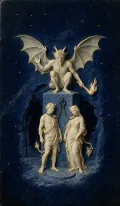
Also read withThe HermitThree of PentaclesTen of PentaclesAll pairs ↗
Questions to keep
- Which belief or habit did you inherit that you have never examined for yourself?
- Who has taught you something that lasted, and what made their teaching trustworthy?
- Where would learning a form properly give you more freedom than inventing your own?
Ask them with three cards ↗A three-card reading in which each position asks one of these questions.
A small practice
Write down one rule you live by, then note who taught it to you and whether you would still choose it today.
Cards that share its symbols
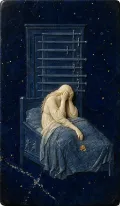 Nine of SwordsShares: The hand raised in blessing · The layered vestments · The kneeler with roses
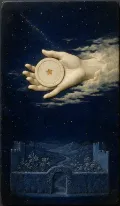 Ace of PentaclesShares: The hand raised in blessing · The kneeler with a lily · The kneeler with roses
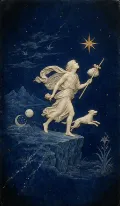 The FoolShares: The kneeler with roses · The kneeler with a lily
 The MagicianShares: The layered vestments · The hand raised in blessing