Minor Arcana · Wands
Five of Wands
Tarot card meaning: upright, reversed and the symbols of the Olivia image
The Five of Wands is lively friction: many hands, many directions, one shared fire, and the question of whether the contest sharpens you or simply scatters you.
- Upright
- competitionfrictionhealthy rivalrymany voicestesting ideasrough practice
- Reversed
- avoided conflictquiet tensionconflict fatiguescattered effortfinding common aimstepping back
Upright
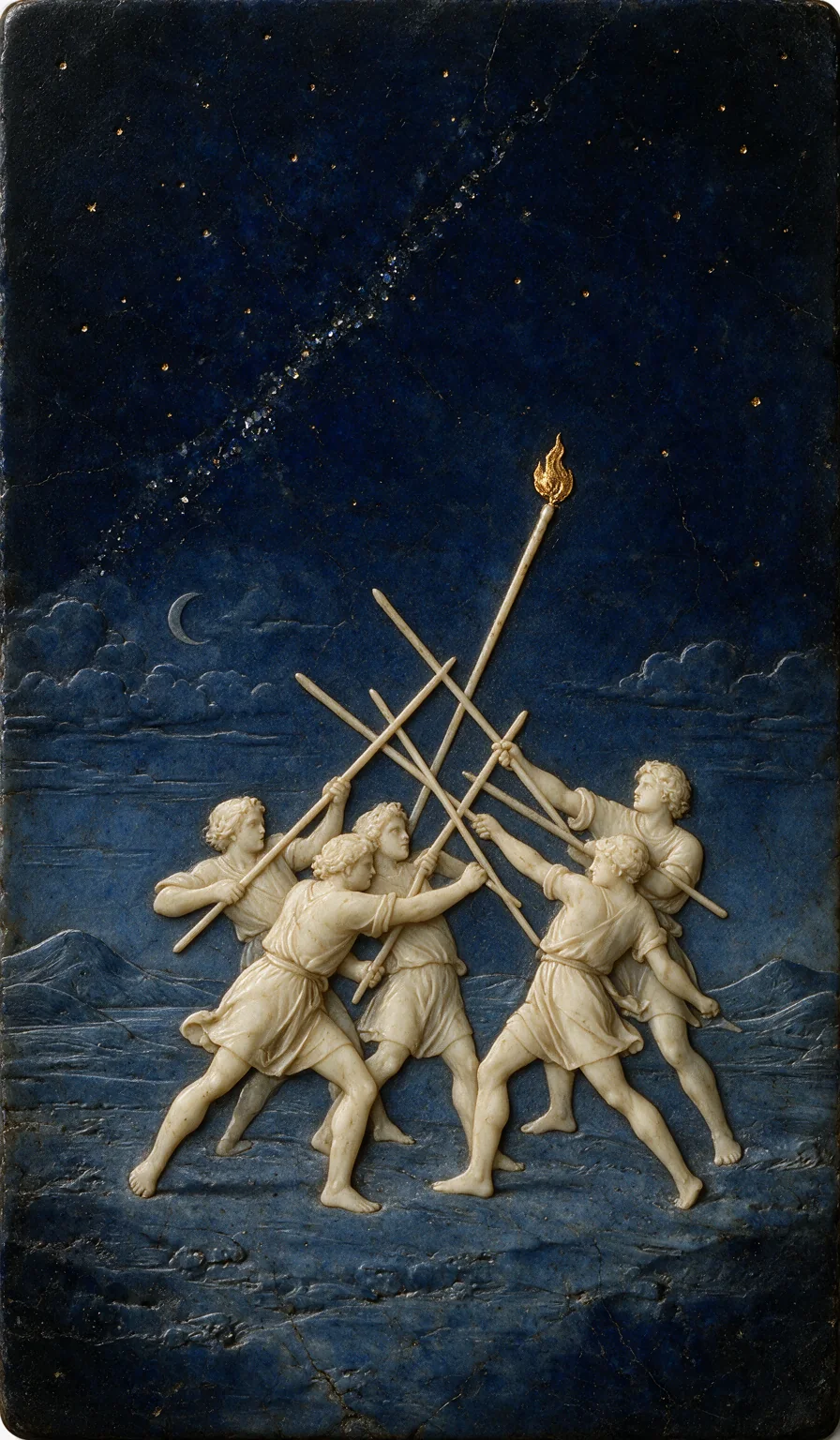
The Five of Wands brings several strong wills into the same small space. In Olivia’s card five barefoot youths in short belted tunics press in from both sides, and their staves cross and recross above their heads until it is hard to tell whose is whose: at least seven tips can be counted against the night. Nothing is broken and no one has fallen. The faces are intent rather than furious, and the scene sits somewhere between a skirmish, a game and a rehearsal. That is the card’s territory: friction that is energetic, untidy and not yet decided.
What makes this version distinctive is the gold flame burning at the tip of the tallest staff, above the whole tangle. Arms reach toward the place where the staves meet, and the rearmost figure on the right lifts the face toward that crossing rather than toward any rival. The card draws attention to what the contest is really about. Rivalry can sharpen skill, test an idea and bring out voices that politeness would keep quiet; it can also turn into motion for its own sake.
Upright, the Five invites you to take part fully while staying curious: name the shared aim, agree a few rules, and let the differences do useful work.
Reversed
Five of Wands reversed can point to friction that has gone underground: disagreements smoothed over rather than settled, or a contest you keep stepping away from because it feels exhausting. It can also show the opposite movement, a scuffle kept going by habit long after the flame at its centre has been forgotten. Either way, energy that could build something goes into managing tension.
This position asks which differences deserve an open, well-held conversation and which you could simply set down. Sometimes the useful move is to lower your staff for a moment and ask what everyone is reaching for. Sometimes it is to step into a debate you have been avoiding, knowing that disagreement among equals need not become a fight.
Read the image
Every element below is carved into this card. Scroll, hover or press a number to follow it on the image.
The Milky Way band
What you seeA glittering drift of silvery flecks crosses the upper sky diagonally, from lower left to upper right, with small gold star flecks scattered on either side in the dark lapis.
What it carriesMost versions of this card set the contest under a plain daylight sky. Olivia moves it to night beneath the Milky Way: one continuous river of light above many scattered efforts, a wider order that the scuffle below cannot see from inside itself.
Follow this symbol through the deck ↗The gold flame
What you seeAt the tip of the tallest staff, higher than every other, a small flame worked in gold burns upward against the night. Apart from the star flecks, it is the only gold on the card.
What it carriesWands are the suit of Fire, yet the traditional Five shows only staves and no flame. Here one staff has caught light. It can be read as the shared aim or bright idea all this energy is circling: the thing worth contesting, and the thing a struggle can forget.
Follow this symbol through the deck ↗The pale crescent
What you seeLow in the sky on the left, a thin crescent moon carved in paler lapis opens to the right, resting just above a bank of rounded clouds on the horizon.
What it carriesThe traditional card has no moon. In tarot the Moon stands for tides, moods and what is only half seen. A crescent over the contest suggests a phase rather than a permanent state: tempers, like tides, rise and then ebb.
Follow this symbol through the deck ↗The crossing staves
What you seeLong, smooth ivory staves cross and recross above the heads, pointing every way at once. At least seven separate upper tips can be counted against the sky, more than the five of the title.
What it carriesThe traditional image gives each of five youths a single wand. Olivia multiplies them until it is hard to tell whose staff is whose. That is the texture of the Five: energy everywhere, crossing rather than aligned. Crossed staves can be a clash, or the frame of something being built together.
Follow this symbol through the deck ↗The upturned face
What you seeAt the right, the rearmost figure stretches one arm high to grip a staff near where several cross, and lifts the face upward and to the left, toward the crossing staves rather than toward any other figure.
What it carriesThe other figures look across at one another or into the tangle. This face is lifted above the other heads, toward the crossing staves with the flame rising beyond them. It offers the card’s quiet alternative: taking full part in the contest while remembering what the effort is for.
Five young figures
What you seeFive barefoot, curly-haired youths in short belted ivory tunics lunge and lean inward from both sides, arms raised, shoulders overlapping. Their faces are calm and intent rather than angry.
What it carriesThe traditional image shows five youths with staves raised, commonly read as mock battle, a game or rough practice as much as a real fight. Olivia keeps them young and unarmoured, with no wound and no fallen figure: this is friction among equals, not war.
The low hills
What you seeBehind the group, low peaks and ridges carved in greyer lapis run along the horizon at both the left and right edges, beneath rounded banks of lighter blue cloud.
What it carriesDistant hills recur across the Wands suit as the wider terrain beyond the present effort. Here they sit at the far edges, well away from the contest: the larger landscape is waiting, and none of the figures is looking at it yet.
Follow this symbol through the deck ↗Bare feet, open ground
What you seeEvery visible foot is bare. Legs brace in wide lunges, one leg bent and one stretched behind, on rough, scored lapis ground that shows no path, grass or marked boundary.
What it carriesWands are embodied drive, and these wide stances put effort through the whole body. The open ground has no line drawn on it: no one has yet agreed where the game begins and ends. It invites you to notice whether the rules of your own contest have been named.
The number
Five is the rank of disruption. After the settled celebration of the Four, the Five breaks the balance so that something can grow again. In Wands, the suit of Fire, will and creative drive, that disruption takes the form of competing energies: many people, or many impulses within one person, each wanting to lead. On the Tree of Life five is Geburah, Severity, the sphere of strength and testing. The Six of Wands shows the rider who comes through; the Five is the rough practice that makes it possible.
The tradition
In the Golden Dawn system the Five of Wands is titled the Lord of Strife. It is attributed to Saturn in the first decan of Leo (0 to 10 degrees), and to Geburah, the fifth Sephirah, expressed through the fiery suit of Wands. Saturn’s weight and limits meeting Leo’s proud fire are commonly read as ambition pressing against resistance. Aleister Crowley kept the single word Strife for his Thoth card. In Marseille-pattern decks the Five of Batons is an ornamental arrangement of crossed batons with no human scene. Pamela Colman Smith’s 1909 design gave the card a scene of five youths brandishing staves, which Arthur Edward Waite called mimic warfare, as if in sport or strife.
Love, work and self
- Love
- In close relationships the Five of Wands often reflects lively, repeating friction: the same small argument about plans, chores or who decides, with everyone reaching for the same flame from a different angle. It cannot tell you what another person feels or intends. It asks whether the disagreement is about the aim, the method or the wish to be heard. With yourself, the card can show competing wants pulling at once, each deserving a turn rather than a winner.
- Work
- At work or in study this card often appears in brainstorms, group projects, competitive applications or teams with unclear roles. The crossing staves in Olivia’s image show energy that is real but not yet aligned. Useful friction needs a little structure: a stated goal, a turn for each voice, an agreed way of deciding. Where money is part of the contest, the card offers no verdict on figures; it asks only whether the outcome is being shaped by clear agreement or by whoever pushes hardest.
- Self
- For your relationship with yourself, the Five can describe an inner committee: ambition, doubt, loyalty and curiosity each grabbing for the same staff. Olivia’s image offers a way through in the figure at the right who, still gripping a staff, lifts the face above the other heads toward the crossing staves and the flame beyond. You need not silence the inner debate. Try naming each voice, noticing what each is protecting, and asking which one stands closest to the fire you actually care about.
In a spread
Read the card through each position before you look at Olivia’s version. A position is a question, and the same card answers each one differently.
The situation
What aspect of the situation deserves attention?
Olivia’s readingAt the centre of a question, the Five of Wands points to energetic friction among several wills or wishes. The contest itself is not the problem; what matters is what it is for.
What complicates it
What tension or assumption deserves a closer look?
Olivia’s readingAs a challenge, the card can show effort scattered in too many directions, a debate that has become a test of stamina, or reluctance to speak where a clear voice is needed.
A helpful next step
What small action could help you understand or respond?
Olivia’s readingAs advice, it invites you to name the shared aim before arguing about the method, agree a few simple rules, and treat disagreement as practice rather than as a threat.
In conversation with
- Five of Wands + Six of Wands
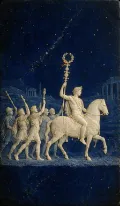
The Six of Wands lifts one wreathed rider above the crowd. After the Five’s tangle of staves, the pair draws attention to how contest turns into recognition, and to what, or whom, the struggle helped bring forward.
- Five of Wands + Five of Swords
Both Fives show conflict, in different keys. The Five of Swords pictures a contest won at a cost, with others turning away; the Five of Wands is rough play among equals where no one has lost yet. Together they ask how to disagree without leaving wreckage.
- Five of Wands + The Chariot
The Chariot holds two opposing forces steady and moves in one chosen direction. Beside the Five of Wands, where energies cross with no one steering, the pair draws attention to will that organises friction rather than simply adding to it.
Questions to keep
- What is this disagreement really about: the aim, the method, or the wish to be heard?
- Where is friction sharpening your skill, and where is it only using up your energy?
- If everyone involved looked up at the same flame, what would that flame be?
Ask them with three cards ↗A three-card reading in which each position asks one of these questions.
A small practice
Write one current disagreement’s shared aim in a single sentence, then list each voice involved, including your own, and what it is reaching for.
Cards that share its symbols
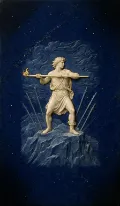 Seven of WandsShares: The upturned face · The gold flame · The crossing staves · The Milky Way band
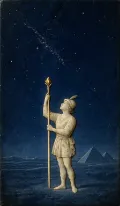 Page of WandsShares: The gold flame · The upturned face · The Milky Way band · The crossing staves
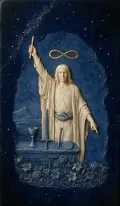 The MagicianShares: The Milky Way band · The crossing staves · The low hills
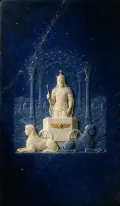
 The EmperorShares: The Milky Way band · The low hills · The upturned face