Cards in conversation · Lesson 3 of 6
Suit walks and the missing step
Read cards of one suit as steps in a single story, and turn the step a spread leaves out into the question worth asking.
Ten numbers, one story
A suit is not ten separate cards that happen to share a symbol. Read in order, it is one element passing through ten stages. The Ace offers the whole element as a seed, still unformed. The Two pairs and chooses, the Three grows and expresses, the Four settles into structure. The Five tests that structure, the Six restores balance through exchange, the Seven stops to assess or imagine. The Eight moves or rearranges, the Nine holds the element at full strength, and the Ten completes it, with the full load that completion carries.
Set any card against that ladder and it becomes a step with a before and an after. In Cups, the suit of Water, feeling and imagination, the Five spills, the Six remembers and offers, the Seven dreams, and the Eight walks away from cups still standing. Knowing where a card sits in its suit tells you what it has come through, and what the next step asks of it.
Reading a run
When two or three consecutive numbers of one suit land in a spread, read them together as a small story before you read them one by one. The Ace, Two and Three of Wands become spark, plan and first reaching out: a desire noticed, a direction chosen, a first move made towards the wider world. The Eight, Nine and Ten of Swords become feeling trapped by a thought, worry in the small hours, and the end of that line of thinking. A run gives you a verb where single cards give you nouns.
Read the run in suit order first. If the cards land on the table as Ten, Nine, Eight, you can also read it as unwinding: start where things feel finished and work back to the point where they first felt stuck. Neither direction is a timeline. A run shows the shape of a process you are inside, and the useful question is which step you are standing on now.
The missing step
Sometimes a spread holds two cards of one suit with a single number missing between them: the Four and the Six of Pentacles, the Two and the Four of Swords, the Six and the Eight of Cups. Look hard at the card that is absent. It names the stage the story seems to skip, and a skipped stage is often exactly where a reading has something to offer.
Bring the missing card in as a question, not as a card you ought to have drawn. Open its page, read its essence line, and ask whether that step happened quietly, whether it is still open to you, or whether you went round it. Do not pull it from the deck to fill the gap. The gap is the finding; filling it with a fresh card turns a clear question back into noise.
Keep this to one missing step. With two or more numbers between the cards the thread grows too thin to follow, and each card is better read through its own position.
Walking the whole suit
The surest way to learn a suit’s story is to walk it once, slowly. Open the Ace to the Ten of one suit in order and tell its story in ten sentences, one per card, each beginning where the last one ended. Write it in your own words. When a sentence will not come, that card is the one you do not yet know from the inside, and it deserves a second visit.
Then add the four courts as four ways of carrying the same element. In Cups, the Page meets a feeling that surfaces unasked, with curiosity rather than judgement; the Knight sets feeling in motion at a walking pace; the Queen holds it close with patient attention; the King stays steady in its presence, however strong it runs. These are temperaments anyone can use, not people arriving in your life. Notice which of the four you reach for, and which you rarely try.
Hold the ladder lightly
The number ladder is a teaching device with a history. Readers of Marseille-pattern decks, whose number cards show only a count of cups or swords with no scene, work largely from number and suit. Golden Dawn writers linked each number, Ace to Ten, to one of the ten Sephiroth of the Kabbalistic Tree of Life, and Pamela Colman Smith’s 1909 scenes gave every step a picture. Olivia’s card pages keep these traditions as history, card by card.
So walk the suit, but do not march to it. A run describes a shape, not a schedule, and a missing step points to where you might look, not to something that must follow. Where the story in the suit and the story you know from your own life part company, trust your life and let the cards sharpen the question.
Interactive
Practice: the deck laid out
Choose a number
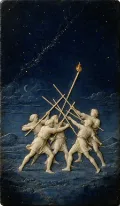 Five of Wands
 Five of Cups
 Five of Swords
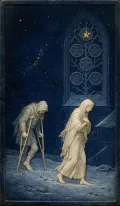 Five of Pentacles
The Fives: one idea met in Fire, Water, Air and Earth. What do they share, and what does each suit do with it?
Try this
- Open the card pages for the Ace to the Ten of Cups in order and write one sentence for each, beginning where the last one ended.
- Follow the Symbol Trail called The cup, and note on each card who holds, offers or turns away from the cups.
- Add the Page, Knight, Queen and King of Cups, and write which way of carrying feeling you use most.
- Look back through your notebook for two cards of one suit with exactly one number missing between them; open the missing card’s page and write its question.
- Walk a suit you find harder, and circle the card where your sentences stopped coming.
To remember
- Read consecutive cards of one suit as one small story, not separate notes.
- A single missing step between two cards of a suit becomes your question.
- A suit walk shows the shape of a process, never a timetable.