Minor Arcana · Cups
Five of Cups
Tarot card meaning: upright, reversed and the symbols of the Olivia image
The Five of Cups gives loss its full weight, while quietly showing that something valued still stands, waiting until you are ready to turn toward it.
- Upright
- griefdisappointmentregretmourningwhat remains
- Reversed
- delayed griefslow turningacceptancehidden sorrowreplayed regret
Upright
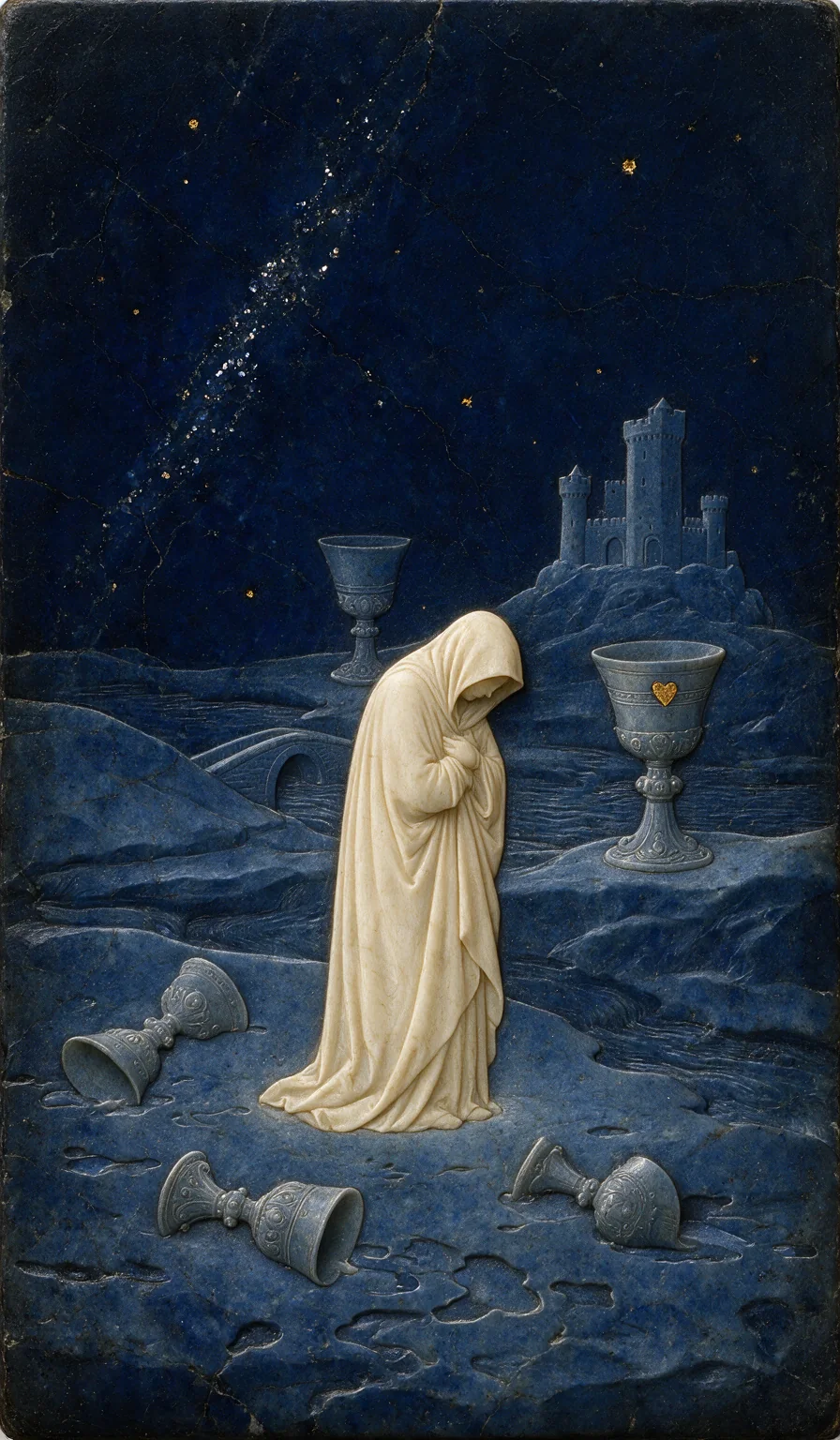
The Five of Cups is the card of loss felt fully. Something that mattered has spilled: a hope, a plan, a relationship, a version of the future you were carrying. In Olivia’s carving a single figure stands wrapped from head to ground in an ivory cloak, hood drawn forward, head bent low. Both hands are held to the chest. Nothing is being reached for yet, and the card does not ask it to be.
Around the figure’s feet three goblets lie on their sides, thin trickles still running from two of their mouths toward small puddles in the stone. They are carved as finely as the cups that still stand, because grief measures value: it hurts this much because it mattered this much. Upright, the card invites you to name what was lost plainly, without rushing to replace the feeling with gratitude or a lesson.
Yet the card counts five, not three. Two cups remain upright: one on a ledge to the right, marked with a small gold heart, and one further back on a ridge behind the figure’s shoulder. A bridge still spans the river, and a castle stands intact on the hill beyond. The Five of Cups does not ask you to look at these yet. It holds both truths in one frame: what is gone, and what is still here when you are ready to turn.
Reversed
Five of Cups reversed draws attention to the slow turn from what was lost toward what still stands: the head beginning to lift, the eyes finding the gold-hearted cup, a first step toward the bridge. It can also point to grief that was set aside before it could be felt, or to regret replayed so often that it has become a place to live rather than a feeling to pass through.
Turning around does not mean the loss mattered less, and a sorrow that returns is not a sign that you have failed. The card asks what you have allowed yourself to feel and what you have skipped. Sometimes the kindest next step is to let the loss be real a little longer; sometimes it is to notice one cup that is still full.
Read the image
Every element below is carved into this card. Scroll, hover or press a number to follow it on the image.
The bowed ivory hood
What you seeA tall figure carved in warm ivory stands wrapped from head to ground in one heavy cloak. The hood is drawn far forward over the face, and the head bends low toward the right.
What it carriesThe traditional mourner wears black; Olivia’s is pale ivory, the brightest thing on the card. Grief here is not darkness but the most visible, most human presence in the scene. The hood turns attention inward: a time to feel rather than to be seen or to explain.
Follow this symbol through the deck ↗Hands held to the chest
What you seeThe hands are drawn up and gathered at the breast inside the folds of the cloak, just below the hooded chin. Neither hand reaches toward any of the five cups.
What it carriesHands clasped at the heart are a long-standing gesture of mourning and of self-comfort: they hold what hurts close. Because neither hand reaches out, the card shows the pause before any choice. The loss is being felt, and nothing yet is being picked up or put down.
Follow this symbol through the deck ↗Three fallen cups
What you seeThree pale grey lapis goblets lie on their sides, one to the left of the figure and two in the foreground, their bowls carved with round, coiled ornament. Thin pale trickles run from the mouths of two of them.
What it carriesThree spilled cups are the heart of the traditional image: what has been lost, and what cannot be poured back. Here they are carved as finely as the cups still standing, a reminder that grief measures value; what has gone mattered because it was worth carrying.
Follow this symbol through the deck ↗The gold-hearted cup
What you seeOn a flat rock ledge to the right, a little further back than the figure, a tall goblet stands upright. A small heart of gold is set between two incised bands on its bowl.
What it carriesIn the traditional card two cups still stand behind the mourner, commonly read as what remains. Olivia marks one of them with gold, the deck’s sign of what is precious. It stands in the direction the figure faces, but the bowed head has not yet lifted to see it.
Follow this symbol through the deck ↗The far cup on the ridge
What you seeHigher and further away, on the far bank to the left, just behind the figure’s bowed shoulder, a second goblet stands upright: smaller than the gold-hearted cup, carved in the same grey-blue stone, with no gold.
What it carriesThe second remaining cup stands behind the figure’s shoulder, outside its line of sight. It can stand for support, memories or resources that are present but not yet noticed: things that do not need to be looked at today, only known to be there.
Follow this symbol through the deck ↗The arched bridge
What you seeBehind the figure a small stone bridge with a single rounded arch crosses the river, carved in muted blue lapis. Its far end disappears behind the ivory cloak.
What it carriesA bridge appears in the traditional image too, often read as the way across from grief toward what comes next. Here it lies at the figure’s back, partly hidden by the cloak: a crossing that exists, but that the moment of loss does not need to hurry toward.
Follow this symbol through the deck ↗The castle on the hill
What you seeOn a rocky hill at the right, beyond the river, stands a castle carved in paler lapis: a tall crenellated keep between round towers, one with a pointed roof, and arched doorways at its base.
What it carriesThe traditional image places a building beyond the river, commonly read as home, shelter or the life that goes on. Here it is a full castle of several towers on its own hill, sturdy and intact above the water: a structure of safety the loss has not touched, still standing while the feeling takes its time.
Follow this symbol through the deck ↗Puddles in the stone
What you seeAcross the foreground the lapis ground is marked with shallow, irregular puddle shapes with raised pale rims, gathered around the fallen cups and running down to the bottom edge of the card.
What it carriesIn the traditional card the overturned cups pour their contents onto the ground. Here most of the spill has already settled into small, still pools. What has been lost does not simply vanish; it soaks into the ground and becomes part of the landscape the figure stands on.
Follow this symbol through the deck ↗The Milky Way above
What you seeA glittering diagonal band of pale mineral runs from the left side of the sky up toward the top centre, among scattered gold star flecks on the deep ultramarine ground.
What it carriesStars are not part of the traditional scene. Olivia sets this grief under a wide night full of them. The mourner does not look up, but the sky stays open overhead: a sense of scale large enough to hold sorrow without making it smaller than it is.
Follow this symbol through the deck ↗
The number
Five breaks the steady square of Four. After the stability of the Fours, every Five brings disruption, strain or loss that asks the suit to find its footing again. In Cups, the suit of Water and feeling, the disruption is emotional: the quiet withdrawal of the Four gives way to cups knocked over. Among the Fives, Wands meet in contest, Swords face a hollow victory and Pentacles endure hardship; the Five of Cups is the one that mourns. The Six that follows returns to kindness and memory.
The tradition
In the Golden Dawn system the Five of Cups is titled the Lord of Loss in Pleasure. It is assigned to Mars in Scorpio, the first decan of that sign (0 to 10 degrees), and to Geburah, Severity, the fifth Sephirah on the Tree of Life, expressed through the suit of Water. Mars, the planet of force and cutting away, in deep, fixed, watery Scorpio is commonly read as feeling that goes to the bone. Aleister Crowley titled the card Disappointment. Marseille-pattern decks show five cups among flowering ornament, with no scene; Pamela Colman Smith’s 1909 card introduced the cloaked mourner, three overturned cups, two still standing, a river, a bridge and a building beyond.
Love, work and self
- Love
- In love and close friendship the Five of Cups draws attention to disappointment or loss: a relationship that ended, changed, or did not become what you hoped. It does not tell you what anyone else feels or intended. It asks you to let your own sorrow be real, and then, gently, to notice the two cups still standing: people who have stayed, care that continues, your own capacity to love. With yourself, it asks for the patience you would offer a grieving friend.
- Work
- At work or in study the card can point to a setback that stings: a project that fell through, a rejection, a result below what you hoped, a door that closed. Before the next plan, it invites an honest account of what was lost and what it cost you. Then look at what still stands, like the cups on the ledge and the ridge: skills gained, allies, work that survived. Where money is part of the setback, the card only asks you to notice how disappointment colours the way you see it.
- Self
- For your relationship with yourself, the hooded figure can stand for a part of you that is still mourning, perhaps quietly, beneath everything else you are doing. The hands held to the chest suggest self-comfort rather than self-reproach. The card invites you to stay with that part for a while without trying to fix it, and to notice that the bridge behind it does not disappear while it grieves. Regret softens when it is listened to, not argued with.
In a spread
Read the card through each position before you look at Olivia’s version. A position is a question, and the same card answers each one differently.
The situation
What aspect of the situation deserves attention?
Olivia’s readingAt the centre of a question, the Five of Cups can point to a loss or disappointment that shapes everything around it, and to what still stands nearby, perhaps not yet noticed.
What complicates it
What tension or assumption deserves a closer look?
Olivia’s readingAs a challenge, the card can show attention fixed so firmly on what spilled that the remaining cups, the bridge and the people nearby stay out of sight.
A helpful next step
What small action could help you understand or respond?
Olivia’s readingAs advice, it invites you to name the loss honestly, allow the feeling its time, and then, when you are ready, turn your head toward one thing that remains.
In conversation with
- Five of Cups + Ace of Cups
The Ace of Cups shows one cup overflowing; the Five shows cups overturned. Together they draw attention to the whole arc of feeling, from the first open offering to the ache of loss, and to how the capacity to love outlasts any single spill.
- Five of Cups + Six of Cups
The Six of Cups follows the Five, turning from grief toward memory and simple kindness. In this deck the cup offered in the Six carries the same small gold heart as the cup still standing here: what remains, finally handed over and received.
- Five of Cups + Eight of Cups
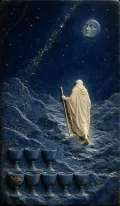
Both show an ivory-cloaked figure under the Milky Way: the Five stands still, bowed over what spilled; the Eight walks away from cups still standing. Together they ask whether this is a time to mourn in place or to leave with care.
Also read withFour of CupsKing of CupsAll pairs ↗
Questions to keep
- What loss have you not yet allowed yourself to name plainly, even privately?
- Which cup is still standing in your life, even if you have not looked at it lately?
- What would help you feel this loss fully without making a home inside it?
Ask them with three cards ↗A three-card reading in which each position asks one of these questions.
A small practice
Write down one thing you lost and one sentence about why it mattered, then write one thing that still stands, and leave both lines side by side.
Cards that share its symbols
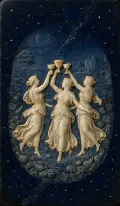 Three of CupsShares: The gold-hearted cup · Three fallen cups · Hands held to the chest · The Milky Way above · The castle on the hill
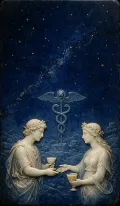 Two of CupsShares: The Milky Way above · Three fallen cups · Hands held to the chest · The gold-hearted cup
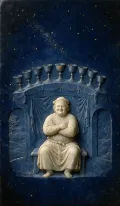 Nine of CupsShares: Three fallen cups · The gold-hearted cup · Hands held to the chest · The Milky Way above
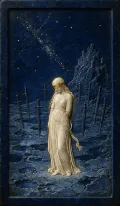 Eight of SwordsShares: Hands held to the chest · The castle on the hill · The Milky Way above · Puddles in the stone