Major Arcana · I
The Magician
Tarot card meaning: upright, reversed and the symbols of the Olivia image
The Magician is the moment an intention finds its tools: one clear act that joins what you imagine with what you can actually reach.
- Upright
- focused willskillresourcefulnessconcentrationclear intentionfirst action
- Reversed
- scattered effortunused talentperformance over substancehesitation to beginmisdirected skill
Upright
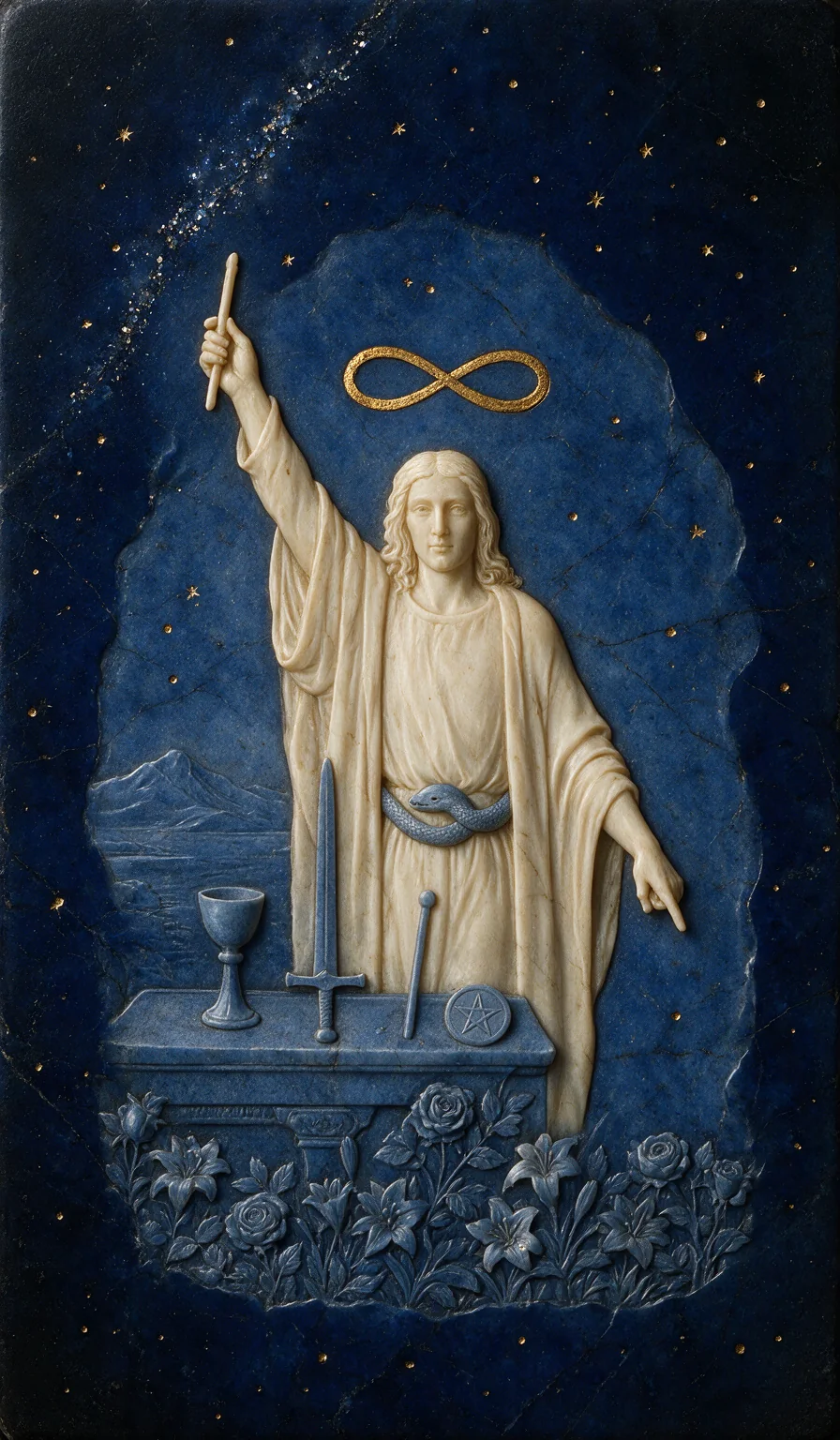
The Magician stands where the Fool’s open possibility turns into a single, deliberate act. In Olivia’s carving the figure faces you directly, calm and level-eyed, one arm lifting an ivory wand towards the starry sky while the other hand points to the ground. Between those two gestures the whole card happens: something is drawn down from the level of ideas and directed into the world, precisely and on purpose.
Look at the table. The cup, the sword, the slim wand and the star-marked disc are all there, but they are carved in the same blue as the stone, not yet taken up. The card draws attention to what is already within reach: feeling, thought, energy and practical means. You rarely need a new resource so much as a decision about which one to use first, and for what.
Above the figure hangs the gold lemniscate, the largest piece of gold on the card, and around the waist a serpent lies coiled with its head raised. Both speak of energy that circulates rather than runs out. Upright, the Magician invites focused attention: one task, chosen clearly, done with the skill you have now. Readiness here is less a feeling than a practice, something you build by beginning.
Reversed
The Magician reversed turns attention to skill that is present but not yet connected to a clear purpose. The tools may sit on the table while the hands stay busy elsewhere: plans multiplied, talents kept in reserve, effort spent on looking capable rather than making something. It can also point to hesitation, a wish to feel completely ready before the first move.
Consider the gesture on the card: one hand up, one hand down. Reversed, that current can stall at either end, all vision and no landing, or constant activity with no direction behind it. Ask which end is weaker for you now. A smaller, more honest scope, or naming what support is missing, can reconnect the two.
Read the image
Every element below is carved into this card. Scroll, hover or press a number to follow it on the image.
The glittering Milky Way
What you seeA diagonal band of fine silvery sparkle runs from the top edge down to the left edge of the night sky, passing just beside the tip of the raised wand. It is far denser than the scattered gold star flecks.
What it carriesThe traditional Magician stands against a plain yellow sky; Olivia sets the figure under the whole night instead. The wand is lifted into the same sky the galaxy crosses: a reminder that the Magician’s power comes from something larger and passes through one person.
Follow this symbol through the deck ↗The raised ivory wand
What you seeThe figure’s right arm, on the viewer’s left, reaches up and out above the head, the fingers closed around a slender ivory rod held nearly upright, with a small grooved knob at its top end.
What it carriesThe raised wand is the first half of the Magician’s gesture, commonly read as “as above, so below”: energy drawn from above in order to be brought down into form. It is a conductor rather than a weapon; held this high, it makes an intention visible before anything is made.
Follow this symbol through the deck ↗The gold lemniscate
What you seeAbove the head floats a horizontal figure of eight inlaid in gold, two smooth closed loops crossing at the centre. It is the largest piece of gold on the card, set against the pale blue field behind the figure.
What it carriesPamela Colman Smith drew a lemniscate over the Magician and again over the figure in Strength, and Olivia keeps both in gold. The sign of infinity is commonly read as endless exchange: energy flowing out and returning. In a deck sparing with gold, it marks what does not run out: attention, renewed each time it is given.
Follow this symbol through the deck ↗The ivory robe and mantle
What you seeA plain round-necked tunic under a heavy mantle draped over both shoulders, gathered in deep folds at the raised arm and falling in long folds behind the table. Both are carved in the same warm ivory.
What it carriesIn the Waite-Smith card a red mantle is worn over a white robe, commonly read as desire worn over purity of purpose. Olivia removes the red: the whole figure is one ivory. Intention and wanting are not layered here but made of a single material.
The serpent girdle
What you seeA scaled serpent carved in grey-blue lapis circles the waist as a belt and crosses over itself in a loop at the front. Its head rests on top of the loop, facing the viewer’s left, mouth closed.
What it carriesIn the traditional image the Magician’s girdle is a serpent swallowing its own tail, the ouroboros of eternity and renewal. Olivia’s serpent is coiled but open: head raised on the coil, mouth empty. The cycle is still there, alert rather than sealed, like a skill kept ready close to the body.
Follow this symbol through the deck ↗The mountains and water
What you seeBehind the table on the left, a pale mountain range rises beyond a wide stretch of still water marked with fine horizontal lines, all carved in shallow relief in a lighter, greyer blue.
What it carriesThe Waite-Smith Magician has no landscape, only a plain sky. Olivia opens a view behind the table: mountains for what is solid and distant, water for feeling and reflection. The Magician works in front of a real world, and the work is meant to reach it.
Follow this symbol through the deck ↗The hand pointing down
What you seeThe figure’s left arm, on the viewer’s right, extends down and outwards from the mantle. The index finger points firmly down towards the carved flowers at the foot of the card, the other fingers curled in.
What it carriesThe second half of the gesture: what is drawn from above is directed into the earth. Together, the raised wand and the pointing finger make the figure a channel between two levels. They turn the card from inspiration into application: the idea has to land somewhere specific.
Follow this symbol through the deck ↗The four tools on the table
What you seeOn a heavy lapis table with a moulded base stand, from left: a stemmed cup, a sword upright on its pommel with the point to the sky, a slim rod ending in a round knob, and a disc bearing a five-pointed star.
What it carriesThe four suit emblems: wands for will and energy, cups for feeling, swords for thought, pentacles for the body and material things. Waite and Smith set them on the Magician’s table as the tools of all four elements. Here they are carved in the blue of the stone, not in ivory: resources within reach, not yet picked up.
Roses and lilies below
What you seeAlong the foot of the card, in front of the table, open roses, rosebuds and star-shaped lilies grow together among leaves, all carved in grey-blue lapis rather than ivory or red.
What it carriesThe traditional card frames the Magician with red roses and white lilies: desire and pure intention, the cultivated passions the work serves. Olivia keeps both flowers but plants them only below, in the stone’s own blue: a garden growing from the ground the Magician points towards.
Follow this symbol through the deck ↗
The number
The Magician is card 1, the first station after the Fool in the Major Arcana. Where zero is pure potential, one is the first number that stands for something: a single point placed on an empty page. Here the traveller’s open possibility gathers into one will. This step asks you to choose a single intention and act on it, accepting that choosing also means setting other options aside for now.
The tradition
In the Golden Dawn system the Magician carries the title “The Magus of Power” and is attributed to the Hebrew letter Beth, “house”, and to the planet Mercury, on the twelfth path of the Tree of Life between Kether and Binah. Mercury, messenger and patron of skill, suits a card about traffic between levels. Italian decks came to call the card Il Bagatto, and the Marseille pattern Le Bateleur: a street conjurer at a table of cups, dice and small tools, part craftsman, part trickster. Waite and Pamela Colman Smith’s 1909 design turned the conjurer into a ceremonial figure, with the lemniscate overhead, the wand raised and the four suit emblems on the table.
Love, work and self
- Love
- In love, the Magician asks what you actually bring to a relationship, rather than what you hope another person will supply. Attention, humour, patience and honest words are all tools on the table. The card can point to a moment for saying clearly what you want, or for taking the first practical step instead of rehearsing it. With yourself, it invites you to treat your own needs as something you can act on, not only wish about.
- Work
- At work or in study, the Magician draws attention to the gap between having abilities and using them on purpose. List what is already available: a skill, a contact, an hour, a draft. The card favours one concrete piece of work finished well over five started. If money is part of the question, the card turns attention to what you can see and check for yourself, such as a clear written plan, rather than hopeful guesses.
- Self
- For yourself, the Magician turns attention to concentration. The raised wand and the pointing hand describe a simple loop: notice an idea, then give it a place in the day. Where does your energy leak into busyness, and where does it actually produce something? The card invites small, repeatable acts of focus: one task named in the morning, one moment at night to see what was made. Skill grows from that repetition.
In a spread
Read the card through each position before you look at Olivia’s version. A position is a question, and the same card answers each one differently.
The situation
What aspect of the situation deserves attention?
Olivia’s readingAt the centre of the question, the Magician suggests that the resources you need may already be largely present. The question can then become one of focus: which tool, used with what intention, comes first.
What complicates it
What tension or assumption deserves a closer look?
Olivia’s readingAs what complicates the matter, the Magician can point to talent scattered across too many aims, or to cleverness spent on looking busy. The effort may be there while the direction is missing.
A helpful next step
What small action could help you understand or respond?
Olivia’s readingAs advice, the Magician invites you to choose one intention, gather what you already have, and take a single concrete step today that turns the idea into something visible.
In conversation with
- The Magician + The Fool
The Fool is zero, pure possibility and a light pack; the Magician is one, the same energy gathered at a table with tools. Together they ask how an open beginning becomes a deliberate first act without losing its freshness.
- The Magician + The High Priestess
The Magician stands with every tool laid out in the open, wand raised; the High Priestess sits still, eyes closed, a scroll half hidden at the figure’s side. Together they draw attention to the balance of doing and knowing: action that grows from listening, and inner knowledge that eventually takes form.
- The Magician + Strength
In Olivia’s deck, as in the Waite-Smith, the same gold lemniscate hangs in the sky of both cards. The Magician directs will through skill; Strength directs it through patience and gentleness. Together they ask whether your power works by sharp focus or by steady care.
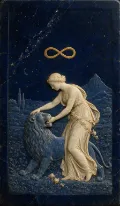
Also read withAce of WandsTwo of WandsEight of WandsAce of PentaclesTwo of PentaclesAll pairs ↗
Questions to keep
- Which tool already on your table have you not yet picked up, and what would using it look like?
- What is one intention you could state in a single sentence and act on this week?
- Where does your effort produce something real, and where does it only keep you busy?
Ask them with three cards ↗A three-card reading in which each position asks one of these questions.
A small practice
Write one intention at the top of a page, then note one resource you already have for each suit: energy, feeling, thought, practical means. Use one of them today.
Cards that share its symbols
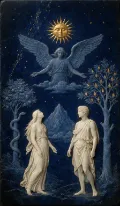 The LoversShares: The serpent girdle · The mountains and water · The ivory robe and mantle · The hand pointing down
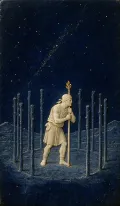 Nine of WandsShares: The glittering Milky Way · The hand pointing down · The raised ivory wand · The mountains and water
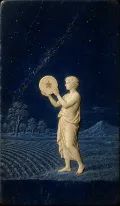 Page of PentaclesShares: The glittering Milky Way · The hand pointing down · The mountains and water · The ivory robe and mantle
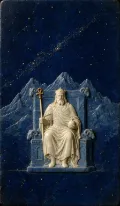 The EmperorShares: The glittering Milky Way · The mountains and water · The ivory robe and mantle