Minor Arcana · Wands
Nine of Wands
Tarot card meaning: upright, reversed and the symbols of the Olivia image
The Nine of Wands is the strength of having been tested and still standing: bandaged, watchful, a little weary, and still holding the line.
- Upright
- resilienceperseveranceguarded strengththe last stretchboundarieshard-won experience
- Reversed
- exhaustionover-vigilancedefensivenessdepleted reserveslowering the guardasking for help
Upright
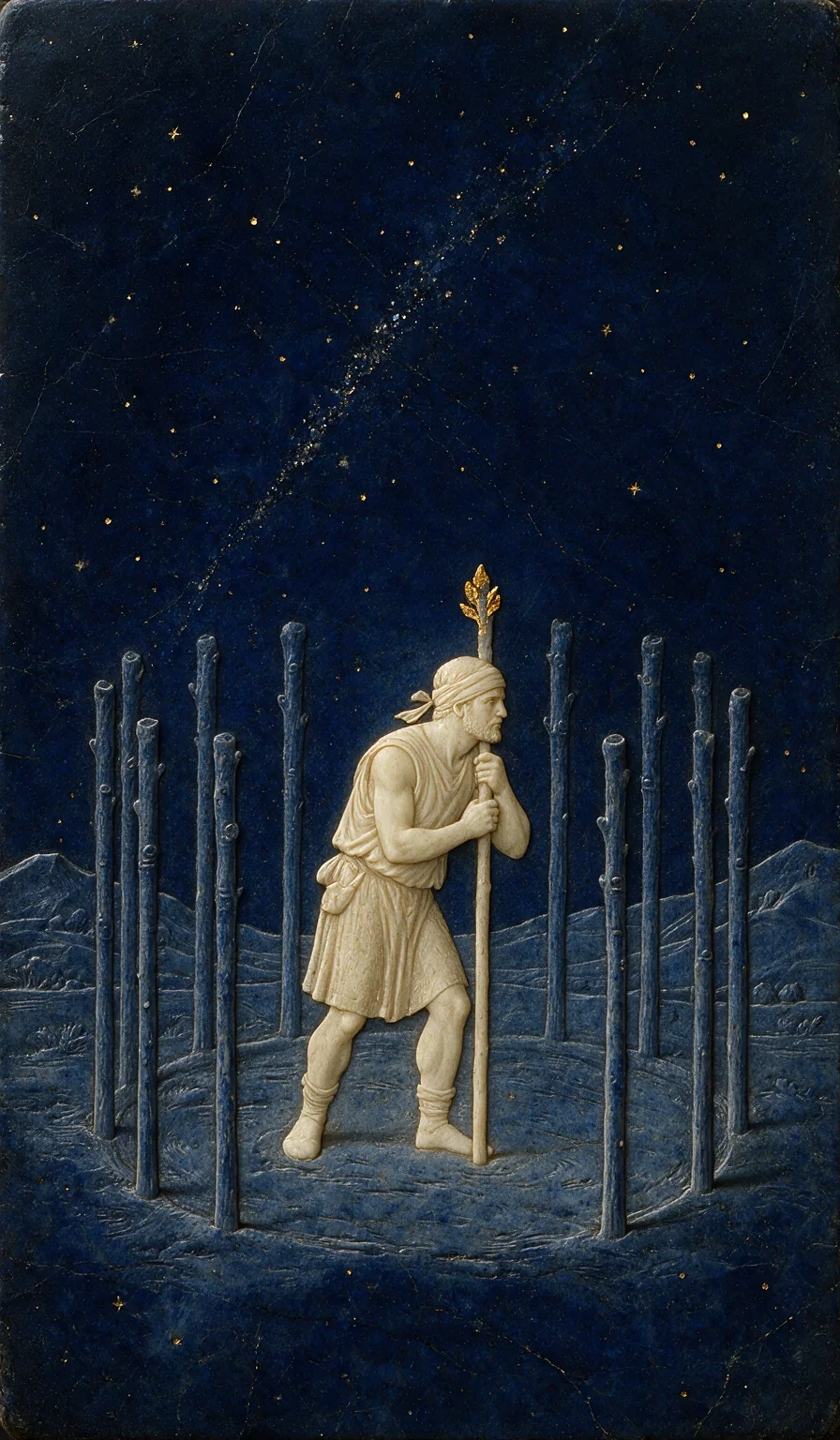
The Nine of Wands shows strength after the struggle rather than before it. The figure at the centre of Olivia’s card has clearly been through something: a bandage is wound around the head and knotted at the back, and the whole body leans forward onto a single staff, both hands gripping it close to the chest. Yet the feet are planted and the eyes are open, turned sideways toward the staves on the right. This is endurance with memory in it. The card draws attention to what you have already come through, and to the steadiness that experience has given you.
Here the staves do not stand in a line behind the figure, as in the traditional image. Twelve of them, carved in the blue of the stone itself, stand in a broken ring on both sides, and the ground inside is an oval scored with curving lines. The picture holds both sides of the Nine at once: boundaries that protect, and a perimeter held so long that it has shaped the earth. Only the figure’s own staff is ivory, and at its tip a sprig of gold leaves is opening.
Upright, the card invites you to recognise your staying power, to keep going if the goal still matters, and to ask honestly which defences still serve you. The last stretch is often where rest, and a clear sense of what is worth guarding, help most.
Reversed
Nine of Wands reversed can point to a watch kept past the point of need, or to reserves worn so thin that one more demand feels like too much. The grip on the staff tightens, the glance keeps returning to the edge of the ring, and every approach starts to look like a challenge. Sometimes the reversal shows the opposite movement: a guard beginning to lower, with all the uncertainty that brings.
Neither is a failure of resilience. Vigilance learned in hard conditions deserves respect, and it can also be reviewed. This position asks where rest, shared effort or a clear no could take the place of constant bracing, and which gaps in the palisade you might open on purpose.
Read the image
Every element below is carved into this card. Scroll, hover or press a number to follow it on the image.
The Milky Way band
What you seeA pale diagonal drift of silvery flecks crosses the dark lapis sky from lower left to upper right, high above the figure, with small gold stars scattered on either side of it.
What it carriesMost traditional versions of this card show a plain sky. Olivia sets the scene at night beneath the Milky Way, so the card reads as a long watch kept through dark hours, and as a reminder that the sky is far wider than the small ring of ground below.
Follow this symbol through the deck ↗The gold sprig
What you seeAt the tip of the figure’s own staff, just above the bandaged head, a small sprig of gold leaves opens upward, gleaming against the dark lapis night.
What it carriesIn the traditional suit, wands sprout fresh leaves as a sign that Fire is still alive. Here only the figure’s own staff carries leaves, and they are gold. Whatever the watch has cost, what is being carried is still growing: this strength tends life as well as defending it.
Follow this symbol through the deck ↗The bandaged head
What you seeA cloth bandage is wound around the figure’s head and tied in a knot at the back, two loose ends trailing to the left. The bearded face is seen in profile, turned to the right, eyes open and watchful.
What it carriesThe bandage is the traditional mark of this card: a wound already taken in earlier struggles. It says this strength is experienced, not naive. The sideways glance toward the staves on the right shows vigilance grown into habit, always checking whether the next challenge has arrived.
Both hands on the staff
What you seeTwo ivory hands grip the staff one above the other, drawn close to the chest, the upper fist just below the bearded chin. The shoulders round forward over them.
What it carriesIn the traditional image the figure clutches the wand as if ready for attack. Here the grip reads as support as much as guard: the staff is being leaned on. The card asks what is holding you up now, and whether you are gripping it harder than you need to.
Follow this symbol through the deck ↗Twelve blue staves
What you seeTwelve knotted staves carved in the blue lapis itself, each with cut branch stubs, stand upright on the rim of the oval ground, six on either side of the figure, some nearer to us and some behind.
What it carriesPamela Colman Smith’s 1909 card lines eight wands up behind the figure like a fence. Olivia sets twelve, more than the title’s nine, in a broken ring on both sides of the figure. That is the card’s double edge: a palisade protects, and it can also enclose the one who keeps it.
Follow this symbol through the deck ↗The hills beyond
What you seeBeyond the ring, rolling hills and a low mountain ridge are carved in greyer lapis, with small bushes and rocks, running to the horizon on both sides behind the staves.
What it carriesWands cards often place distant hills on the horizon as the next venture or a wider life beyond the present effort. Here open land lies just past the palisade, visible through its gaps: the watch is one part of the landscape, not the whole of it.
Follow this symbol through the deck ↗The planted ivory staff
What you seeOne pale ivory staff, unlike the blue ones, runs from the gold sprig past the figure’s tunic to the ground, its foot planted just beside the forward foot, with the figure leaning into it.
What it carriesIn Wands the staff is will, drive and creative fire. The blue staves are the long struggle; this one is the figure’s own. Carved in ivory, the same material as the body, it makes a quiet point: the strength that remains belongs to you and is not another obstacle.
Follow this symbol through the deck ↗The trodden oval
What you seeThe staves stand along the rim of an oval of ground set off from the lapis around it. Its surface is scored with curving, swirling lines, and the figure’s feet and staff rest inside it.
What it carriesThe traditional image has no such worn ring of ground. It suggests ground walked over and over during a long watch, a perimeter held so long that it has shaped the earth. It invites a gentle question: how much of your energy now goes into patrolling your own edges?
Follow this symbol through the deck ↗
The number
Nine is the last step before the fullness of Ten: the stage where most of the work is done and the final effort feels heaviest. In Wands, the suit of Fire, will and drive, that means stamina tested by time. The Eight of Wands brings swift movement; the Nine stands still and holds its ground; the Ten shows the load carried to its limit. On the Tree of Life nine is Yesod, the Foundation, so this card asks what firm ground your effort now stands on, and whether it can hold you as well as your defences.
The tradition
In the Golden Dawn system the Nine of Wands is titled the Lord of Great Strength. It is attributed to the Moon in the second decan of Sagittarius (10 to 20 degrees), and to Yesod, the Foundation, the ninth Sephirah, expressed through the fiery suit of Wands. The Moon’s changing tides meeting Sagittarius’s restless fire are commonly read as strength that rises and falls yet keeps returning. Aleister Crowley later shortened the title to Strength. In Marseille-pattern decks the Nine of Batons is an ornamental arrangement of crossed and upright batons with no scene. Pamela Colman Smith’s 1909 design gave the card its familiar picture: a bandaged figure leaning on one wand, with eight more standing behind like a palisade.
Love, work and self
- Love
- In close relationships the Nine of Wands can reflect a guard that went up for good reasons: an old hurt, or a long season of carrying things alone. It cannot tell you what another person intends. It asks what your own watchfulness is protecting, and whether it still lets anyone in through the gaps between the staves. With yourself, it invites the same fairness: respect for how much you have endured, and room to be met rather than only defended.
- Work
- At work or in study this card often appears in the last hard stretch of a project, a qualification or a long season of pressure. It honours persistence, and it also asks whether you are still responding to a threat that has passed. Notice which checks and safeguards are genuinely useful, and which have become a habit of bracing. Where money or practical risk is involved, the view of a qualified person is better support than carrying every decision alone.
- Self
- For your relationship with yourself, the card draws attention to the body that has done the holding. The figure in Olivia’s image leans in with rounded shoulders, both fists gripping the staff just below the chin: tiredness and resolve in a single posture. Notice where you carry that brace, whether in the jaw, the shoulders or the breath. The gold leaves at the tip of the staff are a reminder that what you have been guarding is still alive, and still growing.
In a spread
Read the card through each position before you look at Olivia’s version. A position is a question, and the same card answers each one differently.
The situation
What aspect of the situation deserves attention?
Olivia’s readingAt the centre of a question, the Nine of Wands points to hard-won resilience and a watchfulness shaped by experience. What you have come through may be part of the answer.
What complicates it
What tension or assumption deserves a closer look?
Olivia’s readingAs a challenge, the card can show defences held so long that they now enclose you, or tiredness mistaken for weakness when it is simply the cost of a long watch.
A helpful next step
What small action could help you understand or respond?
Olivia’s readingAs advice, it invites you to hold steady through the last stretch if the goal still matters, while choosing one protection to loosen and one form of rest or support to accept.
In conversation with
- Nine of Wands + Seven of Wands
The Seven of Wands defends a position actively, still in the thick of it; the Nine keeps the watch after the fight. Together they ask whether the struggle is happening now, or whether you are guarding against a remembered one.
- Nine of Wands + Ten of Wands
In Olivia’s Ten of Wands the bandaged figure returns, bent under one bundle of pale staves with a gold sprig among them. After the Nine’s guarded ring, the pair draws attention to when holding everything becomes carrying everything.
- Nine of Wands + Strength
Strength calms the lion with open, gentle hands, while the Lord of Great Strength stands braced on a staff. Side by side they contrast force held tightly with strength that can soften, and ask which this situation needs.
Questions to keep
- Which of your defences still protect you, and which are you keeping out of habit?
- What have you already come through that shows you how steady you can be?
- If you rested for one evening, what could you trust to hold without your watch?
Ask them with three cards ↗A three-card reading in which each position asks one of these questions.
A small practice
Stand with your weight on both feet for one minute, let your shoulders drop, and name aloud one thing you no longer need to guard.
Cards that share its symbols
 The MagicianShares: The Milky Way band · Twelve blue staves · The hills beyond · Both hands on the staff
 Three of WandsShares: The gold sprig · The Milky Way band · Twelve blue staves · Both hands on the staff
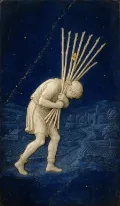 Ten of WandsShares: Twelve blue staves · The gold sprig · Both hands on the staff · The Milky Way band
 Ace of SwordsShares: Both hands on the staff · The gold sprig · The Milky Way band · The hills beyond