Major Arcana · VI
The Lovers
Tarot card meaning: upright, reversed and the symbols of the Olivia image
The Lovers is the moment you choose what you love with open eyes, so that a bond or a decision also expresses what you value.
- Upright
- unionchoiceshared valuesalignmentmutual respecthonest desire
- Reversed
- divided valuesindecisionimbalancemixed motiveschoosing to please
Upright
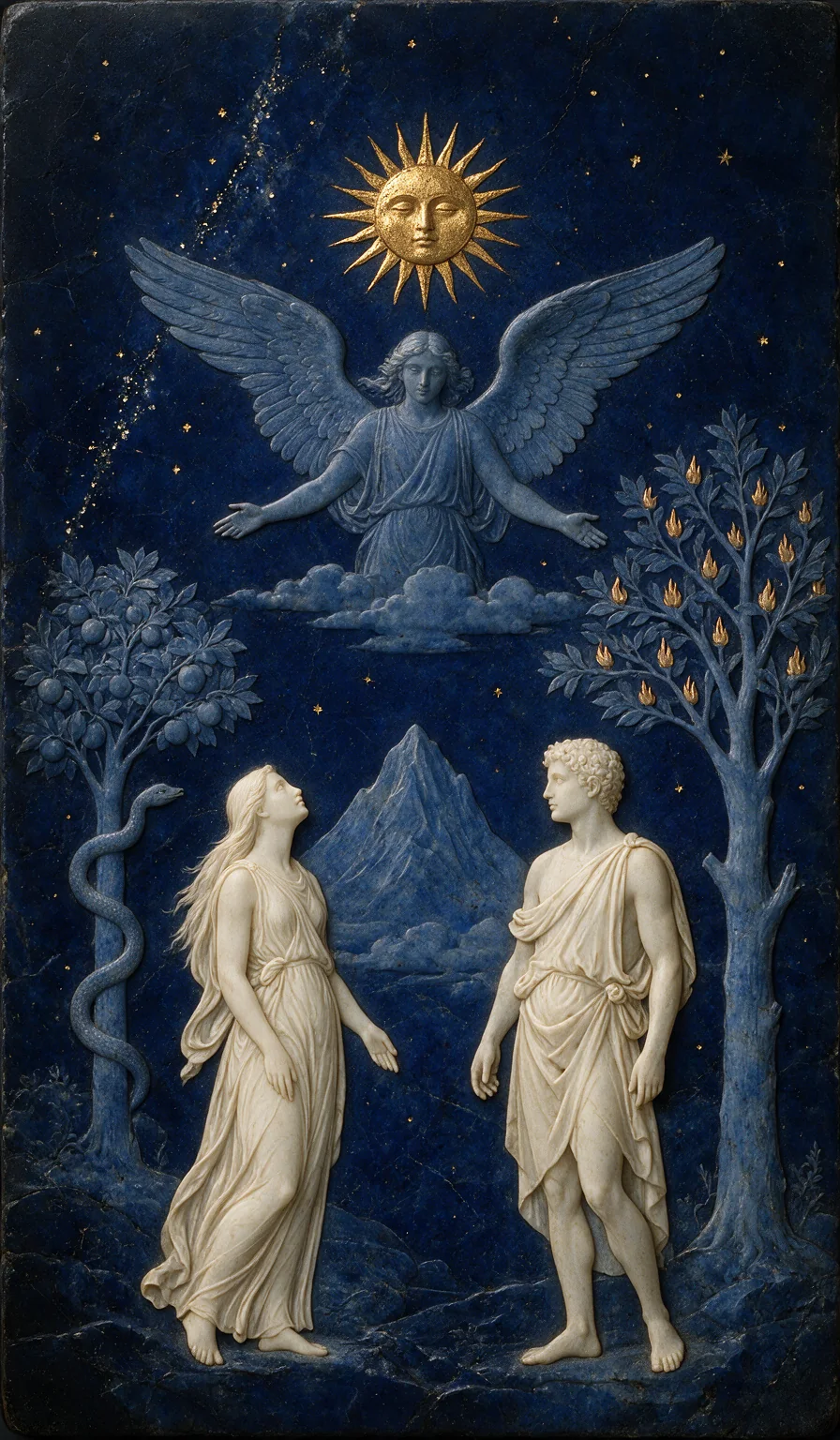
The Lovers stands at the point where connection and choice become the same thing. In Olivia’s carving two ivory figures face each other on a lapis ground, a single blue peak rising in the space between them, while a winged figure opens both arms from the clouds above. Upright, the card draws attention to a union that is chosen rather than drifted into: a relationship, a partnership, a commitment, or a decision that finally matches what you care about.
Look at where each figure is looking. The one on the left lifts the face towards the angel; the one on the right looks straight across. One consults something higher, the other attends to the person in front of them, and the card holds both. Behind them grow two trees: gold flames on the right, heavy blue fruit on the left with a serpent wound round its trunk. Desire and knowledge, warmth and experience, stand side by side rather than as enemies.
Notice, too, that their hands have not yet met. The Lovers is rarely about a choice already made. It asks what you are saying yes to, what that yes asks of you, and whether you could say it freely. Where another person is involved, it leaves room for their choice as well as yours.
Reversed
The Lovers reversed can point to a gap between what you want and what you value, or between what you choose and what you say you choose. The two gazes that complete each other upright can split apart: all attention on another person with your own values left unconsulted, or all attention on principle with the person in front of you unseen. It can also describe a decision postponed until someone else makes it for you.
This is not a verdict on any relationship. It invites an honest look at where you are agreeing in order to please, to avoid friction or to keep options open. Name the value underneath, then look for one small choice that brings your actions and that value back within reach of each other.
Read the image
Every element below is carved into this card. Scroll, hover or press a number to follow it on the image.
The gold sun, eyes closed
What you seeAt the top centre, set clear above the angel’s head, a gold sun spreads straight, pointed rays against the lapis night. Its round face is calm, with the eyes closed.
What it carriesIn the traditional image a great sun blazes directly behind the angel: full, conscious light over the whole scene. Olivia gilds it, in a deck where gold is used sparingly, but closes its eyes. The light is present without staring down; the choice below is left to the two who make it.
Follow this symbol through the deck ↗The angel above the clouds
What you seeA large winged figure carved in grey-blue lapis, not ivory, rises from a bank of lapis clouds. The wings spread across most of the card’s width; the arms open wide with both hands held open.
What it carriesLater readers often name this angel Raphael, the angel of healing, and read it as a blessing or a wider view over the relationship. Here it is cut from the same stone as the night sky rather than the couple’s ivory: guidance woven into the landscape, not a third person standing in the scene.
Follow this symbol through the deck ↗The tree of gold flames
What you seeBehind the right-hand figure a slender blue tree carries eighteen small gold flames among its carved leaves. Apart from the sun and the scattered gold flecks in the sky, they are the only gold on the card.
What it carriesWaite called this the Tree of Life bearing twelve fruits, and its flames are commonly read as the twelve signs of the zodiac: passion and spirit. Olivia’s tree carries more than the traditional twelve and gilds every one, so desire here is warm and plentiful, not rationed.
Follow this symbol through the deck ↗The tree of blue fruit
What you seeOn the left, a leafy tree hangs heavy with round fruit, carved in the same blue lapis as its leaves. None of the fruit is gilded; it stays in shadow against the night.
What it carriesThis is the Tree of the Knowledge of Good and Evil from the Eden story: experience, appetite, self-awareness. Set opposite the tree of flames, it makes the card a question about two kinds of wanting: a longing that burns, and a knowing that must be tasted before it is understood.
Follow this symbol through the deck ↗The serpent on the trunk
What you seeA finely scaled serpent in pale grey-blue winds in loose S-bends around the trunk of the fruit tree. Its head rises level with the left-hand figure’s face and points towards it.
What it carriesIn the Eden story the serpent offers the fruit; in tarot it is commonly read as temptation, and also as the knowledge that comes from admitting what you want. Its head is level with the figure who looks upward, so the pull of desire and the search for guidance meet in one person.
Follow this symbol through the deck ↗The single blue peak
What you seeBetween the two figures one sharp mountain rises in paler, veined lapis, with low mist lying across its foot. It fills the space between their heads.
What it carriesThe mountain between the lovers is traditionally read as a shared aim, or the height a relationship climbs together; some readers see spiritual union at its summit. Here it stands exactly in the gap between the pair: what separates the two is also what they could reach for together.
Follow this symbol through the deck ↗One gaze up, one across
What you seeThe long-haired figure on the left tips the face back to look up at the angel. The curly-haired figure on the right looks level and straight across at the left-hand figure.
What it carriesThe traditional card sets up the same exchange of looks, often read as a circuit: one partner looks to the higher principle, the other looks to the partner. Neither gaze is wrong. Together they ask how care for another person and care for your own values can inform each other.
The draped ivory robes
What you seeBoth ivory figures wear classical drapery: on the left a long gown tied at the waist, on the right a short tunic knotted at the hip with a mantle over one shoulder.
What it carriesPamela Colman Smith’s couple stand unclothed, unguarded before each other as in Eden, and on opposite sides to these. Olivia dresses them and mirrors their places, shifting the emphasis from innocence to adult choice: two people who arrive with histories and still decide to stand face to face.
Hands that almost meet
What you seeLow in the centre, the left figure’s nearer hand is lowered and turned open towards the other. The right figure’s nearer hand hangs loose, fingers curled. A band of dark lapis still separates them.
What it carriesNothing touches yet. The offer is made and not yet answered, and this is where the card’s real subject lives: a union that belongs to each person to give freely, or not at all. The Lovers is less about a bond already sealed than about the moment of choosing it.
Follow this symbol through the deck ↗
The number
The Lovers is card six. After the Hierophant at five, where the traveller receives teaching and inherited rules, the sixth step is the first choice made from the inside: what you love, and what you will stand for. Six is often read as balance between two; the six-pointed star is drawn from two interlaced triangles, one rising and one descending. The Chariot at seven then carries the chosen direction into motion. This step asks you to make a value your own by choosing it.
The tradition
In the Golden Dawn system The Lovers bears the title “The Children of the Voice; the Oracle of the Mighty Gods”. It is attributed to Zayin, the Hebrew letter whose name means sword, and to Gemini, the mutable Air sign of the Twins, on the seventeenth path of the Tree of Life, joining Binah and Tiphareth. Marseille decks show L’Amoureux: a young man between two women while a winged Cupid aims an arrow from a rayed disc above, commonly read as a choice between two loves or two ways of life. In 1909 Pamela Colman Smith recast the scene as the first couple in Eden beneath a great angel; Olivia keeps that Eden, but clothes the pair.
Love, work and self
- Love
- In love and close bonds, The Lovers draws attention to mutual choosing: two people who keep deciding for each other, rather than a feeling that simply happens to them. In the carving both figures stand on their own feet, facing one another, neither leaning on the other. The card favours closeness that leaves each person whole. It can also point to your relationship with yourself: whether your desires and your values are on speaking terms. Notice one place where they agree, and honour it.
- Work
- In work and study, The Lovers can point to a partnership, a collaboration, or a choice between two paths that both appeal. The question underneath is alignment: which option lets you work in a way you respect? Before comparing titles, pay or grades, write down what each path would ask you to practise every day. With money matters, let the card clarify your values, and let careful figures and qualified advice guide the numbers.
- Self
- For your own growth, The Lovers asks you to meet two parts of yourself as the carved figures meet: the part that looks up for guidance and the part that looks straight at what it wants. Neither needs to win. Between them stands the blue mountain, something both could climb. Where do your longing and your principles pull in different directions, and what would a choice that honours both look like this week?
In a spread
Read the card through each position before you look at Olivia’s version. A position is a question, and the same card answers each one differently.
The situation
What aspect of the situation deserves attention?
Olivia’s readingAt the heart of a question, The Lovers suggests the real issue is a choice about values, often disguised as a choice between people, places or options. What matters most is what your yes would stand for.
What complicates it
What tension or assumption deserves a closer look?
Olivia’s readingAs a challenge, The Lovers can point to divided loyalties, a decision avoided in the hope that it will make itself, or a wish to please someone that quietly overrides what you believe.
A helpful next step
What small action could help you understand or respond?
Olivia’s readingAs advice, The Lovers invites you to choose deliberately: name the value at stake, say it plainly to anyone involved, and let your next step be one you could explain without apology.
In conversation with
- The Lovers + The Devil
The Devil echoes The Lovers: two ivory figures again stand beneath a winged presence, now chained at the neck to its stone block. Together they draw attention to the difference between a bond freely chosen and an attachment that has begun to feel unchosen.
- The Lovers + Two of Cups
The Two of Cups is The Lovers in the minor key: two people pledging cups to each other. Together they draw attention to the everyday practice of union, the small mutual offerings that keep a chosen bond alive.
- The Lovers + The Hierophant
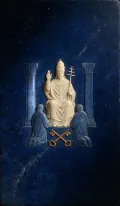
The Hierophant blesses two followers who kneel before tradition; in The Lovers an angel opens its arms over two people who face each other instead. Together they draw attention to the step from values you were taught to values you choose.
Also read withThe ChariotSeven of CupsAll pairs ↗
Questions to keep
- What are you really saying yes to in this choice, and what would it ask of you each day?
- Where are you looking up for permission when you could look straight at what you want?
- Which of your values would you most want a close relationship to share, and why?
Ask them with three cards ↗A three-card reading in which each position asks one of these questions.
A small practice
Write the choice you are facing at the top of a page, list three values underneath, and mark which option honours each one.
Cards that share its symbols
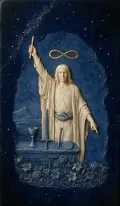 The MagicianShares: The draped ivory robes · The serpent on the trunk · The single blue peak · Hands that almost meet
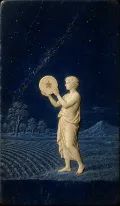 Page of PentaclesShares: Hands that almost meet · One gaze up, one across · The single blue peak · The draped ivory robes
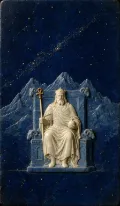 The EmperorShares: The single blue peak · One gaze up, one across · The draped ivory robes
 Five of WandsShares: The tree of gold flames · One gaze up, one across · The single blue peak