Minor Arcana · Pentacles
Page of Pentacles
Tarot card meaning: upright, reversed and the symbols of the Olivia image
The Page of Pentacles is the patient student of the practical world: curious about how things work and willing to learn them slowly, by hand.
- Upright
- studyapprenticeshippractical curiositya new skillsteady applicationfirst steps
- Reversed
- endless preparationscattered focusprocrastinationimpatience with basicsperfectionism
Upright
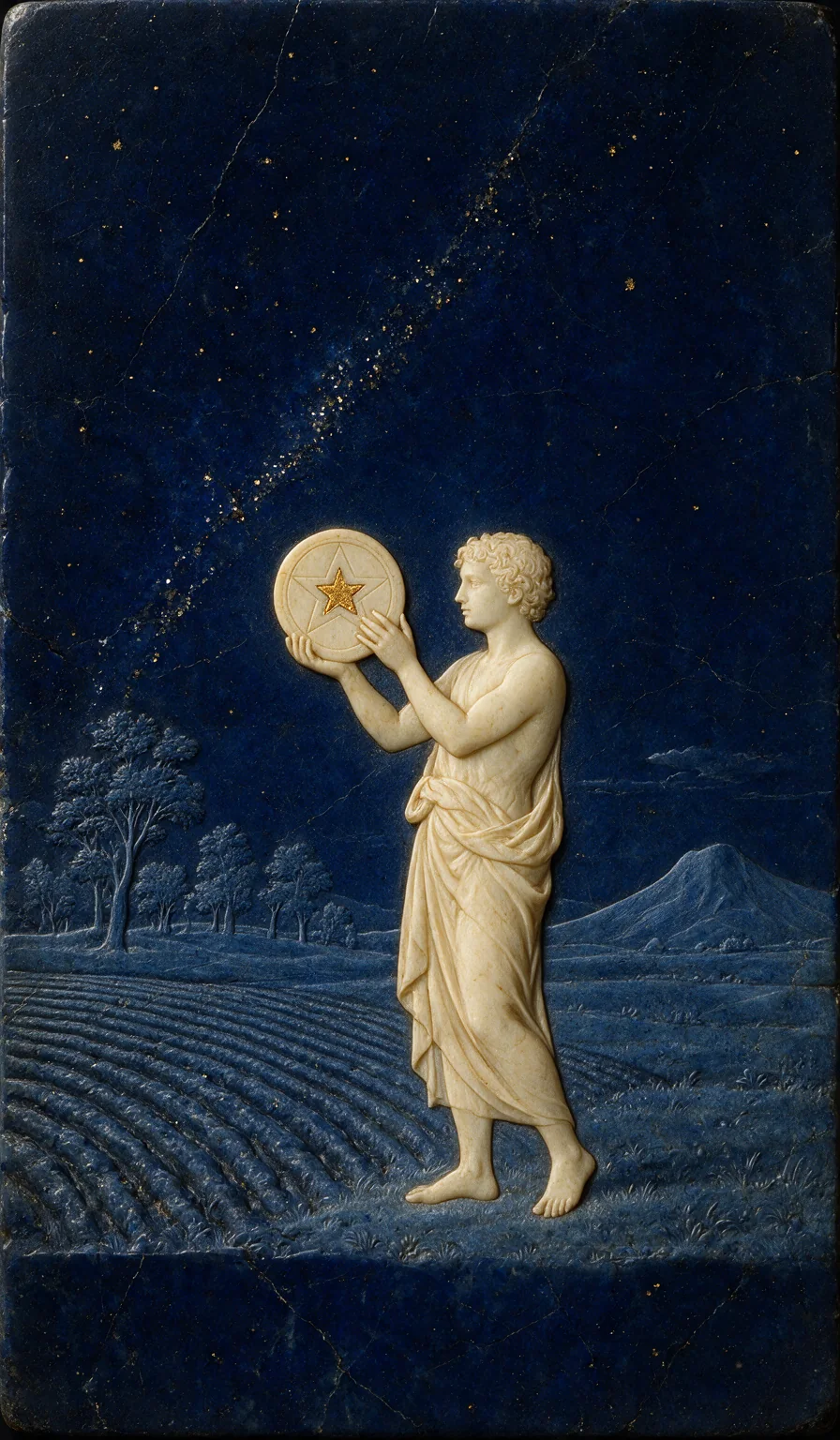
The Page of Pentacles draws attention to the beginning of competence: the stage where something practical has caught your interest and you want to understand it properly. In Olivia’s image the figure holds the disc at eye level and looks at nothing else. The star on it is mostly drawn in thin incised lines, like a diagram in a workbook, and only its small centre is gold. That is how learning often feels: the outline is visible long before the value is fully yours.
Notice the hands. One cups the disc from underneath while the other steadies its edge with spread fingers, the way you might hold a new tool or an unfamiliar instrument to feel its weight. Nothing is being displayed or traded yet. The feet are bare on the grass, one step ahead of the other, and the field behind is freshly ploughed: ground prepared, not yet sown.
Upright, this card invites you to treat a practical matter as something worth studying: a craft, a course, a body of knowledge, the way your money or your health actually works. It favours small, regular sessions over grand plans, and honest questions over looking already expert. The gold river in the sky above suggests how much there is to know; the Page answers by attending to one star at a time.
Reversed
Page of Pentacles reversed can point to study that never turns into practice. Research, tools, timetables and courses may keep accumulating while the first real attempt waits for a better moment. It can also show the opposite: impatience with the dull basics, a wish to skip straight to results, or attention scattered across too many beginnings at once.
Look again at the image: the Page holds one disc, close, with both hands. Reversed, the invitation is to put some of the preparation down and pick up a single, unimpressive exercise you can do today. Let it be clumsy. Ask whether perfectionism is protecting you from the ordinary awkwardness of learning.
Read the image
Every element below is carved into this card. Scroll, hover or press a number to follow it on the image.
The river of gold flecks
What you seeAcross the dark lapis sky, a diagonal band of dense gold flecks, with a few paler specks over a faint haze, runs from the upper right down towards the left, ending just left of the raised disc.
What it carriesThe traditional Page stands under a plain daylit sky. Olivia sets the scene at night and threads a stream of gold through the stone, so the small gold star in the Page’s hands reads as one grain of a much larger field: the vast made studiable, one piece at a time.
Follow this symbol through the deck ↗The ivory disc
What you seeA thick ivory disc with a raised rim, held at eye level; a five-pointed star is incised in thin lines within an inner circle, and only a small solid star at its centre is gold.
What it carriesThe pentacle is the suit’s emblem of earth: body, skill, money, time and the things you can make. Here most of it is plain ivory, drawn in outline like a diagram, with gold only at the core. It is something to be learned before it can be spent.
Follow this symbol through the deck ↗Two hands, two jobs
What you seeThe ivory hand further from the viewer cups the disc from below, palm up; the nearer hand rests along its side with fingers spread, steadying it rather than gripping.
What it carriesIn the traditional image the coin seems to hover just above the Page’s raised palms. Olivia gives the hands contact and a division of labour, one supporting and one steadying, the posture of someone handling a new tool carefully enough to learn its weight.
Follow this symbol through the deck ↗The level, absorbed gaze
What you seeThe head is carved in clean profile, facing left, with short tight curls and no hat; the eyes look straight across at the disc, lips closed, face calm and unhurried.
What it carriesThe Page is commonly read as the card of study and application, and the whole face is given to one object. The traditional figure wears a soft cap; Olivia leaves the head bare, so nothing competes with the line of sight between the eyes and the star.
The grove on the left
What you seeBehind the figure and to the left, a grove of rounded trees is carved in pale lapis relief on the horizon, one taller tree with a slender, forked trunk standing in front.
What it carriesA grove of trees belongs to the traditional image of this card. Trees are slow wealth: years of growth you can stand under. Set behind the student, the grove suggests where patient learning leads, a place that is grown rather than bought.
Follow this symbol through the deck ↗A single distant peak
What you seeOn the right, low hills rise to one broad peak carved in greyer lapis, with a thin band of cloud above it; it sits far behind the figure, at the level of the waist.
What it carriesA distant mountain is part of the traditional scene, and in tarot mountains often stand for an aim that takes effort to reach. Here it is small and far off, behind the Page, while the gaze stays on the disc: mastery exists, but today’s work is closer.
Follow this symbol through the deck ↗The classical ivory drape
What you seeA thin garment clings to the chest, leaving the arms bare; below it, heavier cloth is gathered in a roll at the waist and falls in deep vertical folds to the calves.
What it carriesThe traditional Page wears a belted tunic, a soft cap and shoes, clothing for an errand. Olivia drapes the figure like a classical statue, which shifts the emphasis from the messenger’s task to the student’s attention, simple and unadorned.
The ploughed field
What you seeAcross the left half of the ground and up behind the feet, many parallel furrows sweep in long curving arcs, carved in ridged lapis that catches the light along each crest.
What it carriesA freshly ploughed field appears in the traditional image too. Ploughed ground is prepared but not yet sown or harvested, the exact moment of the Page: the work of readiness is done, and what grows next depends on what you plant and tend.
Bare feet in the grass
What you seeBoth ivory feet are bare and planted on grass carved with small tufts; one is set ahead of the other, heels down, in a slow step towards the left.
What it carriesThe traditional Page walks slowly, absorbed in the coin. Olivia keeps the unhurried step and leaves the feet bare, so the student learns earth with the soles as well as the eyes: direct contact with the ground the suit is named for.
The number
Pages are the students and messengers of the tarot court: the stage of first encountering something and wanting to understand it. In Pentacles, the suit of earth, what they study is the tangible world: materials, skills, bodies, money and time. The Ace of Pentacles offers the coin as a seed; the Page is the first to hold it up and look at it closely, with no hurry to spend it. The Knight of Pentacles then carries that knowledge into steady, repeated work.
The tradition
In the Golden Dawn system the Page is the Princess, and this card is titled the Princess of the Echoing Hills, Rose of the Palace of Earth. It is Earth of Earth: the element at its most concentrated and physical. Princesses carry no zodiac span; each is the Throne of its Ace and rules a quadrant of the heavens around the north pole, for Pentacles the quadrant of Aries, Taurus and Gemini. Marseille decks call this card the Valet de Deniers, a standing attendant with a coin. Arthur Edward Waite described the figure moving slowly, absorbed in the pentacle, and Pamela Colman Smith’s 1909 design set the Page in a green meadow beside a grove and a ploughed field.
As a temperament
- Temperament
- As a temperament, the Page of Pentacles is curious, careful and quietly persistent. This way of being wants to know how things are made and why they work, and prefers to find out by doing. It is comfortable being a beginner, asks practical questions, and does not mind that progress is slow as long as it is real.
- Gifts
- The gifts here are focus, diligence and respect for material things. This approach reads the manual, practises the scale, keeps the notebook and turns up again the next day. It notices details others skip, learns from what the material itself shows, and builds a foundation solid enough for later skill to stand on.
- Shadow
- In shadow, study becomes a way of never starting. You may collect information, equipment or qualifications without using them, or become so absorbed in one small task that the wider situation slips out of view. The opposite shadow is impatience, abandoning a skill before it has had time to settle into the hands.
Love, work and self
- Love
- In love and close relationships, the Page of Pentacles suggests learning another person the way you would learn a craft: through attention, small consistent gestures and questions asked because you genuinely want the answer. It can describe a connection that grows slowly and practically. With yourself, it invites curiosity about your own habits and needs, studied kindly, as something you are still getting to know rather than something already decided.
- Work
- At work, in study and with money, this card favours apprenticeship: a new skill, a course, a first project or a closer look at how your finances actually move. It suggests starting modestly and keeping records, so that effort becomes visible. Consider which practical knowledge would make your situation steadier, and what the smallest regular session of learning it could look like in the week ahead.
- Self
- For your own life, the Page of Pentacles turns attention to the body and the hands: learning by making, walking, cooking, mending or growing something. Like the barefoot figure on the grass, you might find that direct contact teaches more than reading about it. Self-worth here comes from competence slowly earned, and from giving one ordinary thing your full attention.
In a spread
Read the card through each position before you look at Olivia’s version. A position is a question, and the same card answers each one differently.
The situation
What aspect of the situation deserves attention?
Olivia’s readingAt the heart of a question, this card suggests the matter is about learning something practical: the situation asks for study, patience and real-world information more than for a quick decision.
What complicates it
What tension or assumption deserves a closer look?
Olivia’s readingAs a challenge, it can show preparation that keeps postponing action, a focus so narrow that the wider picture is missed, or frustration with how slowly a new skill develops.
A helpful next step
What small action could help you understand or respond?
Olivia’s readingAs advice, it invites you to choose one concrete thing to learn and give it a short, regular session this week, holding it close enough to see how it actually works.
In conversation with
- Page of Pentacles + Ace of Pentacles
With the Ace of Pentacles, the coin passes from offer to study. The Ace is the opportunity held out; the Page is the one who takes it in both hands and looks closely. Together they ask what you will do with a practical beginning.
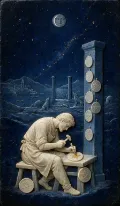
- Page of Pentacles + Eight of Pentacles
The Eight of Pentacles is the apprentice at the bench, repeating the same work until it is right. Beside the Page, it turns curiosity into practice and draws attention to the hours that turn an interest into a skill.
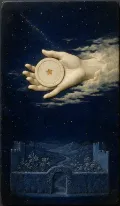
- Page of Pentacles + Knight of Pentacles
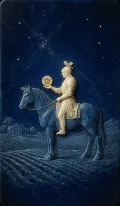
The Knight of Pentacles holds the same gold-starred disc out on one flat palm, astride a horse standing on ploughed furrows. Beside the Page, it draws attention to the step from studying something closely to working it steadily, season after season.
Also read withPage of WandsAll pairs ↗
Questions to keep
- What practical skill or subject keeps drawing your attention back, and what would it mean to study it properly?
- Where might preparation be standing in for the first real attempt?
- What could you learn this week through your hands rather than through reading?
Ask them with three cards ↗A three-card reading in which each position asks one of these questions.
A small practice
Choose one everyday object and study it for five minutes as if for an exam: how it is made, what it weighs, how it wears. Write down three things you had never noticed.
Cards that share its symbols
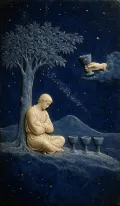 Four of CupsShares: Two hands, two jobs · The grove on the left · The river of gold flecks · The level, absorbed gaze · A single distant peak
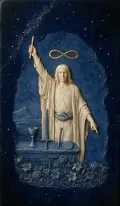 The MagicianShares: The river of gold flecks · The classical ivory drape · A single distant peak · Two hands, two jobs
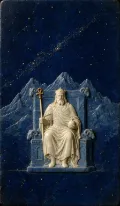 The EmperorShares: The river of gold flecks · A single distant peak · The level, absorbed gaze · The classical ivory drape
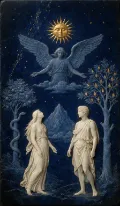 The LoversShares: A single distant peak · The level, absorbed gaze · The classical ivory drape · Two hands, two jobs