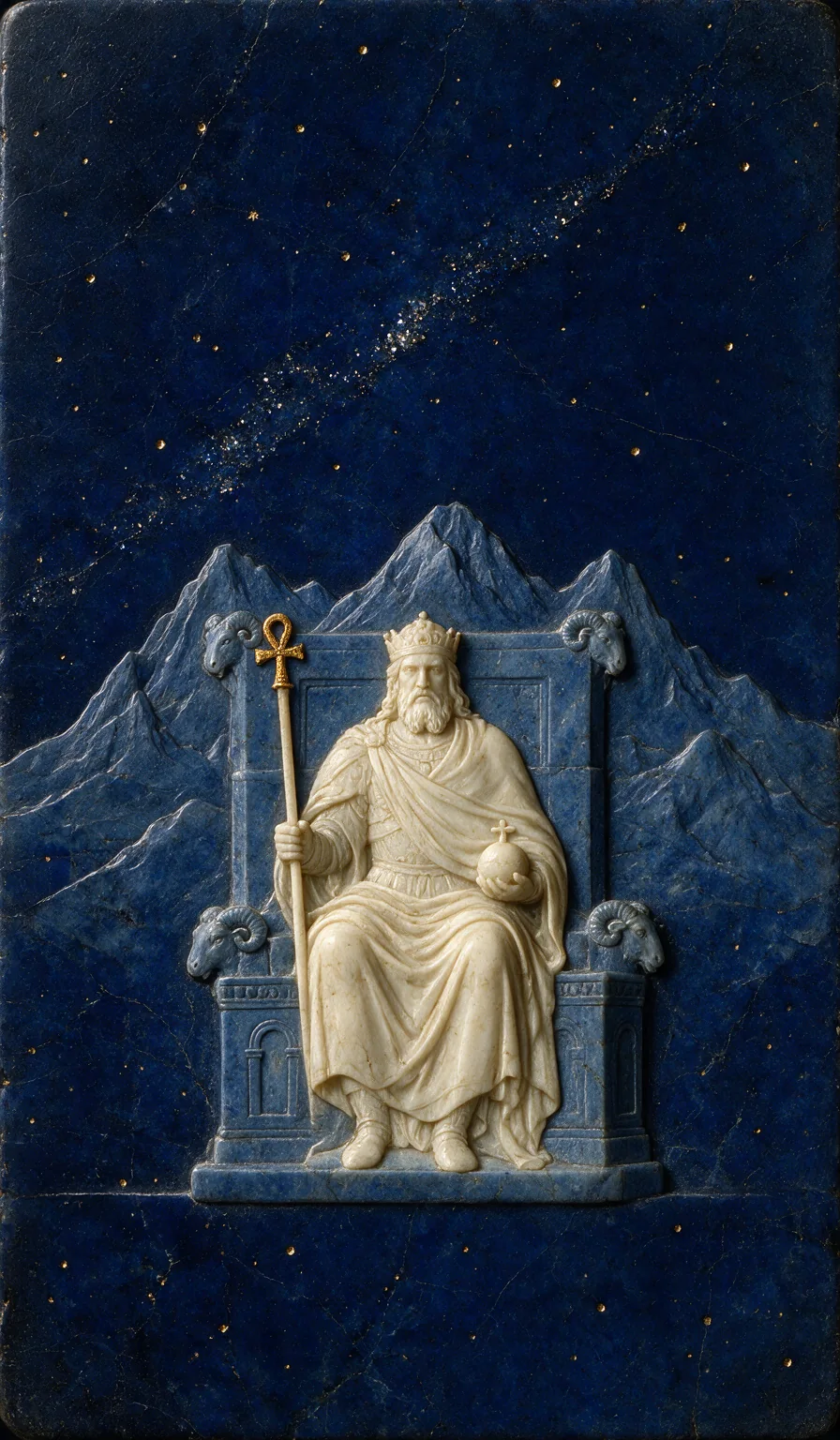
Major Arcana · IV
The Emperor
Tarot card meaning: upright, reversed and the symbols of the Olivia image
The Emperor is the steady structure that lets things grow: clear agreements, fair boundaries and responsibility held calmly, without needing to control every detail.
- Upright
- structureresponsibilitystabilityclear boundariesleadershipdependability
- Reversed
- rigidityovercontrolshaky foundationsunclaimed authorityrules without purpose
Upright
The Emperor sits at the point where ideas become arrangements. In Olivia’s carving the figure is set square to you on a throne built of lapis blocks, feet planted side by side on a broad base, bare mountains rising behind like a second wall. Nothing leans or hurries. Upright, the card draws attention to the structures that hold your life together: the routines, agreements, roles and boundaries that let effort add up instead of scattering.
Look at what the Emperor holds. In one hand, a tall sceptre crowned by a gold ankh, the sign of life; in the other, a small orb resting in an open palm. Authority here is not a fist. It is the responsibility to keep something living and whole, and the four ram heads on the throne show the drive of Aries harnessed to that task rather than let loose.
The card can point to a moment to set a clear rule, to take charge of a project that has drifted, or to say plainly what you will and will not carry. It asks you to be dependable more than impressive: to choose an arrangement you can explain, uphold fairly and revise when circumstances genuinely change.
Reversed
The Emperor reversed can point to structure that has lost its purpose. On one side is rigidity: a rule kept because it is the rule, control extended into details that do not need it, the throne’s right angles turned into walls. On the other is the empty seat: authority you hold but do not use, decisions left to drift, boundaries never quite stated. Both leave the orb unheld.
Ask which form is closer to your situation. If it is rigidity, name one rule and what it protects, and loosen it if the answer has changed. If it is absence, choose one small area where you can take responsibility clearly this week, and say so to the people it concerns.
Read the image
Every element below is carved into this card. Scroll, hover or press a number to follow it on the image.
The river of stars
What you seeA diagonal band of glittering silver-grey speckle crosses the lapis sky from the upper right towards the left, among scattered gold pyrite flecks, and fades out above the mountains on the left.
What it carriesThe traditional Emperor sits under a plain, warm-coloured sky; Olivia sets the ruler beneath the Milky Way instead. It places human authority inside a far larger and older order, a slow wheeling pattern that no throne commands and every throne sits beneath.
Follow this symbol through the deck ↗The bare lapis peaks
What you seeJagged mountains carved in paler grey-blue lapis rise behind the throne on both sides, their ridges sharply faceted; the tallest peak rises above the throne back, just to the right of the crown. Nothing grows on them, and no water runs below.
What it carriesThe Waite-Smith Emperor also sits before bare mountains, commonly read as hard-won stability and the discipline of high, dry ground. A thin stream at their foot is traditional; Olivia leaves it out, so the scene holds only stone: firm footing, with little to soften it.
Follow this symbol through the deck ↗The ivory crown
What you seeAn ivory crown of upright points, the tallest at the top centre ending in a small ball, sits level on the Emperor’s head. Long wavy hair falls from beneath it to the shoulders.
What it carriesA crown marks an office rather than a person: a responsibility held for as long as it is carried. Carved in the same ivory as the face and robe, not in gold, it reads here as a role the figure wears, not a treasure put on display.
Follow this symbol through the deck ↗The frontal bearded face
What you seeThe Emperor looks straight out at the viewer, brows level, mouth closed behind a full beard that falls in carved waves to the collar. The head is held upright, neither tilted nor turned.
What it carriesThe Marseille Emperor is usually shown in profile; the Waite-Smith figure turns to face you, white-bearded and composed. A long beard has long signified age and experience. Facing forward, the figure meets a situation directly, with attention that stays steady and does not drift.
The gold ankh sceptre
What you seeThe Emperor’s right hand, on the viewer’s left, grips a long ivory staff headed by a gold ankh with a looped top and flared crossbar. Apart from the star flecks, it is the carving’s only gold.
What it carriesThe Waite-Smith Emperor also holds an ankh-topped sceptre, the Egyptian sign of life. In a deck where gold is rare, making this the one gold object in the Emperor’s hands points to what authority is for: keeping life going, not merely keeping order.
Follow this symbol through the deck ↗Four carved ram heads
What you seeFour curled-horned ram heads are carved in grey-blue lapis on the throne: one at each top corner of the high back and one at the front of each armrest, all turned outward.
What it carriesThe ram is the sign of Aries, attributed to the Emperor in the Golden Dawn system, and the Waite-Smith throne carries ram heads too. Aries opens the zodiac at the spring equinox: drive, initiative, the will to begin and to lead. Carved into the seat, that force is contained and put to work.
The draped mantle
What you seeA heavy ivory mantle falls from the shoulders and crosses the chest in one broad diagonal fold, over a tunic with a patterned collar, sleeve and belt; below, its folds cover the knees and fall almost to the boots.
What it carriesBeneath the robe, the Waite-Smith Emperor wears armour, a sign that this rule has been defended. No armour is clearly visible here: only cloth, a patterned tunic and soft boots. The emphasis shifts to authority held through presence and agreement rather than visible force.
The orb with its cross
What you seeIn the left hand, on the viewer’s right, the Emperor cradles a small ivory orb from beneath, fingers curled up around its side, a plain cross standing on its top.
What it carriesThe globus cruciger, a sphere topped by a cross, is the old European emblem of rule over the world. Resting in an open palm rather than gripped, it suggests dominion understood as care: the whole of a situation held in view and in hand.
Follow this symbol through the deck ↗The block-built lapis throne
What you seeThe throne is carved from paler, veined lapis as a set of square blocks: a tall panelled back, armrest pillars with blind arched niches and a carved frieze, all standing on a broad, stepped base.
What it carriesThe traditional throne is a squared block of grey stone, and four, the Emperor’s number, is the number of the square. Olivia builds it like architecture, from right angles and arches: structure made visible, stable and lasting, and, when overdone, hard to move.
Follow this symbol through the deck ↗
The number
The Emperor carries four, the number of the square, the four directions and the four corners of a foundation; on this card, four ram heads mark the corners of the throne. In the Fool’s journey, the Empress at three has brought abundance and growth; the Emperor gives that growth a form it can live in. Next comes the Hierophant at five, where structure becomes shared tradition. This step asks you to build: to set the lines and agreements that let what you care about last.
The tradition
In the Golden Dawn system the Emperor bears the title “Sun of the Morning, Chief among the Mighty” (sometimes printed “Son of the Morning”). It is attributed to Heh, the fifth Hebrew letter, and to Aries, the cardinal fire sign ruled by Mars, on the fifteenth path of the Tree of Life joining Chokmah and Tiphareth. Aleister Crowley later exchanged the letters of the Emperor and the Star, giving the Emperor Tzaddi while keeping Aries. In the Marseille pattern L’Empereur sits in profile, legs crossed, beside a shield bearing an eagle. In 1909 Pamela Colman Smith turned the figure to face the viewer, armoured beneath a robe, on a ram-headed stone throne before bare mountains.
Love, work and self
- Love
- In love and close bonds, the Emperor asks what holds the relationship steady: shared routines, kept commitments, boundaries both people understand. It can point to a need to say clearly what you can offer and what you cannot, or to notice where one person has quietly taken charge of everything. Structure in love is not coldness; the orb rests in an open palm, not a closed fist. With yourself, it can mean keeping the small commitments you make to your own rest.
- Work
- In work and study, the Emperor favours clear roles, realistic plans and decisions that someone actually owns. It can point to a moment to organise a project that has sprawled, to set a schedule you can keep, or to step into a responsibility you have been circling. In money matters, it supports orderly records and deliberate choices made with proper advice, not grand gestures. Ask whether your systems serve the work, or the work now serves the systems.
- Self
- For your own growth, the Emperor invites you to become someone you can rely on. Look at the carving: feet planted side by side, back upright against the throne, face turned straight towards what is in front of it. Self-discipline here is not punishment; it is a structure that frees attention for what matters. Which daily habit, kept steadily, would make the rest of your life easier to carry, and what small rule would protect it?
In a spread
Read the card through each position before you look at Olivia’s version. A position is a question, and the same card answers each one differently.
The situation
What aspect of the situation deserves attention?
Olivia’s readingAt the heart of a question, the Emperor suggests that what is really at stake is structure: who decides, what the agreements are, and whether the foundations can bear what you are building.
What complicates it
What tension or assumption deserves a closer look?
Olivia’s readingAs a challenge, the Emperor can point to control held too tightly, or to authority nobody is willing to take. Either way, the structure may no longer be serving the people inside it.
A helpful next step
What small action could help you understand or respond?
Olivia’s readingAs advice, the Emperor invites one clear decision: set a boundary, write down a plan or take ownership of a task, then keep to it steadily for a week before judging it.
In conversation with
- The Emperor + The Empress
The Empress at three and the Emperor at four are natural partners: growth, and the form that holds it. Together they draw attention to the balance between nurture and order, abundance and the structure that lets it last.
- The Emperor + Two of Wands
In the Golden Dawn system the Two of Wands is Mars in Aries, the Emperor’s own sign, and its traditional figure also holds a small globe. Together they draw attention to authority looking outward: planning new ground from a secure base.
- The Emperor + The Tower
The Emperor builds; the Tower shows a structure breaking open, as symbolic change rather than a forecast. Together they draw attention to foundations: which of your walls are load-bearing, and which have grown too rigid to bend when things shift.
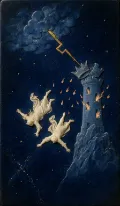
Also read withThree of WandsFour of PentaclesKing of PentaclesAll pairs ↗
Questions to keep
- Which agreement or routine, made clear, would make your situation easier to carry?
- Where are you holding control more tightly than the task actually needs?
- What responsibility have you been circling that you are ready to take up plainly?
Ask them with three cards ↗A three-card reading in which each position asks one of these questions.
A small practice
Write down one boundary you want to keep this week, with a single sentence on what it protects, and read it each morning before you begin.
Cards that share its symbols
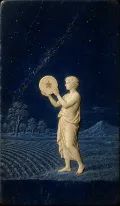 Page of PentaclesShares: The river of stars · The frontal bearded face · The bare lapis peaks · The draped mantle
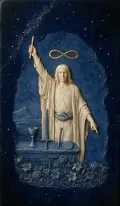 The MagicianShares: The river of stars · The draped mantle · The bare lapis peaks
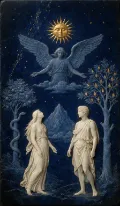 The LoversShares: The bare lapis peaks · The frontal bearded face · The draped mantle
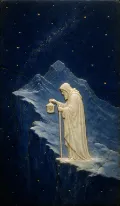 The HermitShares: The river of stars · The bare lapis peaks · The draped mantle