Minor Arcana · Wands
Three of Wands
Tarot card meaning: upright, reversed and the symbols of the Olivia image
The Three of Wands looks out over what your effort has set in motion: a pause on high ground to watch, prepare and widen your horizon.
- Upright
- expansionforesightfirst resultswider horizonspreparationenterprise
- Reversed
- impatiencedelayed returnsnarrowed viewrigid plansstaying ashore
Upright
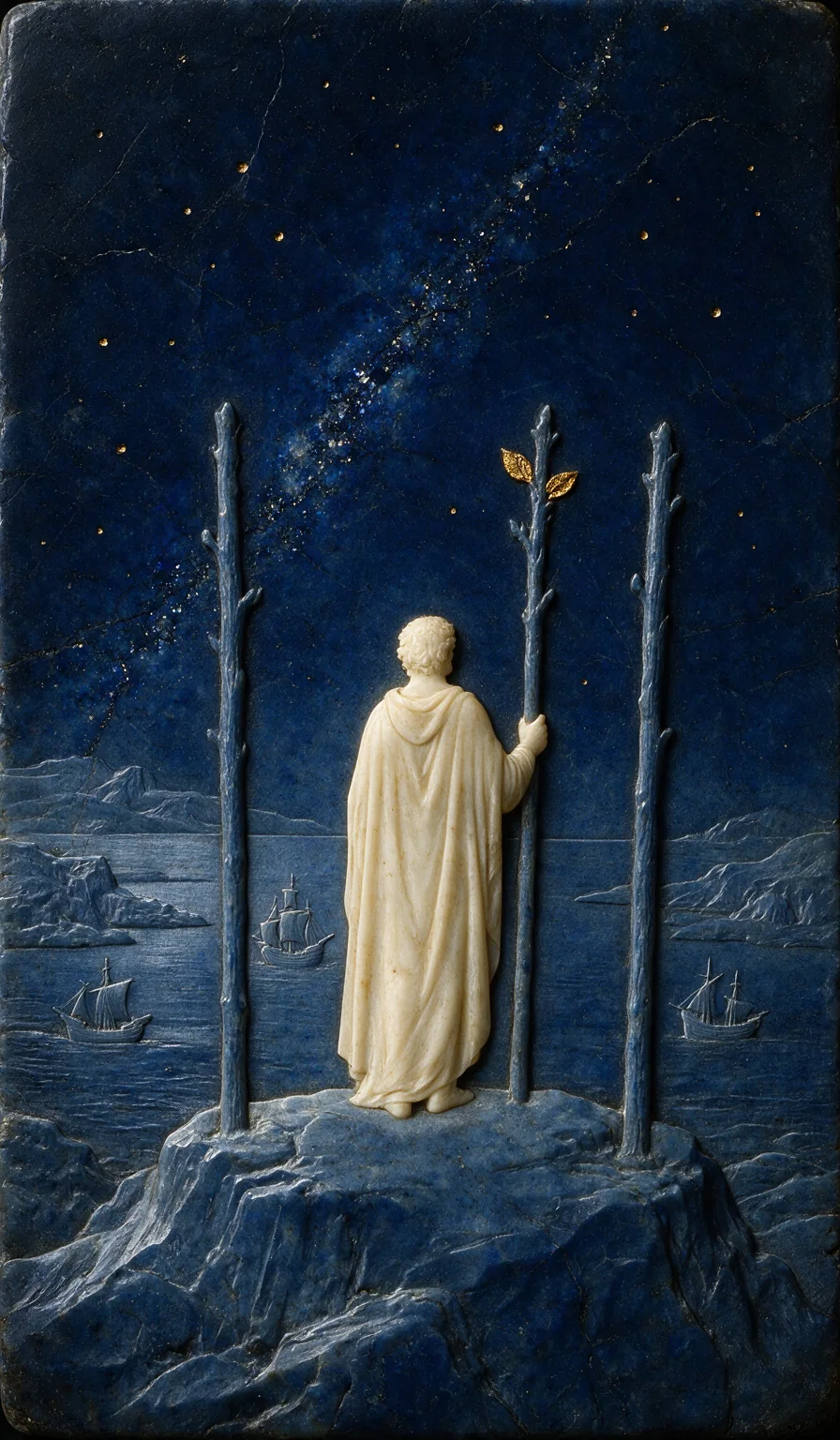
The Three of Wands shows the moment after the first move. A single ivory figure stands on a high lapis rock with its back to you, cloak falling from the shoulders, looking out across a calm sea toward distant shores. Three wands are planted in the stone beside it. Something has been started, sent or offered, and now the view opens: ships are already under sail below, and the question becomes what this beginning could grow into.
Wands are the suit of Fire: will, drive, creative intent. In the Three, that fire turns into foresight. Look at where the figure’s hand rests: on the middle wand, the only one of the three that has put out leaves, and those two leaves are gold. The staff you keep hold of is the one still growing. The other two stand planted and bare, like work already set in place that no longer needs holding.
Upright, the card invites you to lift your eyes from the task to the horizon. It draws attention to expansion, trade and partnerships at a distance, study that widens your map, and the patience to let efforts travel before they return. The night sky here, crossed by a pale band of stars, suggests seeing further than daylight allows: a longer view, and the calm to prepare while you wait.
Reversed
Three of Wands reversed draws attention to a view that has narrowed, or a wait that has become hard to bear. Replies may be slow, a plan may be taking longer to reach its shore, and impatience can tempt you to call everything back to land. The inward form is quieter: plans kept so private that they never meet the wider world, or held so tightly that nothing coming back is allowed to change them.
Delay is not a verdict on the effort you made. The card asks what you can prepare while the ships are still out, which assumption could be checked, and whether the one living wand in your hand needs care closer to home before you look any further.
Read the image
Every element below is carved into this card. Scroll, hover or press a number to follow it on the image.
Two gold leaves
What you seeNear the top of the middle wand, two small gold leaves grow from opposite sides of the lapis branch, the right one slightly lower. Apart from the star flecks, they are the only gold on the card.
What it carriesIn the traditional image the wands of this suit sprout small leaves, a sign of living fire. Here only one wand has leaves, and they are gold, the deck’s mark of what matters. The growth sits on the wand the figure holds: what you keep hold of is what is still alive and growing.
Follow this symbol through the deck ↗The band of stars
What you seeA pale, glittering band of mineral crosses the dark lapis sky diagonally from the upper right toward the left, passing behind the left wand, with small gold flecks scattered like stars around it.
What it carriesThe traditional Three of Wands is set under a bright daytime sky. Olivia moves the scene to night and lays a band of stars across it; stars were the navigator’s old guide. It suggests foresight that works beyond what is plainly visible, and a direction to steer by while results are still at sea.
Follow this symbol through the deck ↗Three planted wands
What you seeThree wands of grey-blue lapis, knotted with short broken-off side shoots, stand upright with their feet in the rock. The figure fills the wide gap between the left and middle wands; the right wand stands nearer the middle.
What it carriesWands carry the suit’s Fire: will, drive and intent. Three set in stone read as work that has taken hold, the “established strength” of the card’s old title. Two stand on their own, needing no hand: efforts already in place, which leave attention free for the view.
Follow this symbol through the deck ↗The figure seen from behind
What you seeAn ivory figure with short curled hair stands with its back to the viewer, wrapped in a long, heavy cloak with a hood gathered at the neck; the hem falls to the feet on the rock.
What it carriesThe turned back is the card’s classic gesture: attention given wholly to what lies ahead. It invites you to stand where the figure stands rather than meet its gaze. The plain, weighty cloak suggests patience and readiness for a long watch rather than display.
Follow this symbol through the deck ↗The hand on the wand
What you seeThe figure’s right arm comes out from under the cloak, and its hand closes around the middle wand a little below shoulder height. It is the only wand the figure touches.
What it carriesIn the traditional image the figure also keeps one staff in hand. The grip here is light but steady, support rather than struggle. It suggests staying connected to one living thread of your work while the rest has been released into the world.
Follow this symbol through the deck ↗Three ships under sail
What you seeOn the sea below, three small ships carved in pale lapis sail with canvas set: one further out, between the left wand and the figure, and two nearer the viewer, close to the left and right edges.
What it carriesShips are the card’s traditional picture of ventures sent out: trade, messages, plans travelling toward distant shores. Seen from above, they are already under way. They invite patience with a process that no longer needs you at the helm, and attention to what may come back.
Follow this symbol through the deck ↗The sea and far shores
What you seeA wide sea, finely lined with ripples, runs to a straight horizon that crosses behind the figure at about mid-back, with rocky headlands and hills carved in paler lapis on both sides of the card.
What it carriesWater between the watcher and the far coasts gives distance a shape: the space between effort and return. The shores on either side mark places not yet reached. The card asks you to measure that distance honestly, neither shrinking it nor letting it discourage you.
Follow this symbol through the deck ↗The high rock
What you seeThe figure and all three wands stand on a broad, flat-topped outcrop of faceted lapis that fills the lower quarter of the card, its carved faces dropping steeply toward the sea.
What it carriesThe traditional figure stands on a cliff or ridge above the water. Height gives perspective and rock gives footing: this card’s strength is established, not improvised. From firm ground you can look a long way without losing your balance.
Follow this symbol through the deck ↗
The number
Three is the number of first growth: the seed of the Ace and the choice of the Two produce something that can be seen. In Wands, the suit of Fire and will, the Two holds a plan and weighs the world; the Three has acted on it and watches the first results travel out. Threes across the Minor Arcana often concern collaboration and a first structure. Here the structure is literal, three wands set in rock, and the next step, the Four, celebrates something established.
The tradition
In the Golden Dawn system the Three of Wands is titled the Lord of Established Strength. It is assigned to the Sun in Aries, the second decan of that sign (10 to 20 degrees), and to Binah, Understanding, the third Sephirah on the Tree of Life, expressed through the suit of Fire. The Sun is exalted in Aries, and the pairing is commonly read as vitality with a secure footing; Aleister Crowley titled the card Virtue. Marseille decks show three batons as an ornamental pattern with foliage and no scene. Pamela Colman Smith’s 1909 card gives it a scene: a figure seen from behind on high ground, watching ships out at sea, a composition Olivia’s card follows.
Love, work and self
- Love
- In close relationships the Three of Wands can point to a bond that is widening: plans made further ahead, distance bridged, a shared life reaching toward new places or people. It does not tell you what another person feels or will do. It asks whether you are both looking toward the same horizon, and whether you leave room for each other to sail at your own pace. With yourself, it may show a readiness to want more than the familiar shore.
- Work
- At work or in study, this card often reflects the stage after launch: a proposal sent, an application submitted, a project handed to others. The figure stands still yet keeps a hand on one wand, which is a useful picture: stay connected to what matters most while results travel. Use the interval to prepare the next stage, widen your contacts or learn something that broadens the map. Where money is involved, keep timelines realistic and seek qualified advice before committing further.
- Self
- For your relationship with yourself, the Three of Wands turns attention to perspective. From high ground you can see how far you have already come and how much sea remains. Notice whether you measure progress only by what has arrived, rather than by what is under way. The gold leaves on the held wand suggest that growth continues while you wait. Give yourself credit for what you have set in motion, and let your horizon be a little wider than last month.
In a spread
Read the card through each position before you look at Olivia’s version. A position is a question, and the same card answers each one differently.
The situation
What aspect of the situation deserves attention?
Olivia’s readingAt the centre of a question, the Three of Wands can point to something that may already be in motion: the real question could be how you wait, prepare and widen your view while the first results travel.
What complicates it
What tension or assumption deserves a closer look?
Olivia’s readingAs a challenge, the card can show impatience with distance: wanting returns before the ships are home, or looking so far ahead that the ground under your feet is neglected.
A helpful next step
What small action could help you understand or respond?
Olivia’s readingAs advice, it invites you to step back and survey the whole situation: name what you have started, prepare one next step, and reach toward a wider circle than usual.
In conversation with
- Three of Wands + Two of Wands
In Olivia’s Two of Wands the figure holds a globe and faces a wand whose tip has budded in gold. In the Three the figure turns to the sea, and the gold has opened into two leaves. Together they trace the step from planning to watching a plan travel.
- Three of Wands + The Emperor
The Emperor carries Aries, the sign of this card’s decan. Side by side they set structure beside expansion, asking how firm foundations and clear authority over your own choices can support a wider reach rather than limit it.
- Three of Wands + The Sun
The Golden Dawn places the Sun in this card’s decan. With The Sun, the Three of Wands draws attention to confidence and visibility: letting your work be seen in open daylight after the quieter night watch of this card.
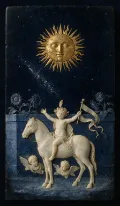
Also read withFour of WandsAll pairs ↗
Questions to keep
- What have you already set in motion that you could now watch with more patience?
- Which horizon would you look toward if you trusted the ground you stand on?
- Which single wand do you want to keep hold of while other efforts travel?
Ask them with three cards ↗A three-card reading in which each position asks one of these questions.
A small practice
Write down three things you have set in motion recently, then note one small way to prepare for each one’s return this week.
Cards that share its symbols
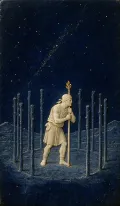 Nine of WandsShares: The band of stars · Two gold leaves · The hand on the wand · Three planted wands
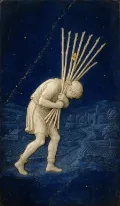 Ten of WandsShares: Three planted wands · Two gold leaves · The hand on the wand · The band of stars
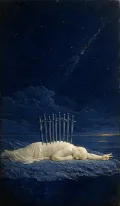 Ten of SwordsShares: The hand on the wand · The sea and far shores · The band of stars · The high rock
 The MagicianShares: The band of stars · Three planted wands · The hand on the wand