Minor Arcana · Swords
Ace of Swords
Tarot card meaning: upright, reversed and the symbols of the Olivia image
The Ace of Swords is the first clear edge of thought: a truth seen plainly, a question sharpened, a word that cuts through confusion with care.
- Upright
- claritytruthbreakthroughclear decisionhonest wordsfresh idea
- Reversed
- clouded thinkingharsh wordsoverthinkinghasty conclusionsunspoken truth
Upright
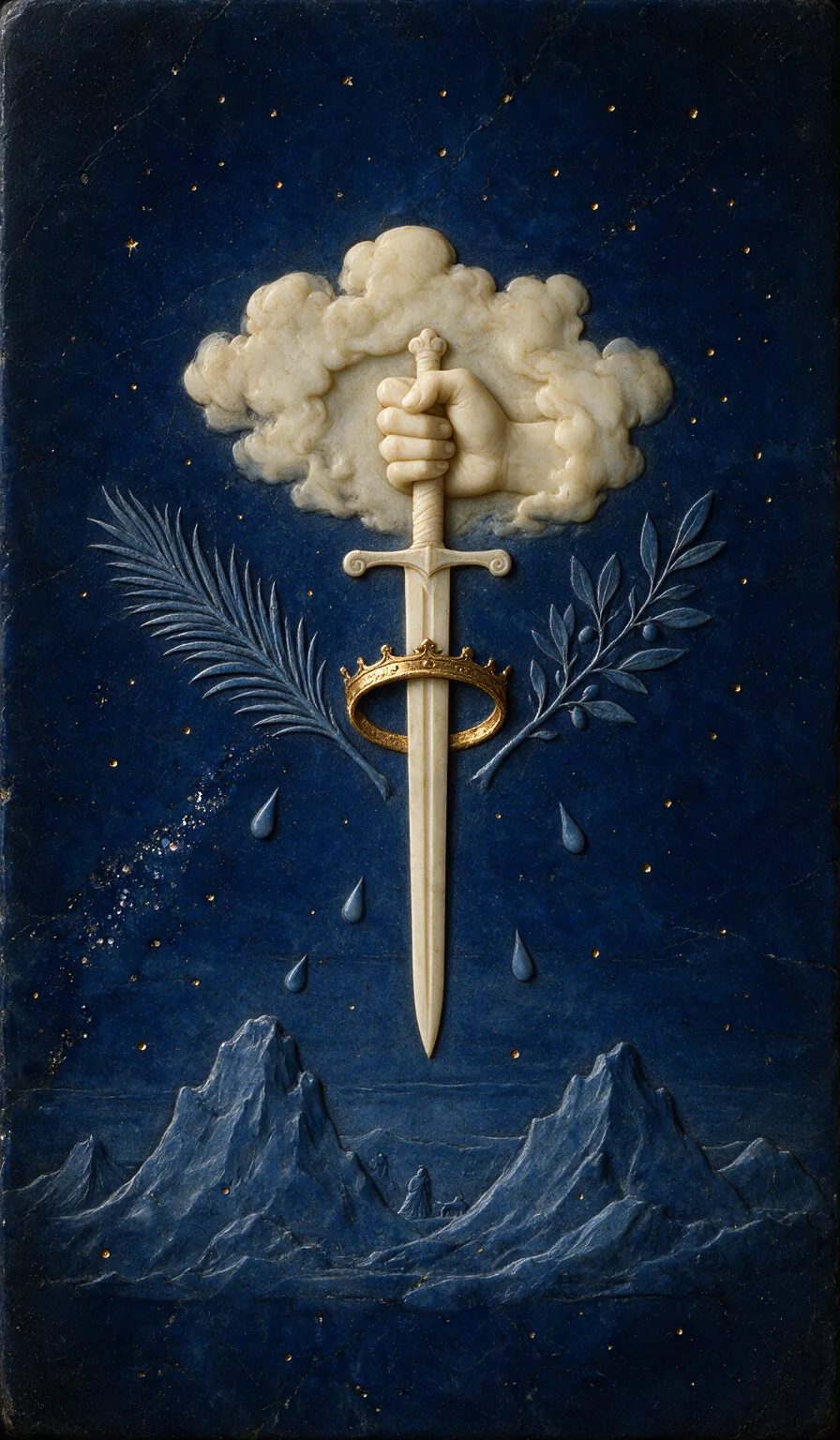
The Ace of Swords draws attention to the moment a thought comes clear. Swords are the suit of Air, of words, reasoning and discernment, and their Ace is that suit at its seed: one idea, one honest sentence, one distinction that suddenly makes a muddle make sense. In Olivia’s deck an ivory hand reaches out of an ivory cloud and holds the sword in a closed, steady grip, as if the insight has been handed to you whole.
What sets this version apart is the direction of the blade. The traditional Ace of Swords lifts its blade toward the sky; here it points down, between five falling blue drops, toward two mountains and small travellers in the valley below. Clarity in this card is not meant to stay abstract. It asks to be brought down to real ground: said aloud, written down, tested against the facts of your day.
The gold crown threaded on the blade, with a palm frond on one side and an olive branch on the other, keeps the edge honest. A true word can bring relief and a small cost together, peace and a little grief. Upright, the card invites you to name what you now see as simply as you can, and to use that edge to clarify rather than to wound.
Reversed
Ace of Swords reversed can point to clarity that has not yet come down from the cloud. Thoughts may circle without landing, or a question may be too broad to answer. Sometimes the reversal shows the opposite: a conclusion reached so fast and held so tightly that it cuts before it has been checked, the blade swung rather than held.
This position asks you to slow the edge. Separate what you know from what you have assumed, and let one precise sentence replace ten anxious ones. If words are needed, choose their timing and tone with care. A truth offered gently usually travels further than one delivered as a verdict.
Read the image
Every element below is carved into this card. Scroll, hover or press a number to follow it on the image.
The hand from the cloud
What you seeA carved ivory hand emerges from a billowing ivory cloud, its wrist vanishing into the cloud on the right, its fist closed round the bound grip, thumb folded over the fingers, holding the sword vertically.
What it carriesIn the traditional deck a hand from a cloud offers each Ace, commonly read as a gift arriving from beyond ordinary effort: an insight you did not have to manufacture. Here hand and cloud share one warm ivory, so clarity feels given rather than seized, and the grip is steady, not raised to strike.
Follow this symbol through the deck ↗The blade pointing down
What you seeBelow a three-lobed pommel and a crossguard whose ends curl into round scrolls, the long ivory blade hangs point downward, a fine central ridge running to its sharp tip above the mountains.
What it carriesSwords belong to Air: thought, speech and the power to tell one thing from another. The traditional Ace raises its blade point upward into a crown. Olivia turns it toward the earth, the mountains and the travellers, so this clarity is aimed at lived ground: an idea brought down to where it can be used.
Follow this symbol through the deck ↗The gold crown on the blade
What you seeAn open circlet of gold, the one large piece of gold on this card, is threaded onto the blade below the crossguard; the ring is seen in perspective, and its points end in small beads, the central point taller than the rest.
What it carriesIn the classic image the crown sits on the sword’s tip and is commonly read as mastery or a truth that rules; the Golden Dawn linked every Ace to Kether, the Crown. Here it rings the blade like a halo, authority that clear thinking passes through and must carry, rather than a prize at the end.
Follow this symbol through the deck ↗The palm frond, left
What you seeOn the viewer’s left a long palm frond, carved in paler grey-blue lapis, sweeps up and outward from a stem that ends beside the blade just below the crown, its fine leaflets angled toward its tip.
What it carriesGolden Dawn descriptions of this Ace pair the palm with suffering, and older Christian art gives it to martyrs as a sign of victory won through hardship. Beside the sword it admits that clarity can cost something: a true word may involve a loss before it brings relief.
Follow this symbol through the deck ↗The olive branch, right
What you seeOn the right an olive sprig in the same pale lapis rises from beside the blade toward the upper right, with slender pointed leaves and small round olives along its stem, mirroring the palm across the sword.
What it carriesThe olive has stood for peace since antiquity, and Golden Dawn texts name this one the olive branch of peace. Set opposite the palm, it balances the pair: the same edge that separates can also settle a quarrel, when a clear word ends confusion instead of prolonging it.
Follow this symbol through the deck ↗Five falling blue drops
What you seeFive teardrop shapes in smooth, pale blue lapis hang in the air below the branches, three to the left of the blade and two to the right, each pointed at the top and rounded below.
What it carriesTraditional versions scatter six small golden yods, flame-like drops, around the sword, often read as grace or spirit descending into matter. Olivia makes them five cool blue drops instead, closer to rain or tears: insight arriving quietly, sometimes with feeling attached, settling rather than blazing.
Follow this symbol through the deck ↗A glittering band of stars
What you seeAt mid-left a diagonal vein of pale, sparkling mineral crosses the dark lapis like a band of stars, while gold flecks, one larger and star-shaped near the upper left, are scattered across the whole sky.
What it carriesThis is Olivia’s own detail, not part of the traditional card. Swords belong to the sky, and the vein reads like the Milky Way on a clear night: a reminder that clear thought can widen the view as well as narrowing it to a single point.
Follow this symbol through the deck ↗Twin peaks in lapis
What you seeTwo steep, faceted peaks rise in the lower third in lighter blue lapis, with smaller ridges at either edge and a level horizon behind; the sword’s tip points into the gap between them.
What it carriesMountains also sit below the sword in Pamela Colman Smith’s version of this Ace, commonly read as hard facts, difficulty and the heights thought can reach. Here the blade points into the gap between two peaks: the passage through a problem rather than a view over it.
Follow this symbol through the deck ↗Travellers in the valley
What you seeBetween the peaks, tiny low-relief figures in muted blue: a hooded, robed walker beside a four-legged animal, and a fainter figure higher up the left-hand slope behind them.
What it carriesAnother of Olivia’s additions; the traditional Ace shows no people. The travellers give the sword’s clarity a human scale. A bright idea in the sky means little until it reaches someone walking a real road, and these walkers are small, patient and still moving.
The number
Every Ace is a root: the whole of its suit held in a single point before it divides into two, three and onward. In Swords, the suit of Air, that root is the first clear act of mind, the idea before the argument, the word before the debate. Nothing has been weighed or defended yet; the Ace simply offers the edge. The Two of Swords asks what to do with it once choices appear. The Ace invites you to notice the clarity itself while it is still fresh.
The tradition
In the Golden Dawn system the Ace of Swords is titled the Root of the Powers of Air. Aces take no decan: each is assigned to Kether, the Crown, first Sephirah of the Tree of Life, in its own element, and is said to rule a quarter of the heavens around the pole. The order’s Book T describes a white hand from clouds grasping a sword that supports a crown, with the olive branch of peace on one side, the palm of suffering on the other, and Hebrew letters falling from the point. Marseille decks already show a hand from a cloud raising a crowned sword; Pamela Colman Smith’s 1909 card keeps the crown at the tip, above distant mountains.
Love, work and self
- Love
- In close relationships the Ace of Swords can point to a conversation that clears the air, or to finally understanding what you need and being able to say it. It cannot show what another person thinks or intends; it turns attention to your own clarity. The olive and the palm on either side of this blade suggest that an honest word may bring peace and a little pain together. Say one true thing kindly, and let the other person answer in their own time.
- Work
- At work or in study, this card can reflect a breakthrough: the plan that finally makes sense, the argument that holds, the question that reframes a whole project. Write it down while it is sharp. The downward blade in this image is a reminder to test the idea against real conditions before building on it. Where money or contracts are involved, clear thinking includes asking a qualified person to check the details.
- Self
- For your relationship with yourself, the Ace of Swords invites honesty without harshness. Notice the story you tell about a situation, and ask whether one clearer sentence would describe it better. The small travellers at the foot of these mountains are a reminder that insight is meant to be walked with, a step at a time. Clarity about yourself can arrive as a quiet recognition rather than a verdict, and it can be revised as you learn more.
In a spread
Read the card through each position before you look at Olivia’s version. A position is a question, and the same card answers each one differently.
The situation
What aspect of the situation deserves attention?
Olivia’s readingAt the centre of a question, the Ace of Swords can point to a clear truth or idea that is ready to be seen. Naming it simply may matter more than acting on it straight away.
What complicates it
What tension or assumption deserves a closer look?
Olivia’s readingAs a challenge, the card can show sharpness turned against yourself or others: a conclusion held too hard, or honest words spoken without regard for timing and care.
A helpful next step
What small action could help you understand or respond?
Olivia’s readingAs advice, it invites you to find the one distinction that makes the situation clearer, write it as a single sentence, and test it before you act on it.
In conversation with
- Ace of Swords + Justice
Justice holds its sword point upward beside a pair of scales, while this Ace lowers its blade toward the ground. Together they turn attention to fairness as well as clarity: seeing the truth plainly, then weighing it before any decision is made.
- Ace of Swords + Ace of Cups
The two Aces set head and heart side by side. Together they ask whether a fresh understanding and a fresh feeling are pointing the same way, and what each could learn from the other.
- Ace of Swords + Two of Swords
The Two of Swords shows a mind holding two options in suspension. After the Ace, the pair traces what happens when a single clear idea meets real choices, and asks what would help you keep that first clarity.
Also read withTen of SwordsPage of SwordsKing of SwordsAll pairs ↗
Questions to keep
- What single distinction would make this situation easier to think about?
- Which truth do you already see clearly but have not yet said aloud?
- How could you say what you know in a way that clarifies rather than cuts?
Ask them with three cards ↗A three-card reading in which each position asks one of these questions.
A small practice
Write your situation in one sentence of no more than fifteen words, then read it aloud and change any word that is vaguer or harsher than the truth.
Cards that share its symbols
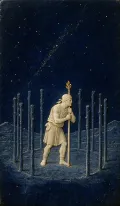 Nine of WandsShares: A glittering band of stars · The palm frond, left · The hand from the cloud · Twin peaks in lapis
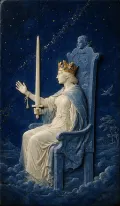 Queen of SwordsShares: The blade pointing down · The gold crown on the blade · The hand from the cloud · A glittering band of stars
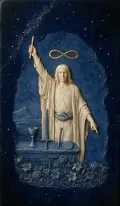 The MagicianShares: A glittering band of stars · Twin peaks in lapis · The hand from the cloud
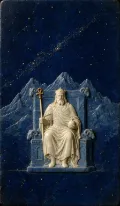 The EmperorShares: A glittering band of stars · Twin peaks in lapis · The gold crown on the blade