Minor Arcana · Wands
Ten of Wands
Tarot card meaning: upright, reversed and the symbols of the Olivia image
The Ten of Wands shows a load that has grown too heavy to carry this way, and asks what can be set down, shared or rearranged.
- Upright
- burdenovercommitmentresponsibilityfinal stretchhard work
- Reversed
- setting downdelegatingcollapse of effortcarrying alonesaying no
Upright
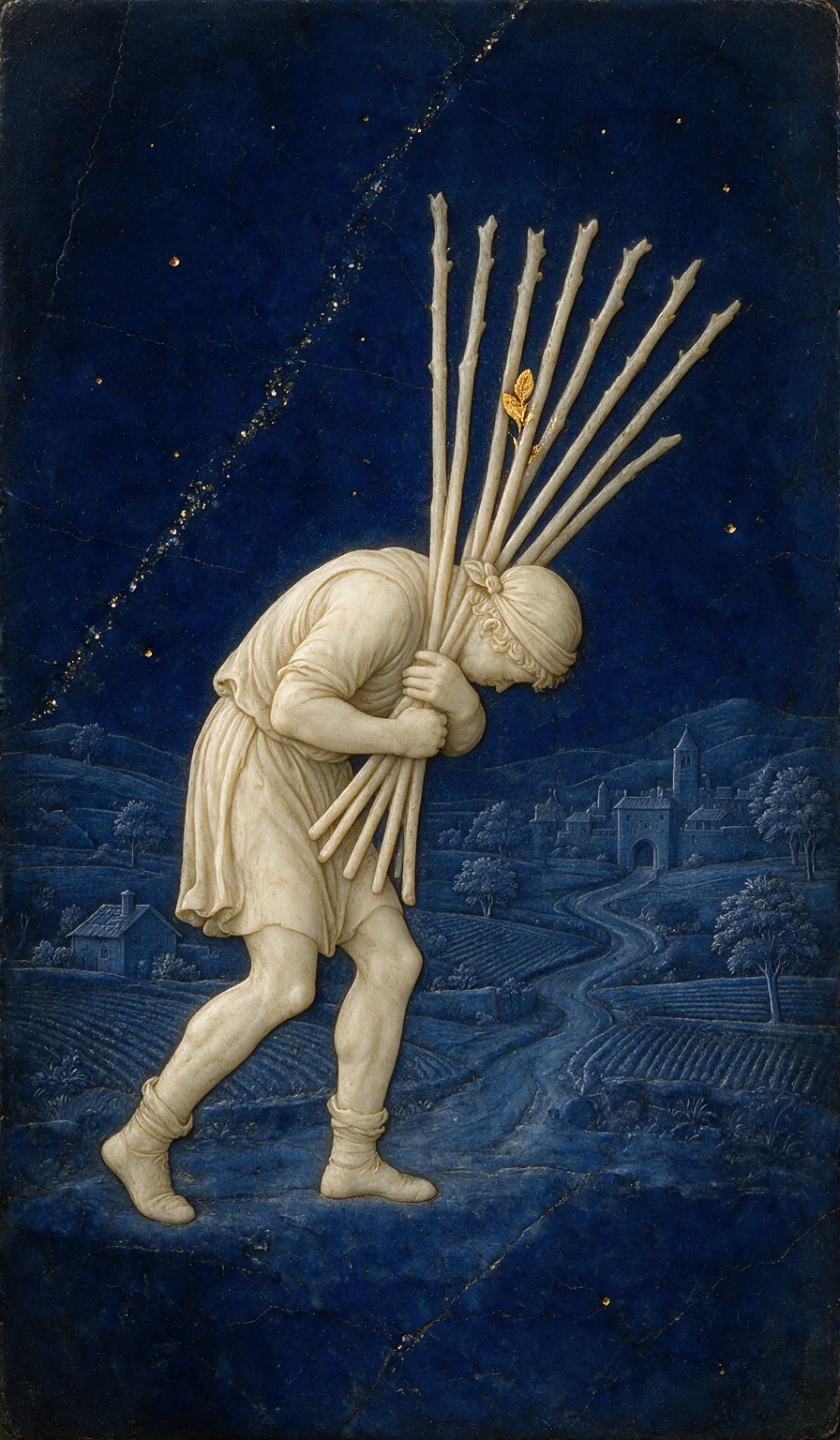
The Ten of Wands draws attention to the moment when something you chose, and may still care about, has become a weight. Ten is the end of the suit’s count, and in Wands, the suit of Fire and drive, it can show enthusiasm that has turned into obligation: every yes you said, every task you picked up because you could, now gathered into one armful. In Olivia’s image the figure hugs the staves with both hands and walks bent almost double, the head bowed towards the ground and the cloth round it pulled so low that the eyes are hidden.
Look at where the wands go. They fan out high above the bowed head, leaning the way the figure walks, while on the right a walled town with an open gate waits at the end of a winding road. The destination is close, yet the figure cannot look up to see it. The card often points to this: nearly finished, but too absorbed in the effort to notice how near the end is, or how the carrying could change.
Olivia adds two quiet details. High among the staves a small gold sprig is still growing, the living spark of why you took this on. And the scene is set at night, under a sky scattered with small gold stars. Upright, the card invites you to name the whole load, honour what you have carried, and choose one thing to put down.
Reversed
Ten of Wands reversed can point to the load beginning to shift. Sometimes that is relief: you set part of it down, hand a task on, or say no, and the bundle becomes something you can hold with one arm. Letting go can feel like failing when you are used to being the dependable one; it can also be the first honest look at your limits.
In other readings the reversal turns the weight inward. The staves are still carried, but quietly and alone, refusing help because asking seems harder than struggling on. Or the bundle slips all at once because it was never rearranged. Either way, this position asks which burdens you hold out of habit, and what would change if you looked up at the town ahead.
Read the image
Every element below is carved into this card. Scroll, hover or press a number to follow it on the image.
The fanned ivory wands
What you seeLong ivory staves rise from the figure’s grip and fan out above and beyond the bowed head against the night sky. Eight rough tips are clearly visible, each shaft knotted with small cut-off twig stubs.
What it carriesWands belong to Fire: drive, purpose and the energy to begin things. Ten of them together is every plan and commitment gathered into one armful. Their fan rises high over the bowed head and leans in the direction of travel, so the load stands taller than its carrier.
Follow this symbol through the deck ↗The gold sprig
What you seeA small sprig of gold leaves on a thin gold stem sprouts from among the upright wands, high above the figure’s head. It is the only gold on the carved figure and its load.
What it carriesOlivia sets one small living sprig of gold among the bare staves, echoing the leaves that bud on the Ace of Wands. Under all the weight, the original spark that made this worth carrying is still alive, if small.
Follow this symbol through the deck ↗The bowed, wrapped head
What you seeThe head is wrapped in ivory cloth knotted at the crown and pulled low over the brow, so no eye shows; curls escape around the ear. Only nose, lips and chin appear, turned towards the ground.
What it carriesThe traditional carrier cannot see past the bundle, a classic image of losing perspective under responsibility. Here the sight is covered in another way: the cloth hides the eyes and the face is turned to the ground, so the effort narrows attention to the next step and nothing else.
Two clutching hands
What you seeOne hand grips the bundle just below the chin; the other, a closed fist on a bent arm, holds it lower against the chest. Below the grip, the lower ends of the staves splay out towards the viewer’s left.
What it carriesThe staves are hugged, not balanced on a shoulder or tied with a cord. This is a load carried by holding on, which takes both hands and leaves none free. The splaying ends suggest a bundle that is already slipping from its own arrangement.
Follow this symbol through the deck ↗The walled town ahead
What you seeOn the right, carved in lighter blue lapis, a walled town rises among trees: an arched gateway, a tall tower with a pointed roof, clustered rooftops and low hills behind.
What it carriesMost readings place a destination in this card, a house or town where the load can finally be set down. Olivia makes it a gated town, a place of other people, work handed on and shelter. The end is near and visible, though the carrier is not looking.
Follow this symbol through the deck ↗The winding road
What you seeA pale road winds up from the flat ground ahead of the figure’s front foot, curving between furrowed fields and trees until it reaches the arched gate of the town.
What it carriesThe road is not straight: it winds in curves on its way to the gate. It adds a detail the traditional image leaves implicit, that the last stretch of a long effort often feels longer than it looks, and that the way still leads somewhere.
Follow this symbol through the deck ↗The labouring stride
What you seeBare, muscular legs step towards the right in soft boots slouched at the ankles. The back heel lifts off the ground, both knees bend, and the whole body leans far forward from the hips.
What it carriesThe posture carries the card’s meaning before any symbol does. The figure is still moving, and still strong, but every step is paid for. The bent back and bent knees ask a practical question: how long can this particular way of carrying last?
The house left behind
What you seeBehind the figure on the left, a small farmhouse with a single chimney sits among bushes on a rise above ploughed fields, carved in the same muted blue lapis as the landscape.
What it carriesOlivia adds a home already passed. It can stand for the rest, ease or private life set aside while the load is carried, and for the fact that the carrier has come a long way from where the gathering began.
Follow this symbol through the deck ↗Glittering vein and stars
What you seeA pale, glittering mineral vein crosses the dark lapis sky diagonally from the top edge down towards the left side, while small gold flecks are scattered across the sky like stars.
What it carriesThe scene is set at night, unlike the daylight of the traditional image. The work has run past the end of the day. Yet the sky above the bowed head holds glittering points of light the carrier cannot see: rest and wider perspective are there, one look upward away.
Follow this symbol through the deck ↗
The number
Ten completes the count of the pips: the seed of the Ace has grown through every stage and reached its fullest, heaviest form. In Wands, the suit of Fire, will and enterprise, completion means that energy has become structure, and structure has become weight. The single leafy wand of the Ace is now ten staves held in the arms. Ten also stands at a threshold: after it the suit turns to the Page, a fresh student’s start, as if the only way forward is to set something down.
The tradition
In the Golden Dawn system the Ten of Wands is titled the Lord of Oppression. It is assigned to Saturn in Sagittarius, the third decan of that sign (20 to 30 degrees), and to Malkuth, the Kingdom, the tenth Sephirah, in the suit of Fire. Saturn’s limiting weight laid on Sagittarius, the sign of wide horizons and far travel, is commonly read as ambition pressed down by duty. Aleister Crowley kept the single title Oppression. Marseille decks show the ten batons as an interlaced pattern with no figure. Pamela Colman Smith’s 1909 design gave the card a hunched figure carrying the whole bundle towards buildings in the distance, its view blocked by the staves.
Love, work and self
- Love
- In close relationships the Ten of Wands can point to one person carrying most of the practical and emotional work: remembering, arranging, holding things together. It does not tell you what anyone else feels or intends. It asks what you are carrying that was never agreed, and whether it has been named aloud. With yourself, too, notice whether you treat care as another duty. The gold sprig among the staves is a reminder that love is the reason for the load, not the load itself.
- Work
- At work or in study this card often mirrors a full list: projects accepted one at a time until there is no room to think. Write everything down, as the staves would look laid out on the ground, and mark what is truly yours, what could be handed on, and what can wait. The town gate is near; finishing may take less than another push. Where money or contracts are involved, check options with a qualified person before taking on more.
- Self
- For your relationship with yourself the Ten of Wands asks about posture, literally and otherwise. Notice where you hold weight: shoulders, jaw, a bowed neck like the figure’s. The image is set at night, which can reflect effort that has run past the end of the day. Rest here is not a reward for finishing; it is part of how the carrying can continue. One look upward, at the stars in this sky, can change what the next step feels like.
In a spread
Read the card through each position before you look at Olivia’s version. A position is a question, and the same card answers each one differently.
The situation
What aspect of the situation deserves attention?
Olivia’s readingAt the centre of a question, the Ten of Wands can point to an accumulated load: responsibilities that each made sense but together may have become too much. Seeing the whole bundle clearly may matter more than pushing on.
What complicates it
What tension or assumption deserves a closer look?
Olivia’s readingAs a challenge, the card can show a habit of carrying everything alone, head down, so absorbed in effort that you cannot see how close the end is, or who might help.
A helpful next step
What small action could help you understand or respond?
Olivia’s readingAs advice, it invites you to set one stave down today: hand on a task, postpone something, or say no once, then notice how the rest of the load feels.
In conversation with
- Ten of Wands + Ace of Wands
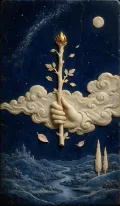
The Ace of Wands holds a single sprouting wand; the Ten holds the whole bundle. Together they trace the suit from spark to weight and ask whether the living leaves, like the gold sprig here, are still part of what you carry.
- Ten of Wands + Four of Wands
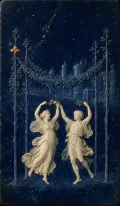
The Four of Wands shows a garland strung between the staves and figures dancing before a walled town. Beside the Ten it turns attention to the town ahead: the place where the load is set down and effort becomes something shared and enjoyed.
- Ten of Wands + Nine of Wands
The Nine of Wands stands upright inside a ring of staves, holding just one; the Ten walks bent under the whole bundle. Both figures wear a cloth bound round the head. Together they ask when holding on stopped protecting you and began to wear you down.
Questions to keep
- If you laid out everything you are carrying, which piece would you put down first?
- Which of these responsibilities did you choose, and which did you simply never refuse?
- Where is the small living spark in this effort, and how can you keep it visible?
Ask them with three cards ↗A three-card reading in which each position asks one of these questions.
A small practice
List everything you are carrying this week, then circle one item to hand on, postpone or decline, and take that step before the day ends.
Cards that share its symbols
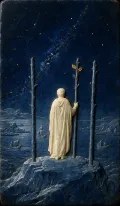 Three of WandsShares: The gold sprig · Glittering vein and stars · The fanned ivory wands · Two clutching hands
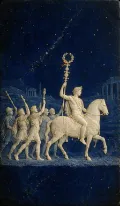 Six of WandsShares: The fanned ivory wands · The walled town ahead · The winding road · Glittering vein and stars
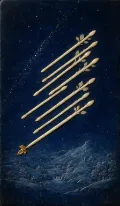 Eight of WandsShares: The fanned ivory wands · The gold sprig · Glittering vein and stars · The house left behind
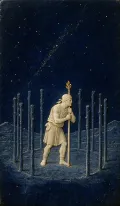 Nine of WandsShares: Glittering vein and stars · The gold sprig · Two clutching hands · The fanned ivory wands