Minor Arcana · Swords
Knight of Swords
Tarot card meaning: upright, reversed and the symbols of the Olivia image
The Knight of Swords is a thought at full gallop: sharp conviction, quick words and decisive action, asking whether your speed still serves your aim.
- Upright
- decisive actiondirectnesssharp focusconvictionspeed of thoughtcourage of mind
- Reversed
- hastescattered urgencyharsh wordstunnel visionrestless mind
Upright
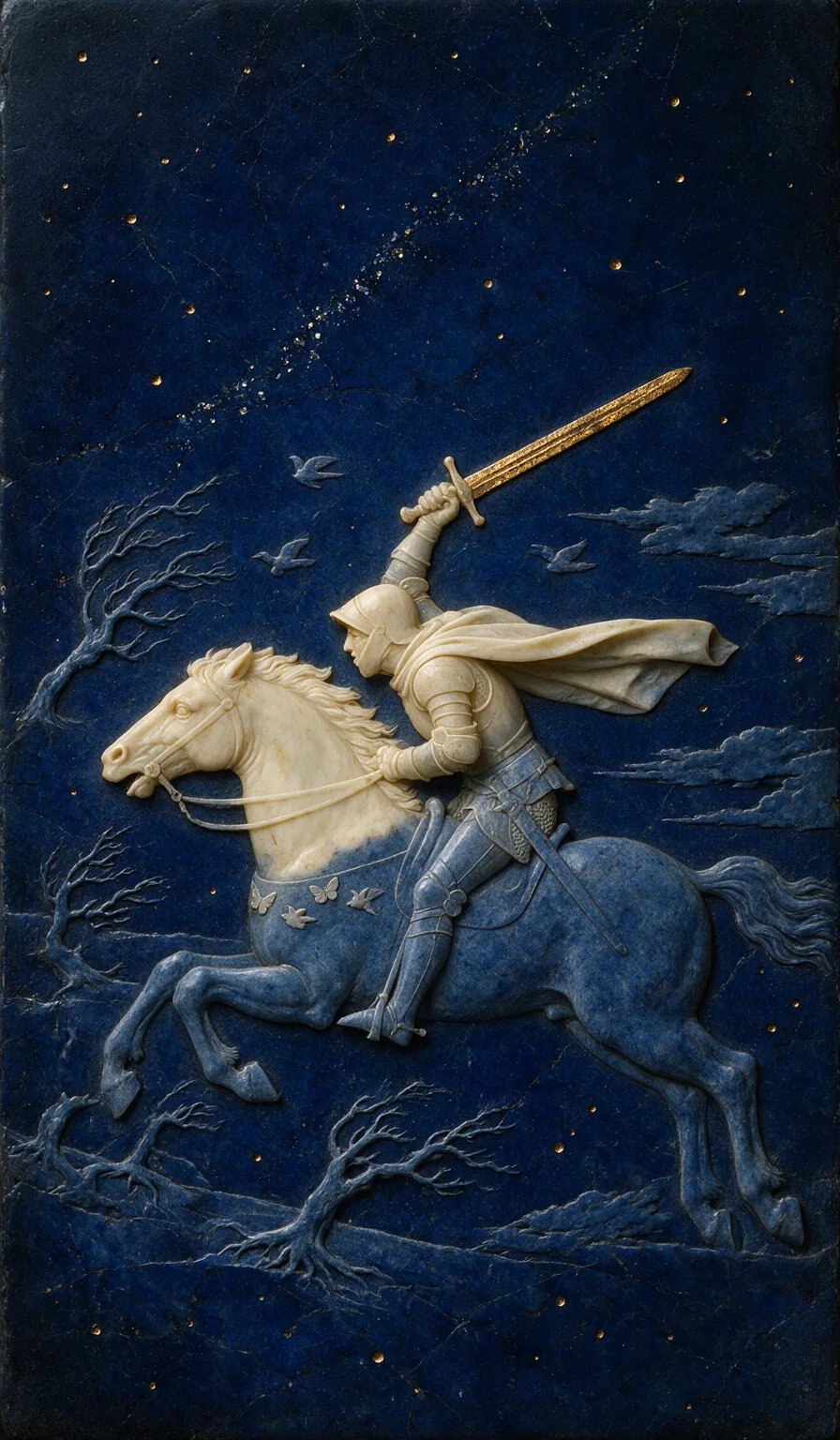
The Knight of Swords draws attention to a mind that has made itself up and is already moving. An idea, a principle or a truth you feel sure of has become action: you speak, you write, you decide, and you do it now. In Olivia’s carving the rider leans forward over the horse’s neck, the gilded blade raised and drawn back, the ivory cloak dragged straight out behind. Every line of the body points the same way.
Swords are the suit of Air, and this Knight is Air in motion: quick thinking, clear argument, the courage to name what others avoid. Look at the trees below the horse: bare, bent hard to the right by the wind, while the rider gallops left, straight into it. The card often turns attention to the energy it takes to hold a position against resistance, and to the clarity that makes that possible.
Upright, it invites you to trust a well-tested conclusion and act on it cleanly. It also asks one small thing before the charge: that the blade is aimed at a problem, not a person, and that the speed serves the purpose. Only the upper parts of horse and rider are ivory; everything below is still night-blue lapis. A quick look at what you have not yet seen is part of acting well.
Reversed
Knight of Swords reversed can point to a charge that has lost its target. The mind still races, but the energy scatters into urgency, argument or a string of quick decisions that do not add up to a direction. Words may come out sharper than the moment needs, or a conclusion may be defended simply because it was reached first.
Sometimes the reversal turns inward: a restless mind replaying the same case at night, running at full speed while going nowhere. This position invites you to rein in, not to stop. Loosen your grip on the sword for a moment, check your facts and your aim, and let someone else answer before you ride on.
Read the image
Every element below is carved into this card. Scroll, hover or press a number to follow it on the image.
The raised gilded sword
What you seeA long, straight gold blade with a central groove, raised high above the rider’s head and angled back toward the upper right; its crossguard with knobbed ends, grip and round pommel are ivory.
What it carriesThe sword is the emblem of Air: intellect, speech, decision and the cutting edge of truth. Raised and drawn back mid-stride, it is a thought about to become an act. Olivia gilds this blade alone among the carved objects, so the card’s worth rests on the idea itself, and on where it is aimed.
Follow this symbol through the deck ↗The helmeted, leaning rider
What you seeAn ivory figure in a rounded helmet, face in profile, leans over the horse’s neck, one fist on the reins, the other lifting the sword. From the waist down the armour is lapis, a scabbard hanging at the hip.
What it carriesKnights are the movers of each suit, carrying its element out into the world. The forward lean shows full commitment: the whole body follows the head. The helmet leaves the face open, so the charge stays a matter of one mind’s judgement rather than anonymous force.
The cloak streaming back
What you seeA heavy ivory cloak flies out behind the rider’s shoulders in long folds, its end curling open toward the right edge, between the two banks of wind-torn cloud.
What it carriesA cloak often speaks of shelter, warmth or concealment. Here it is pulled straight back by speed and wind, covering nothing. It makes momentum visible, and hints at what gets left behind at this pace: comfort, cover and perhaps a second look.
Follow this symbol through the deck ↗Horse of ivory and lapis
What you seeThe horse’s head, neck, mane and chest are ivory; from the shoulder the stone turns to blue lapis for body, legs and tail. Its mouth is open around the bit, both forelegs bent and lifted clear of the ground.
What it carriesThe horse carries the knight’s force and mirrors the rider’s temper. Here ivory is kept for the upper parts of horse and rider, and everything below turns to lapis, as if the thinking part leads while the rest still belongs to the night it rushes through.
Follow this symbol through the deck ↗Butterflies and birds on the chest
What you seeOn the lapis of the horse’s chest, just below a thin raised line curving across it, sit four small pale grey reliefs in a row: butterfly, bird, butterfly, bird, all with wings open.
What it carriesButterflies and birds are creatures of Air, and the traditional image commonly decorates this horse’s trappings with them as the suit’s signature. The butterfly also carries the old sense of psyche, the soul or mind. Their delicacy sits strikingly against the charge: lightness carried into battle.
Follow this symbol through the deck ↗Three birds in flight
What you seeThree small birds carved in pale grey-blue lapis cross the sky with wings spread: two to the left of the raised arm, one to the right, just below the line of the blade.
What it carriesBirds belong to the sky and so to the suit of Air: messages, thoughts in flight, news carried on the wind. Small and scattered, they show how quickly ideas travel here, and how a thought, once released, moves beyond your reach.
Follow this symbol through the deck ↗Wind-torn clouds
What you seeTwo banks of greyish-blue clouds are carved along the right side of the card, stretched into long horizontal streaks with ragged edges, as though dragged across the sky by a strong wind.
What it carriesClouds in the Swords suit usually mark the weather of the mind: unsettled, changing, sometimes obscuring. These are not heavy storm clouds but fast ones, pulled thin. They set the card’s tempo and suggest conditions that shift as quickly as the rider moves.
Follow this symbol through the deck ↗Bare trees bent by wind
What you seeLeafless trees in lighter blue lapis lean hard, their branches swept toward the right; the one below the horse grips the sloping ground with spread, exposed roots. The rider gallops the other way, toward the left.
What it carriesWind-bent trees are a traditional feature of this card, showing Air at full strength. Here they reveal something more: the rider charges straight into the wind, against the direction everything else is pushed. That is courage and resistance at once, and it costs effort.
Follow this symbol through the deck ↗Glittering vein across the sky
What you seeA long diagonal band of tiny pale, glittering mineral specks crosses the dark lapis from the upper right toward the left, high above the sword, among scattered gold star flecks.
What it carriesThis belongs to Olivia’s lapis sky, not to the traditional image. The band rises the same way the blade points, a path of light above the charge. It can be read as the wider view: the whole sky the rider does not stop to look at.
Follow this symbol through the deck ↗
The number
Knights stand second in the court sequence, after the Page and before the Queen and King. Where the Page receives and carries a message, the Knight acts on it: this is the rank of movement, pursuit and commitment to one direction. In Swords, the suit of Air, what moves is thought itself: an argument, a decision, a truth spoken aloud. Here the mind stops weighing options and chooses one, with all the force and all the risk that brings.
The tradition
In the Golden Dawn system the mounted court figure of Swords, which corresponds to the Knight of Waite and Smith’s deck, is titled the Lord of the Wind and the Breezes, King of the Spirits of Air. These mounted figures carry the fiery part of each suit, so this card is Fire of Air: the swiftest, most forceful expression of the element. It is given the zodiac from 20 degrees Taurus to 20 degrees Gemini, the last decan of Taurus and the first two of Gemini. Older Italian and Marseille decks show the Knight of Swords as an armoured rider. Pamela Colman Smith’s 1909 design set the rider at full gallop beneath wind-driven clouds and bent trees, and Waite described the charge as if scattering enemies.
As a temperament
- Temperament
- The Knight of Swords is the temperament of the swift, principled mind: the part of anyone that sees the point, names it and moves on it before the moment passes. It is impatient with fog and vagueness, happiest with a clear question, and ready to argue for what seems true.
- Gifts
- Its gifts are courage of speech and speed of decision. This quality cuts through confusion, defends an idea or a person when that is needed, and keeps a project from drowning in deliberation. Like the rider leaning into the wind, it can hold a line against real resistance.
- Shadow
- In shadow, the same drive rides over people and details. Words become weapons, certainty hardens before the facts are in, and speed turns into a way of avoiding doubt. The cloak streaming behind the rider is a reminder of how much gets left behind at full gallop.
Love, work and self
- Love
- In close relationships the Knight of Swords can point to honesty spoken quickly: a truth you need to say, a boundary you are ready to state, a conversation rehearsed until it feels urgent. It does not tell you how another person will hear it. It asks whether your words are aimed at the problem or at the person, and whether you are leaving room for a reply. With yourself, notice the inner voice that charges in with verdicts, and ask it to slow its horse.
- Work
- At work or in study, this card can reflect a phase of fast decisions, sharp analysis and the energy to push a stalled project forward. It suits debate, writing, presenting an idea or fixing a clearly defined problem. Before you commit, check the one assumption your plan rests on, and let colleagues catch up with your reasoning. Where money is involved, the card turns attention to your pace rather than to any particular choice.
- Self
- For your relationship with yourself, the Knight of Swords draws attention to the pace of your thinking. Notice when the mind runs ahead of the body, like the ivory head and chest of this horse leading a body still made of night-blue stone. Speed can feel like clarity without being it. Ask what you know, what you assume, and whether a short pause, a walk or a night’s sleep would make the charge cleaner.
In a spread
Read the card through each position before you look at Olivia’s version. A position is a question, and the same card answers each one differently.
The situation
What aspect of the situation deserves attention?
Olivia’s readingAt the centre of a question, the Knight of Swords points to a conviction that wants to become action, and to the speed and force with which you may be ready to move.
What complicates it
What tension or assumption deserves a closer look?
Olivia’s readingAs a challenge, the card can show haste outrunning understanding: a quick conclusion defended too hard, or sharp words that win the point and lose the conversation.
A helpful next step
What small action could help you understand or respond?
Olivia’s readingAs advice, it invites you to act on what you have clearly thought through, speak plainly, and check your aim once before you ride.
In conversation with
- Knight of Swords + Page of Swords
With the Page of Swords the pair traces a sequence in the suit: the alert student who watches, questions and tests an idea, then the rider who carries it at full speed. Together they ask whether your idea is ready for the charge.
- Knight of Swords + Knight of Pentacles
The Knight of Pentacles is traditionally the most unhurried of the knights. Beside the Knight of Swords the two show opposite paces, and together they draw attention to what in your situation needs speed and what needs steady ground.
- Knight of Swords + The Chariot
The Chariot also shows driven forward motion, held by will and balance rather than speed alone. With the Knight of Swords it turns attention toward direction: where your energy is going, and who is really steering.
Questions to keep
- What conclusion are you acting on, and when did you last check it?
- Where is your speed serving your purpose, and where is it replacing reflection?
- If your words were a blade, what exactly would you want them to cut?
Ask them with three cards ↗A three-card reading in which each position asks one of these questions.
A small practice
Before you send the message or make the call, write your aim in one line and read it aloud; then wait ten minutes and decide whether to ride.
Cards that share its symbols
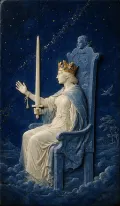 Queen of SwordsShares: The raised gilded sword · Butterflies and birds on the chest · Three birds in flight · Glittering vein across the sky · Bare trees bent by wind · Wind-torn clouds
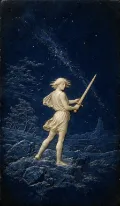 Page of SwordsShares: The raised gilded sword · Glittering vein across the sky · Wind-torn clouds · Three birds in flight · Bare trees bent by wind
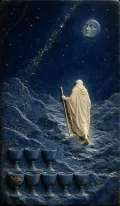 Eight of CupsShares: Glittering vein across the sky · The cloak streaming back · Bare trees bent by wind
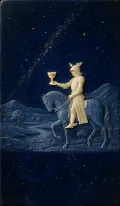 Knight of CupsShares: Glittering vein across the sky · The helmeted, leaning rider · Horse of ivory and lapis