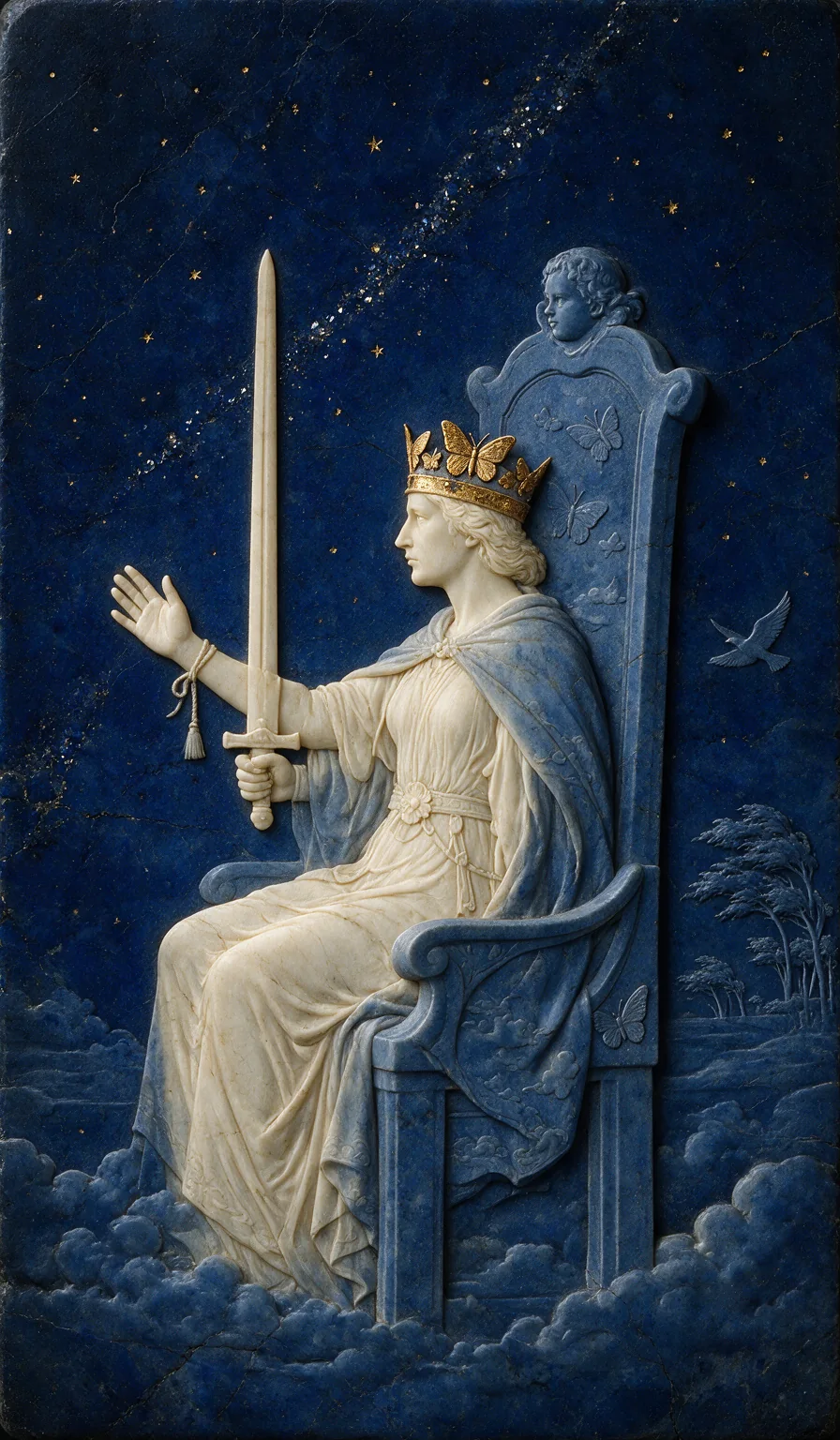
Minor Arcana · Swords
Queen of Swords
Tarot card meaning: upright, reversed and the symbols of the Olivia image
The Queen of Swords is clarity that has been earned: seeing plainly, speaking honestly and keeping a boundary without losing the open hand.
- Upright
- discernmenthonest speechclear boundariesindependenceperspective
- Reversed
- coldnesscutting wordsblurred boundariesguarded griefoverthinking
Upright
The Queen of Swords draws attention to a quality of mind that has been tested and come out clear. In Olivia’s carving the Queen sits in strict profile on a tall lapis throne, the ivory sword held upright in the fist so that its point rises above the crown. The blade does not threaten anyone. It marks a line: this is what is true, as far as it can be seen. The other hand is raised and open, a knotted cord with a tassel tied loosely at the wrist. Precision and candour are offered together.
The crown is made of gold butterflies, and more butterflies are carved into the throne behind. Air is the element of this suit, and butterflies live on it; they are also old images of the soul and of change. This Queen’s clarity did not arrive untouched. It grew through experience, some of it painful, and that is why it can be trusted. At the lower right, trees bend hard in the wind while the Queen sits still above the clouds.
Upright, the card asks you to separate what you know from what you fear or assume, and to say it simply. It can point to a boundary that needs naming, a conversation that needs one honest sentence, or a decision that becomes easier once you stop negotiating with your own doubts. Clear does not have to mean cold: keep the hand open.
Reversed
Queen of Swords reversed can show clarity that has turned sharp or turned inward. Words may cut more than the moment needs, or judgement may harden into a distance that keeps everyone, including you, at arm’s length. Sometimes the edge protects an old hurt that has not yet been spoken.
The reversal can also point the other way: a boundary blurred to avoid discomfort, or a mind circling the same thought without reaching a conclusion. Look again at the image. The sword is upright and the hand is open; both are needed. Ask what you actually need to say, then find the plainest, kindest way to say it, and notice where overthinking has taken the place of a simple decision.
Read the image
Every element below is carved into this card. Scroll, hover or press a number to follow it on the image.
The upright ivory sword
What you seeA long, straight ivory blade stands vertical at arm’s length ahead of the Queen’s face, its point rising higher than the crown; a closed fist grips it below a crossguard with a raised centre and flared ends, above a round pommel.
What it carriesThe sword is the suit’s emblem of air: thought, language, discernment and truth. Held perfectly upright, it is neither threatening nor lowered, a sign of judgement kept straight. Here it is held out in a closed fist, well ahead of the body, so clarity is actively held rather than set aside.
Follow this symbol through the deck ↗Crown of gold butterflies
What you seeThe Queen, in profile facing left, wears a gold-rimmed crown whose points are gold butterflies, one large at the front and smaller ones beside it, over curling ivory hair gathered at the nape.
What it carriesButterflies crown this Queen in the traditional image too: the soul, breath and transformation, creatures that live on air. In Olivia’s carving the crown is the one worked gold on the figure, so what is honoured here is a mind that has changed through experience.
Follow this symbol through the deck ↗Open hand, tasselled cord
What you seeThe other arm reaches forward at shoulder height, palm open and fingers raised; a knotted ivory cord is tied loosely around the wrist, its long end hanging down to a tassel.
What it carriesThe raised open hand is commonly read as invitation and candour: the Queen holds a blade yet offers an empty palm. The cord at the wrist, as in the traditional image, can suggest a tie or a grief that has been lived with and no longer binds.
Follow this symbol through the deck ↗The child’s head crest
What you seeA curly-haired child’s head carved in pale lapis crowns the top of the throne back, shown in profile and looking left, the same way as the Queen; no wings are visible.
What it carriesThe Golden Dawn gave this Queen a winged child’s head as a crest, and a winged cherub appears on the traditional throne. Here the child is wingless and faces where the Queen faces, as if an earlier, more innocent self keeps watch alongside adult judgement.
Follow this symbol through the deck ↗Butterflies on the throne
What you seeSeveral butterflies of different sizes are carved in shallow relief on the tall lapis throne back, scattered behind the Queen’s crown, head and shoulders; another rests on the side panel below the armrest.
What it carriesRepeated from crown to throne, butterflies make transformation the ground this Queen sits on, not only an ornament worn. Carved in the same greyed blue as the throne rather than gold, they are the quieter, settled form of the change the crown celebrates.
Follow this symbol through the deck ↗The lone bird
What you seeA single bird with outspread wings flies in the open night to the right of the throne, carved in grey-blue lapis, heading left towards the Queen’s back.
What it carriesBirds belong to air, and a single high-flying bird appears in the traditional Queen of Swords as an image of the free, far-seeing mind. Its solitude matches the Queen’s: independence and perspective gained partly by standing a little apart.
Follow this symbol through the deck ↗The glittering diagonal band
What you seeA band of fine sparkling flecks crosses the deep blue sky diagonally from the top edge above the throne down towards the left, passing behind the upper blade; gold stars are scattered around it.
What it carriesThe starry band is not part of the traditional image; it belongs to the night skies of Olivia’s deck. Here it crosses behind the raised blade, and a clear sky suits a Queen of clear seeing: the view opens when the weather of feeling settles.
Follow this symbol through the deck ↗Wind-bent trees
What you seeA stand of slender trees at the lower right is carved in dark lapis, their crowns blown sharply to the left and their trunks curving under the force of the wind.
What it carriesWind is the element of Swords made visible, and wind-blown trees appear elsewhere among the Swords court cards as a picture of unsettled thought. Here the trees bend while the Queen sits upright, so the card separates the turbulence around a situation from the steadiness of the one judging it.
Follow this symbol through the deck ↗Clouds beneath the throne
What you seeHeaped cumulus clouds carved in lapis fill the bottom of the card, rising around the ivory hem and the throne’s square legs; smaller clouds are cut into the blue cloak draped over the armrest.
What it carriesGrey cumulus clouds beneath the throne come from the Golden Dawn description of this Queen, and clouds recur throughout the suit as the weather of the mind. The throne rises out of them, and the cloak draped over its arm carries them too: thought acknowledged, not ruling.
Follow this symbol through the deck ↗
The number
Queens hold the inward mastery of their suit: the element lived as a way of being rather than a task to pursue. In Swords, the suit of air, that means mastery of thought and speech from the inside. After the Page’s watchful curiosity and the Knight’s headlong charge, the Queen has learned when a word is needed and when it is not. This mastery shows as discernment: telling fact from interpretation, and a boundary from a wall.
The tradition
In the Golden Dawn system this card is the Queen of the Thrones of the Air, Water of Air: the receptive, reflecting side of the element. Its zodiac span runs from 20° Virgo to 20° Libra, covering the decans of the Ten of Pentacles and the Two and Three of Swords. Book T describes a crowned Queen above grey cumulus clouds, crested with a winged child’s head, holding a drawn sword and a severed head. Pamela Colman Smith’s 1909 card keeps the upright sword and the clouds, shows an open, raised hand where Book T has the severed head, and decorates crown and throne with butterflies. Older Marseille decks show a crowned Queen holding a sword.
As a temperament
- Temperament
- As a temperament, the Queen of Swords is perceptive, direct and self-possessed. This way of being listens for what is actually being said, notices the gap between a claim and the evidence, and prefers a clear answer to a comfortable one. It is independent without being aloof, and it has usually learned its steadiness by living through something difficult.
- Gifts
- The gifts here are honest speech and clean boundaries: naming a problem without drama, giving feedback that helps, saying no without apology or punishment. This Queen can hold complexity, sort a tangled situation into what is known and unknown, and offer others a clear mirror when they are ready to look.
- Shadow
- In shadow, clarity becomes coldness or armour. You may judge quickly, keep feeling out of every conversation, or use accuracy as a way to stay unreachable. Old sorrow can sit behind a sharp tongue. The image offers a counterweight: the sword stays upright, but the other hand stays open.
Love, work and self
- Love
- In love and close relationships, the Queen of Swords asks for honesty spoken with care. It can point to a boundary that needs saying out loud, or to the relief of stating plainly what you want instead of hoping it is guessed. It also draws attention to how you speak to yourself: whether your inner voice is clear and fair, or quick to cut. Warmth and truth can share the same sentence.
- Work
- At work, in study and with money matters, this card favours clear thinking: reading the fine print, separating evidence from opinion, writing the email that says exactly what is needed. It can point to a role as editor, analyst or honest adviser. Consider where a plain question would save a week of assumption, and where you could state a limit on your time or scope without softening it into vagueness.
- Self
- For your own life, the Queen of Swords turns attention to the stories you tell about what has happened to you. Like the Queen looking straight ahead in profile, you might look at one situation directly and name it without exaggeration or dismissal. This card honours the independence that comes from knowing your own mind, and the tenderness that remains in someone who has been through sorrow and still keeps a hand open.
In a spread
Read the card through each position before you look at Olivia’s version. A position is a question, and the same card answers each one differently.
The situation
What aspect of the situation deserves attention?
Olivia’s readingAt the heart of a question, this card suggests the matter turns on seeing clearly and saying so: a truth to name, a boundary to set, or an assumption to test against the facts.
What complicates it
What tension or assumption deserves a closer look?
Olivia’s readingAs a challenge, it can show judgement grown too sharp or too distant, or a habit of analysing a feeling instead of letting yourself feel it.
A helpful next step
What small action could help you understand or respond?
Olivia’s readingAs advice, it invites one honest, precise sentence: say what you mean, distinguish what you know from what you guess, and keep your tone open enough to be heard.
In conversation with
- Queen of Swords + Justice
Justice also holds a sword upright, and Libra, the sign of scales, falls within this Queen’s zodiac span. Together they draw attention to fairness: a judgement that weighs the evidence and still remembers the person on the other side.
- Queen of Swords + Three of Swords
The Three of Swords sits within the Queen’s Golden Dawn span, and the pair links grief and clarity. The Three is the wound; the Queen is what can grow from having lived through it: perspective, honesty and a steadier voice.
- Queen of Swords + Queen of Cups
The Queen of Cups is Water of Water, feeling at its most receptive, beside this Queen’s Water of Air. Side by side they ask how feeling and clear thought can support each other in the same conversation.
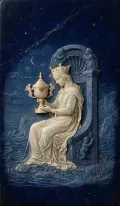
Also read withKing of SwordsAll pairs ↗
Questions to keep
- What do you actually know here, and what are you assuming or fearing?
- Which boundary could you state plainly without turning it into a punishment?
- Where has sharpness been protecting an old hurt that could now be spoken?
Ask them with three cards ↗A three-card reading in which each position asks one of these questions.
A small practice
Write one sentence that states a truth about your situation as plainly as possible, then read it aloud and adjust the tone until it is both clear and kind.
Cards that share its symbols
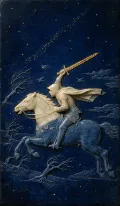 Knight of SwordsShares: The upright ivory sword · Butterflies on the throne · The lone bird · Clouds beneath the throne · Wind-bent trees · The glittering diagonal band
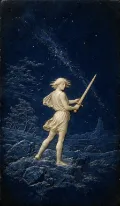 Page of SwordsShares: The upright ivory sword · The glittering diagonal band · Clouds beneath the throne · The lone bird · Wind-bent trees
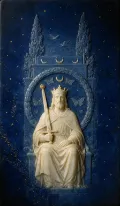 King of SwordsShares: The upright ivory sword · Crown of gold butterflies · Open hand, tasselled cord · Butterflies on the throne · The lone bird
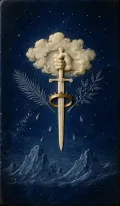 Ace of SwordsShares: Open hand, tasselled cord · The upright ivory sword · Crown of gold butterflies · The glittering diagonal band