Minor Arcana · Cups
Eight of Cups
Tarot card meaning: upright, reversed and the symbols of the Olivia image
The Eight of Cups turns attention to the moment when something built with care no longer nourishes you, and to the courage of looking for what does.
- Upright
- walking awayhonest dissatisfactionsearch for meaningoutgrowinginner pilgrimageletting go
- Reversed
- staying from dutyrestless leavingfear of changeunnamed longingdrifting
Upright
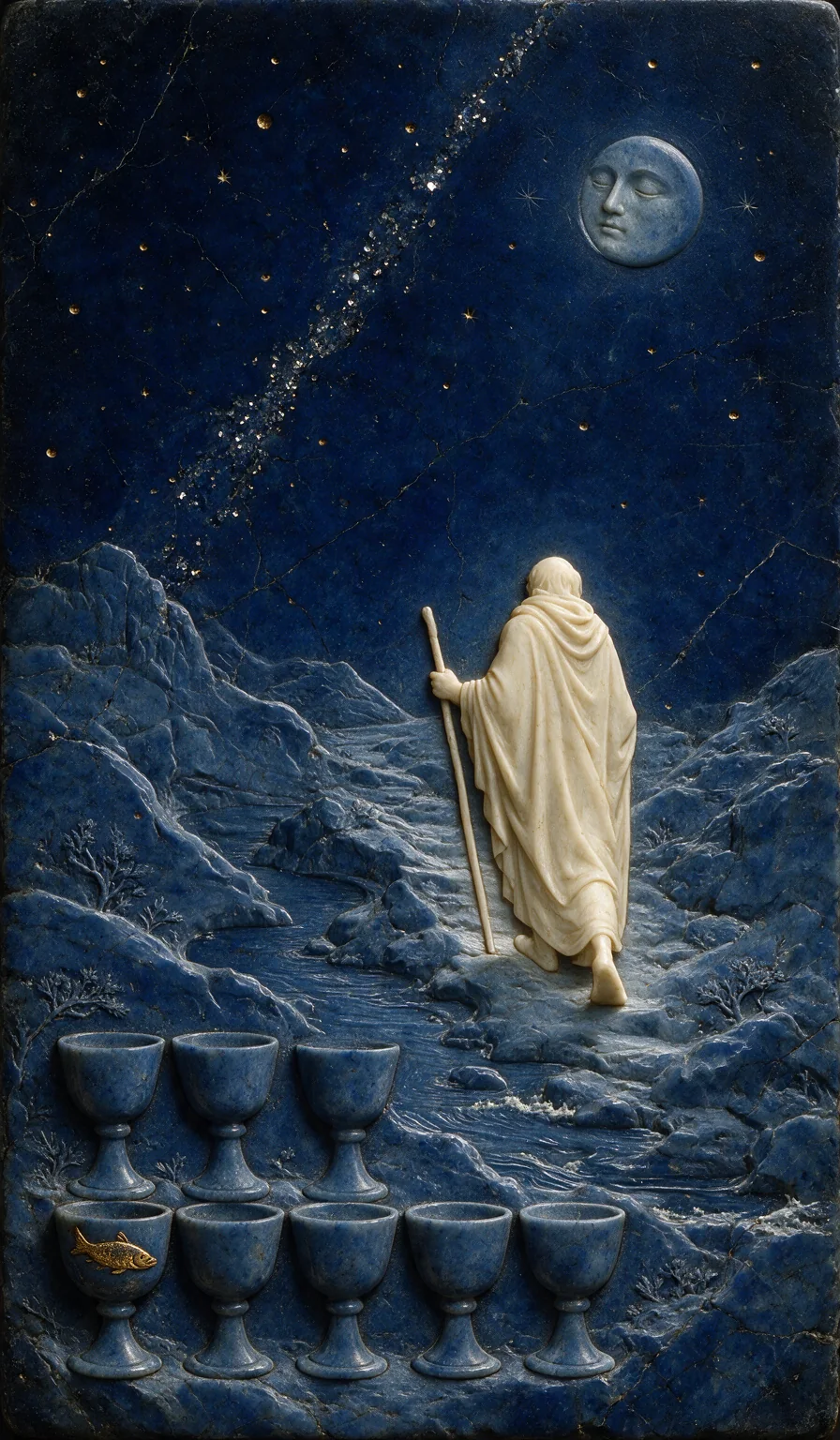
The Eight of Cups describes a turning point that rarely looks dramatic from outside. Eight cups stand in two neat rows at the foot of the card, carved from the same blue stone as the ground, whole and upright. Nothing has been spilled or broken. Yet the only ivory figure on the card has turned its back on them and is walking uphill into the night, staff in hand. This is the card of leaving something that still works, because working is no longer enough.
The upper row holds three cups and then stops; where more might stand, the river shows through. That gap is the quiet centre of the card: a sense that something is missing even when everything visible is in order. The Eight asks you to take that sense seriously enough to understand it, rather than argue yourself out of it or act on it in a rush.
Above the traveller, the moon has closed its eyes, and a band of glittering stars runs across the sky like a road. The search happens by night: without full clarity, guided more by feeling than by proof. Upright, the card can point to emotional honesty, the maturity to outgrow an arrangement, and a search for meaning that begins with one step rather than a finished plan.
Reversed
Eight of Cups reversed can point to a leaving that cannot quite happen, or one that happens too often. You may notice yourself staying beside the cups out of habit, duty or fear of the dark hills, while the sense of something missing grows quieter but not smaller. Or the opposite: walking away from each arrangement just as it asks for patience, so that nothing has time to become fulfilling.
In both forms the card turns attention inward. Before deciding to stay or go, try to name what you are searching for. Sometimes another attempt is wise because something has genuinely changed; sometimes the honest step is simply to admit the gap out loud, to yourself first.
Read the image
Every element below is carved into this card. Scroll, hover or press a number to follow it on the image.
The moon with closed eyes
What you seeHigh on the right hangs a full, round moon carved in pale greyish blue lapis. Its face is turned slightly toward the left, eyes closed and lips shut, with small star shapes incised in the sky around it.
What it carriesThe traditional image also gives this card a moon with a face, commonly read as an eclipse or a changing moon. Olivia shows a whole disc, asleep or inward. The traveller moves by night, without full daylight clarity, guided by feeling and quiet knowing rather than by proof.
Follow this symbol through the deck ↗The glittering road overhead
What you seeA band of glittering pale mineral crosses the dark ultramarine sky diagonally, from the top edge near the centre down toward the left-hand hills, among scattered gold star flecks.
What it carriesThe Milky Way is not part of the traditional card. In medieval tradition it was often called the Way of Saint James, the road pilgrims followed to Santiago. Here it runs above the traveller like a second path: the search has a direction, even when the ground is dark.
Follow this symbol through the deck ↗The hooded ivory traveller
What you seeThe only ivory figure on the card walks away from the viewer, up a rocky path. A hood covers the head and a heavy cloak falls in deep folds to the ankles. The feet are bare, one heel lifted mid-step.
What it carriesThe departing figure is the heart of the traditional image: someone leaving what they have built. Olivia’s traveller is hooded and barefoot, closer to a pilgrim than a wanderer. We never see the face, so the card asks you to supply the reason for leaving yourself.
Follow this symbol through the deck ↗The long walking staff
What you seeThe traveller grips a long, slender ivory staff in the right hand at chest height, its rounded knob above the hand and its foot planted on the rock just left of the walking feet.
What it carriesA staff also accompanies the traditional traveller. It belongs to pilgrims and hermits: support for a long road, carried by someone who means to keep going. It suggests that leaving here is considered and sustained, not a sudden flight from feeling.
Follow this symbol through the deck ↗Bare trees on the slopes
What you seeLeafless, finely branched trees are carved in low relief on the left-hand slopes and on the rocks to the right of the path, in the same blue lapis as the hills.
What it carriesThe traditional image shows a barren landscape; Olivia adds trees stripped to their branches. Bare trees belong to late autumn and winter: a season when outward growth pauses and life withdraws to the roots. The search on this card is a dormant season, not a failure.
Follow this symbol through the deck ↗The winding river
What you seeA river winds out of the hills on the left, runs behind the cups and breaks into white water over rocks at the lower right, between the cups and the traveller’s path.
What it carriesWater appears at the foot of the traditional image as well. Cups are Water, and here that water keeps moving past the cups rather than filling them. Feeling does not stay where it was poured; the river quietly separates what is kept from what is sought.
Follow this symbol through the deck ↗The gap in the row
What you seeThe upper row holds three cups on the left and then stops. In the space where more cups could stand, the river and its white water show through the carved rocks.
What it carriesThe traditional arrangement also leaves a space in the upper row, commonly read as what is missing. Here the gap opens onto moving water. Everything present is in order; what is absent is exactly the thing that sets the traveller walking.
Eight cups in two rows
What you seeEight stemmed cups, three in the upper row and five in the lower, are carved from the same blue lapis as the ground. All stand upright and unbroken, rims level, lined up close together.
What it carriesCups hold feeling, relationship and what nourishes you. Nothing here is spilled, unlike the Five of Cups. These are real achievements, neatly arranged; carved from the landscape itself, they read as something established. The card’s question is why something so orderly no longer satisfies.
Follow this symbol through the deck ↗The gold fish
What you seeOn the leftmost cup of the lower row a small fish in gold relief swims across the bowl, scales and fins detailed, facing right toward the river and the traveller.
What it carriesThe fish is Olivia’s addition. Fish belong to Water and to Pisces, the sign the Golden Dawn gave this card. Gold in this deck marks what is precious: even in the cups left behind, something living and valuable remains, and it faces the direction the traveller has taken.
Follow this symbol through the deck ↗
The number
Eight is the rank of movement after settling. The Seven’s many possibilities have been sorted, and the question now is what to do with what you know. In the Kabbalistic scheme used by the Golden Dawn, eights belong to Hod, Splendour, the sphere of reflection and discernment. In Cups, the suit of Water, feeling and relationship, that discernment turns on the heart itself: an honest review of what nourishes you and what has become routine. The Nine and Ten that follow speak of contentment; the Eight is the sorting that makes room for it.
The tradition
In the Golden Dawn system the Eight of Cups is the Lord of Abandoned Success. It rules the first decan of Pisces, Saturn in Pisces, and as an Eight it is placed in Hod within the suit of Water. Saturn’s heaviness in a fluid water sign is commonly read as the card’s tone: a success that has lost its savour. Aleister Crowley later titled his version Indolence. In Marseille-pattern decks the card shows only eight cups among formal ornament; the walking figure, the moon and the stacked cups with a gap come from Pamela Colman Smith’s 1909 design for the Waite-Smith deck.
Love, work and self
- Love
- In love and close bonds, the Eight of Cups draws attention to a relationship that looks complete on paper, every cup in its place, while something important feels absent. It does not tell you to leave. It asks for an honest account of what is missing, spoken first to yourself and then, if you choose, to the other person. The same applies to your relationship with yourself: a habit of self-care that once helped may now be kept only out of loyalty.
- Work
- At work or in study, the card can point to a role, project or course that you built carefully and still do well, yet no longer find meaningful. The stacked cups are real achievements; the gap in the row is real too. Consider what exactly has stopped nourishing you: the task, the pace, the people or the direction. Where money is part of the picture, the card speaks of meaning rather than figures: it asks what the effort is for, not what it is worth.
- Self
- For your inner life, the Eight is a pilgrim’s card. The traveller goes barefoot and hooded, carrying only a staff, under a moon with closed eyes. It suggests a time for turning inward, travelling light and letting feeling lead where logic has run out. A long walk, a quiet retreat or simply an evening without distraction can help you hear what the dissatisfaction is trying to say before you decide anything.
In a spread
Read the card through each position before you look at Olivia’s version. A position is a question, and the same card answers each one differently.
The situation
What aspect of the situation deserves attention?
Olivia’s readingAt the centre of your question, the Eight of Cups suggests that the real issue may be less what has gone wrong than what has quietly stopped mattering, and what you may now be looking for instead.
What complicates it
What tension or assumption deserves a closer look?
Olivia’s readingAs a complication, the card can point to difficulty leaving something familiar, or to a restlessness that walks away before understanding what is missing. Either way, the unnamed gap may make the choice harder.
A helpful next step
What small action could help you understand or respond?
Olivia’s readingAs advice, the Eight invites you to name what is missing in one honest sentence, then take one small step toward it, keeping the way back open while you learn more.
In conversation with
- Eight of Cups + The Hermit
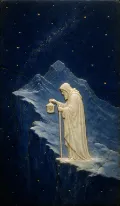
With The Hermit, a second hooded ivory figure with a staff stands alone in the night, lantern held out. Together they draw attention to a withdrawal that is chosen and purposeful: stepping away from the familiar to listen for your own guidance rather than to escape.
- Eight of Cups + The Moon
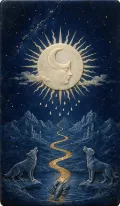
With The Moon, a moon with a face hangs above water and a path winding toward the mountains. The pair highlights a search made without full clarity, where intuition leads and it helps to move slowly and test each step.
- Eight of Cups + Four of Cups
With the Four of Cups, dissatisfaction appears twice: first as withdrawal beside cups that no longer appeal, then as the decision to walk on. Together they ask whether you are ready to act on a feeling you have been sitting with.
Also read withFive of CupsSeven of CupsKnight of CupsSix of SwordsAll pairs ↗
Questions to keep
- What is missing from this situation, even though everything visible seems in order?
- What are you searching for that the cups you have gathered cannot hold?
- What is keeping you here: your own choice, loyalty or fear of the dark road?
Ask them with three cards ↗A three-card reading in which each position asks one of these questions.
A small practice
Draw eight small cups on a page with a gap in the top row, and write inside that gap, in a few words, what feels missing right now.
Cards that share its symbols
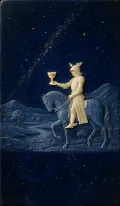 Knight of CupsShares: The glittering road overhead · Eight cups in two rows · The gold fish · The winding river
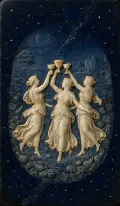 Three of CupsShares: Eight cups in two rows · The moon with closed eyes · The glittering road overhead
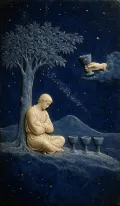 Four of CupsShares: Eight cups in two rows · Bare trees on the slopes · The glittering road overhead
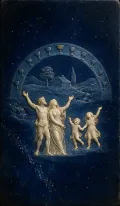 Ten of CupsShares: Eight cups in two rows · Bare trees on the slopes · The glittering road overhead