Minor Arcana · Swords
Page of Swords
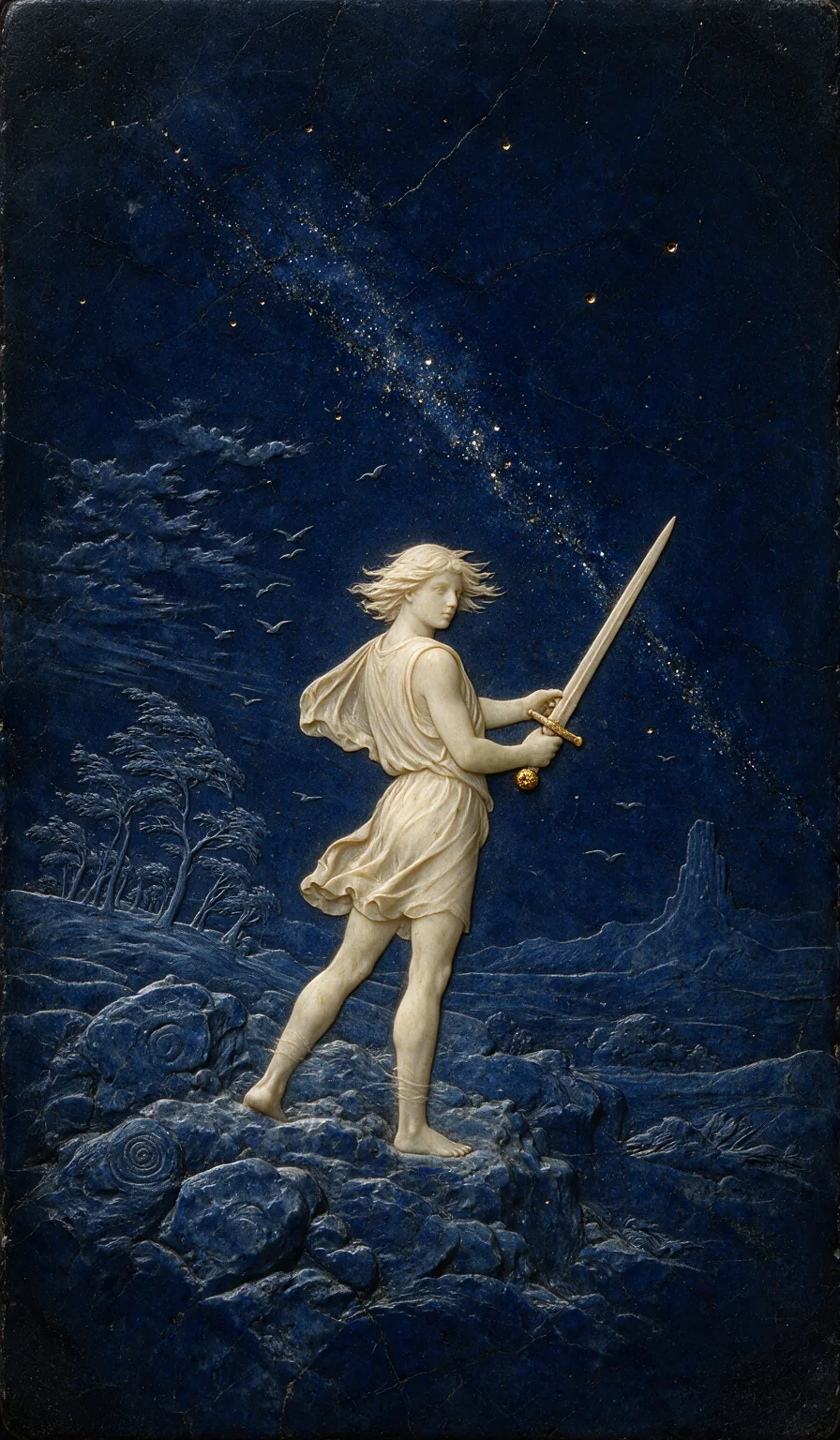
Tarot card meaning: upright, reversed and the symbols of the Olivia image
The Page of Swords is a quick, curious mind learning to hold a new idea: asking, testing and watching closely before it cuts.
- Upright
- curiosityalert attentionhonest questionsfresh ideascareful study
- Reversed
- hasty judgementgossipsuspicionscattered thinkinguntested ideas
Upright
The Page of Swords is the moment a mind wakes up to a question and wants to test it. In Olivia’s image the figure is caught mid-stride on rough lapis rock, barefoot, the back heel lifted and the front foot planted. Both hands hold the sword forward and up across the night sky, the gold crossguard between them, while the head turns sharply to the right. The whole body is attention: looking, weighing, ready to move.
Wind runs through everything. Hair, tunic hem and the drape at the shoulder stream out behind, trees on the hill bend, and birds scatter across a sky crossed by the glittering Milky Way. Swords are the suit of air and thought, and this card shows thought at its freshest: quick, restless, still unsure of its own strength. The blade is plain ivory; only the hilt is gold. What is valuable here is not yet the cut but the grip, the choice of how to hold a new idea.
Upright, the card invites curiosity with care. Ask the extra question, read the source, notice what does not fit the story you have been told. Keep your observations light enough to revise. Being new to a subject is no obstacle to seeing clearly; it can help you notice what others stopped seeing long ago.
Reversed
Page of Swords reversed draws attention to a quick mind running ahead of its footing. A question hardens into a verdict before the facts arrive, or sharp words go out faster than they can be checked. Curiosity can also turn toward other people’s business, so that watching becomes gossip or a search for flaws. Sometimes the movement goes inward: a thought is turned over so many times that it never reaches the page or the conversation it needs.
The image offers a practical correction: both feet find rock before the sword moves. Look for your footing first. Check where a piece of information came from, and ask whether you would say it directly to the person it concerns.
Read the image
Every element below is carved into this card. Scroll, hover or press a number to follow it on the image.
The ivory sword, gold hilt
What you seeA long, straight ivory blade with a faint central ridge slants up and to the right into the night sky. The crossguard and round pommel are gold; one hand grips above the crossguard, the other below it.
What it carriesSwords belong to air: thought, speech and the power to make distinctions. A Page’s sword is a learner’s tool. The traditional Page holds it upright; here it angles forward across the sky like a question pointed outward, and only the hilt, where the hands take hold, is gold.
Follow this symbol through the deck ↗The turned head
What you seeWhile the body is seen partly from behind, the ivory head turns into profile towards the viewer’s right, the gaze directed past the gripping hands. Short hair is tossed out on both sides by the wind.
What it carriesThe traditional Page glances about alertly, watchful of the surroundings. Olivia’s figure turns the whole face one way, which gives that watchfulness a focus: the attention of someone who has noticed something particular and wants to understand it before moving on.
The Milky Way and stars
What you seeA glittering band of pale flecks crosses the lapis sky diagonally from the upper left towards the lower right, passing behind the upper blade. Small gold points of pyrite are scattered around it.
What it carriesThe traditional Page stands under a daytime sky crowded with cloud. Olivia sets the scene at night, with the galaxy as a road of light. For the suit of air it suggests the wide field of possible thoughts, which the sword crosses as one chosen line of inquiry.
Follow this symbol through the deck ↗Windswept clouds
What you seeClouds carved in paler, greyer lapis gather on the upper left, their lower edges pulled out into long horizontal streaks, as though dragged sideways by a strong wind.
What it carriesClouds recur across the suit of Swords as the weather of the mind: moods, rumours, thoughts that gather and disperse. In the traditional image they pile up wildly around the Page. Here they are pushed to one side, leaving clear sky around the figure and the blade.
Follow this symbol through the deck ↗The scattered birds
What you seeSmall pale birds with outstretched wings, carved in light lapis, fly in a loose trail across the sky above the trees on the left, with a few more on the right near the horizon.
What it carriesBirds belong to air and are commonly read as messages, news and thoughts in flight; a flock is traditional on this card. Scattered rather than in formation, they suggest ideas and information arriving from several directions at once, not yet gathered into one clear message.
Follow this symbol through the deck ↗Wind-bent trees
What you seeA stand of slender trees grows on a hill at the left edge, carved in pale blue lapis, their thin trunks leaning and their feathery crowns tossed by the wind.
What it carriesTrees bending under wind appear in several Swords cards and show that air, unseen, moves real things. Beside the Page they measure the pressure of the moment: the same wind that tosses the branches and hair leaves the figure’s stance steady.
Follow this symbol through the deck ↗The distant pinnacle
What you seeOn the right horizon a single tall, narrow rock pinnacle rises from a plateau carved in low relief, standing apart from the flatter hills and plains around it.
What it carriesMountains in tarot often stand for goals, difficulty or the heights of abstract thought. This lone spire stands in the direction of the stride, a clear marker on the horizon: a question worth walking towards, still far off and not yet reached.
Follow this symbol through the deck ↗Bare feet on rock
What you seeBoth feet are bare. The back foot touches the rock only with its toes, heel lifted; the front foot is planted flat on rough, broken lapis. Fine thread-like strands wrap around both lower legs.
What it carriesThe traditional Page walks over rugged ground. Here the ground is broken rock and the stride looks deliberate. In the Golden Dawn scheme this court is the earthy part of air, and the grounded feet give a quick mind something solid to test its ideas against.
Follow this symbol through the deck ↗Spirals in the stone
What you seeTwo concentric spirals are incised into the boulders at the lower left, like ancient rock carvings; the lower one is larger, with more turns, and the upper sits on a rounded stone.
What it carriesSpirals are not part of the traditional Page of Swords; they are Olivia’s addition. An ancient carved motif, often read as growth that comes back to the same point at a new level, they sit well beneath a student whose thinking is still circling towards clarity.
Follow this symbol through the deck ↗
The number
Pages are the students of their suit and, traditionally, its messengers. In Swords, the suit of air, what they study is thought itself: words, arguments, news and the edge of a clear distinction. The Page holds the same blade the King wields from a throne, but holds it as a learner does, testing its weight and angle. This rank asks for beginner’s attention: noticing sharply, speaking honestly, and learning when a question is ready to become a statement.
The tradition
In the Golden Dawn system the Page is the Princess, and this card is titled the Princess of the Rushing Winds, Lotus of the Palace of Air. It is Earth of Air: the element beginning to settle into form. Princesses carry no zodiac span; Book T instead makes each the Throne of its Ace and sets it over a quarter of the heavens around the pole, for Swords the quadrant above Capricorn, Aquarius and Pisces. The Marseille pattern shows a Valet d’Épée, a standing attendant with a drawn sword. Pamela Colman Smith’s 1909 design gave the Page a raised sword, rugged ground, wind-driven clouds and a flock of birds.
As a temperament
- Temperament
- As a temperament, the Page of Swords is quick, watchful and inquisitive. This way of thinking notices details, asks why, and enjoys the first taste of a new subject. It moves easily between ideas and people, gathering information as it goes, and it is most alive when a problem has not yet been solved.
- Gifts
- The gifts here are sharp observation, candour and a readiness to learn in public. This Page can ask the obvious question others avoid, spot the inconsistency in a plan and carry a message clearly. Earth of Air gives the quality a practical turn: ideas that want testing, not only discussing.
- Shadow
- In shadow, alertness becomes suspicion and curiosity becomes intrusion. You may argue for the pleasure of winning, pass on what you have not checked, or keep watching a situation instead of stepping into it. The image offers a counterweight: the blade is raised high, yet nobody stands in its path.
Love, work and self
- Love
- In close relationships the Page of Swords asks for honest, curious conversation. You might ask a question you have been circling for weeks, or listen to an answer without preparing your reply. The card also turns attention to how information travels between you: messages read too quickly, tone guessed from a few words, checking in that slides into checking up. With yourself the same care applies: notice the stories you tell about your worth and ask where they came from.
- Work
- At work and in study this card favours research, first drafts, interviews, fact-checking and learning a skill from the ground up. It suits the stage where you gather information before committing to a plan. Ask the simple question in the meeting; test an assumption on a small sample before scaling it. In money matters it points towards reading the details and understanding the terms, and towards asking someone qualified where your own knowledge ends.
- Self
- For your own growth, the Page of Swords invites you to become a student of your own mind. Notice which thoughts arrive fast and loud, and which take longer to form. In the image the face, the stride and the blade all point the same way; you may find that your attention and your direction have drifted apart. A notebook helps: writing a thought down gives it somewhere to stand, like a bare foot on rock.
In a spread
Read the card through each position before you look at Olivia’s version. A position is a question, and the same card answers each one differently.
The situation
What aspect of the situation deserves attention?
Olivia’s readingAt the centre of your question, this card points to an open, alert mind: there may still be something here to learn, and the most useful move could be a better question rather than a quick answer.
What complicates it
What tension or assumption deserves a closer look?
Olivia’s readingAs a challenge, the Page of Swords can show haste in thinking: conclusions drawn from partial information, words sharpened before they are understood, or so much watching that you stop acting.
A helpful next step
What small action could help you understand or respond?
Olivia’s readingAs advice, gather one more piece of information before you decide. Ask a clear, open question, check a source you have been taking on trust, and let your first opinion stay provisional for now.
In conversation with
- Page of Swords + Ace of Swords
The Ace of Swords offers a single clear insight; the Page is the student learning to hold it, and in the Golden Dawn scheme its throne. Together they draw attention to a new idea in its first days, when it needs clarity and practice before confident use.
- Page of Swords + Knight of Swords
The Page tests the blade; the Knight of Swords charges with it. Side by side they draw attention to pace: whether a new line of thought needs more study or is ready for action, and what might be lost by rushing the step between them.
- Page of Swords + Justice
Justice weighs; the Page investigates. Together they point toward fair inquiry: gathering evidence before judging, hearing more than one side of a story, and letting what you find change your view when it honestly should.
Questions to keep
- What question about this situation have you not yet asked out loud?
- Where might you be treating a first impression as though it were a settled fact?
- Which source of information do you rely on without having checked it recently?
Ask them with three cards ↗A three-card reading in which each position asks one of these questions.
A small practice
Write down one belief you hold about your situation, then note one fact that supports it and one fact that would change it, and go and check the second.
Cards that share its symbols
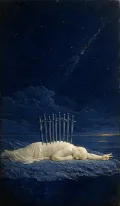 Ten of SwordsShares: The ivory sword, gold hilt · The turned head · Windswept clouds · The Milky Way and stars · Bare feet on rock
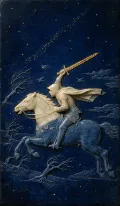 Knight of SwordsShares: The ivory sword, gold hilt · The scattered birds · Windswept clouds · Wind-bent trees · The Milky Way and stars
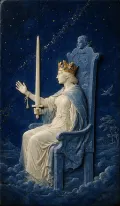 Queen of SwordsShares: The ivory sword, gold hilt · The scattered birds · The Milky Way and stars · Wind-bent trees · Windswept clouds
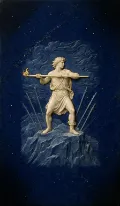 Seven of WandsShares: The turned head · Bare feet on rock · Windswept clouds · The Milky Way and stars