Minor Arcana · Cups
Knight of Cups
Tarot card meaning: upright, reversed and the symbols of the Olivia image
The Knight of Cups is feeling set in motion: the heart carried forward as an offering, at a walking pace, towards whatever it loves.
- Upright
- heartfelt offerromantic idealismimaginationsincere invitationgentle pursuitcreative inspiration
- Reversed
- moodinessunrealistic idealsstalled gesturesemotional driftdisappointment
Upright
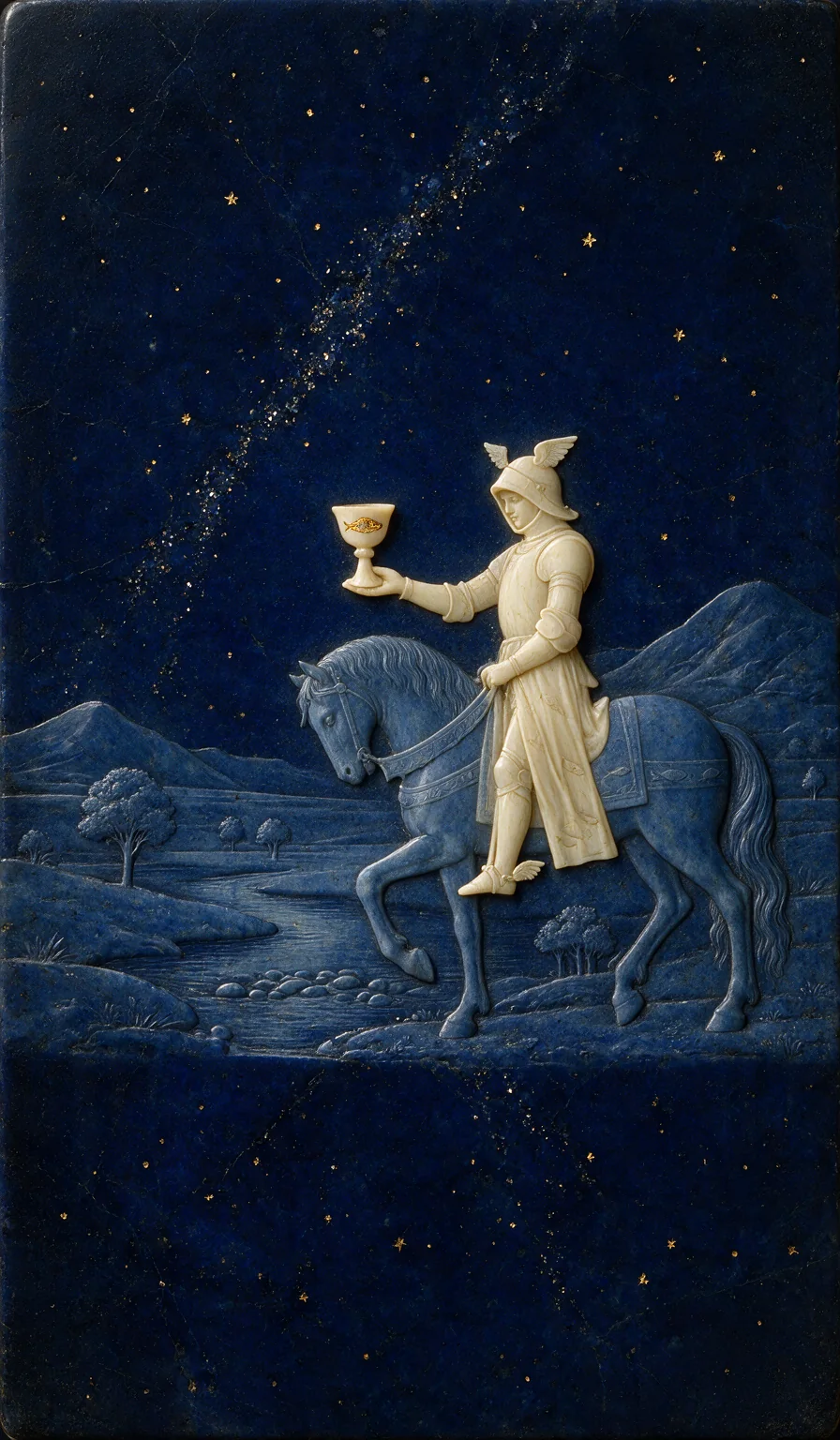
The Knight of Cups draws attention to the moment when a feeling becomes a gesture. In Olivia’s image the rider holds an ivory goblet out ahead on an open palm, as if bringing it to someone just beyond the edge of the card. A single gold fish shines on its bowl, one of the few touches of gold in the scene. The horse, carved in pale lapis, bows its head and lifts one foreleg in an unhurried walk towards a stream.
Upright, this card honours sincerity, romance and imagination that wants to be shared: an invitation, an apology, a proposal, a poem, a piece of work made with feeling. Fire of Water in the old system, it is emotion with momentum. It can point to a time to say what you feel, or to follow an idea that moves you, rather than keeping it safely inside.
Yet the details ask for care. The rider’s eyes are lowered, absorbed rather than watchful, and the cup rests on the palm instead of in a grip, so it could as easily be offered as spilled. The Knight invites you to carry your ideal gently and to notice what the person or situation in front of you is actually saying.
Reversed
Knight of Cups reversed can point to feeling that has drifted away from action. An ideal may have grown larger than the situation in front of you, so that no real gesture feels good enough to make; or a heartfelt offer may be stalling between imagining and doing. When reality differs from the scene you pictured, disappointment can turn into moodiness, withdrawal or a quiet retreat into daydreams.
It can also show charm running ahead of substance: warm words that are easier to give than to follow through. The image offers a counterweight. The horse keeps walking, one step at a time, towards a row of stones in the stream rather than a leap across the water. A smaller, real gesture can carry more than a perfect one that never leaves your hands.
Read the image
Every element below is carved into this card. Scroll, hover or press a number to follow it on the image.
The river of stars
What you seeA long diagonal band of glittering pyrite specks crosses the night sky from near the top edge, right of centre, down to the left, passing above and left of the raised cup before fading over the hills.
What it carriesMany cultures have called the Milky Way a river in the sky, and here it mirrors the stream on the ground below. For a court card of Cups, it sets the Knight between two waters: the dreamed and the actual. Olivia’s night setting adds this sky to the traditional daylight scene.
Follow this symbol through the deck ↗Winged helmet, head bowed
What you seeThe rider’s rounded ivory helmet has a brim, a guard framing the face and two small feathered wings rising from the crown; the face, in three-quarter view, looks down, not up at the cup.
What it carriesWings on the head belong to Hermes, the messenger between worlds, and Waite linked this Knight’s winged helmet to the higher graces of the imagination. The lowered gaze adds a quieter note here: an inward, listening rider, more absorbed in feeling than scanning the road ahead.
Goblet on the open palm
What you seeAn ivory goblet with a knopped stem rests on the flat of the rider’s outstretched hand, raised high above the horse’s bowed head; a single gold fish is inlaid on the bowl.
What it carriesThe cup is the suit’s vessel of feeling, and this Knight carries it as an offering rather than a weapon. Resting on an open palm instead of gripped by the stem, it is easy to give and easy to spill. Its gold fish is the brightest touch of gold in the scene.
Follow this symbol through the deck ↗Armour under soft cloth
What you seeBeneath the loose ivory tunic the rider wears plate armour: a rounded shoulder piece, a jointed elbow guard on the rein arm and a knee guard above a greave on the visible leg.
What it carriesKnights are traditionally armoured, and this one wears it under a soft, fish-patterned tunic and carries no weapon. Protection is present but covered by tenderness: the image of a heart that has some guard up, even while it rides out to offer itself.
The blue horse, head lowered
What you seeCarved in lighter, greyer lapis rather than ivory, the horse bows its head deeply, mane cut in flowing strands; a bridle crosses its face and a broad rein patterned with leafy scrolls runs back to the rider’s low hand.
What it carriesWaite noted that this Knight rides quietly, and the horse carries that mood. Here it is made of the same stone as the river and hills, as if the landscape of feeling itself were carrying the rider. Its bowed head reads as gentleness and patience, not charge.
Follow this symbol through the deck ↗Fish on cloth and tunic
What you seeSmall fish are carved along a lapis band crossing the horse’s flank and on the square saddlecloth beside it; fainter fish are scattered across the rider’s long ivory tunic, some tilted as if swimming.
What it carriesFish belong to water and to the imagination moving below the surface; the traditional Knight of Cups wears them on the tunic. Olivia repeats them on the saddlecloth, so rider and mount are both dressed in water. The feeling is not only carried here; it is worn.
Follow this symbol through the deck ↗The winged heel
What you seeThe rider’s foot, in a pointed ivory shoe fastened with a strap at the ankle, carries a small feathered wing at the heel, where a spur would usually sit.
What it carriesA wing where a spur belongs: this Knight is moved on by lightness rather than pressure. It echoes the wings of the helmet, framing the figure top and bottom with the messenger’s sign, and suggests that imagination sets the pace more than force of will.
Follow this symbol through the deck ↗The raised foreleg
What you seeThe horse’s near foreleg is lifted and bent at the knee, hoof hanging above the ground near the water’s edge, while the other three legs stand on the rocky bank.
What it carriesThis is a walking step, not a leap. Compared with the rearing or bounding horse of the traditional Knight of Wands, this one moves at the pace of feeling, one considered stride at a time. Movement is real but unhurried, and the step towards the water is still being weighed.
Follow this symbol through the deck ↗Stream and a row of stones
What you seeA stream winds from the far hills across the left of the scene towards the horse’s raised hoof, with a row of rounded stones lying across it just ahead; trees stand on the banks beyond.
What it carriesWater is the suit’s element, and in the traditional card the Knight approaches a river. Olivia adds a row of stones like stepping stones: a way across that asks for attention at every step. Deep feeling can be crossed, the image suggests, not with a leap but stone by stone.
Follow this symbol through the deck ↗
The number
Knights are the movement of their suit: the rank that pursues, travels and carries its element out into the world. After the Page of Cups, who first notices a feeling or an intuition, the Knight takes it somewhere. In Cups, the suit of water, love, imagination and relationship, that pursuit becomes courtship, creative inspiration and the offering of the heart. Before the Queen’s deep inner attunement and the King’s steady emotional authority, this rank shows feeling as a quest: sincere, romantic and still learning how to meet what is real.
The tradition
In the Golden Dawn system this card is titled the Lord of the Waves and the Waters, King of the Hosts of the Sea: Fire of Water. The Golden Dawn called its mounted court figure a King; the 1909 Waite and Smith deck renamed it Knight. Its zodiac span runs from 20° Aquarius to 20° Pisces, covering the decans of the Seven of Swords, Eight of Cups and Nine of Cups. Marseille decks show a Cavalier of Cups riding with a cup in hand. Waite described this Knight as graceful but not warlike, riding quietly, with a winged helmet pointing to the higher graces of the imagination. Waite’s divinatory notes include approach, proposition and invitation.
As a temperament
- Temperament
- As a temperament, the Knight of Cups is romantic, imaginative and led by feeling: the part of anyone that is moved by beauty, falls for an idea, and wants to bring something heartfelt to another person. This way of acting moves gently and sincerely, trusts mood and intuition, and would rather court than conquer.
- Gifts
- The gifts here are sincerity, tenderness and creative vision. This temperament can make an apology feel real, turn a feeling into a letter, a song or a design, and invite others into a warmer way of seeing. It brings grace to difficult conversations and the courage to show what matters instead of hiding it.
- Shadow
- In shadow, the ideal outruns the real. You may fall for a picture of a person or a plan rather than what is actually there, drift with passing moods, or offer more in words than you can give in practice. The image offers a counterweight: the horse walks slowly, and the stones in the stream invite a crossing one step at a time.
Love, work and self
- Love
- In love and close relationships, the Knight of Cups brings tenderness, romance and the wish to express what you feel: a note, an invitation, an honest word after a long silence. It asks whether you are offering the cup to the actual person or to an ideal of them, and whether your gesture leaves room for a reply you have not scripted. With yourself, it invites the same courtesy you would show someone you admire.
- Work
- At work, in study and with money, this card favours projects with feeling in them: creative proposals, writing, design, care work, anything that needs sincerity to land. It can point to an idea that moves you enough to pitch. Pair the inspiration with one practical step, a draft, a date, a budget checked with care, so the offering reaches someone rather than staying beautiful in your head.
- Self
- For your own life, the Knight of Cups turns attention to what moves you and how you carry it. Like the rider with lowered eyes, you may be listening inward: to longing, to a creative pull, to something you have not yet said. You might ask what you would bring if you rode out today, and let that offering be small, honest and actually given.
In a spread
Read the card through each position before you look at Olivia’s version. A position is a question, and the same card answers each one differently.
The situation
What aspect of the situation deserves attention?
Olivia’s readingAt the heart of a question, this card suggests the matter turns on a feeling that wants expression: an offer, invitation or creative idea perhaps already being carried forward, and how sincerely and realistically it is held.
What complicates it
What tension or assumption deserves a closer look?
Olivia’s readingAs a challenge, it can show idealism or moodiness getting in the way: waiting for the perfect moment or response, romanticising a situation, or letting a lovely intention stay in the imagination instead of becoming a gesture.
A helpful next step
What small action could help you understand or respond?
Olivia’s readingAs advice, it invites one sincere, concrete gesture: say what you feel, send the note, share the work, and carry it gently, like the cup on an open palm, leaving room for a real response.
In conversation with
- Knight of Cups + Seven of Cups
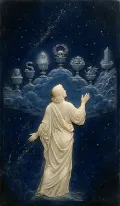
The Seven of Cups shows many visions floating in clouds; the Knight of Cups carries a single cup forward. Together they draw attention to the moment of choosing one ideal, and to whether it has been tested against ordinary life.
- Knight of Cups + Page of Cups
In Olivia’s Page of Cups a gold fish rises from a bowl held close and gazed at, a first surprise of feeling. The Knight lifts a gold fish on a raised goblet and carries it out. Together they show noticing becoming offering.
- Knight of Cups + Eight of Cups
The Eight of Cups falls within this Knight’s zodiac span, and there too a gold fish marks one cup; yet its traveller walks away from stacked cups by night. Together they contrast leaving what no longer fills you with carrying forward what still does.
Questions to keep
- What feeling or idea are you carrying right now that wants to become a real gesture?
- Who are you really offering your cup to: the person or situation in front of you, or an ideal of them?
- What would a smaller, sincere version of your perfect gesture look like this week?
Ask them with three cards ↗A three-card reading in which each position asks one of these questions.
A small practice
Write the offer, apology or invitation you keep imagining, then cut it to three honest sentences you could actually send or say this week.
Cards that share its symbols
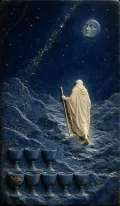 Eight of CupsShares: The river of stars · Stream and a row of stones · Goblet on the open palm · Fish on cloth and tunic
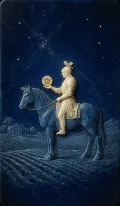 Knight of PentaclesShares: Winged helmet, head bowed · The blue horse, head lowered · Armour under soft cloth · The river of stars
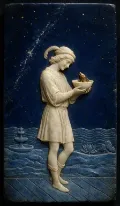 Page of CupsShares: Fish on cloth and tunic · Goblet on the open palm · The river of stars
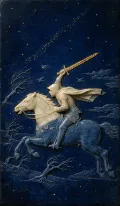 Knight of SwordsShares: Winged helmet, head bowed · The blue horse, head lowered · The river of stars