Minor Arcana · Pentacles
Knight of Pentacles
Tarot card meaning: upright, reversed and the symbols of the Olivia image
The Knight of Pentacles is steady, patient effort: the unhurried work that prepares the ground, keeps its word and trusts slow results.
- Upright
- patiencereliabilitysteady effortmethoddiligencegroundwork
- Reversed
- inertiarigid routinestagnationboredomperfectionismexcess caution
Upright
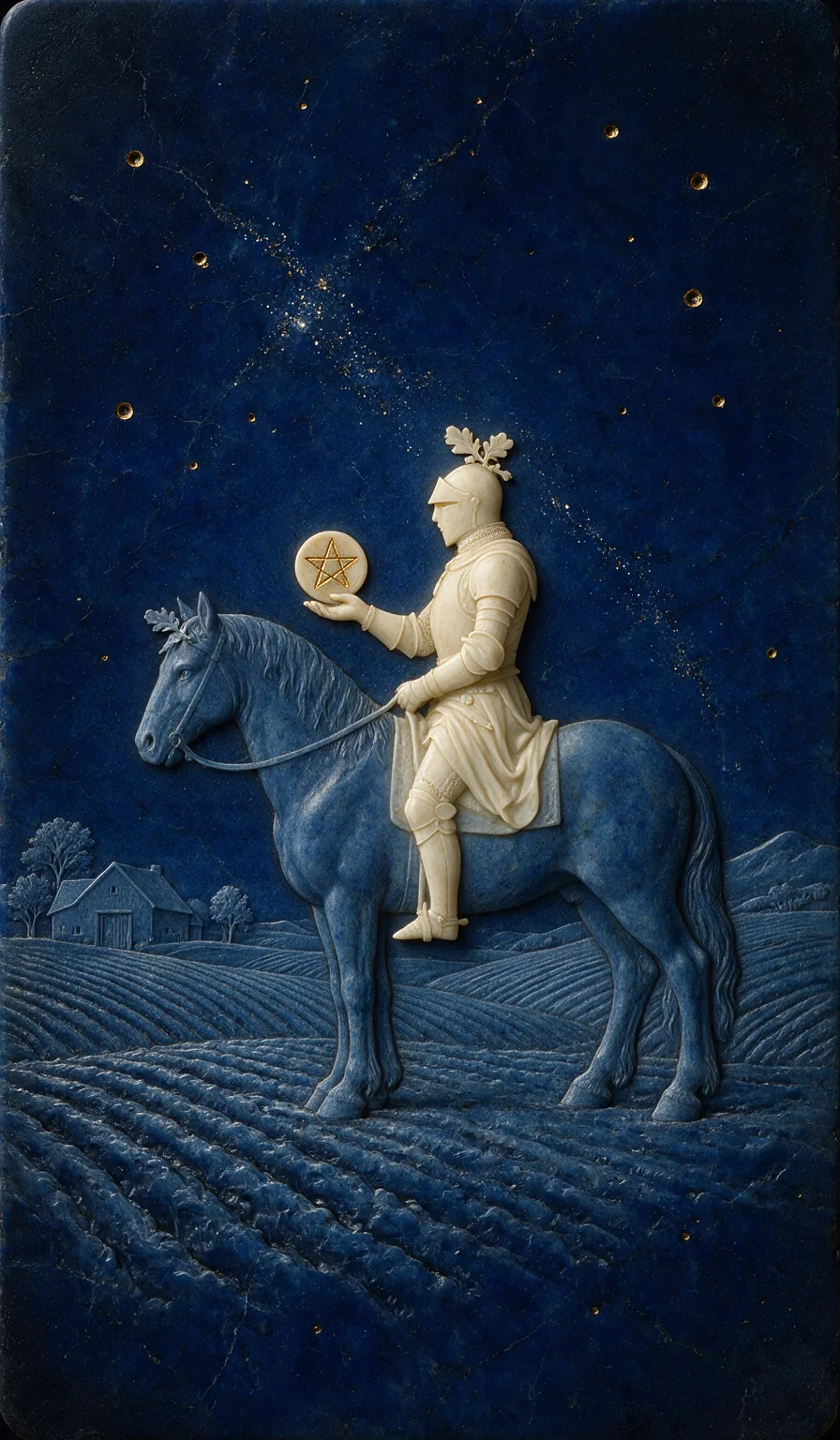
The Knight of Pentacles draws attention to work that moves at the pace of the ground itself. Where the other knights of the tradition ride out, this horse stands still: all four hooves rest flat on the furrows, the reins hang in a slack curve and the rider sits upright, holding the gold-starred disc out on an open palm as if weighing it. Nothing is being chased. Something is being considered, carefully, before the next row is worked.
Pentacles are the suit of earth: bodies, homes, money, time and skill. This Knight carries that element as persistence. In Olivia’s carving the furrows fill the lower third of the card, ridge after ridge, land prepared but not yet green. The work they describe is repetitive and mostly unseen, the kind whose results arrive a season later. A farmhouse at the field’s edge shows who it is for: a household, a store, a place to come back to.
Upright, the card invites you to trust the dependable part of yourself: the part that shows up, does the next unglamorous step and keeps going when no one is watching. It favours a commitment small enough to keep and clear enough to check. Oak leaves crown both the helmet and the horse’s bridle, the tree of slow growth. The card asks what in your situation deserves that kind of patience, and whether you can give it without hurry.
Reversed
Knight of Pentacles reversed can point to steadiness that has slowed into inertia. The horse still stands, but no longer because the ground is being read; it stands because moving has begun to feel harder than staying. A routine may be followed so faithfully that no one asks whether it still serves the goal it was built for, or caution may keep a finished plan waiting for one more check.
Sometimes the reversal shows the opposite strain: dependable effort pushed to exhaustion, or perfectionism that makes every task twice as long. Look at the spur fixed to the rider’s heel. It is there to be used, gently, when the moment asks for it. Review your method as you would any tool, and change the one part that has stopped working.
Read the image
Every element below is carved into this card. Scroll, hover or press a number to follow it on the image.
The pentacle on an open palm
What you seeAn ivory disc inlaid with a gold five-pointed star, drawn in a double line, rests upright on the rider’s flat, upturned palm, held out at chest height toward the horse’s head.
What it carriesThe pentacle is the suit’s emblem of earth: body, money, time, skill and anything built up by effort. It is the only gold carved on the figure. Balanced on an open hand rather than gripped, it reads as something weighed and considered, a task examined before a single step is taken.
Follow this symbol through the deck ↗The lowered visor
What you seeThe rider’s rounded ivory helmet has its visor lowered over the eyes, leaving nose, mouth and chin bare above a collar of fine mail; the face is in profile, turned toward the disc.
What it carriesHelmets in the court cards speak of readiness and protection. This one is closed over the eyes yet open at the mouth, and the head inclines toward the pentacle rather than the road ahead. Attention is fixed on the work in hand: steady, and a little shut off from everything around it.
Oak sprigs, helmet and bridle
What you seeA sprig of lobed ivory oak leaves rises from the crest of the helmet; a matching sprig in a paler, greyer tone is tucked into the horse’s headstall just in front of its ears.
What it carriesThe traditional image decks helmet and bridle with sprigs of greenery, the living growth this Knight serves. Olivia carves them clearly as oak, the tree of slow growth and long endurance, so rider and horse wear the same emblem: one pace, one purpose.
Follow this symbol through the deck ↗Reins held low and loose
What you seeThe rider’s other ivory hand rests at waist height, just above the saddle, holding thin blue reins that sag in a soft curve along the neck to the bit.
What it carriesA knight’s reins usually show how hard the rider drives. Here there is no pull at all: the horse is neither urged on nor held back, only kept. It is control without strain, the ease of knowing exactly how fast this ground needs to be crossed.
Follow this symbol through the deck ↗The heavy, standing horse
What you seeA thick-necked, broad-bodied horse carved in mottled lapis stands side-on facing left, ears pricked; all four hooves rest flat on the furrows and its long tail hangs straight down.
What it carriesThe other knights of the tradition ride out, even the Knight of Cups at a walk; this horse is traditionally heavy and still. Olivia keeps it planted and carves it in the same lapis as field and sky, so its strength seems drawn from the land it stands on.
Follow this symbol through the deck ↗Armoured leg and spur
What you seeBelow the ivory skirt, in front of a plain square saddle cloth, the rider’s leg shows mail at the thigh, then plate from knee to pointed foot; a small spur juts from the heel.
What it carriesPlate armour speaks of protection and of a long engagement rather than a skirmish. The spur is a knight’s tool for speed, and it is here, fixed and ready, yet the horse stands. The capacity to hurry exists; this card chooses not to use it.
The farmhouse at the field’s edge
What you seeOn the far left, beyond the furrows, a gabled farmhouse with a chimney, small windows and wide double doors stands in pale lapis among leafy trees, two to its left and one to its right.
What it carriesThe traditional image centres on the ploughed field; Olivia sets a dwelling at its edge. It gives the Knight’s labour an address: the work serves a household, a store for winter, a place people return to. Reliability becomes something others live inside.
Follow this symbol through the deck ↗The ploughed furrows
What you seeDeep, regular furrows carved in the lapis curve across the whole lower third of the card, ridge after ridge, with finer rows rolling back toward the hills; the horse stands directly on them.
What it carriesThe ploughed field is the traditional ground of this Knight: land prepared but not yet harvested. Nothing grows here yet; the work is slow and mostly invisible. Olivia gives the furrows the whole lower third of the card, so preparation takes up more of the image than the rider does.
Crossing veins of light
What you seeTwo diagonal bands of tiny glittering mineral specks cross high in the dark lapis sky, up and to the left of the rider, forming a loose X among scattered round gold star flecks.
What it carriesThis belongs to Olivia’s lapis sky rather than to the traditional image. Two paths of light cross overhead while the rider looks only at the disc. They can stand for the wider view: the larger pattern a steady worker keeps in mind, or forgets to look up at.
Follow this symbol through the deck ↗
The number
Knights stand second in the court sequence, after the Page and before the Queen and King. Where the Page studies the suit and carries its message, the Knight acts on it: this is the rank of movement, pursuit and commitment to one direction. In Pentacles, the suit of earth, movement takes the form of persistence. This Knight pursues a goal the way a farmer does, by returning to it daily. Progress is measured in finished rows, not in miles ridden.
The tradition
In the Golden Dawn system the mounted court figure of Pentacles, which corresponds to the Knight of Waite and Smith’s deck, is titled the Lord of the Wild and Fertile Land, King of the Spirits of Earth. The mounted figures carry the fiery part of each suit, so this card is Fire of Earth: the active, working force within matter. Its zodiac span runs from 20 degrees Leo to 20 degrees Virgo, covering the decans of the Seven of Wands and the Eight and Nine of Pentacles. Older Italian and Marseille decks show the Knight of Coins as a rider with a single coin. Pamela Colman Smith’s 1909 design set this Knight apart from the other three: a heavy horse standing still above ploughed land.
As a temperament
- Temperament
- The Knight of Pentacles is the temperament of steady application: the part of anyone that finishes what it starts, checks the details and prefers a proven method to a bright idea. It moves slowly on purpose, weighing a task the way the rider weighs the disc, and rarely takes on more than it can carry.
- Gifts
- Its gifts are reliability, stamina and care for the unglamorous parts of work: maintenance, records, practice, the next row of the field. Others can build on this quality because it does what it said it would. It turns large aims into routines, and routines into results that last.
- Shadow
- In shadow, patience stiffens into stubbornness and caution into delay. The method becomes the point, change feels like a threat, and work continues long after anyone has asked what it is for. The lowered visor is a reminder that focus can close off the view as easily as it sharpens it.
Love, work and self
- Love
- In close relationships the Knight of Pentacles speaks of love shown through consistency: turning up when you said you would, remembering the small practical things, building trust one ordinary week at a time. It does not describe what another person feels. It asks whether your reliability is also warm, and whether routine leaves room for surprise. With yourself, it can mean keeping small commitments to your own body and rest as faithfully as you keep them for others.
- Work
- At work or in study, this card can reflect a phase of patient, methodical effort: practising a skill, maintaining a system, drafting and redrafting, building something week by week rather than chasing a quick result. It suits long projects whose progress is hard to see. Keep a simple record of rows finished, so the work becomes visible. In money matters, it draws attention to careful planning rather than bold moves; decisions with real stakes belong with a qualified adviser.
- Self
- For your relationship with yourself, the Knight of Pentacles draws attention to pace. Some things in you grow like oak rather than like grass, and cannot be hurried by effort or worry. Notice where you are asking for fast results from slow work. Notice too where steadiness has become a way of avoiding a decision. The rider holds the disc out in the open: look plainly at what you are tending.
In a spread
Read the card through each position before you look at Olivia’s version. A position is a question, and the same card answers each one differently.
The situation
What aspect of the situation deserves attention?
Olivia’s readingAt the centre of a question, the Knight of Pentacles points to a matter that moves through steady, repeated effort: groundwork, maintenance and a commitment kept one ordinary day at a time.
What complicates it
What tension or assumption deserves a closer look?
Olivia’s readingAs a challenge, the card can show a pace that has become too slow for the situation, or a method followed so faithfully that it no longer fits the ground you are on.
A helpful next step
What small action could help you understand or respond?
Olivia’s readingAs advice, it invites you to choose one small, clear task and do it thoroughly, then repeat it tomorrow, trusting accumulation over speed.
In conversation with
- Knight of Pentacles + Knight of Swords
With the Knight of Swords the court’s two extremes of pace meet: one rider is traditionally shown charging into the wind, the other stands on ploughed earth. Together they ask what in your situation needs quick decision and what needs time to settle.
- Knight of Pentacles + Seven of Pentacles
The Seven of Pentacles traditionally shows a figure pausing over a crop that is already growing. Beside this Knight, who stands over furrows not yet green, the pair traces the long middle of any real effort: preparing, tending and waiting for results to show.
- Knight of Pentacles + The Hermit
The Hermit is attributed to Virgo, the sign that fills most of this Knight’s zodiac span in the Golden Dawn system. Both figures are solitary and unhurried; together they draw attention to careful work done quietly, without an audience.
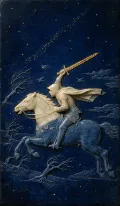
Also read withKnight of WandsPage of PentaclesAll pairs ↗
Questions to keep
- What is one commitment small enough that you could keep it every day this month?
- Where has a reliable routine quietly stopped serving the goal it was built for?
- Which part of your work is still underground, and what would help you trust it?
Ask them with three cards ↗A three-card reading in which each position asks one of these questions.
A small practice
Choose one task you have been postponing and give it fifteen unhurried minutes at the same time each day this week, marking each session with a single stroke.
Cards that share its symbols
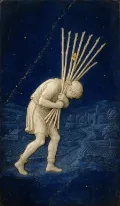 Ten of WandsShares: Oak sprigs, helmet and bridle · Reins held low and loose · The farmhouse at the field’s edge · Crossing veins of light
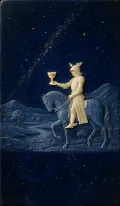 Knight of CupsShares: Crossing veins of light · The lowered visor · Armoured leg and spur · The heavy, standing horse
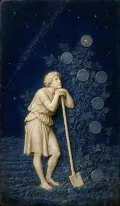 Seven of PentaclesShares: The pentacle on an open palm · Reins held low and loose · Oak sprigs, helmet and bridle · Crossing veins of light
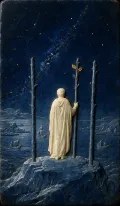 Three of WandsShares: Oak sprigs, helmet and bridle · Crossing veins of light · Reins held low and loose