Minor Arcana · Pentacles
Seven of Pentacles
Tarot card meaning: upright, reversed and the symbols of the Olivia image
The Seven of Pentacles is the pause inside long work: leaning on the tool, looking honestly at what has grown, and choosing where your care goes next.
- Upright
- patienceassessmentlong-term effortcultivationtaking stockslow growth
- Reversed
- impatiencerestless checkingstalled effortdrifting on habitunclear return
Upright
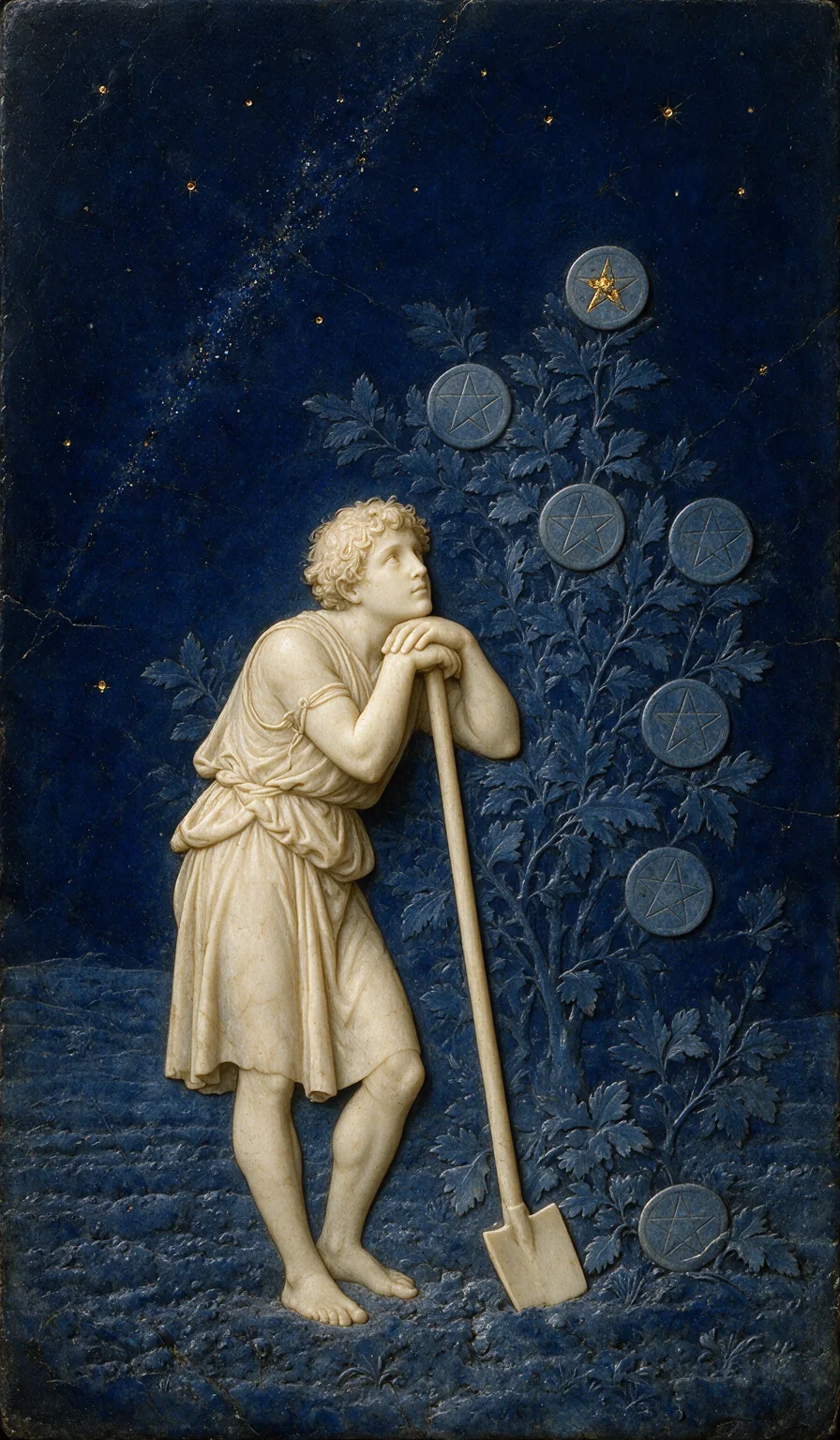
The Seven of Pentacles draws attention to the moment in any long effort when you stop working and look. In Olivia’s carving an ivory figure in a short tunic leans on a long-handled spade, both hands stacked on the top of the shaft and the chin resting on them. Beside the figure a tall bush of pale-blue leaves has grown higher than the figure’s head, and seven pentacles sit among its branches and at its root. The labour has clearly happened; the ground underfoot is dug and furrowed.
What is unusual here is the gaze. The figure is not bent over the crop but looking up and to the right, towards the higher discs, and the highest of them, above the last leaves, carries a star picked out in gold. It is the only gilded disc on the plant. The card holds both halves of patience in one image: the honest reckoning of what has grown so far, and the longing for the result that is not yet within reach. Neither is wrong, but they are different activities, and it helps to know which one you are doing.
Upright, the Seven asks for a fair review rather than a verdict. It can point to a project, a skill, a relationship or a savings habit that has had real care and now needs to be looked at plainly: what is thriving, what has cost more than it returned, what simply needs more time. Tiny seedlings carved along the bottom edge are a reminder that another crop is already started. Rest here is part of the work.
Reversed
Seven of Pentacles reversed can show the pause going wrong in one of two directions. Impatience may pull you to check the plant every hour, dig up what has barely rooted, or abandon an effort because the gilded result at the top has not yet arrived. Or the pause stretches into drift: leaning on the spade so long that the review never happens and the same work continues out of habit.
Both are hard to see from the inside. Look again at the disc at the root of the bush: something has usually come in already, even if it is smaller than hoped. Choose one fair measure and a date to look again, and let that date, rather than your mood on a given day, decide whether to keep tending, change the crop or rest.
Read the image
Every element below is carved into this card. Scroll, hover or press a number to follow it on the image.
The gilded top pentacle
What you seeAt the crown of the bush, higher than every other disc, one grey-blue pentacle carries a five-pointed star outlined and partly filled in gold; the six discs below it show only incised stars.
What it carriesThe pentacle is the suit’s coin and seed: earth, body, resources and the value of work. Gilding only the highest disc is Olivia’s own touch. It reads as the result still ripening at the top of the plant, the part of the harvest that is visible and wished for but not yet within reach.
Follow this symbol through the deck ↗Five plain discs
What you seeFive grey-blue discs, each incised with an outlined pentagram, sit at different heights among the branches, clustered near the top and trailing down the right side of the bush.
What it carriesThe pentacles grow on the plant like fruit, which is the card’s central image: value that has to mature in its own season. Scattered unevenly rather than set in a pattern, they suggest a crop at different stages, some parts of the work further along than others.
Follow this symbol through the deck ↗The upturned gaze
What you seeThe curly-haired ivory figure tilts the head back, chin propped on the hands, and lifts the eyes up and to the right, towards the higher discs and the top of the bush.
What it carriesThe traditional worker is commonly shown looking at the crop, measuring it. Here the look is lifted upward, closer to hope or wondering than inspection. It invites you to notice whether you are assessing what has grown or gazing at what you still want.
Hands folded on the handle
What you seeBoth hands are stacked on the top end of the long ivory handle, and the figure’s chin rests on them, so the weight of the upper body leans onto the tool.
What it carriesLeaning on the tool is the classic gesture of this card: work set down for a moment, not abandoned. The resting chin adds tiredness and thought together. It is the pause in which effort becomes review, and the body is allowed to stop before deciding what comes next.
Follow this symbol through the deck ↗The long-handled spade
What you seeAn ivory spade with a long straight shaft runs diagonally from the figure’s hands down to the right; its flat blade, narrowing to a blunt point, is set into the soil beside the bush.
What it carriesThe traditional worker leans on a hoe. Olivia gives a spade, the tool for digging and planting, and its blade touches the ground rather than hanging idle. The work that produced this crop is close at hand, ready to be taken up again or put away.
Follow this symbol through the deck ↗The tall pale-blue bush
What you seeA branching bush carved in lighter lapis rises from the soil at the right to above the figure’s head, its stems covered in deeply cut, serrated leaves; a smaller sprig grows behind the figure’s back.
What it carriesThe plant is the long investment itself: something that grew slowly from ground that was worked. Traditionally it is green; here it is carved from the same blue stone as the night, only paler, a living thing half merged with its background, as growth often is when you are standing close to it.
Follow this symbol through the deck ↗The disc at the root
What you seeThe seventh pentacle sits low at the base of the bush, almost on the soil, framed by leaves a short distance to the right of the spade blade.
What it carriesSet apart from the six above, this disc can be read as what is already gathered, or the first return close to the ground where the work happened. It asks you to count what has actually come in, not only what still hangs out of reach.
Follow this symbol through the deck ↗Tilled soil and seedlings
What you seeThe whole lower band is dug soil carved in rough, furrowed lapis; the figure stands on it barefoot, and tiny seedlings are cut into the ground along the bottom edge.
What it carriesEarth is the element of Pentacles, and this ground has plainly been worked. The small seedlings show a second crop already started beneath the ripening one: cultivation continues in cycles. Bare feet on the soil keep the figure in direct contact with the work and its season.
Follow this symbol through the deck ↗The river of stars
What you seeA band of fine glittering flecks crosses the night sky diagonally from the top edge down towards the left, among scattered gold stars, on the side away from the figure’s gaze.
What it carriesThe Milky Way is not part of the traditional image; Olivia sets this harvest scene at night. Stars move on slow, reliable cycles, and the sky gives the card’s patience a larger measure of time: some growth is counted in seasons, not days.
Follow this symbol through the deck ↗
The number
Sevens stand past the balance of the Six, at the point where a suit’s work meets its first real test and has to be assessed. In Pentacles, the suit of earth, bodies, money, skill and time, that test is slow growth: the effort is visible, the full return is not. The Seven asks the question every gardener knows halfway through a season: is this working, and is it worth continuing? It is a checkpoint, not a finish line; the Eight returns to the bench and the practice.
The tradition
In the Golden Dawn system the Seven of Pentacles is the Lord of Success Unfulfilled. It is attributed to Saturn in Taurus, the third decan of Taurus (20° to 30°), and, like every Seven, to Netzach, the seventh sephirah, here in the suit of earth. Readers have long connected Saturn’s slowness in a fixed earth sign with labour whose fruit is delayed. Marseille decks show only seven coins arranged among stylised foliage, with no scene. Pamela Colman Smith’s 1909 design gave the now familiar image of a worker leaning on a hoe beside a bush hung with pentacles; Olivia keeps that pose, swaps the hoe for a spade and turns the gaze upward.
Love, work and self
- Love
- In love and close relationships, the Seven of Pentacles looks at what has been planted over time: routines, trust, shared plans. It can point to a relationship that needs an honest review rather than more effort poured in blindly. Notice what is growing well and what you keep waiting on. With yourself, it asks whether you allow slow change the same patience you would give a friend, instead of checking for proof every day.
- Work
- At work, in study and with money matters, this card belongs to the middle of long projects: a course half finished, a business in its second year, a skill that has stopped feeling new. It favours a review with real numbers and real observations over a mood. Decide what a fair return on your time looks like, look at what the evidence shows, and adjust the plan without discarding the growth already there.
- Self
- For your own life, the Seven of Pentacles honours the pause itself. Like the figure leaning on the spade with chin on hands, you are allowed to stop and simply look at what your effort has made. It turns attention toward the difference between reflection and rumination: the first notices, weighs and chooses; the second circles. Tiredness after sustained care is not failure; it is information about pace.
In a spread
Read the card through each position before you look at Olivia’s version. A position is a question, and the same card answers each one differently.
The situation
What aspect of the situation deserves attention?
Olivia’s readingAt the heart of a question, this card suggests the matter may be a long investment of care that has reached a point of review: perhaps something has grown, and it could be time to look at it clearly.
What complicates it
What tension or assumption deserves a closer look?
Olivia’s readingAs a challenge, it can show impatience with slow results, or the opposite: waiting so long that an effort continues on habit and hope without anyone checking whether it still serves.
A helpful next step
What small action could help you understand or respond?
Olivia’s readingAs advice, it invites a deliberate pause: set the tool down, count what has actually come in, name what the work still needs, and choose a date to look again.
In conversation with
- Seven of Pentacles + Eight of Pentacles
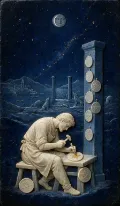
The Eight of Pentacles follows and picks the tools back up: in Olivia’s deck the gold star that hangs out of reach here appears on the disc under the worker’s chisel. Together they describe a craft’s rhythm: pause and assess, then return to patient practice.
- Seven of Pentacles + The Hanged Man
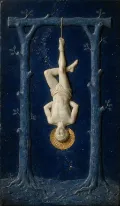
The Hanged Man also stops and waits, suspended rather than leaning. Beside the Seven, the pair draws attention to productive waiting: a pause that changes how you see the work, so that what looked like delay starts to look like ripening.
- Seven of Pentacles + Seven of Cups
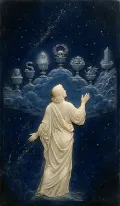
In the Seven of Cups a figure also looks upward, at cups of imagined outcomes resting on clouds; here the gaze rises from one real plant growing out of dug ground. Together they ask you to separate the harvest you picture from the one actually in front of you.
Also read withKnight of PentaclesAll pairs ↗
Questions to keep
- What has actually grown from the effort you have put in so far?
- What do you see when you review this work fairly, rather than gazing past it at the result you want?
- What would a fair measure of progress look like here, and when will you check it?
Ask them with three cards ↗A three-card reading in which each position asks one of these questions.
A small practice
Write down one long effort in three columns: what has grown, what it has cost, what it still needs. Then choose one date to look again.
Cards that share its symbols
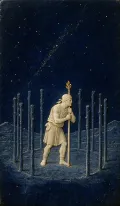 Nine of WandsShares: The river of stars · The tall pale-blue bush · Hands folded on the handle · The long-handled spade
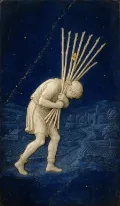 Ten of WandsShares: The tall pale-blue bush · The upturned gaze · Hands folded on the handle · The river of stars
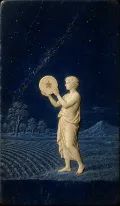 Page of PentaclesShares: The river of stars · The gilded top pentacle · Hands folded on the handle · The upturned gaze
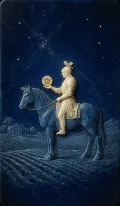 Knight of PentaclesShares: The gilded top pentacle · The tall pale-blue bush · Hands folded on the handle · The river of stars