Minor Arcana · Pentacles
Four of Pentacles
Tarot card meaning: upright, reversed and the symbols of the Olivia image
The Four of Pentacles turns attention to how you hold what keeps you safe: money, time, energy, and whether the grip still serves you.
- Upright
- securityconservingboundariesstabilityself-protectioncontrol
- Reversed
- tight gripscarcity thinkingloosening holdisolationovercaution
Upright
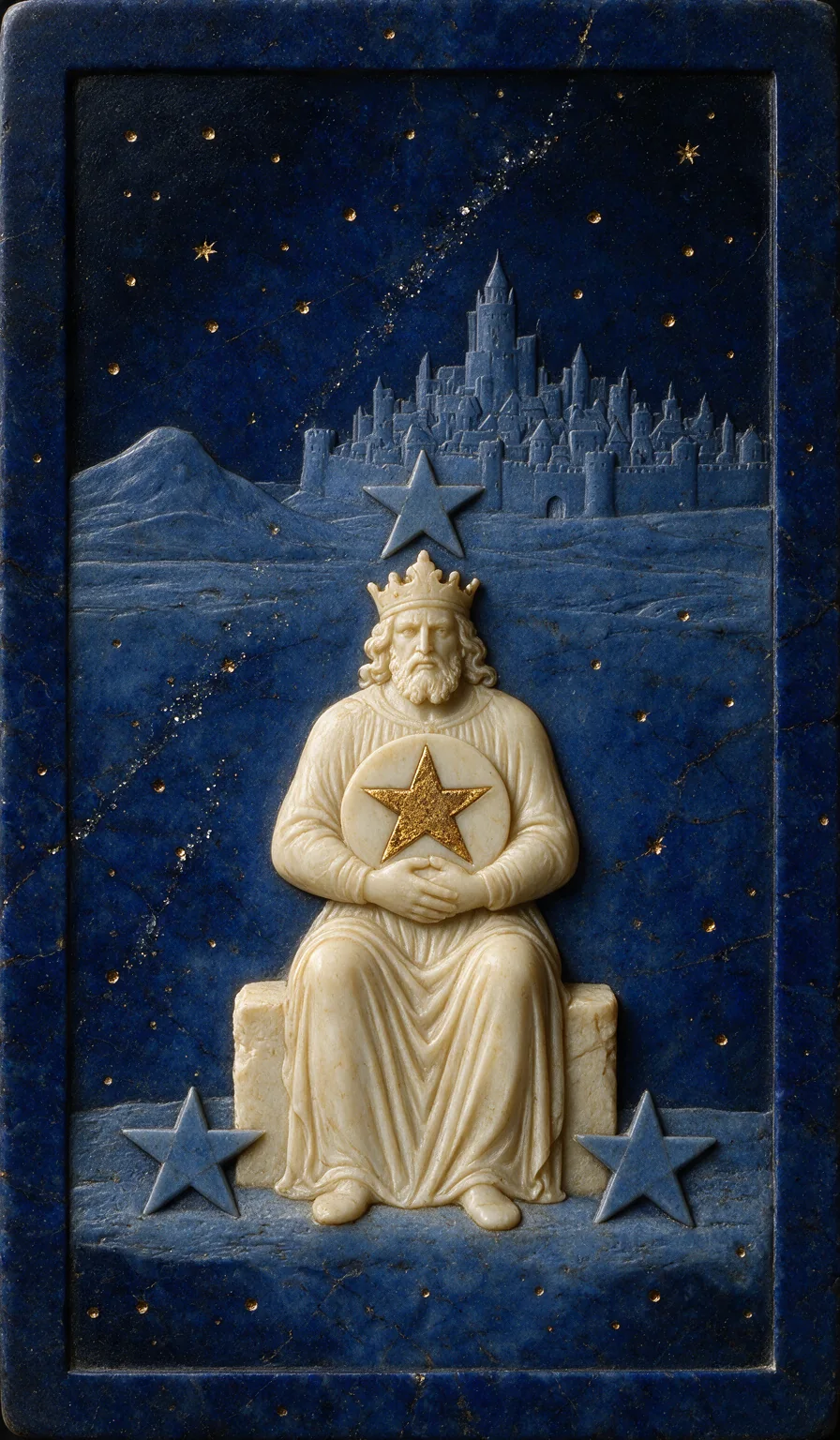
The Four of Pentacles is the card of holding on. In Olivia’s deck a crowned ivory figure sits squarely on a rough block, arms wrapped around a disc pressed to the chest, hands clasped beneath it. Its gold star is the only gold pentacle on the card. Three more stars, carved plainly in blue lapis, hover above the crown and stand on the ground at either side. Everything valued is gathered in, and every side is covered.
Pentacles belong to Earth: the body, money, home, work, time, the material means of a life. After the shared effort of the Three, the Four consolidates. Upright, it can point to healthy security: savings kept for a reason, a boundary around your energy, a firm no that protects something you have built. Where resources have been scarce, holding them carefully is often simply wise.
The card also asks what the holding costs. The walled city lies far behind across an empty plain, and the figure sits with its back to it, guarding rather than taking part. Notice whether your own grip is calm or tense, and whether it still serves the life you want. The question is not whether to let go, but what this security is for.
Reversed
Four of Pentacles reversed draws attention to a grip that has either tightened too far or started, sometimes abruptly, to loosen. The inward form is a quiet scarcity: counting and recounting, refusing help as well as refusing to give, keeping every door closed in case something is lost. The star above the crown can become a worry that never lifts.
The other form is the hold coming undone: spending energy, time or money faster than feels steady, or dropping a boundary to avoid seeming mean. Neither is a verdict. The reversed card invites a middle measure: name one thing you guard out of habit rather than need, and one thing that genuinely deserves protection, and hold each accordingly.
Read the image
Every element below is carved into this card. Scroll, hover or press a number to follow it on the image.
The walled city behind
What you seeCarved in paler lapis on the horizon, a walled city of crowded roofs and pointed towers rises to one tall keep with a conical roof; crenellated walls and an arched gate face the plain, a low hill to the left.
What it carriesThe traditional card sets a city behind the seated figure: the settled, built world of trade and shelter that security makes possible. Here it lies far off across an empty plain, and the figure sits with its back to it, which sharpens the question of what all the holding is for.
Follow this symbol through the deck ↗The star above the crown
What you seeA five-pointed star carved in pale blue lapis, with no disc around it, hangs just above the tallest point of the crown, separated from it by a narrow gap, against the foot of the city walls.
What it carriesIn the traditional image a pentacle rests on the crowned head, commonly read as the mind fixed on possessions. Olivia lifts it clear of the crown and strips its disc, so it reads as a preoccupation hovering over every thought: close enough to shape them, not quite part of the head.
Follow this symbol through the deck ↗The crown and level gaze
What you seeAn ivory crown of pointed tines, the tallest at the centre, sits on thick waves of hair; below it a bearded face looks straight out with drawn brows and a closed, unsmiling mouth.
What it carriesThe crown marks this as a card of earthly power, which is its old Golden Dawn title. The steady frontal gaze commonly reads as watchfulness: something has been gained and is now being kept under guard. Authority here is spent on keeping, rather than on ruling, making or exploring.
Follow this symbol through the deck ↗The gold star on the disc
What you seePressed flat against the chest, a large plain ivory disc carries a five-pointed star inlaid in textured gold, the only large piece of gold on the card; elsewhere gold appears as small flecks and tiny stars in the sky.
What it carriesThis is the pentacle held close and the heart of the card: what is valued most, guarded against the body. It is the only one of the four still framed by its disc and the only one in gold, as if all the worth were gathered into the thing being clasped while the rest fade to plain stone.
Follow this symbol through the deck ↗Hands clasped beneath the disc
What you seeBoth ivory hands meet at the lower rim of the disc, one folded over the other, the forearms curving in from either side so that the arms form a closed ring around it against the body.
What it carriesThe grip is the gesture readers watch on this card: security and clutching differ only in how tightly the hands close. Here the hands rest folded, not clawed, a calm and settled hold. It suggests a long habit of keeping rather than panic, which can be steadiness or a hold that no longer loosens.
Follow this symbol through the deck ↗The squared ivory block
What you seeThe figure sits on a plain rectangular block of rough ivory, visible on both sides of the robe, with squared edges and a pitted, unornamented surface; the robe falls over its front to the ground.
What it carriesThe traditional figure sits on a simple block or stool rather than a throne. The cube is a classic image of Earth and of the number four: square, four-sided, hard to move. Olivia leaves it rough and plain, so the seat of this power is solid but unadorned, built for staying put.
Follow this symbol through the deck ↗The star at the left
What you seeOn the pale lapis ground to the left of the seat stands a bevelled, five-pointed blue star, upright and apart from the figure; the ivory foot nearest to it rests on bare ground.
What it carriesTraditionally the two lower pentacles lie beneath the figure’s feet, holdings stood on so that nobody can shift them. Olivia sets them beside the seat instead, with both feet on bare ground. They read less as something pinned down and more as reserves placed within reach, guarded on either side.
Follow this symbol through the deck ↗The star at the right
What you seeA matching bevelled blue star stands on the ground to the right of the seat, mirroring the left one, so that with the star overhead the three lapis stars frame the figure in a wide triangle.
What it carriesWith the gold star held at its centre, the four pentacles build a guarded enclosure: one above, one on each side, the most precious in the middle. The symmetry is the point, since every side is covered. It is the architecture of safety, and also of a space that nothing new can easily enter.
Follow this symbol through the deck ↗
The number
Four is the number of structure: four walls, four corners, the square that does not tip over. After the seed of the Ace, the juggling of the Two and the shared craft of the Three, the Four secures what has been made. In the suit of Pentacles, where Earth already moves slowly, that stability doubles: a square seat, and pentacles set above, beside and at the heart of the figure. The risk of Four in Earth is stillness hardening into immobility before the loss and exposure of the Five.
The tradition
In the Golden Dawn system the Four of Pentacles is titled the Lord of Earthly Power. It is assigned to the Sun in Capricorn, the third decan of that sign (20 to 30 degrees), and to Chesed, Mercy, the fourth Sephirah on the Tree of Life, expressed in the suit of Earth. The Sun’s vitality in Capricorn’s orderly, ambitious sign is commonly read as power secured and consolidated. Aleister Crowley’s Thoth deck shortened the title to Power. Marseille decks show four coins at the corners around a central ornament. Pamela Colman Smith’s 1909 design gave the card its familiar crowned figure, one coin balanced on the crown, one clutched to the chest and two beneath the feet, with a city behind.
Love, work and self
- Love
- In close relationships the Four of Pentacles can point to how safety is kept: guarded time, a private space, a reluctance to share plans or feelings before they feel secure. That can be a healthy boundary. It can also become a closed ring, like the arms around the disc, leaving little room for anyone to reach in. The card cannot tell you what another person wants. It asks what you are protecting, and whether one small opening would feel safe.
- Work
- At work or in study, this card often appears around keeping what has been built: a role, a budget, a method that works, knowledge you are reluctant to hand over. Protecting your capacity is legitimate, and so is saving effort for what matters. Notice where caution has become control: refusing to delegate, turning down useful risks, holding information others need. With money, the card simply invites clarity about what a reserve is for; the decisions stay yours.
- Self
- For your relationship with yourself, the Four of Pentacles asks where you feel secure and where you feel you must hold on. Notice the body’s version of the card: a clenched jaw, folded arms, hands laced tight. Security is often built from old scarcity, and a grip that once protected you can outlast its reason. You can honour the habit and still test it: loosen one small thing and see what actually happens, rather than what you fear.
In a spread
Read the card through each position before you look at Olivia’s version. A position is a question, and the same card answers each one differently.
The situation
What aspect of the situation deserves attention?
Olivia’s readingAt the centre of a question, the Four of Pentacles can point to security as the real concern: perhaps something valued is being protected, and the way it is held shapes everything else.
What complicates it
What tension or assumption deserves a closer look?
Olivia’s readingAs a challenge, the card can show a grip that has become too tight: caution that shuts out help, change or generosity, and a stillness that feels safer than any movement.
A helpful next step
What small action could help you understand or respond?
Olivia’s readingAs advice, it invites you to protect what genuinely matters, name clearly what that protection is for, and allow a little more openness where the guard has become habit.
In conversation with
- Four of Pentacles + The Emperor
The Emperor is the Major Arcana’s four, a ruler seated in authority. Beside the Four of Pentacles the pair draws attention to structure and control: whether the order you keep is a foundation for others or a wall that holds them out.
- Four of Pentacles + Five of Pentacles
The Five of Pentacles follows in sequence, commonly showing loss and exposure in the cold. Next to the Four it asks whether fear of that hardship is driving the grip, and whether the grip itself keeps help out of reach.
- Four of Pentacles + Six of Pentacles
The Six of Pentacles commonly shows resources weighed and given. Together with the Four the pair turns attention to how resources flow: when keeping is wise, when sharing is possible, and what a fair measure looks like for you.
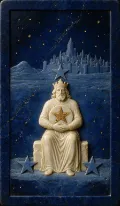
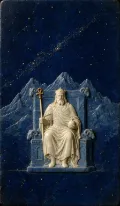
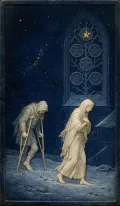
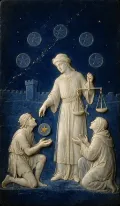
Also read withFour of WandsAce of PentaclesKing of PentaclesAll pairs ↗
Questions to keep
- What are you holding closest to your chest right now, and what is it protecting?
- Where does your caution feel calm and steady, and where has it become tense?
- If you loosened your hold by one small step, what would you actually risk losing?
Ask them with three cards ↗A three-card reading in which each position asks one of these questions.
A small practice
Clasp your hands tightly for thirty seconds, then slowly unlace them; write down one thing you hold that way, and one small way to hold it more lightly.