Major Arcana · XI
Justice
Tarot card meaning: upright, reversed and the symbols of the Olivia image
Justice asks for an honest weighing: seeing a situation clearly, owning your part in it, and letting a fair decision follow from what is true.
- Upright
- truthfairnessaccountabilityclear judgementcause and effectbalance
- Reversed
- self-justificationuneven standardsavoided responsibilityharsh self-judgementrushed conclusions
Upright
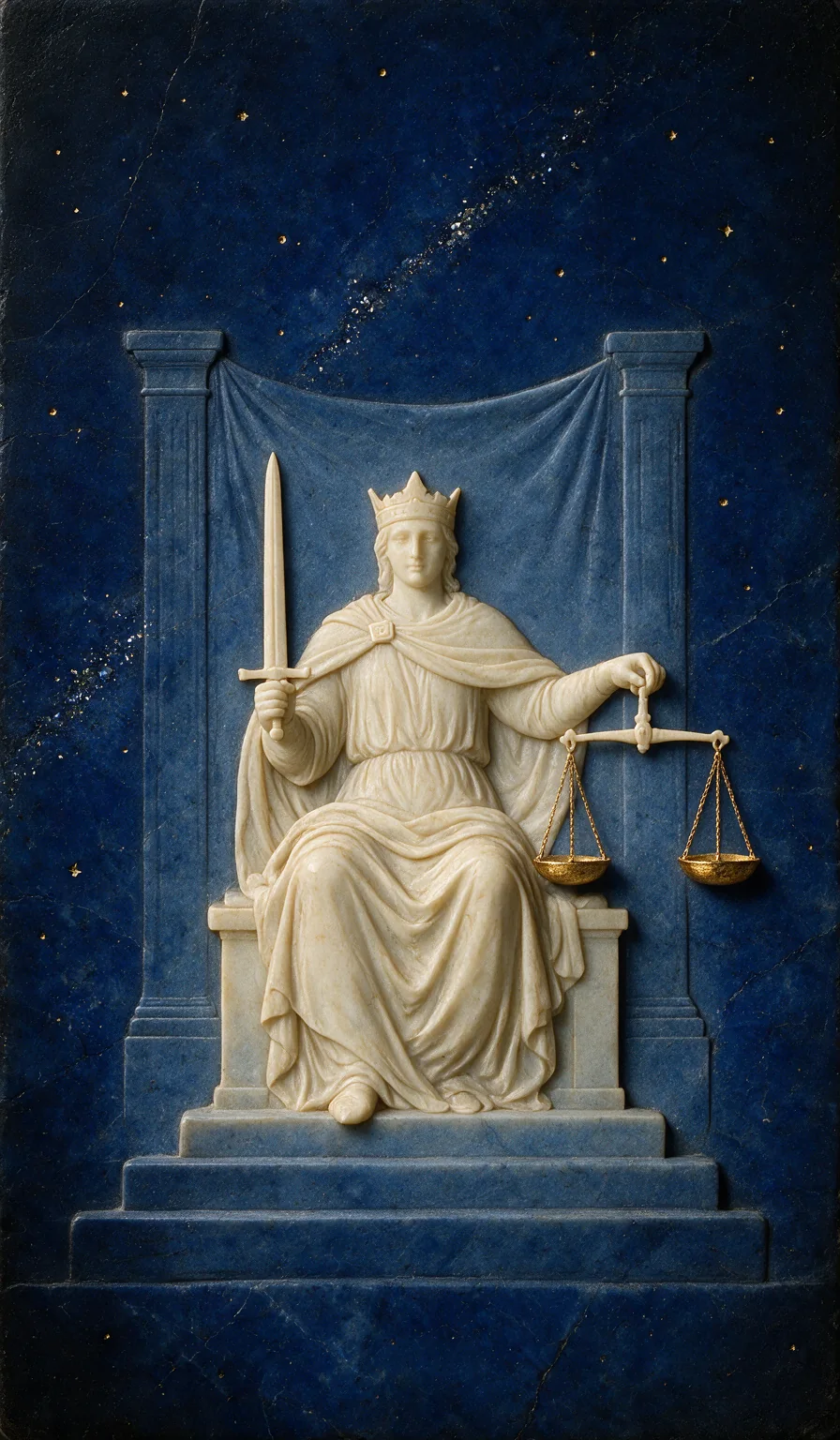
Justice is the card of the honest account. Olivia’s figure sits very upright between two lapis pillars, crowned, eyes open and looking straight out of the card. There is no blindfold here, as there is none in the traditional tarot image: this fairness depends on seeing clearly, not on refusing to look. The sword in the right hand points straight up, ready but still. The scales in the left hang with their gold pans at the same height, waiting for something to weigh.
The card draws attention to cause and effect, and to your own place in the chain. What actually happened? What did you choose, and what followed from it? Justice asks you to tell the story without leaning on the pans: including your part without taking on everyone’s, and naming the effect of another person’s actions without claiming to know what they intended. Its fairness is steady and a little cool. It prefers facts you can check to the version that feels best.
Gold is used sparingly in this deck, and on this figure it goes only to the scales. Weighing is the treasure here, more than the verdict. One ivory foot slips from under the robe onto the top step, as if a decision, once reached, is ready to move. Justice invites that sequence: look clearly, weigh fairly, then take one step you could explain to anyone involved.
Reversed
Justice reversed draws attention to a balance that has tipped, often quietly. One pan may be heavy with self-justification, so that your own actions get context while another person’s get a verdict. Or the weight falls the other way, into harsh self-judgement that holds you responsible for everything. It can also point to a conclusion reached before the facts were in, or a decision postponed because weighing it honestly feels uncomfortable.
Here the card invites a smaller act of fairness: check one fact, apply the same standard in both directions, or say plainly which part is yours and which is not. Balance can return one honest adjustment at a time.
Read the image
Every element below is carved into this card. Scroll, hover or press a number to follow it on the image.
The slanting star drift
What you seeAbove the pillars, a band of fine silvery-white flecks crosses the dark lapis sky on a diagonal, from just over the veil towards the upper right; a fainter drift crosses the left margin. Gold star points scatter around.
What it carriesThe traditional Justice card has no night sky and no stars. Olivia sets the scene under an order far larger than any court. The drift runs on a slant while the scales below hang level: human fairness is a small, deliberate balance made inside a world that is rarely even.
Follow this symbol through the deck ↗The swagged lapis veil
What you seeA plain cloth carved in lighter, greyish lapis is slung between the tops of the two pillars, sagging in a shallow curve and falling in soft vertical folds behind the figure’s crown and shoulders.
What it carriesA veil hangs behind the seated figure in the traditional card too, echoing the High Priestess. Unlike the Priestess’s veil, this one carries no pattern at all. Justice does not reveal hidden mysteries; it works in front of the curtain, with what can be seen, stated and weighed, and leaves the rest honestly unknown.
Follow this symbol through the deck ↗The pointed ivory crown
What you seeThe figure wears an ivory crown whose tall central point is flanked by smaller points, the outer two flaring outwards; a row of small carved marks runs along the band above long, wavy hair.
What it carriesA crown marks authority; here, the authority of a principle rather than of a ruler. The traditional crown carries a small square jewel, often read as ordered thought. Olivia’s crown is plain; the square moves to the clasp at the collar. The eyes stay open: no blindfold, a level gaze.
Follow this symbol through the deck ↗The upright ivory sword
What you seeRaised in the figure’s right hand, at the viewer’s left, a straight double-edged blade points upwards, its tip rising just above the crown. The fist closes just below a straight crossguard; a round pommel shows beneath it.
What it carriesThe sword is discernment: the power to cut cleanly between what is true and what is merely comfortable. Held upright rather than swung, it is ready, not attacking. Its double edge is commonly read as a reminder that honest judgement cuts both ways, including towards the one who holds it.
Follow this symbol through the deck ↗Two fluted pillars
What you seeLeft and right of the throne stand two tall pillars carved in the lighter lapis, with vertical grooves, moulded capitals and stepped bases; the veil hangs from just beneath their capitals.
What it carriesPaired pillars recur across the Major Arcana, most clearly around the High Priestess, and are often read as the two sides of any question. Justice sits between them and turns the pair of opposites into a frame: both sides stand, equal in height, and neither is allowed to fall.
Follow this symbol through the deck ↗The gold-pan scales
What you seeThe figure’s left hand, at the viewer’s right, pinches the ivory handle of a balance. From the knobbed ivory beam, three gold chains hang to each gold pan, and both pans sit at the same height.
What it carriesScales are the oldest emblem of justice, weighing claim against claim, cause against effect. Gold is rare in this deck, and on the figure it appears only in the pans and chains: the act of weighing is what the card treasures most. The pans hang empty and even, ready, not yet decided.
Follow this symbol through the deck ↗The pale stone throne
What you seeThe figure sits on a low, square-cut throne of pale, whitish-blue stone with a moulded top edge and plain block sides, lighter than the pillars; the ivory robe spills over its front in heavy folds.
What it carriesJustice is seated, as in the traditional image: judgement that does not rush to act. This throne is plain block without ornament; the pillars and veil do the framing. Its simple, squared mass suggests stable ground, a place where a decision can rest before it is carried out.
Follow this symbol through the deck ↗One foot on the step
What you seeFrom beneath the hem of the ivory robe a single foot slips forward onto the top step, just left of centre from the viewer’s side; to its right, only the rounded toe of the other foot peeps from the folds.
What it carriesThe traditional Justice card also shows one foot emerging from the robe, often read as a sign that judgement leads to action: a decision is complete only once it steps into the world. The other foot stays back, almost hidden. Weighing and acting remain a pair, one after the other.
Three broad lapis steps
What you seeBelow the throne, three wide steps of lighter, faintly veined lapis descend towards the viewer, each broader than the one above, onto a flat stone floor that fills the base of the card.
What it carriesThe steps raise the seat of judgement above the floor, so that it is approached by degrees, one level at a time. They also open the scene towards the viewer: this is a seat you are invited to walk up to and sit before, not a verdict handed down from out of reach.
The number
Justice is card XI in the Waite-Smith order, following the Wheel of Fortune. Where the Wheel shows forces nobody steers, Justice turns to what you can answer for: your choices and what follows from them. Eleven is ten plus one, a fresh start after a finished cycle, and it reduces to two, echoing the High Priestess, who also sits between pillars before a veil. The step it asks for is accountability: an honest look back before the Hanged Man turns the whole view upside down.
The tradition
In the Golden Dawn system Justice bears the title “Daughter of the Lords of Truth, the Ruler of the Balance”. It is assigned the Hebrew letter Lamed, usually glossed as ox-goad, and the sign Libra, cardinal Air, on the path joining Geburah and Tiphareth on the Tree of Life. In the Marseille pattern Justice was card VIII; the Golden Dawn exchanged it with Strength so that Leo would precede Libra, and Waite followed, making it XI. The figure itself is far older than these correspondences: it comes from the cardinal virtues of medieval and Renaissance art, and early Italian tarots already show Justice with sword and scales. Crowley later renamed the card Adjustment.
Love, work and self
- Love
- In a close relationship, Justice turns attention to reciprocity: whether care, effort and apology travel in both directions. It invites an honest look at what you contribute and what you receive, without keeping a ledger to win an argument. You can name the effect of someone’s words on you without claiming to know why they said them. With yourself, the card can point to fairness turned inwards: the understanding you readily offer others may be something you could extend to yourself.
- Work
- At work or in study, Justice favours clear agreements, accurate records and decisions you could explain to anyone affected. It can point to a review, a fair division of tasks or a moment when credit and responsibility need sorting out. The sword asks for precision; the scales ask whether everyone is measured by the same rule. In money matters it simply suggests checking the figures and the terms before you commit, and seeking qualified advice where the stakes are real.
- Self
- For your inner life, Justice asks what an honest account of your recent choices would sound like, told by a fair witness rather than a prosecutor or a defender. Olivia’s figure looks straight out, eyes open, holding the sword still and the scales level. You might borrow that posture: neither excusing yourself nor piling on blame, simply seeing what happened and what followed. Clarity about your part is often a relief; it shows you what is actually yours to change.
In a spread
Read the card through each position before you look at Olivia’s version. A position is a question, and the same card answers each one differently.
The situation
What aspect of the situation deserves attention?
Olivia’s readingAt the heart of your question, Justice suggests the matter turns on truth and fairness: what really happened, what you are responsible for, and what a balanced decision would need to take into account.
What complicates it
What tension or assumption deserves a closer look?
Olivia’s readingAs a challenge, Justice can point to an uneven standard, a fact you would rather not check, or judgement that has grown rigid. Fairness may be complicated by wanting to be right more than wanting to be clear.
A helpful next step
What small action could help you understand or respond?
Olivia’s readingAs advice, Justice invites you to weigh before you act: gather the facts, hear more than one side, name your own part plainly, then take the step you could explain to everyone involved.
In conversation with
- Justice + The High Priestess
The High Priestess and Justice both sit enthroned between pillars before a veil. The Priestess keeps what lies behind it; Justice works in front of it, with what can be stated and weighed. Together they ask what you sense through intuition and what you can actually show.
- Justice + Wheel of Fortune
The Wheel of Fortune turns on forces no one controls; Justice, the very next card, weighs the choices you can answer for. Together they invite you to separate circumstance from responsibility, and to act fairly within the part that is truly yours.
- Justice + Judgement
Justice weighs an action; Judgement answers a call to rise and begin again. Side by side they draw attention to accountability that does not end in a verdict but opens a way forward: owning what happened so that you can move past it.
Also read withAce of SwordsTwo of SwordsFive of SwordsSeven of SwordsPage of SwordsQueen of SwordsKing of SwordsSix of PentaclesAll pairs ↗
Questions to keep
- What would a fair account of this situation include, if it were told by someone with no side to take?
- Where are you applying one standard to yourself and a different one to someone else?
- What is truly your part in this, and what can you set down as not yours?
Ask them with three cards ↗A three-card reading in which each position asks one of these questions.
A small practice
Draw a line down a page: on one side list the facts you can check, on the other what you are assuming, then read both columns aloud.
Cards that share its symbols
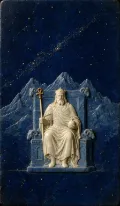 The EmperorShares: The slanting star drift · The pointed ivory crown · The pale stone throne
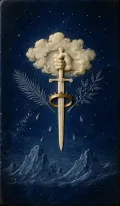 Ace of SwordsShares: The upright ivory sword · The pointed ivory crown · The slanting star drift
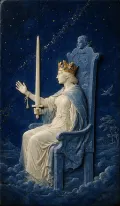 Queen of SwordsShares: The upright ivory sword · The pointed ivory crown · The slanting star drift
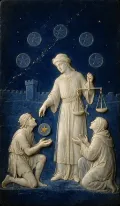 Six of PentaclesShares: The slanting star drift · The gold-pan scales · The upright ivory sword