Minor Arcana · Cups
Four of Cups
Tarot card meaning: upright, reversed and the symbols of the Olivia image
The Four of Cups draws attention to a pause in feeling: turning inward, weary of what is familiar, and not yet noticing what is quietly being offered.
- Upright
- contemplationwithdrawalapathyreassessmentemotional pauseunnoticed offer
- Reversed
- renewed interestlooking updeepened withdrawalrestlessnessclear refusal
Upright
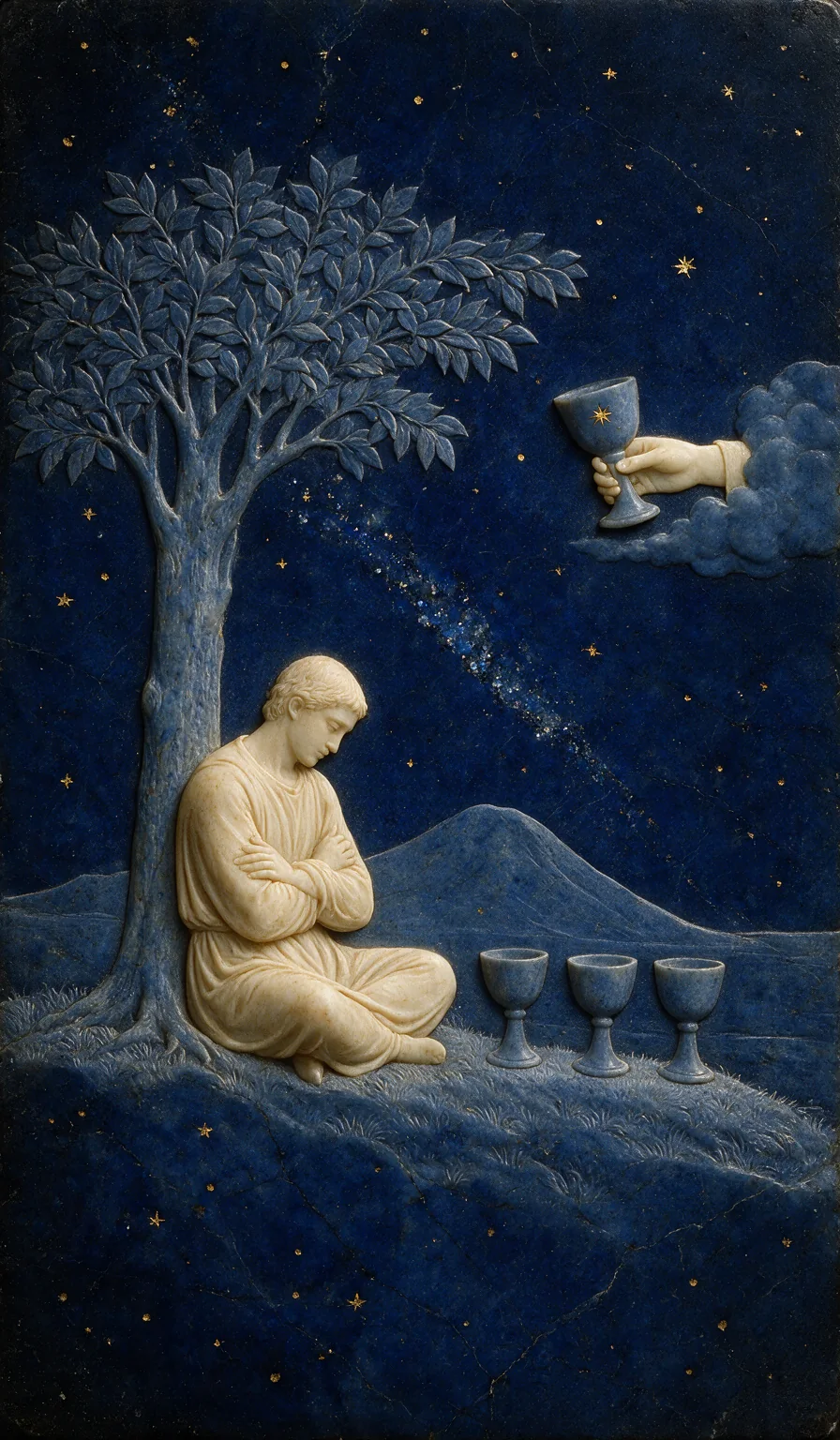
The Four of Cups is the card of a pause in feeling. After the celebration of the Three, something goes quiet. In Olivia’s carving an ivory figure sits cross-legged against a tree, arms folded across the chest, head bowed so that the eyes rest on the grass. Nothing here is broken or lost. It is the flatness that can follow plenty, when what you have no longer moves you and what might come next is hard to imagine.
Three plain lapis cups stand in a neat row beside the figure, familiar and unremarkable. Above and behind, out of the line of sight, a hand reaches from a cloud with a fourth cup, and on its bowl shines a small gold eight-pointed star, like the star Olivia sets on the bowl of the Ace of Cups. What is offered is not more of the same but a new beginning of feeling. Between them a glittering band of stars flows overhead, also unseen.
Upright, the card does not scold you for ingratitude. Withdrawal can be wise: a needed rest, a boundary after too much giving, an honest admission that old sources have run dry. It asks you to look at the quality of your stillness. Is it contemplation, where something is slowly clarifying, or a habit of not looking up? The invitation is simply to notice what is within reach before deciding it holds nothing for you.
Reversed
Four of Cups reversed can point to interest stirring again after a flat stretch: the head lifting, the arms loosening, a first glance toward the cup held out from the cloud. You may find yourself curious about something you had dismissed, or ready to accept an invitation you kept turning down. Go slowly; a returning appetite does not need to be tested all at once.
It can also show the opposite movement: withdrawal that has settled in deeper than you meant, so that even rest no longer restores you. If very little reaches you for a long time, that deserves to be taken seriously and shared with someone you trust or a qualified professional, rather than treated as a failure of gratitude.
Read the image
Every element below is carved into this card. Scroll, hover or press a number to follow it on the image.
The star-marked fourth cup
What you seeHeld out in mid-air at the upper right, a stemmed cup of grey-blue lapis carries a small gold star with eight slender points on its bowl, the only gold set into any cup on the card.
What it carriesIn the traditional image the fourth cup is plain, a gift from outside that the figure does not see. Olivia marks it with the same eight-pointed gold star that shines on the Ace of Cups: what is offered here is a fresh beginning of feeling, not simply one more of the same.
Follow this symbol through the deck ↗The hand from the cloud
What you seeAn ivory hand with a plain cuff at the wrist reaches out of a billowing lapis cloud at the right edge, fingers and thumb closed around the cup’s stem just beneath the bowl.
What it carriesA hand from a cloud is the tarot’s old sign of something given rather than earned, as on the traditional Aces. It holds the cup steady. Yet it sits high above and to the right of the figure’s bowed head, outside the line of sight, and that gap is the whole tension of the card.
Follow this symbol through the deck ↗The sheltering tree
What you seeA broad tree carved in pale grey-blue lapis rises at the left, its canopy of narrow pointed leaves arching over the scene; the seated figure leans against its trunk, where thick roots spread into the grass.
What it carriesThe traditional image also seats the figure beneath a tree, which some readers compare with the Bodhi tree. Here the tree is support and shelter: the figure rests against something steady. Its outermost leaves reach out toward the offered cup, as if the tree reaches where the figure does not.
Follow this symbol through the deck ↗The glittering diagonal band
What you seeA band of tiny pale, glittering crystals runs diagonally from beneath the tree’s canopy down to the right, fading out above the mountain’s right-hand slope, passing above and right of the figure’s head among gold star flecks.
What it carriesThis band is Olivia’s addition; the traditional card has a plain sky. A river of stars flows just over the figure, unseen. It widens the scene: while attention is turned inward, the night keeps moving, and there is more present than the three cups on the grass.
Follow this symbol through the deck ↗The bowed head
What you seeThe ivory figure’s head tilts down and slightly to the right, eyelids lowered, lips closed, short hair carved in soft waves; the gaze falls toward the grass, not up toward the offered cup.
What it carriesThe lowered head is the card’s core gesture: attention withdrawn from the world and turned inward. Read gently, it is contemplation; held for too long, it can become a habit of not looking. The face is calm, not anguished, which keeps the mood closer to reflection or boredom than to grief.
Arms folded across the chest
What you seeBoth forearms cross over the chest, the fingers of one hand resting on the opposite arm, while the figure sits cross-legged in a long, loose tunic that falls in soft folds, bare feet showing.
What it carriesFolded arms are commonly read as closure: nothing reaching out, nothing let in. With the crossed legs, the whole body forms a closed loop. It can be self-protection after too much, or simply rest; the card asks which, rather than assuming refusal or ingratitude.
The single blue peak
What you seeBehind the figure’s shoulder a broad mountain of lighter blue lapis rises to one soft summit, with lower hills running off to the left behind the tree trunk and to the right behind the cups.
What it carriesMountains in tarot often stand for distant aims or difficulty still to be faced. Here the peak is quiet and far off, and the diagonal band of stars flows down toward it. It hints at a direction beyond the present mood, there whenever the figure lifts their eyes.
Follow this symbol through the deck ↗Three cups on the grass
What you seeThree identical stemmed cups of plain grey-blue lapis stand evenly spaced in a row on the grassy mound, to the right of the figure’s drawn-in feet, in the same grey-blue as the hill behind them.
What it carriesIn the traditional image three cups stand before the seated figure, often read as what is already possessed: pleasures and bonds already won. Here they stand beside rather than in front. They are neither refused nor enjoyed; simply there, familiar enough to be overlooked, plain enough to feel flat.
Follow this symbol through the deck ↗
The number
Four is the number of structure: four corners, four walls, a square that holds still. After the overflowing celebration of the Three, the Four of Cups settles feeling into something stable, and stability in the suit of Water can tip into stagnation. On this card every cup is standing and none has spilled; the difficulty is that nothing moves. Among the Fours, Wands celebrate a home, Swords rest after conflict and Pentacles hold on tight; here contentment slides quietly into indifference.
The tradition
In the Golden Dawn system the Four of Cups is titled the Lord of Blended Pleasure. It is assigned to the Moon in Cancer, the third decan of that sign (20 to 30 degrees), and to Chesed, Mercy, the fourth Sephirah on the Tree of Life, expressed through Water. The Moon rules Cancer, so feeling is thoroughly at home here, even to the point of surfeit: pleasure mixed with a trace of weariness. Aleister Crowley named the card Luxury. Marseille-pattern decks show four cups arranged among foliage, with no figures; Pamela Colman Smith’s 1909 card gave it the now familiar scene: a seated figure beneath a tree, arms folded, three cups on the grass and a fourth offered from a cloud.
Love, work and self
- Love
- In love and close relationships, the Four of Cups draws attention to the flatness that can creep into familiar bonds: the same cups in the same row, valued in principle and hardly felt. It cannot tell you what another person feels. It asks whether you have stopped looking up, and whether an offer of closeness, a small gesture or an invitation, has gone unnoticed. With yourself, it invites patience with a numb season rather than a verdict on the whole relationship.
- Work
- At work or in study, the card can point to boredom with a role that once felt rewarding, or a habit of dismissing opportunities before looking at them. The three cups on the grass stand for what you already have: skills, a post, a routine. Before chasing something new or refusing it outright, notice what the offer actually contains. Where money is involved, the card says nothing about the decision itself; it only asks whether flatness or restlessness is doing the choosing.
- Self
- For your relationship with yourself, the figure resting against the tree is a picture of rest that is allowed. You do not have to be interested in everything. The card asks you to tell the difference between a pause that restores and a withdrawal that numbs. The body can help: in this carving the arms are folded and the eyes are down. What happens to your mood when you unfold your arms and look at the sky for a minute?
In a spread
Read the card through each position before you look at Olivia’s version. A position is a question, and the same card answers each one differently.
The situation
What aspect of the situation deserves attention?
Olivia’s readingAt the centre of a question, the Four of Cups points to a pause in feeling: interest may have dimmed, and something may be on offer that you have not yet looked at properly.
What complicates it
What tension or assumption deserves a closer look?
Olivia’s readingAs a challenge, the card can show dismissing options before examining them, staying inside a familiar dissatisfaction, or mistaking tiredness for a final answer about what you want.
A helpful next step
What small action could help you understand or respond?
Olivia’s readingAs advice, it invites you to rest without shutting the door: take the pause you need, then lift your eyes once and look honestly at anything that may be held out to you.
In conversation with
- Four of Cups + Ace of Cups
The gold eight-pointed star on the offered cup is the star set on the bowl of the Ace of Cups. Together they draw attention to a fresh beginning of feeling that may be available again, and to whether you are ready to look up and receive it.
- Four of Cups + Five of Cups
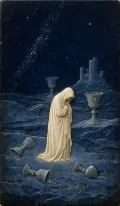
In the Five of Cups a hooded figure bows over spilled cups; here the figure bows away from a cup held out. In both, one gold-marked cup stands outside the gaze. Together they ask where your attention has settled, and what still stands upright nearby.
- Four of Cups + The Hanged Man
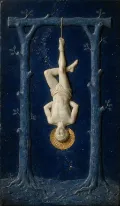
The Hanged Man chooses a suspended pause in order to see differently; the Four of Cups drifts into one. Side by side they invite you to make your stillness deliberate: to ask what this pause is for, and what new view it could open.
Also read withEight of CupsNine of CupsFour of SwordsAll pairs ↗
Questions to keep
- What is your lack of interest asking for: rest, a boundary, or a different kind of possibility?
- Which of your cups have become so familiar that you no longer notice what they hold?
- What might be held out to you right now that you have not yet looked up to see?
Ask them with three cards ↗A three-card reading in which each position asks one of these questions.
A small practice
Sit for five minutes with your arms unfolded and your eyes raised, then write down one thing within reach today that you have been overlooking.
Cards that share its symbols
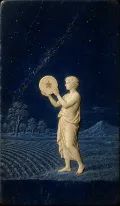 Page of PentaclesShares: The glittering diagonal band · The hand from the cloud · The bowed head · The sheltering tree · The single blue peak
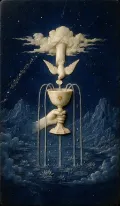 Ace of CupsShares: The star-marked fourth cup · The hand from the cloud · The single blue peak · The glittering diagonal band
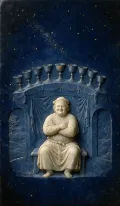 Nine of CupsShares: The star-marked fourth cup · The bowed head · The hand from the cloud · The glittering diagonal band
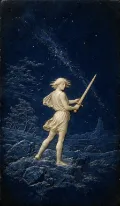 Page of SwordsShares: The bowed head · The glittering diagonal band · The sheltering tree · The single blue peak