Minor Arcana · Cups
Nine of Cups
Tarot card meaning: upright, reversed and the symbols of the Olivia image
The Nine of Cups turns attention to satisfaction: the moment a wish is met, enough is recognised as enough, and pleasure can be enjoyed without apology.
- Upright
- contentmentwish fulfilledenjoymentgratitudeeasesensual pleasure
- Reversed
- hollow satisfactioncomplacencyoverindulgencedisplay over feelingprivate contentment
Upright
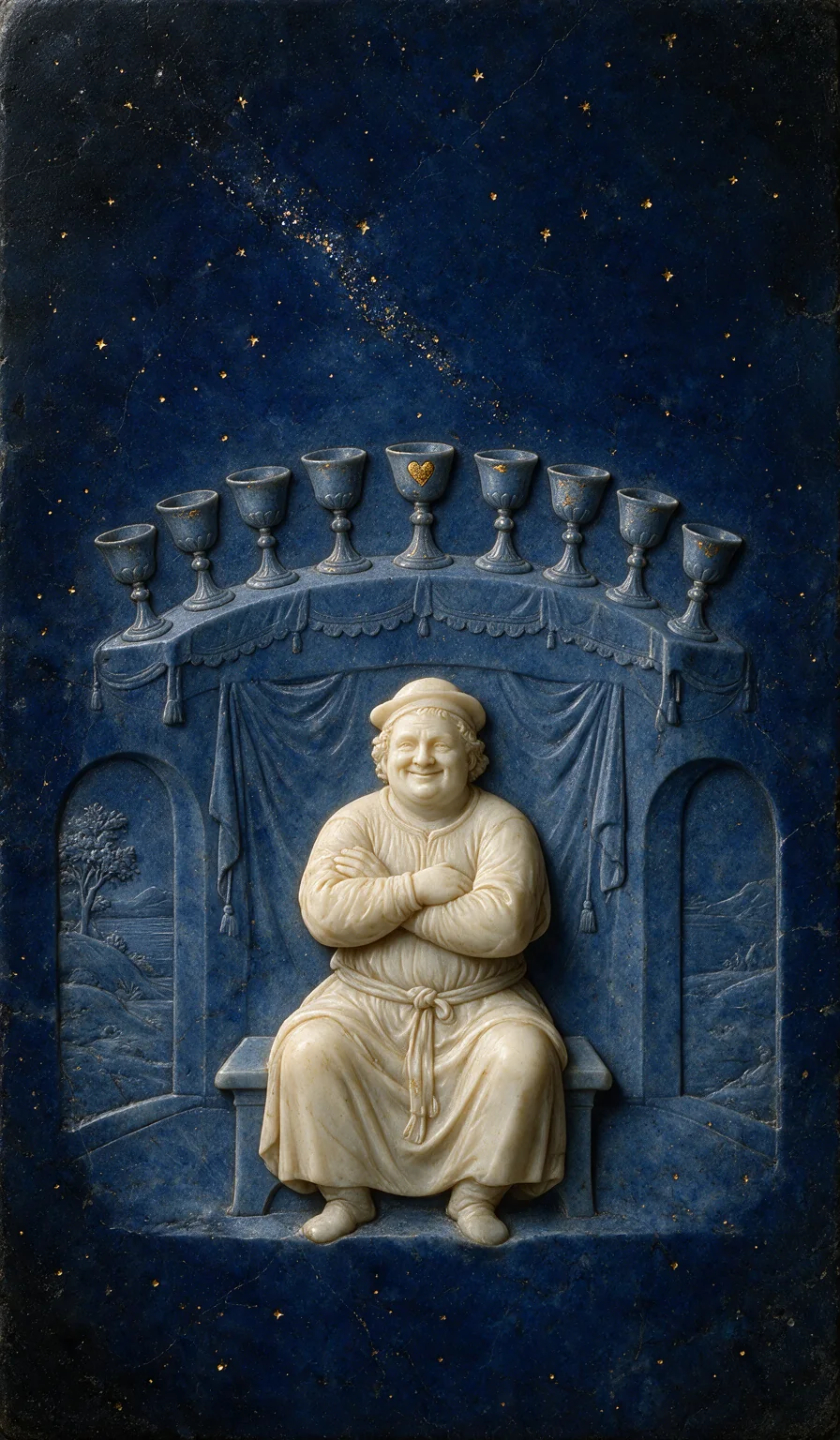
The Nine of Cups is the card of enough. Many readers call it the wish card, and it draws attention to the moment when something you hoped for has arrived, or when you notice that much of what you need is already here. In Olivia’s carving a round-faced ivory figure sits squarely on a plain bench, arms folded, smiling with the whole face. Behind and above, nine grey-blue goblets stand in an arc along a draped shelf, like a row of well-earned toasts.
The cup at the top of the arc carries a heart of gold, set directly above the figure’s head. This detail is Olivia’s own, and it changes the question. Among all the satisfactions on display, one is marked as truly precious. Upright, the card invites you to enjoy what is good without justifying it through usefulness or applause, and to name which pleasure actually matters to you rather than which one looks best on the shelf.
Notice, too, what surrounds the scene: a curtain hung behind the seat, arched windows opening onto water and hills, the Milky Way crossing the sky. The comfort is real, and it sits inside a much wider world. Contentment here is a way of resting, not a way of shutting the door.
Reversed
Nine of Cups reversed draws attention to the gap that can open between having and enjoying. A wish may have been met in form but not in feeling, or pleasure may have tipped into excess: one more cup set on a shelf that is already full. The folded arms can read as a guard rather than ease, and the draped display as something arranged for others to see.
It can also turn inward in a gentler way: a satisfaction kept private, or a quiet contentment you have not yet allowed yourself to name. This is useful information, not ingratitude. The card asks what the gold-hearted cup would hold if you chose it for yourself, and what enough would feel like on your own terms.
Read the image
Every element below is carved into this card. Scroll, hover or press a number to follow it on the image.
Nine cups in an arc
What you seeNine stemmed goblets stand in a shallow arc along a curved ledge, each carved from grey-blue lapis with a fluted lower bowl and a rounded knop on the stem. The row dips lower toward both ends.
What it carriesNine is the fullest number before the Ten, and the arc of cups is traditionally read as emotional abundance on display: everything wished for, gathered and set out. Carved from the same blue stone as the sky, these cups belong to the scene rather than glittering apart from it.
Follow this symbol through the deck ↗Gold heart on the centre cup
What you seeThe fifth cup, at the peak of the arc and directly above the figure’s head, carries a small inlaid heart of bright gold on its bowl. The other cups show only scattered, irregular gold flecks.
What it carriesThe heart is Olivia’s addition; the traditional card marks no single cup. Placed at the top of the row and aligned with the smiling face, it suggests that among many satisfactions one matters most: the wish that is really your own, not the ones collected for show.
Follow this symbol through the deck ↗The draped curved shelf
What you seeThe cups rest on a curved ledge covered with a cloth whose edge falls in swags with a scalloped fringe and small pendant drops, with tassels hanging near each end, all in pale lapis.
What it carriesThe traditional image also sets the cups on a cloth-covered, arching counter behind the seated figure. The dressed shelf turns simple possession into presentation: a display, almost a stage. It asks gently whether contentment is being lived or arranged to be seen.
The smiling face and cap
What you seeThe ivory figure’s round face is creased by a broad smile, eyes narrowed almost shut, cheeks full. Short curls show beneath a small rounded cap with a narrow brim.
What it carriesThe traditional figure of the Nine of Cups is commonly read as someone well fed and pleased with life. Olivia’s carving leans toward warmth rather than smugness: the smile reaches the eyes. The card invites you to recognise ordinary, bodily pleasure as real satisfaction.
Arms folded high
What you seeBoth arms are folded high across the chest in thick, rounded sleeves; the fingers of one hand show against the opposite upper arm. Nothing is held; the cups stand behind the figure, out of reach.
What it carriesFolded arms are commonly read two ways in this card: as the ease of someone with nothing left to chase, or as a closed, self-satisfied guard. Both readings are traditional, and the card asks which is true for you: settled contentment, or holding everything at a distance.
Follow this symbol through the deck ↗The knotted rope belt
What you seeA plain cord circles the waist of the long ivory tunic and ties in a loose knot at the centre, its two ends hanging down over the lap and fraying into small tassels.
What it carriesA simple cord rather than a jewelled belt gives the figure a homely, almost monastic plainness: plenty worn lightly. A knot is also a traditional sign of something bound and secured. Here satisfaction is tied loosely, easy to undo, not locked shut.
The curtain behind the seat
What you seeBehind the figure hangs a pale blue lapis curtain gathered in swags beneath the shelf, its side lengths falling to cords that end in tassels level with the figure’s elbows.
What it carriesThe curtain is Olivia’s own staging; the traditional card sets the figure against a plain ground. A curtain frames and also hides. Behind the display of plenty something is kept private, which leaves room to ask what the pleased surface covers, and whether anything behind it needs attention.
Follow this symbol through the deck ↗Arched windows on the land
What you seeTwo tall round-arched openings flank the seat. Through the left one, in low relief, a tree stands on a hillside above still water, with a mountain beyond; the right shows rolling slopes and a distant ridge.
What it carriesThe windows are not part of the traditional image. They open the enclosed room of pleasure onto wider country: water, hills and a tree that keeps growing whether anyone watches or not. Contentment here is not sealed off; the larger world stays visible from the comfortable seat.
Follow this symbol through the deck ↗Milky Way above the cups
What you seeAbove the cups a glittering band of pale mineral crosses the dark ultramarine sky diagonally, running from the upper left down toward the row of cups, among scattered small gold stars.
What it carriesThe Golden Dawn gave this card to Jupiter in Pisces, a planet of increase in a sign of boundless water. The Milky Way, a river of light in many old traditions, echoes that: the small room of plenty sits beneath something far larger, which no display could hold.
Follow this symbol through the deck ↗
The number
Nine is the last step before the Ten: the fullest point of a suit before completion tips into overflow or a new cycle. In Cups, the suit of Water, feeling and relationship, that fullness is emotional. After the loss of the Five, the memories of the Six, the choices of the Seven and the leaving of the Eight, the Nine arrives at satisfaction held close. The Ten will share it with a household; the Nine keeps it near. Among the Nines, the Nine of Pentacles enjoys self-made comfort, while the Nines of Wands and Swords hold vigilance and worry.
The tradition
In the Golden Dawn system the Nine of Cups is titled the Lord of Material Happiness. It is assigned to Jupiter in Pisces, the second decan of that sign (10 to 20 degrees), and to Yesod, Foundation, the ninth Sephirah on the Tree of Life. Jupiter was the traditional ruler of Pisces, so the planet of increase stands here in its own sign, commonly read as generous, easy plenty. Aleister Crowley’s Thoth deck uses the single title Happiness. Marseille-pattern decks show the nine cups alone, with no figure; Pamela Colman Smith’s 1909 card added the contented seated figure with folded arms before an arched row of cups on a draped counter. Some modern readers link Pisces with Neptune.
Love, work and self
- Love
- In love and close friendship the Nine of Cups draws attention to the pleasure of being together as things are, without a next milestone to reach: a shared meal, an easy evening, the relief of not having to perform. It cannot tell you what another person feels. It asks whether the contentment you show is the contentment you feel, and invites you to say plainly what you enjoy. With yourself, it welcomes comfort you do not have to earn.
- Work
- At work or in study the card can point to a goal reached, praise received, or a stretch where things are simply going well. The arc of cups invites you to pause and register it before reaching for the next target. It also asks whether your satisfaction depends on how the results look to others. Around money, it invites you to notice what is already sufficient before measuring it against the next target.
- Self
- For your relationship with yourself, the smiling figure with folded arms is a portrait of ease worth practising. Notice what brings you real bodily pleasure: rest, warmth, taste, a good laugh. The gold heart on one cup asks you to tell apart the wishes that are truly yours from those inherited or collected for show. The curtain behind the seat is a reminder that not every contentment needs an audience.
In a spread
Read the card through each position before you look at Olivia’s version. A position is a question, and the same card answers each one differently.
The situation
What aspect of the situation deserves attention?
Olivia’s readingAt the centre of a question, the Nine of Cups points to satisfaction that may already be present or within reach, and to what enough honestly means for you here.
What complicates it
What tension or assumption deserves a closer look?
Olivia’s readingAs a challenge, the card can show contentment used as a guard, comfort that has slipped into complacency, or a wish met in form that still feels empty inside.
A helpful next step
What small action could help you understand or respond?
Olivia’s readingAs advice, it invites you to pause and enjoy one good thing fully, then name which wish on your shelf is truly your own.
In conversation with
- Nine of Cups + Ten of Cups
The Nine of Cups keeps satisfaction close; the Ten of Cups opens it to a household and a shared life. Together they turn attention to the difference between private contentment and happiness held in common, and to what you would like to share.
- Nine of Cups + Four of Cups
In Olivia’s Four of Cups a figure sits with folded arms, eyes lowered, beside cups that fail to tempt; the Nine repeats the gesture with a broad smile beside plenty that is plainly enjoyed. Together they ask whether folded arms mean refusal or rest.
- Nine of Cups + Nine of Pentacles
Both Nines show a figure at ease amid their own plenty, and in both one of the nine emblems is marked in gold. The Nine of Pentacles savours comfort built through steady work, the Nine of Cups feeling and pleasure. Together they ask how you let yourself enjoy what you have.
Also read withNine of SwordsAll pairs ↗
Questions to keep
- What does enough feel like for you right now, in your body and not only on paper?
- Which wish on your shelf is truly your own, and which did you collect to be seen?
- Where could you let yourself enjoy something fully this week, without earning it first?
Ask them with three cards ↗A three-card reading in which each position asks one of these questions.
A small practice
Tonight, before sleep, write down three pleasures from the day, however small, and underline the one you would choose again if nobody ever knew.
Cards that share its symbols
 Two of CupsShares: Milky Way above the cups · Nine cups in an arc · Arms folded high · Gold heart on the centre cup
 Three of CupsShares: Gold heart on the centre cup · Nine cups in an arc · Arms folded high · Milky Way above the cups
 Four of CupsShares: Nine cups in an arc · Arms folded high · Milky Way above the cups · The smiling face and cap
 Five of CupsShares: Arms folded high · Nine cups in an arc · Gold heart on the centre cup · Milky Way above the cups