Minor Arcana · Cups
Ace of Cups
Tarot card meaning: upright, reversed and the symbols of the Olivia image
The Ace of Cups is the first welling of feeling: love, tenderness, intuition or creative joy arriving as a gift, and an invitation to receive it.
- Upright
- open heartnew feelingreceptivitycompassioncreative flowintuition
- Reversed
- held-back feelingemotional overflowhard to receiverunning dryinward tenderness
Upright
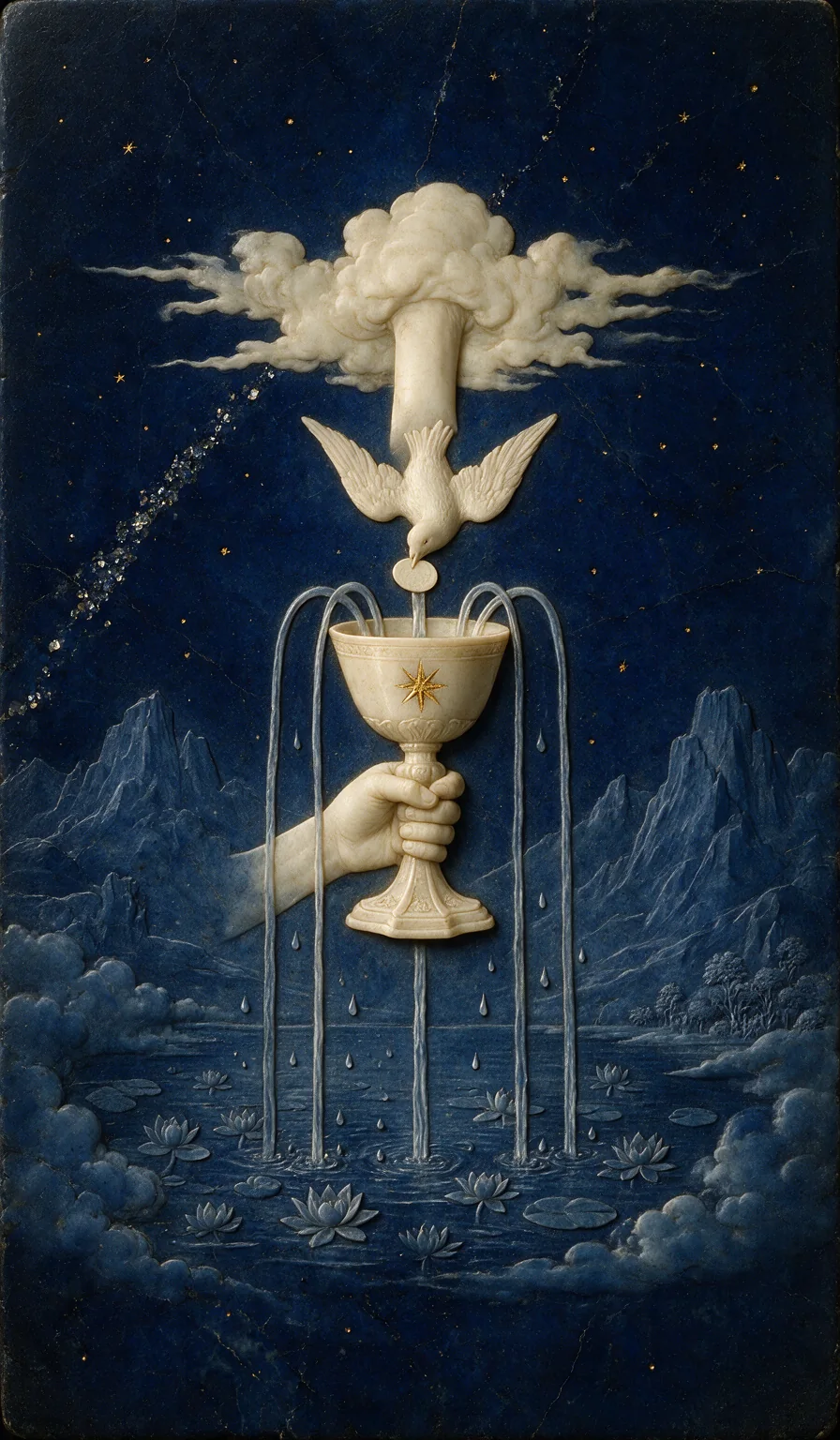
The Ace of Cups draws attention to the moment feeling begins to rise: affection, tenderness, a new closeness, a surge of creativity, or a quiet sense that something inside has opened. As the root of the suit of Water, it concerns emotional life in its purest, least complicated form, before it is sorted, explained or shared out. Nothing in the card needs to be earned. The dove dives from the cloud with its wafer, and water pours from the cup in five clean streams: more than any single vessel can hold.
Olivia’s version adds two telling details. The cup is held by a hand that enters from the side of the card, gripping the stem firmly, so receiving is not passive; it is an act of steadying and keeping the vessel upright. And the cup carries a gold eight-pointed star in place of the traditional letter, linking this first feeling with the hope of The Star.
Upright, the card invites you to make room. Notice what is welling up, and let it exist for a while before you decide what it means or where it should go. The lotuses on the pool below suggest that feeling, given space, can take root and flower. You can welcome tenderness and still keep your judgement and your boundaries; the water here falls into a pool with shores.
Reversed
Ace of Cups reversed draws attention to feeling that cannot quite flow. It may be held back, for good reasons such as tiredness, caution or a need for privacy, or it may be hard to receive care when it is offered. Sometimes the reverse is true: emotion pours out faster than the cup can steady it, and you give more than you have.
Picture the chalice tipped: either the streams stop, or everything spills at once. This position asks where your own cup stands. Is it empty because you keep offering and rarely receive, or full because a feeling has been waiting to be named? A first step can be small: one feeling spoken, one kindness accepted, one moment of care turned toward yourself.
Read the image
Every element below is carved into this card. Scroll, hover or press a number to follow it on the image.
The ivory cloud and column
What you seeA billowing ivory cloud spreads across the upper sky, its edges drawn out into wisps on both sides; from its centre a smooth, rounded ivory column descends and ends at the dove’s tail.
What it carriesIn the traditional image the hand itself emerges from the cloud. Here the cloud sends down only a shaft and the dove, while the hand enters from the side of the card. The gift from above and the human reach to receive it meet at the cup.
Follow this symbol through the deck ↗The dove with the wafer
What you seeAn ivory dove dives head first beneath the column, wings spread wide, holding a small round wafer in its beak just above the cup; a thin glassy stream runs from beneath the wafer into the bowl.
What it carriesThe descending dove with a wafer is a signature detail of Pamela Colman Smith’s 1909 Ace of Cups, drawn from Christian images of the Holy Spirit and the Eucharist. It speaks of grace: feeling that arrives as a gift, not an achievement. The traditional wafer bears a small cross; Olivia’s is plain.
Follow this symbol through the deck ↗The gold star on the bowl
What you seeSet on the front of the ivory bowl is a gold star with eight slender points, the only gold among the ivory carvings; beneath it runs a band of carved leaves.
What it carriesThe traditional cup carries a letter-like mark, read variously as an M, a W or a Hebrew letter. Olivia replaces it with an eight-pointed gold star, the form of star associated with The Star card, so this first cup of feeling also carries a quiet sign of hope and renewal.
Follow this symbol through the deck ↗The ivory chalice
What you seeA wide, deep ivory chalice with a moulded rim, a carved knop on its stem and a broad lobed foot decorated in low relief, held upright at the centre of the card.
What it carriesThe cup is the emblem of the suit of Water: a vessel for feeling, love, intuition and imagination. At the Ace it is a single open container, not yet shared or spilt. It suggests capacity: an inner space that can receive and hold what arrives.
Follow this symbol through the deck ↗The hand from the left
What you seeAn ivory forearm enters from the left, its far end fading softly into the lapis; the hand closes firmly around the stem just below the knop, and two streams of water run across the arm.
What it carriesIn the Aces a hand offers the suit’s gift. Here it comes not from a cloud but from the side, at the height of the landscape, and grips the stem firmly. Receiving feeling is shown as an act you take part in: something held, steadied and kept upright.
Follow this symbol through the deck ↗Five streams to the pool
What you seeFour glassy streams rise from inside the bowl and arch over the rim, two to each side; a fifth drops straight down the centre below the foot. All five reach the pool, with drops falling between them.
What it carriesThe overflowing fountain is the heart of this card: more than the cup can hold, given freely. The five streams of the traditional image are commonly read as the five senses. Here the water falls in clean, steady lines and ripples where it lands, abundant but not flooding.
Follow this symbol through the deck ↗Lotuses on the pool
What you seePale carved lotus blossoms and flat round pads float on a rippled blue pool; rings spread where the streams strike the water, and banks of grey-blue cloud frame the pool at both lower corners.
What it carriesThe Golden Dawn’s description of this card already places lotuses and water-lilies in the water below. The lotus rises from mud to open on the surface, so it is often read as emotional life flowering, and as feeling that has somewhere to settle and grow.
Follow this symbol through the deck ↗Blue peaks on either side
What you seeJagged peaks carved in lighter blue lapis rise on both sides of the cup at mid-height, with a stand of small carved trees on the right-hand shore below them.
What it carriesThe traditional Ace of Cups shows little land. Olivia adds high, sharp mountains, which in tarot often mean effort, distance or sober thought. Here they stand back and give the water its valley: feeling flowing freely, but held inside a real landscape with shores.
Follow this symbol through the deck ↗The glittering diagonal trail
What you seeBelow the cloud’s left wing a trail of faceted, glittering crystals runs diagonally down to the left edge of the card, among small gold star flecks scattered across the dark lapis sky.
What it carriesThis detail is Olivia’s own: what looks like a natural vein of crystals in the stone reads like a second overflow, light spilling from the sky as water spills from the cup. It hints that what the Ace offers can feel larger than one person, as wide as the night.
Follow this symbol through the deck ↗
The number
Every Ace is a root: the whole potential of its suit before it divides into the choices and stories of the other numbers. In Cups, the suit of Water, that root is feeling itself: the capacity to love, to be moved, to sense and to imagine. The Ace holds this as a single overflowing vessel. Later numbers turn it toward another person (the Two) and toward shared contentment (the Ten), but here it is simply the first welling, whole and not yet asked to do anything.
The tradition
In the Golden Dawn system the Ace of Cups is titled the Root of the Powers of Water. The Aces were given no decans: each stands for its element in Kether, the crown of the Tree of Life, the seed from which its suit unfolds, and the order’s Book T set them around the north pole of the heavens, each ruling a quarter of the sky. Book T already describes a hand from clouds holding a cup, a fountain falling into calm water with lotuses and water-lilies. Pamela Colman Smith’s 1909 card added the dove and wafer, imagery commonly linked to the Holy Grail, a subject A. E. Waite wrote about at length. Marseille decks show a single tall, ornate vessel with no hand.
Love, work and self
- Love
- In close relationships the Ace of Cups can point to affection that is new or newly felt: warmth toward someone, a rekindled tenderness, or simply a readiness to be close. It does not tell you what another person feels or what will follow. It asks about your own cup: can you receive care as well as give it? With yourself, it invites the same generosity you would offer a friend, poured in steady streams rather than all at once.
- Work
- At work or in study, this card often reflects creative flow and genuine care for what you are doing: an idea that moves you, a project with heart, kindness within a team. Notice where your interest wells up without being forced, and give it a little room. Where money or practical decisions are involved, let enthusiasm sit alongside clear information; a full cup is still worth holding with a steady hand.
- Self
- For your relationship with yourself, the Ace of Cups invites you to notice what is rising in you before you rush to explain it. Feeling here is shown as something given, falling from above and gathering in a pool where lotuses grow. Ask what would help it settle and root: rest, music, water, writing, a quiet walk. Tenderness toward yourself is not indulgence; it is how the cup stays upright.
In a spread
Read the card through each position before you look at Olivia’s version. A position is a question, and the same card answers each one differently.
The situation
What aspect of the situation deserves attention?
Olivia’s readingAt the centre of a question, the Ace of Cups points to a feeling that may be beginning or asking to be let in. What you feel may matter more here than what you plan.
What complicates it
What tension or assumption deserves a closer look?
Olivia’s readingAs a challenge, the card can show feeling held at arm’s length, care that is hard to accept, or an outpouring so strong that your own needs are forgotten.
A helpful next step
What small action could help you understand or respond?
Olivia’s readingAs advice, it invites you to receive: let one kind gesture in, name one feeling honestly, and give your inner life a small, protected space to grow.
In conversation with
- Ace of Cups + The Star
The Star pours water beneath an eight-pointed star, and Olivia’s Ace of Cups carries the same kind of gold star on its bowl. Together they turn attention to renewal: feeling that flows back after a hard season and brings quiet hope.
- Ace of Cups + Ten of Cups
The Ten of Cups completes what the Ace begins. Side by side they trace the suit from a single overflowing vessel to shared contentment, and ask what small, daily care helps a first feeling grow into something lasting.
- Ace of Cups + Five of Cups
The Five of Cups dwells on what has spilt and been lost; the Ace shows water flowing freely. Together they draw attention to what is still full, and to the possibility of receiving again after grief.

Also read withAce of WandsFour of CupsPage of CupsQueen of CupsAce of SwordsAll pairs ↗
Questions to keep
- What feeling is welling up in you right now that you have not yet named?
- Where do you find it easier to give care than to receive it, and why might that be?
- What would it look like to hold your own cup with a steady, gentle hand this week?
Ask them with three cards ↗A three-card reading in which each position asks one of these questions.
A small practice
Pour a glass of water slowly and, while you drink it, name one feeling you are ready to let in, without deciding what to do about it.
Cards that share its symbols
 Four of CupsShares: The ivory chalice · The hand from the left · The glittering diagonal trail · Blue peaks on either side
 Ace of PentaclesShares: The hand from the left · The ivory cloud and column · The glittering diagonal trail · Lotuses on the pool
 The MagicianShares: The glittering diagonal trail · Blue peaks on either side · The hand from the left
 The HermitShares: The glittering diagonal trail · The gold star on the bowl · Blue peaks on either side