Minor Arcana · Pentacles
Five of Pentacles
Tarot card meaning: upright, reversed and the symbols of the Olivia image
The Five of Pentacles looks at material hardship and isolation, and at help that may be nearer than it seems from out in the cold.
- Upright
- hardshipscarcityfeeling left outendurancebodily strainunseen support
- Reversed
- slow thawhelp within reachshame about needhard to askworry turned inward
Upright
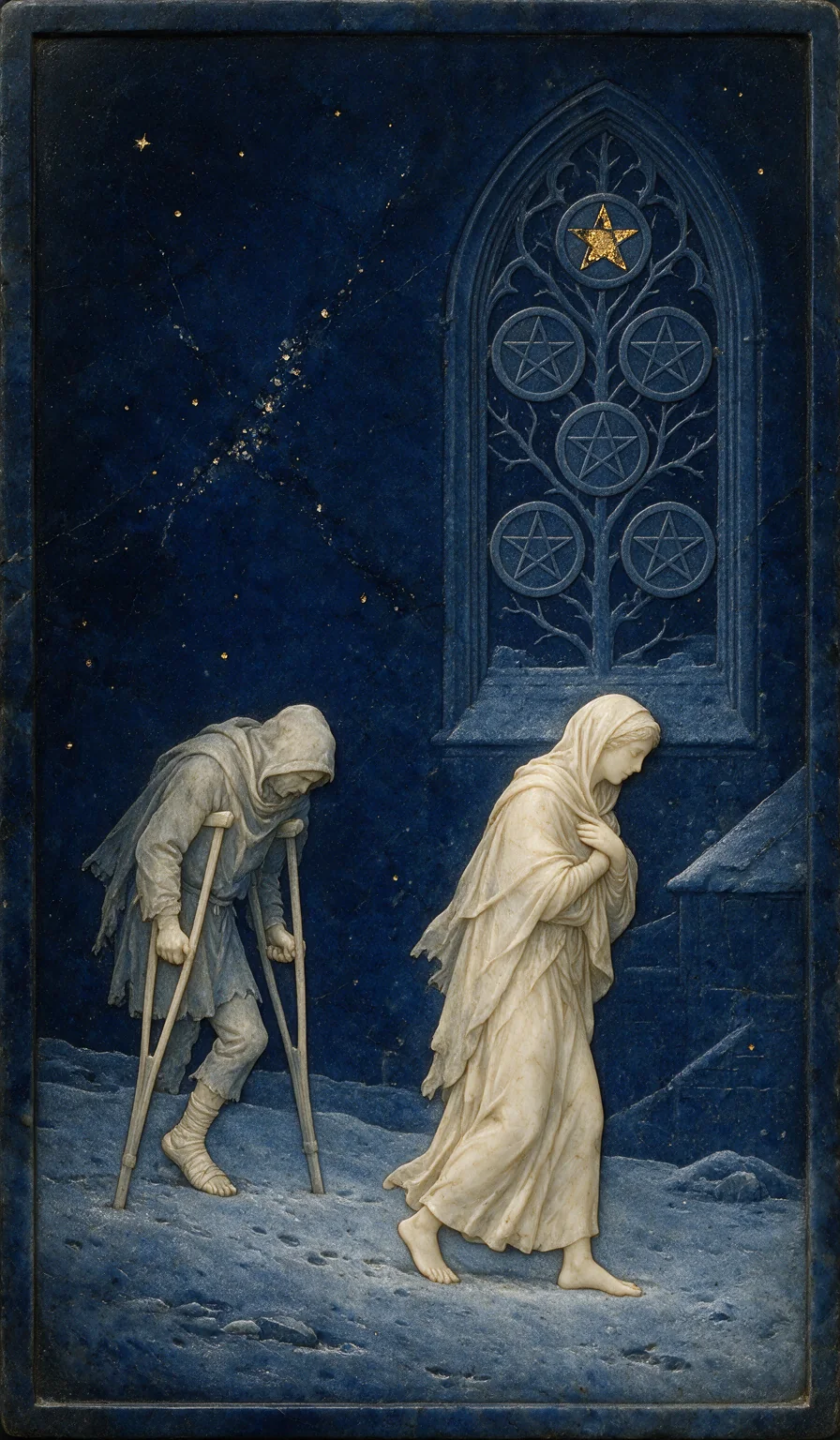
The Five of Pentacles is the card of being out in the cold: short of money, health, shelter or belonging, and feeling it in the body. In Olivia’s carving, two figures cross a field of frosted lapis at night. One leans on two crutches, the only visible foot wrapped in cloth; the other walks barefoot, shawl pulled over the head, arms folded tight across the chest. Both heads are bowed. The card does not judge the hardship or explain it away. It asks you to name it plainly: what is actually missing, and what is it costing you?
Above them rises a Gothic window. Where the traditional image sets bright stained glass above the snow, this window is unlit, its tracery a bare winter tree carrying five pentacles carved in the same cold blue as the wall. Only the star at its crown is gold, and neither figure looks up to see it. That is the card’s quiet point. Support, resources and people who care may be closer than they feel, yet hard to see when attention narrows to the next painful step.
So the Five of Pentacles invites two small acts: to acknowledge the strain without treating it as a verdict on your worth, and to lift your eyes once. Which door, service, friend or institution nearby could you approach, even if the window looks dark from where you stand?
Reversed
Five of Pentacles reversed can point to the first signs of a thaw: a door opening, a practical offer, energy slowly returning. It can also describe the card’s inward form, when help is within reach but hard to accept. Tiredness, embarrassment or an old disappointment keep the arms folded across the chest, as on the shawled walker, and asking feels impossible.
Here the card invites you to notice whether hardship has become a habit of mind: a feeling of standing outside even when the door is no longer shut. Name one concrete need, make one approach, and let the response be whatever it is. Accepting support does not cancel your strength; it lets you stop carrying everything alone through the snow.
Read the image
Every element below is carved into this card. Scroll, hover or press a number to follow it on the image.
The gold star above
What you seeAt the crown of the window’s tracery, a solid five-pointed star inlaid in gold sits inside a carved roundel. Apart from small flecks in the night sky, it is the only gold on the card, set high above both figures.
What it carriesA star is traditionally a sign of orientation and hope, as in The Star. In the traditional image the whole window is bright stained glass; here the one bright point in the scene is this star, hanging above the walkers’ heads, unseen by either of them, and still there while they pass.
Follow this symbol through the deck ↗Five pentacles in stone
What you seeBelow the gold star, five pentagrams inside circles are carved in the lapis itself, arranged as a pair, then one, then another pair, all in the same cold blue as the wall.
What it carriesThe five pentacles are the card’s number and the suit of earth: money, body, shelter, work. Here they are not gold but carved in the wall’s own blue, as if resources exist and are visible, yet belong to the building rather than to the hands of the people outside.
Follow this symbol through the deck ↗The unlit Gothic window
What you seeA tall pointed arch frames tracery shaped as a bare, leafless tree rising from a single trunk, with the pentacles held in its branches. No light shows through, and pale snow lines the sill.
What it carriesIn the traditional image the window glows, so the figures pass warmth they do not notice. Olivia’s window is dark, which shifts the question: support may be built into the world around you without being obvious from outside. The winter branches still carry the pentacles: dormant, not dead.
Follow this symbol through the deck ↗The shawled walker
What you seeA figure in warm cream ivory, shawl drawn over the head, walks to the right with head bowed and eyes cast down; both arms fold across the chest, one hand gripping the shawl.
What it carriesThe shawled figure is commonly read as endurance, and sometimes as pride or shame about being in need. Arms folded over the heart close the body around itself: a protective, brave posture, and also one that makes it hard to reach out for anything, including help.
Follow this symbol through the deck ↗The bowed, hooded head
What you seeBehind, on the left, a second figure in greyer, weathered ivory hunches forward under a deep hood, face shadowed and turned down towards the snow, a torn cloak trailing from the shoulders.
What it carriesThe traditional image gives this walker injury and a hard road through snow. Here the hood and the lowered gaze matter most: neither figure looks up, so the gold star and the window go unseen. Hardship narrows attention to the next step, which is natural and also limiting.
Follow this symbol through the deck ↗The dark house
What you seeAt the right edge, a small building is carved in shadowed lapis, its pitched roof edged with snow and its walls faintly marked; no lit window shows anywhere on it.
What it carriesOlivia’s carving adds a second shelter to the scene, and it repeats the theme: homes and buildings stand close by, closed and dark. It can point to places of belonging that are near in distance but far in feeling, and to the knock nobody has made yet.
Follow this symbol through the deck ↗The two crutches
What you seeThe hooded figure leans on two pale crutches with plain crossbars under the arms; both hands grip the handles halfway down, and the tips press into the snow on either side of the body.
What it carriesCrutches are the card’s plainest image of need, and of support already in use. The figure is carrying on with help, not without it. The Five of Pentacles often describes not having nothing, but having support that is thin, tiring or barely enough.
Follow this symbol through the deck ↗The bandaged foot
What you seeThe one foot visible beneath the ragged trouser leg is bound in wrapped strips of cloth up to the shin, and steps forward into the snow between the two crutch tips.
What it carriesBandages mark injury and the ongoing work of care. In a card of material trouble, the wrapped foot keeps the body in view: strain on health, rest and energy belongs to the Pentacles suit as much as money does, and it deserves practical attention, not only endurance.
Bare feet, footprints
What you seeThe shawled figure walks barefoot over pale, frosted lapis; small hollow footprints are pressed into the snow behind and between the walkers, and a few low stones break the surface near the bottom edge.
What it carriesBare feet on snow make the cold concrete: nothing stands between these walkers and the ground. The trail of prints also records that they keep moving. Hardship here is a passage crossed step by step, and the prints show how far they have already come.
Follow this symbol through the deck ↗
The number
Fives break the steadiness of the four. After the Four of Pentacles holds tight to what it has, the Five shows what happens when the grip fails or circumstances shift: something material is lost, stretched or suddenly insecure. In the earth suit, that disruption lands in practical life: income, home, health, work, the body’s reserves. The number asks for honesty about the gap rather than a show of stability, and it leans forward, since the Six of Pentacles turns to giving and receiving.
The tradition
In the Golden Dawn system the Five of Pentacles is titled Lord of Material Trouble and assigned to Mercury in Taurus, the first decan of that earth sign. As a Five it belongs to Geburah, the sphere of severity on the Tree of Life, here expressed in the material world, and the Order read it as strain and loss. Marseille-pattern decks show only five coins, four at the corners and one in the middle, among stylised foliage. Pamela Colman Smith’s 1909 design gave the card its lasting scene: two poor figures passing through snow beneath a stained-glass church window bearing five pentacles. Crowley’s Thoth deck later titled it Worry.
Love, work and self
- Love
- In close relationships, including the one with yourself, the Five of Pentacles can point to feeling on the outside: two people walking the same cold road, one a few steps behind the other, without speaking, or a sense of being unwelcome where you hoped for warmth. Like the two figures on the card, you may be closer to support than it seems. The card invites you to say one plain thing about what you need, and to notice where pride or tiredness keeps your arms folded.
- Work
- At work, in study or around money, this card turns attention to strain that is real and practical: a shortfall, lost hours, a role that no longer holds you, exhaustion that limits what you can do. It is not a judgement of your ability. The card invites you to write the situation down in concrete terms, then look for the dark window nearby: a support service, a tutor, a colleague, an adviser, an entitlement you have not yet claimed.
- Self
- For your own wellbeing, the Five of Pentacles asks how you treat yourself when resources run low. Notice the bandaged foot and the bare feet on snow: the body carries hardship too, and rest, warmth and food are not luxuries here. The card invites you to separate what is happening to you from what it says about you, and to allow yourself one small comfort without first having to earn it.
In a spread
Read the card through each position before you look at Olivia’s version. A position is a question, and the same card answers each one differently.
The situation
What aspect of the situation deserves attention?
Olivia’s readingAt the centre of your question may sit a sense of lack or exclusion: something material, physical or social feels insufficient, and you may be walking past support without looking up.
What complicates it
What tension or assumption deserves a closer look?
Olivia’s readingWhat complicates things may be the hardship itself, or reluctance to ask for help because of pride, shame or an earlier disappointment. Attention narrowed to getting through can miss a door that is open.
A helpful next step
What small action could help you understand or respond?
Olivia’s readingName your most pressing practical need in one sentence, then approach one person, place or service that might help with part of it, before deciding the window is closed.
In conversation with
- Five of Pentacles + Six of Pentacles
With the Six of Pentacles, the story continues: hardship meets giving and receiving. Together they draw attention to the balance of help in your life, where you need to receive support and where you might be able to offer it.
- Five of Pentacles + The Star
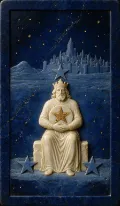
With The Star, the small gold star over this window becomes the central image of a whole card. Together they ask where hope can return after strain, and invite you to lift your eyes towards what still guides you on a cold night.
- Five of Pentacles + Four of Pentacles
With the Four of Pentacles, you see both sides of scarcity: holding everything tight, and being left with too little. Together they ask whether fear of the cold is shaping your choices, and what a less clenched relationship with security could look like.
Also read withThree of PentaclesNine of PentaclesAll pairs ↗
Questions to keep
- What exactly is missing right now, in money, health, shelter or company, when you name it without judging yourself?
- Which source of help nearby have you walked past because asking felt too hard?
- Where are your arms folded across your chest, protecting you and also keeping support out?
Ask them with three cards ↗A three-card reading in which each position asks one of these questions.
A small practice
Write your most pressing need in one sentence, list three people or places that could help with any part of it, and contact one of them this week.