Minor Arcana · Swords
Six of Swords
Tarot card meaning: upright, reversed and the symbols of the Olivia image
The Six of Swords turns attention to a quiet crossing: leaving strain behind, accepting help, and carrying what you have learned towards calmer ground.
- Upright
- transitionmoving onaccepted helpcalmer watersquiet recovery
- Reversed
- stalled crossingunfinished businesscarried baggagerefused helpclinging to shore
Upright
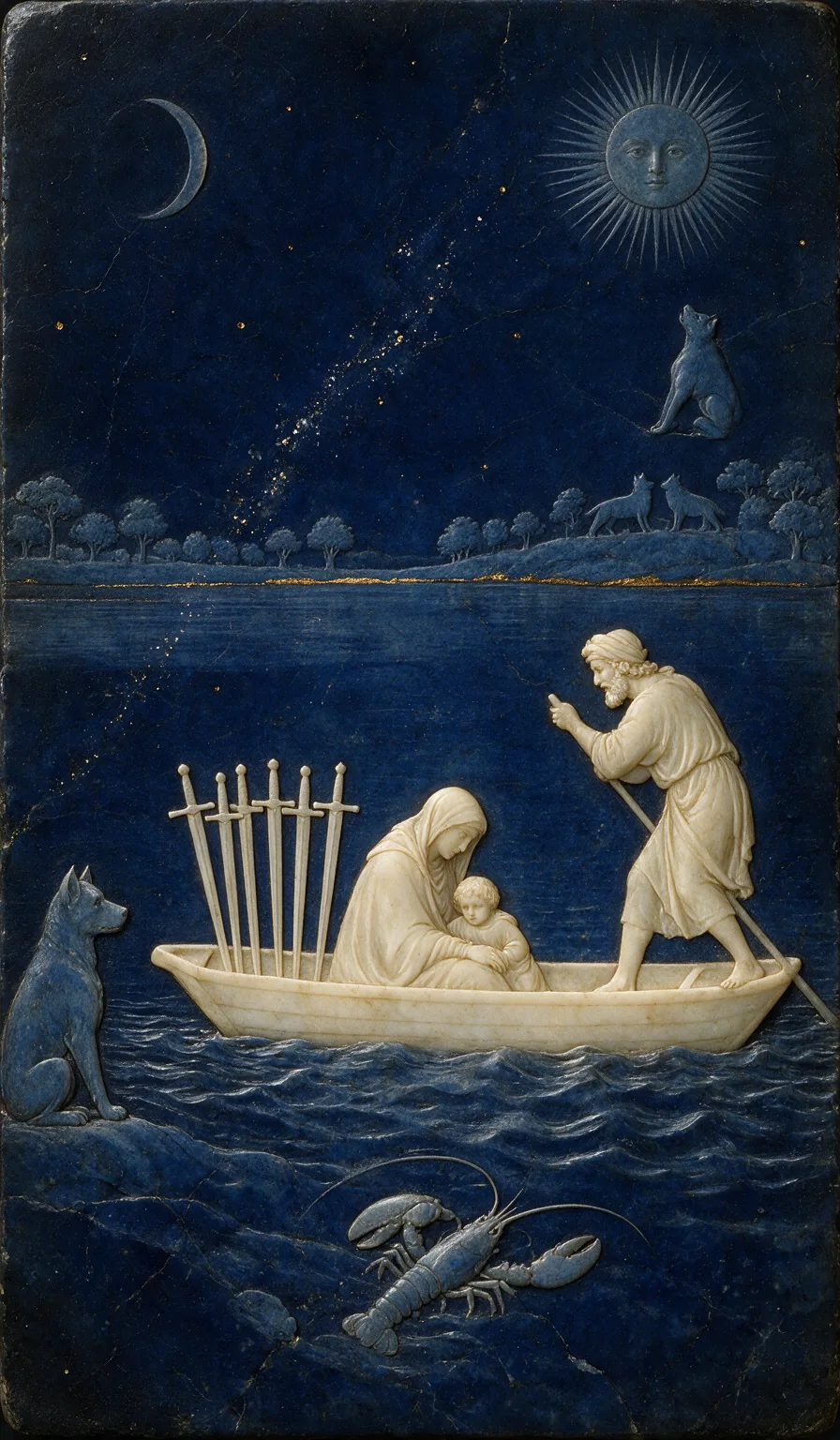
The Six of Swords draws attention to a passage: a move away from a time of strain towards ground that may be easier to stand on. It is rarely a triumphant card. In Olivia’s carving a hooded passenger bows over a child in the middle of a plain ivory boat, and the whole scene has the hush of travel at night. Nothing is being fought here. Someone is simply getting across.
Look at who does the work. At the stern, a barefoot figure leans into a long pole, pushing against the riverbed so the boat can move. Upright, the card invites you to let that kind of help count, whether it comes from a person, a routine, or the part of you that keeps going steadily when feeling is heavy. Six ivory swords stand upright in the boat. They come along: the thoughts, lessons and hard-won clarity of what came before are carried, not dropped.
The water tells the rest. Around the hull it is choppy with pale crests; beyond, it lies flat and finely lined, with a thread of gold along the far shore. The crossing happens in the rough part, not after it. Olivia also borrows the dog, wolves and crayfish of The Moon, so this passage may be partly felt before it is understood. You do not need the whole map to take the next pole stroke.
Reversed
Six of Swords reversed draws attention to a crossing that has stalled, or to the discovery that some difficulties have come with you into a new setting. The boat may feel stuck in the chop, the pole finding little purchase. Perhaps help has been refused because accepting it feels like admitting how hard things were, or the swords feel heavier now than they did at the start.
This position does not mean the move was wrong. It asks what still needs tending before the passage can feel complete: a conversation left unfinished, a practical step postponed, a feeling kept below the surface like the crayfish. Take stock of what you are carrying, set down what is not yours to carry, and ask again for the help that makes movement possible.
Read the image
Every element below is carved into this card. Scroll, hover or press a number to follow it on the image.
Six upright ivory swords
What you seeSix ivory swords stand in a close row in the left half of the boat, points hidden inside the hull, hilts rising above the passengers: knobbed pommels, straight crossguards, plain blades, the row fanning slightly apart.
What it carriesSwords are the suit of Air: thoughts, words and decisions. In the traditional image they ride upright in the boat, and here too nothing is thrown overboard. What was learned in difficulty comes along; standing clear of the passengers, the blades are carried, not wielded.
Follow this symbol through the deck ↗The hooded passenger and child
What you seeIn the middle of the boat a seated figure, wrapped from head to knee in a hooded mantle, bows over a curly-haired child and holds the child close with both arms. The child’s face turns towards the viewer.
What it carriesThe traditional card shows a huddled, cloaked passenger with a small child, often read as sorrow carried quietly and something tender protected on the way. Olivia’s passenger shelters rather than slumps: the bowed head reads as care, and the child’s face stays turned outward, towards the world beyond the boat.
Follow this symbol through the deck ↗The figure at the pole
What you seeAt the right end of the boat a barefoot figure in a long tunic and wrapped headcloth leans forward towards the passengers, one raised hand gripping the top of a long pole that slants down past the stern into the water behind.
What it carriesThe one who punts is the card’s helper, commonly read as assistance accepted: another person, or the steady part of you that keeps working while feeling rests. A pole pushes against the riverbed rather than cutting the water, so progress here comes from patient, repeated effort.
Follow this symbol through the deck ↗The ivory boat in choppy water
What you seeA plain, long, shallow ivory boat with a raised prow at the left and a small crossbar near the stern. Pale-crested waves ripple around its hull; with the pole pushing back to the right, it travels left.
What it carriesA boat is tarot’s image of passage: crossing from one state to another with something to hold you up. Smith’s card is often read as moving from rough water towards smoother water. Here the chop surrounds the boat itself: the crossing happens inside the unsettled part, not after it.
Follow this symbol through the deck ↗The gilded far shore
What you seeBeyond the boat the water lies flat and finely lined. Across it, a low bank of rounded lapis trees runs the width of the card, and a thin vein of gold traces the waterline along most of its length.
What it carriesIn the traditional image the further shore is simply where the passage leads. Olivia marks it with the card’s one sustained line of gold, quietly and without drama. Calmer ground exists and is already visible across the water, even while the crossing is still under way in the chop.
Follow this symbol through the deck ↗Sun-face and crescent together
What you seeAt the upper right a pale grey-blue disc with a calm, open-eyed face sends out long, straight rays; at the upper left a thin crescent moon curves in lighter lapis. Gold flecks glitter in a diagonal band below them.
What it carriesThe traditional Six of Swords has a plain sky. Olivia sets day and night in one sky, a between-time that suits a crossing. The rayed face also recalls the disc of The Moon: a hint that this passage is travelled partly by feel, not only by map.
Follow this symbol through the deck ↗Wolves beneath the sun
What you seeBelow the sun a seated wolf lifts its muzzle towards the rayed face. Lower down, two more wolves with bushy tails stand facing each other on the far bank, all carved in grey-blue lapis.
What it carriesWolves are not part of the traditional Six of Swords; they come from The Moon, where a wolf and a dog howl at the sky. Here they suggest the wilder, instinctive voices of a transition: restless feeling calling out on the far side, heard but held at a distance by the water.
The dog on the rock
What you seeAt the lower left a large seated dog in grey-blue lapis, tall pointed ears raised and mouth closed, sits upright on a rocky ledge at the water’s edge and faces the prow of the boat.
What it carriesIn The Moon the dog is the tame counterpart of the wolf: instinct at peace with human company. Placed on the near shore, in the direction the boat is moving, it reads as calm, loyal company for the crossing, the steadier part of you already on solid ground.
The crayfish below
What you seeBeneath the waves, on dark rocky ground, a grey-blue crayfish lies angled from lower left to upper right, both claws held out and long antennae arching overhead; a small rounded stone lies to the left of its tail.
What it carriesThe crayfish is another guest from The Moon, where it crawls out of a pool as feeling rising from deep, wordless places. Under this crossing it stays below the surface: some feelings travel underneath, and do not have to be hauled up into words for the boat to move.
Follow this symbol through the deck ↗
The number
Six is the number of balance restored. After the upheaval of the Fives, the Sixes bring a return to harmony: generosity in Pentacles, remembered sweetness in Cups, recognition in Wands. In Swords, the suit of Air and mind, that harmony arrives as relief rather than victory: thought moving away from conflict towards calmer understanding. Sitting between the Ace’s single clear idea and the Ten’s overload, the Six asks for movement in company rather than solitary struggle.
The tradition
In the Golden Dawn system the Six of Swords is titled the Lord of Earned Success. It is assigned to Mercury in Aquarius, the second decan of that sign (10 to 20 degrees), and to Tiphareth, Beauty, the sixth Sephirah on the Tree of Life, expressed through the suit of Air. Mercury’s quick intelligence in detached, far-sighted Aquarius is often read as a mind regaining its balance after strain; Aleister Crowley titled the card Science. Marseille decks show only an interlaced pattern of curved blades. The ferry scene comes from Pamela Colman Smith’s 1909 design, and A. E. Waite’s brief description speaks of passengers carried in a punt to the further shore.
Love, work and self
- Love
- In close relationships the Six of Swords can reflect a period of moving on from tension: leaving an argument behind, easing out of a pattern, or giving a connection some distance so it can settle. It does not tell you what anyone else feels. It asks who is holding the pole right now, and whether care is flowing both ways. Like the hooded passenger with the child, you may be protecting something tender while you travel. Let that be enough for this stretch.
- Work
- At work or in study, the card can point to a transition: a new role, a changed plan, or a quieter method after a period of friction. Bring the six swords with you: what the difficult time taught you about limits, communication and what you actually need. Accept practical help without apologising for it. Where money or contracts are involved, a qualified adviser serves better than trying to reach the other side in one push.
- Self
- For your relationship with yourself, the Six of Swords invites a gentler pace of recovery. The choppy water around the boat is honest: moving on can feel unsettled, and relief can arrive alongside sadness. Notice the dog sitting calmly on the rock, the steadier part of you that has not gone anywhere. Rest where you can, let someone else steer for a while if that is available, and measure progress in pole strokes rather than distances.
In a spread
Read the card through each position before you look at Olivia’s version. A position is a question, and the same card answers each one differently.
The situation
What aspect of the situation deserves attention?
Olivia’s readingAt the centre of a question, the Six of Swords can point to a transition that may already be under way, quieter than it looks from outside, in which getting across matters more than arriving quickly.
What complicates it
What tension or assumption deserves a closer look?
Olivia’s readingAs a challenge, the card can show reluctance to leave familiar trouble, difficulty accepting help, or the hope that a new setting alone can settle what still needs attention.
A helpful next step
What small action could help you understand or respond?
Olivia’s readingAs advice, it invites you to choose one steady step away from strain, let reliable help take some of the weight, and bring the lessons along without reliving them.
In conversation with
- Six of Swords + The Moon
The Moon lends this card its dog, wolves and crayfish. Together they draw attention to a crossing made partly in the dark, where feeling runs ahead of understanding, and to trusting small, steady steps when the way is not fully visible.
- Six of Swords + Five of Swords
The Five of Swords shows the aftermath of conflict; the Six moves away from it. Together they trace a sequence and ask whether the moment has come to leave an argument behind rather than try to win it.
- Six of Swords + Eight of Cups
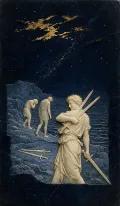
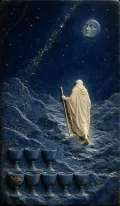
The Eight of Cups also leaves something behind, walking away alone by night. Beside the Six of Swords the pair contrasts a solitary departure with an assisted passage, and asks which kind of moving on fits you now.
Questions to keep
- What are you moving away from, and what calmer ground would be enough for now?
- Which of the swords you carry is worth keeping, and which could be set down on arrival?
- Who, or what steady habit, is holding the pole for you at the moment?
Ask them with three cards ↗A three-card reading in which each position asks one of these questions.
A small practice
Write down one lesson from a hard stretch that you want to keep, then one small practical step that moves you a little further across this week.