Minor Arcana · Cups
Ten of Cups
Tarot card meaning: upright, reversed and the symbols of the Olivia image
The Ten of Cups turns attention to belonging that has become everyday: feeling shared, held and returned among the people who make a place feel like home.
- Upright
- shared joybelongingemotional fulfilmenthomegratitudeharmony
- Reversed
- strained closenessideal picturedisconnectionunspoken needsperformed happiness
Upright
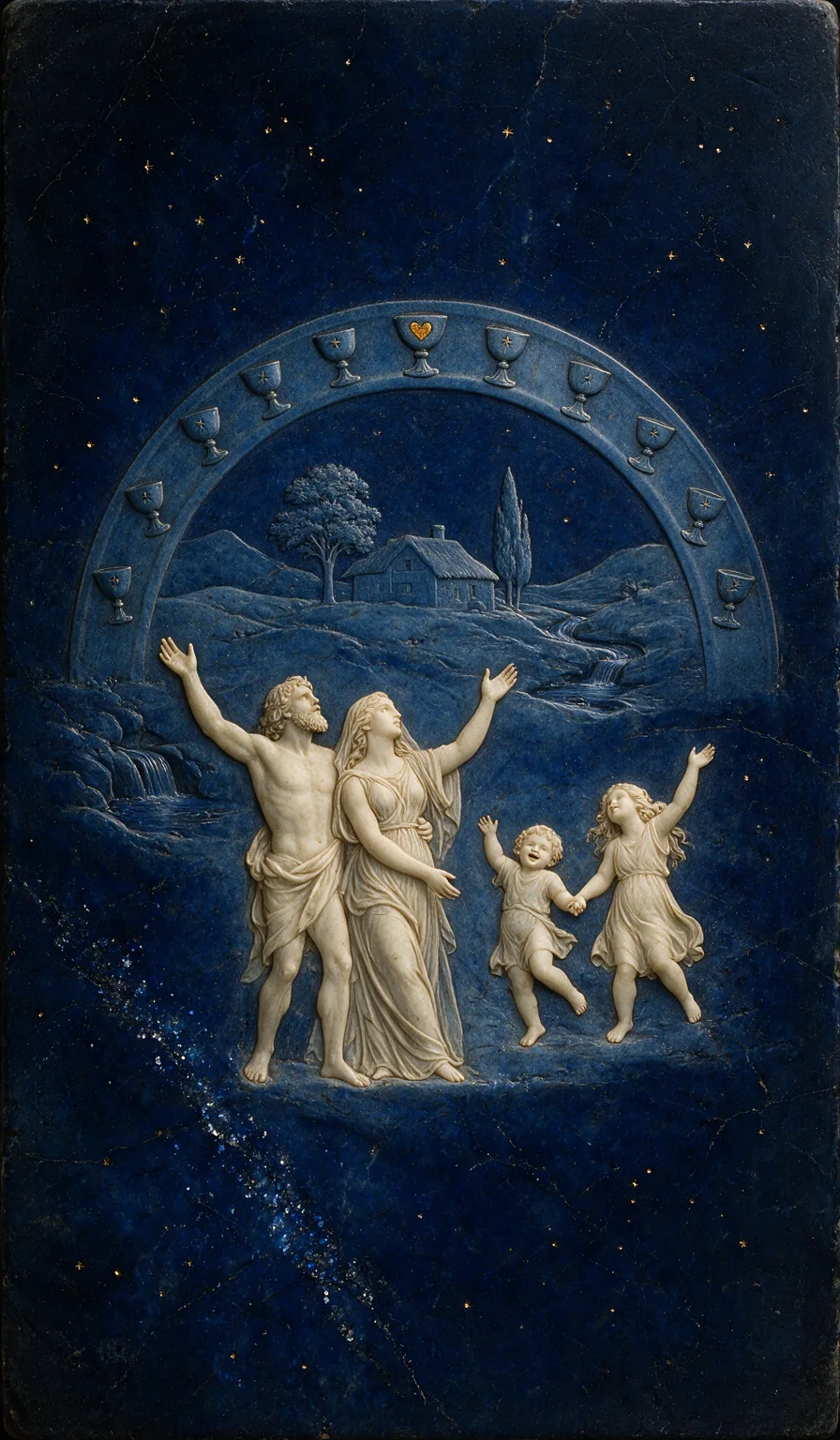
The Ten of Cups draws attention to the fullness that comes when feeling is shared. The Ace offered one cup; here the suit of Water reaches completion, and what completes it is not a possession but a circle of people. In Olivia’s image two adults stand pressed together, one arm holding, one arm raised, while two children dance hand in hand beside them. Nobody holds a cup. Every free hand reaches upward, toward the arch where a gold heart sits among ten starred goblets.
This is the card of belonging that has settled in: being known, welcomed and allowed to be as you are among your people, whether that means family, a partner, friends or a chosen community. The cottage under the arch is small and far away, and that detail matters. The card does not ask you to live inside a perfect picture; it asks you to notice the moments when home is already present, in a shared meal, a joke that needs no explaining, or a quiet evening that feels easy.
Upright, the Ten of Cups invites gratitude with open hands, like the figures’ raised palms. It can point to a time to celebrate what has been built together, to say thank you aloud, and to tend the everyday care that keeps closeness real.
Reversed
Ten of Cups reversed draws attention to distance inside a close circle, or to the pressure of keeping up a picture of harmony that everyday life does not match. The carved arch can start to feel like a frame you are meant to fit: smiling for the photograph while something goes unsaid at the table. It may also point inward, to a sense of not quite belonging even where you are loved, or to needs you have stopped mentioning.
None of this means the circle is broken. Households, friendships and chosen families all pass through strain and repair. The reversed card asks for one honest step: naming a need, making a small repair, or letting the ideal picture go so the real one has room.
Read the image
Every element below is carved into this card. Scroll, hover or press a number to follow it on the image.
The gold-heart cup
What you seeAt the very top of the arch, directly above the cottage, one lapis goblet carries a solid gold heart inlaid across its bowl. Five cups descend the arch on either side of it.
What it carriesCups are the suit of Water: feeling, love and relationship. Olivia sets a heart-marked cup at the keystone, where the traditional arc of ten cups has no single centre. Everything on the arch leans toward one warm point, as if the household’s feeling were gathered there.
Follow this symbol through the deck ↗Ten star-marked goblets
What you seeTen grey-blue goblets with knopped stems and fluted feet are carved in low relief along the arch, five either side of the heart cup. Each bowl bears a tiny incised star touched with gold.
What it carriesThe traditional card shows ten cups riding a rainbow. Counting the heart cup, Olivia’s arch holds eleven: ten star-marked cups keep the card’s number, and the extra one reads like a heart held in common. Their small stars echo the night sky around them.
Follow this symbol through the deck ↗The carved stone arch
What you seeA broad band of paler, greyer lapis rises from the left near the figures’ raised hands, curves in a near semicircle above the cottage and comes down on the right, framing the valley like a window.
What it carriesIn the traditional card this is a rainbow in full colour, a classic image of peace after a storm. Olivia carves it in plain stone, turning passing light into something built: harmony here is a structure people make and keep up, not weather that simply arrives.
Follow this symbol through the deck ↗The cottage in the valley
What you seeInside the arch, a small cottage with a thick thatched roof, a single chimney and a few dark windows sits on a low rise, carved in muted blue lapis among rolling hills.
What it carriesThe house is the card’s quiet goal: home as a place of belonging rather than property. It sits far off and small, which keeps the image honest. The family does not stand inside the ideal; it looks toward it from open ground, where everyday life happens.
Follow this symbol through the deck ↗The broad tree and cypresses
What you seeTo the left of the cottage stands one broad, full-crowned tree on a slender trunk; to its right rise two tall, narrow cypresses side by side, their tips reaching into the starry sky.
What it carriesTrees around the house are traditional signs of a settled, fruitful life. The rounded tree offers shade and shelter; the tall cypress, evergreen and long associated with remembrance, adds a note of endurance. Together they frame the home with both comfort and continuity.
Follow this symbol through the deck ↗The embracing pair
What you seeTwo barefoot ivory adults stand pressed together: a bearded figure with cloth at the hips wraps one arm round the waist of a veiled figure in a long robe. Each lifts one open hand skyward.
What it carriesIn the traditional image the couple are seen from behind, arms raised toward the rainbow. Olivia turns them toward us with faces lifted, so we see their wonder rather than only their backs. One arm holds, one arm opens: closeness and gratitude in a single gesture.
The dancing children
What you seeTo the right, two smaller ivory children hold hands mid-dance, knees bent, heels lifted, each raising the free arm. The curly-haired one laughs openly; the taller, long-haired one tips the face upward.
What it carriesChildren dancing in this card are traditionally read as joy that needs no reason, and as the future a household makes room for. In the traditional image the children play facing each other, turned away from the rainbow; here each lifts a free arm skyward, so their play and the adults’ wonder share one upward reach.
Follow this symbol through the deck ↗The cascade and stream
What you seeOn the far left, a small waterfall spills over carved rocks into a pool beside the adults. Inside the arch on the right, a winding stream drops over a little fall of its own.
What it carriesWater is the element of Cups, and here it moves freely through the land rather than sitting still in the goblets. Feeling that flows, falls and gathers again belongs to this harmony: the scene does not need still water to be at peace.
Follow this symbol through the deck ↗The glittering mineral vein
What you seeFrom the left edge beside the figures, a pale band of glittering mineral runs diagonally down toward the lower centre of the dark lapis, among scattered gold star flecks and fine hairline cracks.
What it carriesThis is natural stone rather than a carved symbol, but it is prominent here and reads like the Milky Way beneath the family’s feet. The night setting departs from the traditional daylight scene: contentment shown at the end of a day, lit from above.
Follow this symbol through the deck ↗
The number
Ten completes the count of the pips: the cycle that began with the Ace has run its full course. In Cups, the suit of Water, that means feeling that has moved from a first opening through meeting, celebration, loss and wishing, and has come to rest in shared life. Ten is also a threshold: a full cup stays full only by being poured and refilled. The Ten of Cups asks what it means to live inside a fulfilment rather than keep reaching toward it.
The tradition
In the Golden Dawn system the Ten of Cups is titled the Lord of Perfected Success and is attributed to Mars in Pisces, the third decan of that sign. As a ten it belongs to Malkuth, the final sephirah, where the suit’s feeling becomes something lived and tangible. Aleister Crowley later named the card Satiety, a title commonly read as a reminder that fullness can tip into having had enough. In Marseille-pattern decks the card simply arranges ten cups, usually with a larger cup set above the rest. Pamela Colman Smith’s 1909 design introduced the family beneath a rainbow of cups, the scene most modern decks, Olivia’s included, follow.
Love, work and self
- Love
- In love and close relationships, the Ten of Cups draws attention to the shared life around a bond: the friends, family and routines that let closeness breathe. Like the pair on the card, one arm around the other and one hand raised to the sky, it asks whether your relationships have room for both intimacy and a wider circle. With yourself, it can mean feeling at home in your own company, the way the children dance without checking who is watching.
- Work
- At work or in study, the Ten of Cups can point to a team or community where people feel they belong, not only where tasks get done. It invites you to notice who makes the place feel humane, and to thank them. It can also ask whether your work leaves space for the people you come home to. In money matters it turns attention toward shared wellbeing and what feels like enough, rather than toward any particular figure.
- Self
- For your inner life, the Ten of Cups asks where you feel at home, in places, people and practices, and whether you let yourself rest there. The figures reach outward and upward rather than turning inward; contentment here includes wonder and gratitude. If you carry an ideal of the perfect family or community, this card invites you to hold it lightly, and to value the real belonging you already have, imperfections and all.
In a spread
Read the card through each position before you look at Olivia’s version. A position is a question, and the same card answers each one differently.
The situation
What aspect of the situation deserves attention?
Olivia’s readingAt the centre of your question, the Ten of Cups points to belonging: what matters most here may be the people involved and how at home everyone can feel, more than any single outcome.
What complicates it
What tension or assumption deserves a closer look?
Olivia’s readingAs the challenge, the Ten of Cups can show an ideal picture of harmony getting in the way of real closeness, or a wish to keep everyone content that leaves your own needs unspoken.
A helpful next step
What small action could help you understand or respond?
Olivia’s readingAs advice, the Ten of Cups invites you to share something good: gather people, say thank you, or make one small gesture that helps someone feel they belong.
In conversation with
- Ten of Cups + Nine of Cups
The Nine of Cups, often called the wish card, sets its cups behind one contented figure; in Olivia’s deck both cards place a gold heart on the central cup. Together they ask how private fulfilment becomes shared, and who enjoys what you have gathered.
- Ten of Cups + Ten of Pentacles
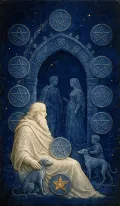
Both tens show a household. The Ten of Pentacles leans toward what is built and handed down: shelter, resources, legacy. The Ten of Cups leans toward what is felt. Together they draw attention to home as both a structure and a warmth, and to whether the two are in balance.
- Ten of Cups + The Sun
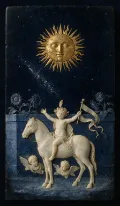
The Sun and the Ten of Cups share a child’s open-armed, uncomplicated joy. The Sun gathers it into one rider beneath a great gold disc; the Ten spreads it across a household under an arch of cups. Together they point to happiness that is simple, visible and shared.
Also read withAce of CupsAll pairs ↗
Questions to keep
- Where in your life do you already feel at home, and who helps make it so?
- Which picture of the ideal family or community are you measuring your real one against?
- What small, regular act of care would help the people close to you feel they belong?
Ask them with three cards ↗A three-card reading in which each position asks one of these questions.
A small practice
This evening, write down three moments from the past week when you felt you belonged, and send a short thank-you to one person who was part of one.
Cards that share its symbols
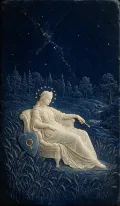 The EmpressShares: The glittering mineral vein · The broad tree and cypresses · The cascade and stream · The gold-heart cup
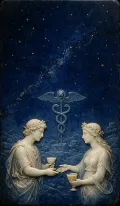 Two of CupsShares: The glittering mineral vein · The cottage in the valley · Ten star-marked goblets · The gold-heart cup
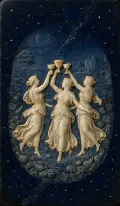 Three of CupsShares: The gold-heart cup · Ten star-marked goblets · The glittering mineral vein
 Four of CupsShares: Ten star-marked goblets · The broad tree and cypresses · The glittering mineral vein