Minor Arcana · Cups
Three of Cups
Tarot card meaning: upright, reversed and the symbols of the Olivia image
The Three of Cups celebrates feeling that is shared: friendship, mutual support and the joy of being welcomed into a circle as you are.
- Upright
- friendshipcelebrationcommunitymutual supportshared joybelonging
- Reversed
- overindulgenceexclusiongossipsocial fatiguedrifting apart
Upright
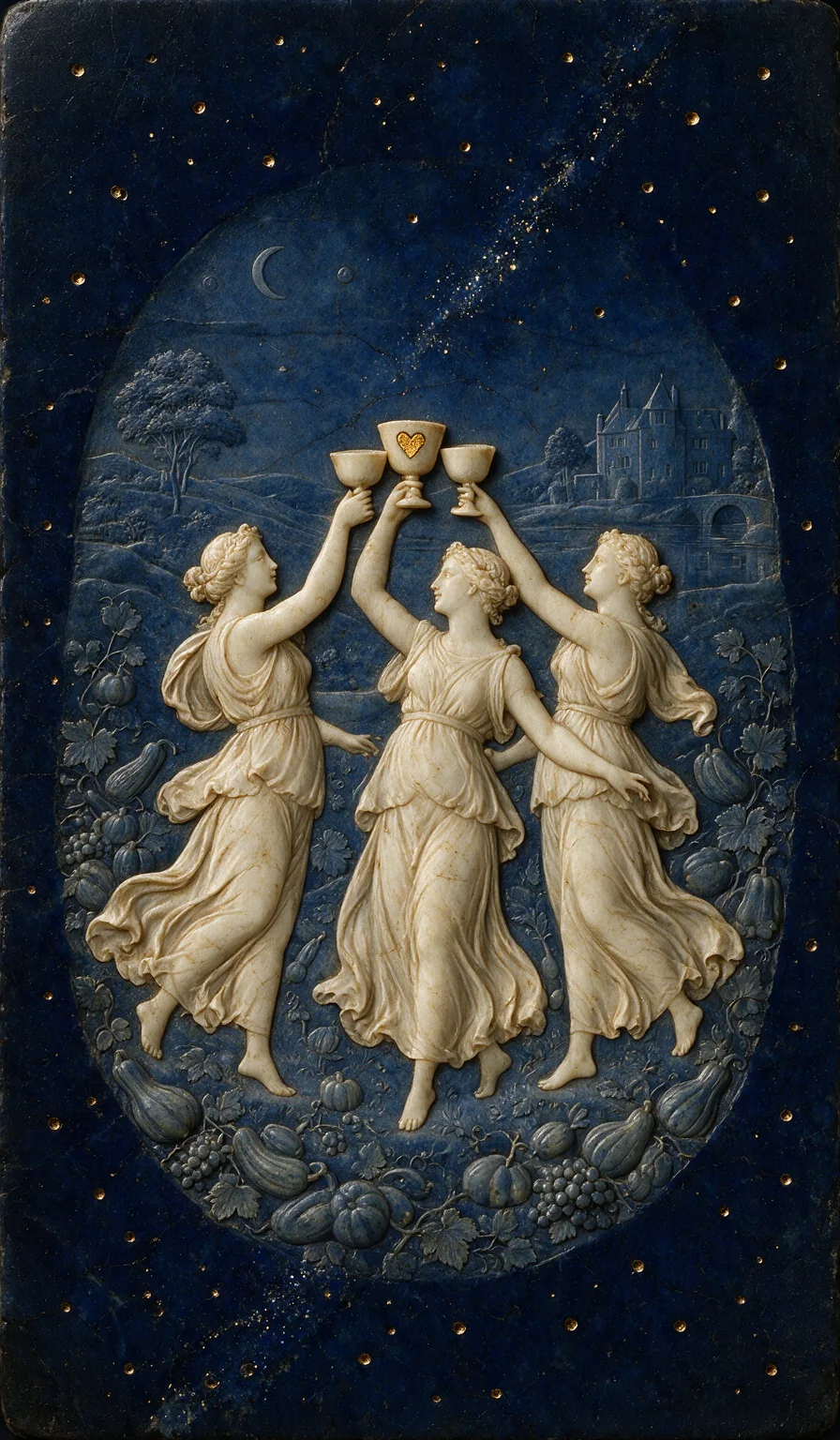
The Three of Cups is the moment feeling becomes company. Perhaps something good has happened, or simply the day is over, and you are among people who are glad to see you. In Olivia’s image three ivory dancers turn in a ring under a crescent moon, raising three cups so that they meet in the air above their heads. The central cup carries a small heart of inlaid gold, the only gold inside the carved oval: what is being celebrated belongs to all of them together.
Look lower and there is a second gesture. Below the raised arms, free hands rest on a neighbour’s hip or reach toward a neighbour’s side, linking the three bodies into one chain. Upright, this card draws attention to that double nature of friendship: the visible toast, and the ordinary support that holds people steady when no one is celebrating. It can point to a gathering, a reunion, a team that works well, or a group where you do not have to explain yourself.
The garland of gourds, vines and grapes at the dancers’ feet adds a note of harvest. Something has ripened, and it is worth marking. The card invites you to let good news be shared, to accept care as well as offer it, and to notice who makes your joys feel larger simply by being there.
Reversed
Three of Cups reversed turns attention toward a circle that has lost its ease. Shared fun can slide into overindulgence, or closeness can tip into talk about whoever is absent. A group can also begin to feel closed, so that belonging depends on laughing at the right jokes or hiding part of yourself. Sometimes the reversal is quieter: friendships drifting because no one has made the call.
In Olivia’s image the hands that link the dancers matter as much as the raised cups. Reversed, the card asks where the toasting continues but the steady touch has gone, or where you have been holding the cup alone. Notice which company restores you and which leaves you performing, and choose one friendship to tend in a small, direct way.
Read the image
Every element below is carved into this card. Scroll, hover or press a number to follow it on the image.
The gold heart
What you seeA small heart of inlaid gold sits on the bowl of the central cup; apart from the star flecks in the dark border, it is the only gold on the card and the brightest point at its centre.
What it carriesThe traditional Three of Cups has no heart on it at all. Olivia marks the meeting point of the three cups with gold, the deck’s sparing sign of something precious: what is being raised here is shared feeling, the warmth that belongs to all three at once.
Follow this symbol through the deck ↗Three raised cups
What you seeThree ivory goblets on short knopped stems meet above the heads of the dancers, each held up by a single hand; the central one is larger and set slightly higher, the two outer cups close on either side.
What it carriesCups are the suit of Water: feeling, love and relationship. Raised together they make a toast, the old gesture of pledging one another. Here the three bowls almost touch, so the image reads less as three separate drinks than as one shared celebration.
Follow this symbol through the deck ↗Three dancing figures
What you seeThree ivory figures in high-belted, flowing classical dresses turn in a loose ring, hair gathered up in carved curls, bare feet mid-step, the ivory threaded with fine gold-brown veins.
What it carriesThe figures are often compared with the Three Graces of classical art, who stood for brightness, mirth and good cheer. Olivia carves them in the manner of an antique relief, so friendship appears as something old and recurring, a pattern people have always danced.
The linking hands
What you seeBelow the raised arms, free hands reach sideways at waist height: the central dancer’s hand rests on the right-hand dancer’s hip, and the left-hand dancer’s open hand reaches toward the central dancer’s side.
What it carriesReadings of this card usually centre on the raised cups. Olivia’s carving gives weight to a second, quieter gesture: touch at waist height, below the toast, joining the three into one turning chain. It suggests the celebration rests on steady contact, not only on the moment of raising the glass.
Follow this symbol through the deck ↗The crescent and two discs
What you seeHigh in the upper left of the paler oval sky, a slim silver-grey crescent is carved in relief, with a small round disc on either side of it, left and right.
What it carriesThe traditional card is set in a garden by day. Olivia moves the gathering under a crescent moon, fitting for a card attributed to Cancer, the sign ruled by the Moon. The night setting turns the scene toward intimacy: celebration among people who can see you after dark.
Follow this symbol through the deck ↗The river of stars
What you seeA glittering diagonal band of silvery flecks runs from the upper right of the dark border down into the lighter oval sky, toward the centre of the card.
What it carriesThe Milky Way is an image of countless points of light belonging to one stream. Above three friends it widens the picture: each small circle of belonging sits inside a much larger human one, and both are part of what this card celebrates.
Follow this symbol through the deck ↗The castle by the water
What you seeOn the right horizon, carved in pale grey-blue lapis, a turreted manor with many windows stands among trees above still water, crossed by an arched stone bridge; a single leafy tree answers it on the left hill.
What it carriesThe traditional Three of Cups shows no buildings. Olivia’s distant castle and bridge suggest home and the way between places: the settled life each dancer returns to after the dance, and the crossings that friendship makes possible between separate lives.
Follow this symbol through the deck ↗The ring of gourds
What you seeAround the dancers’ feet an oval garland of round pumpkins and long curved gourds, with vine leaves and curling tendrils, is carved in greyish lapis, framing the lower half of the scene.
What it carriesHarvest produce lies at the dancers’ feet in the traditional image, marking this as a celebration of something that has ripened. Olivia turns it into a full garland enclosing the ring, so the abundance is not a backdrop but the ground the dance stands on.
Follow this symbol through the deck ↗Clusters of grapes
What you seeSeveral bunches of grapes, carved as tight beaded clusters in blue-grey lapis, sit among the gourds and vine leaves of the garland, the largest at its lower right, below the right-hand dancer’s feet.
What it carriesGrapes are an ancient sign of festivity and of wine shared at table. In a suit of Water they recall that feeling ferments and deepens with time, and gently hint that celebration is richest when it is not drunk too fast.
Follow this symbol through the deck ↗
The number
Threes are the first growth after the meeting of a pair: something new appears between two, and a relationship opens into a small community. In Cups, the suit of Water and feeling, the Two of Cups is a bond between two people; the Three widens that bond into a circle where joy can be witnessed and shared. It is feeling finding expression outside yourself, the stage before the Four, where emotion turns inward again and begins to look at what it already has.
The tradition
In the Golden Dawn system the Three of Cups is titled the Lord of Abundance and attributed to Mercury in Cancer, the planet of exchange and speech in the second decan of a Water sign ruled by the Moon. Like all Threes it belongs to Binah, Understanding, on the Tree of Life. Aleister Crowley kept the title Abundance for his Thoth deck. Marseille-pattern decks show the card as three cups arranged among stylised flowering foliage, with no people. Pamela Colman Smith’s 1909 design shows three figures raising their cups in a garden with harvest produce at their feet, an image commonly compared with the classical Three Graces.
Love, work and self
- Love
- In close relationships the Three of Cups points to love that has room for other people: friends who know you both, a family gathering that feels warm, or the pleasure of celebrating together. It does not describe what anyone else feels. It asks whether your connections are held within a wider circle of support, and whether that circle leaves each person free. With yourself, it invites you to count friendship as a form of love, not a lesser one.
- Work
- At work or in study, this card can draw attention to collaboration that feels easy, a team milestone worth marking, or peers who share what they know. It favours working with others over proving yourself alone. Notice where recognition could be shared more fairly, and where a small celebration would help a group see how far it has come. Where money is involved, the card suggests talking openly with the people it affects rather than deciding in isolation.
- Self
- For your relationship with yourself, the Three of Cups asks where you feel most yourself among others. The dancers turn at different angles yet move as one ring, each keeping a separate step. Notice the company in which you relax rather than perform, and the places where you have slipped into being only the host or the listener. Let yourself be the one who is celebrated for a moment.
In a spread
Read the card through each position before you look at Olivia’s version. A position is a question, and the same card answers each one differently.
The situation
What aspect of the situation deserves attention?
Olivia’s readingAt the centre of a question, the Three of Cups points to friendship, shared joy or a supportive circle as the real subject, rather than a problem to solve alone.
What complicates it
What tension or assumption deserves a closer look?
Olivia’s readingAs a challenge, the card can show a social circle that has become tiring, exclusive or indulgent, or a need for support that you have been reluctant to ask for.
A helpful next step
What small action could help you understand or respond?
Olivia’s readingAs advice, it invites you to share something good with people who care, or to reach out to a friend and make a small, specific plan to meet.
In conversation with
- Three of Cups + Three of Swords
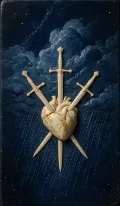
Two Threes of the Minor Arcana, both built around a heart: the Three of Swords shows the grief that can pass between people, the Three of Cups the joy. Together they ask which company helps you carry either one.
- Three of Cups + The Empress
The Empress, card number three, is abundance in one figure; the Three of Cups is abundance shared among many. Together they draw attention to harvest, nourishment and the pleasure of enjoying what has grown.
- Three of Cups + Three of Pentacles
The Three of Pentacles is shared skill at work; the Three of Cups is shared feeling at rest. Together they point to groups that build something well and also take time to celebrate it.
Also read withFour of WandsAll pairs ↗
Questions to keep
- Who helps you feel included without asking you to perform or explain yourself?
- What recent good thing in your life has not yet been shared or marked with anyone?
- Where in your friendships do you mostly give support, and where do you let yourself receive it?
Ask them with three cards ↗A three-card reading in which each position asks one of these questions.
A small practice
Send a short message to one friend naming a specific moment you enjoyed together, and suggest a simple time to meet again.
Cards that share its symbols
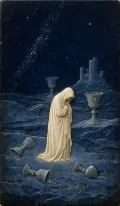 Five of CupsShares: The linking hands · Three raised cups · The gold heart · The castle by the water · The river of stars
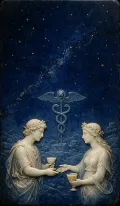 Two of CupsShares: The river of stars · Three raised cups · The linking hands · The gold heart
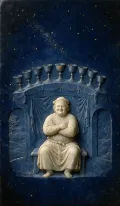 Nine of CupsShares: Three raised cups · The gold heart · The linking hands · The river of stars
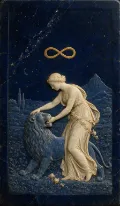 StrengthShares: The river of stars · The crescent and two discs · The linking hands