Minor Arcana · Cups
Seven of Cups
Tarot card meaning: upright, reversed and the symbols of the Olivia image
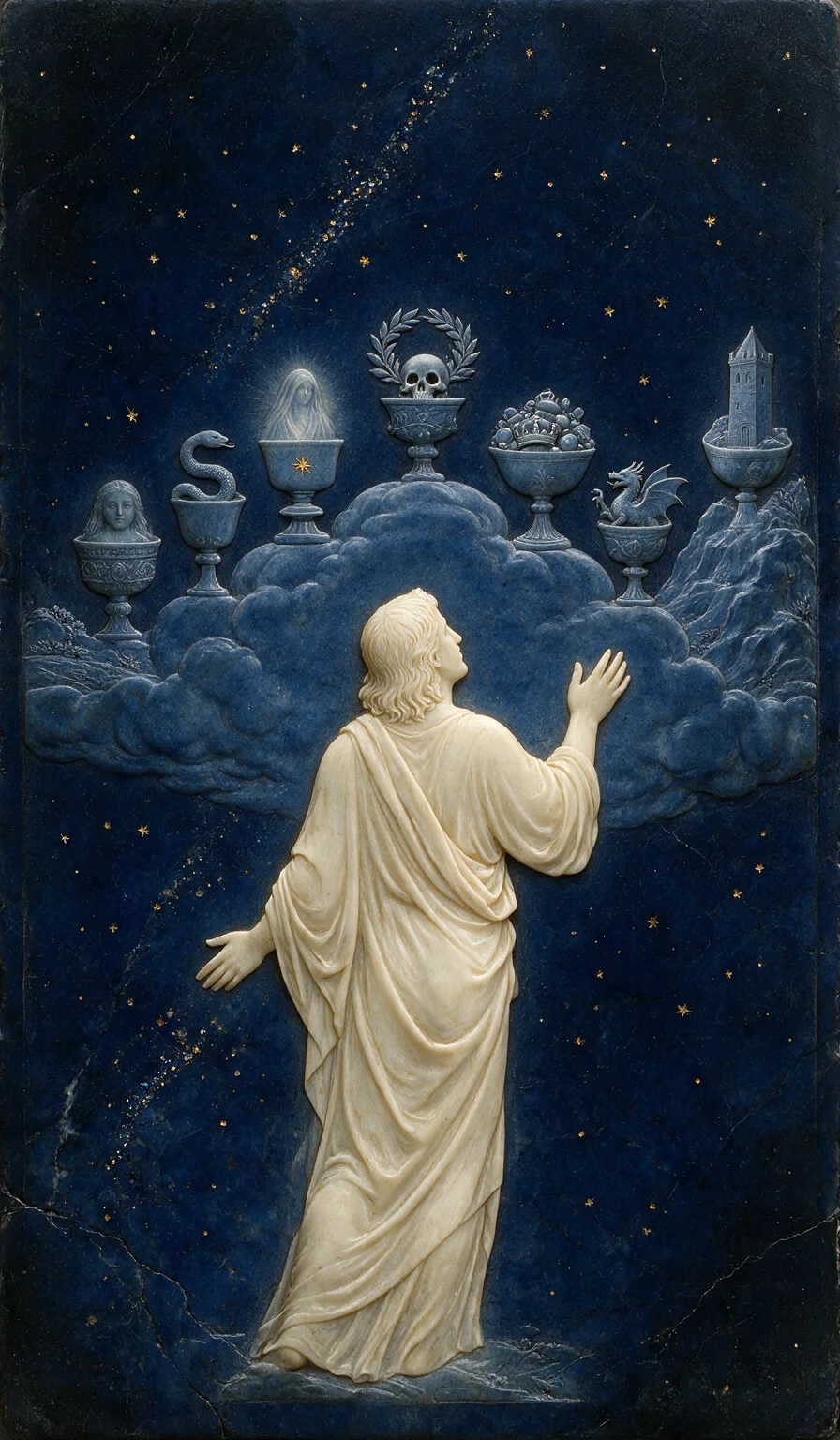
The Seven of Cups turns attention to a crowd of imagined possibilities and asks you to tell what you truly want from what only glitters from afar.
- Upright
- imaginationmany optionsdaydreamsdesirepossibilitysorting choices
- Reversed
- clarity returningdisillusionoption fatigueprivate fantasygrounded choice
Upright
The Seven of Cups is the card of the imagination at full tide. Seven cups rise along a bank of cloud, each holding a different vision, and a single figure stands below, looking up at them. It draws attention to a moment when options multiply faster than you can test them: paths of work, relationships, plans, versions of yourself. None of this is wrong. Imagination is how you learn what you want. The card simply asks you to notice that visions and choices are not yet the same thing.
Olivia’s carving makes that difference visible. The figure is solid ivory, lit and weighted, standing on a narrow pale ledge; the cups are carved in greyer lapis, the same stone as the clouds and the night. Read from left to right, the visions run from a calm face to a serpent, a veiled light, a skull crowned with laurel, a heap of jewels under a small crown, a dragon and a tower on a crag. Some are tender, some grand, some frightening, and they sit shoulder to shoulder, so appeal and cost are hard to tell apart from below.
Only one cup carries gold: the small star on the bowl beneath the veiled figure. The most precious thing on the shelf is the one you cannot see clearly. Upright, the card invites you to name each option plainly, notice which ones draw you because they dazzle and which because they matter, and bring one of them down to earth for a closer look.
Reversed
Seven of Cups reversed can point to the moment the clouds thin. A vision that seemed dazzling begins to look ordinary, and that can feel like loss as much as relief. It may also show the opposite tiredness: so many possibilities kept open that none receives real attention, or daydreams turned inward and kept private because testing them feels exposing. Sometimes the reversal resembles the dreamer’s low, outstretched hand: open, but no longer reaching up.
The card does not ask you to stop imagining. It asks you to let one possibility become real enough to try, and to allow the others to rest as what they are, pictures in the clouds, without treating their release as failure.
Read the image
Every element below is carved into this card. Scroll, hover or press a number to follow it on the image.
The dreamer’s open hands
What you seeThe ivory figure is seen from behind, face turned up in profile toward the cups. The right hand is raised, palm open toward the clouds; the left arm reaches out low to the side, palm open and empty.
What it carriesThe traditional image shows this figure as a dark silhouette. Olivia carves it in bright ivory, the most solid thing on the card, while the visions stay stone-grey. Neither hand has taken hold of anything yet: this is a moment of wonder, not of choosing.
Follow this symbol through the deck ↗The calm head, far left
What you seeFrom the leftmost cup, an ornate bowl carved with scrollwork, rises a serene face with long hair falling to the rim. It looks straight out of the card rather than toward the dreamer.
What it carriesA head in a cup belongs to the traditional image too, often read as a longed-for companion or as your own flattering reflection. Its steady outward gaze makes it the one vision that seems to look back, which is exactly how an idealised person can feel.
The rising serpent
What you seeFrom a plain stemmed cup a serpent lifts its body in a tall S-curve, scales finely incised, mouth open with a thin tongue flicking toward the glowing figure in the next cup.
What it carriesThe serpent is commonly read as desire, temptation or envy, and in older lore also as secret wisdom and healing. Here it leans toward the veiled light, as if appetite and insight stood side by side and could easily be mistaken for one another.
Follow this symbol through the deck ↗The veiled figure of light
What you seeA veiled head and shoulders rise from the third cup, ringed by fine radiating lines of light. On the plain bowl beneath is set a small eight-pointed star of gold, the only gold among the cups.
What it carriesIn the traditional card the shrouded, glowing figure is often read as the higher self or a spiritual calling, a truth not yet revealed. Olivia marks it with gold, the deck’s sign of what is precious, yet keeps it veiled: its value is real, but it cannot be seen whole.
Follow this symbol through the deck ↗Laurel crowning a skull
What you seeThe central cup, set highest of the seven on the crest of the cloud, holds a skull in its bowl, framed by a laurel wreath whose two branches arch up behind it and stay open at the top.
What it carriesThe laurel wreath of victory and fame belongs to the traditional image, where many readers notice a faint skull on its cup. Olivia sets the skull inside the wreath itself: the most elevated vision is success that carries a cost, or a reminder of what winning is for.
Follow this symbol through the deck ↗Heaped jewels and a crown
What you seeA wide bowl carved with a lily-like emblem is piled high with smooth, rounded jewels, and a small crown rests at the front of the heap, facing the viewer.
What it carriesJewels in a cup are traditionally read as wealth, comfort and status. The crown added here turns riches into rank. It stands next to the laurel skull, so reward and its price appear side by side, only one cup apart.
Follow this symbol through the deck ↗The winged dragon
What you seeA small cup, set lower than its neighbours just right of the jewels, holds a winged dragon with open jaws and one clawed forefoot raised, its wings spread wide against the dark lapis sky.
What it carriesThe dragon in the traditional image is commonly read as fear, hidden danger, or raw power that thrills from a safe distance. Here it is the vision set nearest the dreamer’s raised hand, a quiet suggestion that fear can feel like the closest option of all.
The tower on the crag
What you seeAt the far right a tall square tower with a pointed roof, arched door and narrow windows stands on rocks inside a cup, which is itself perched on a jagged lapis mountain.
What it carriesThe castle in the traditional card speaks of security, ambition or a home of your own. Here it is a single lookout tower raised on rock at the card’s edge: safety pictured as height and distance, solid-looking, yet still standing on a vision.
Follow this symbol through the deck ↗The bank of cloud
What you seeFive cups stand on a long band of billowing cloud carved in lighter blue lapis. The leftmost cup rests on a low hill with small shrubs, the rightmost on a jagged rocky slope.
What it carriesClouds are the traditional ground of this card: the cups float rather than stand, marking these options as imagined and untested. Here the two outermost cups touch hill and rock, as if firm ground were near, but only at the edges of the vision.
Follow this symbol through the deck ↗
The number
Seven follows the harmony of the Six with a test. In the Minor Arcana the Sevens tend to ask how you hold what you have gained once things become less simple: the Seven of Wands defends a position, the Seven of Swords weighs strategy, the Seven of Pentacles pauses to assess growth. In Cups, the suit of Water, feeling and imagination, the test is inward. Where the Six of Cups looks back into memory, the Seven looks forward into fantasy, and the question becomes which feelings can bear the weight of a real choice.
The tradition
In the Golden Dawn system the Seven of Cups is titled the Lord of Illusionary Success. It is assigned to Venus in Scorpio, the third decan of that sign (20 to 30 degrees), and to Netzach, Victory, the seventh Sephirah on the Tree of Life, expressed through the suit of Water. Venus, planet of attraction and pleasure, in the intense and secretive sign of Scorpio is commonly read as desire that runs deep and can cloud judgement. Aleister Crowley’s Thoth deck later titled the card Debauch. Marseille-pattern decks show seven cups in an ornamental arrangement; Pamela Colman Smith’s 1909 design filled the cups with visions floating on clouds before a figure seen from behind.
Love, work and self
- Love
- In love and close relationships the Seven of Cups draws attention to the difference between a person and a picture. The calm face in the leftmost cup looks straight out, perfectly composed, as idealised images do. The card cannot tell you what anyone else feels or intends. It asks whether you are relating to someone as they are or to a hoped-for version of them, and, with yourself, whether you are waiting to become an imagined self before you allow closeness.
- Work
- At work or in study the card can point to too many plans at once: courses, roles, side projects, ideas that all shine from a distance. The heaped jewels and the laurel-crowned skull sit side by side here, reward next to its cost. Write each option down with its ordinary demands: hours, skills, money, the people involved. For money decisions, gather the facts and take qualified advice rather than choosing by glow.
- Self
- For your inner life, the seven cups can be read as seven parts of your own imagination: longing, appetite, spirit, ambition, comfort, fear and shelter. None is foolish; each shows you something you value or dread. The card invites curiosity rather than judgement. Notice which vision you return to when you are tired, which when you are hopeful, and which, like the gold-starred veiled figure, you sense matters but cannot yet see.
In a spread
Read the card through each position before you look at Olivia’s version. A position is a question, and the same card answers each one differently.
The situation
What aspect of the situation deserves attention?
Olivia’s readingAt the centre of a question, the Seven of Cups points to many possibilities held at once, and to the task of sorting what you truly want from what simply dazzles.
What complicates it
What tension or assumption deserves a closer look?
Olivia’s readingAs a challenge, the card can show options multiplying instead of narrowing, a fantasy that stands in for a first step, or a decision postponed while every door stays open.
A helpful next step
What small action could help you understand or respond?
Olivia’s readingAs advice, it invites you to pick one vision, bring it down to earth, and test a single concrete detail of it before imagining anything new.
In conversation with
- Seven of Cups + The Moon
The Moon and the Seven of Cups both show imagination under night light, where shapes are not quite what they seem. Together they turn attention to feelings that need time and daylight before you act on them.
- Seven of Cups + The Lovers
The Lovers asks for a choice made from your values; the Seven of Cups shows many possible choices still floating in cloud. Side by side they ask which option you would still choose once its glitter is set aside.
- Seven of Cups + Eight of Cups
In sequence, the Seven of Cups gazes up at many visions and the Eight of Cups walks away from eight cups in two rows; in each, one cup carries gold. Together they ask how clarity about what does not satisfy can become a quiet departure.
Also read withPage of CupsKnight of CupsSeven of PentaclesAll pairs ↗
Questions to keep
- Which of the possibilities in front of you still appeals once you include its ordinary demands?
- What vision do you keep returning to, and what feeling is it really offering you?
- Which option are you avoiding looking at closely, and what might one small test show you?
Ask them with three cards ↗A three-card reading in which each position asks one of these questions.
A small practice
Write down every option you are considering, one per line, and beside each one note a single concrete fact you could check this week.
Cards that share its symbols
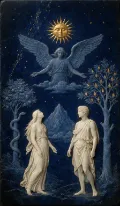 The LoversShares: The rising serpent · The calm head, far left · The dreamer’s open hands
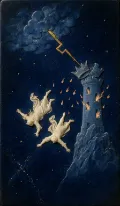 The TowerShares: The bank of cloud · Heaped jewels and a crown · The tower on the crag
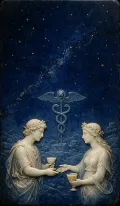 Two of CupsShares: The rising serpent · Laurel crowning a skull · The dreamer’s open hands
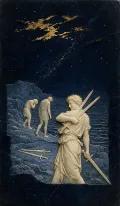 Five of SwordsShares: The calm head, far left · The dreamer’s open hands · The bank of cloud