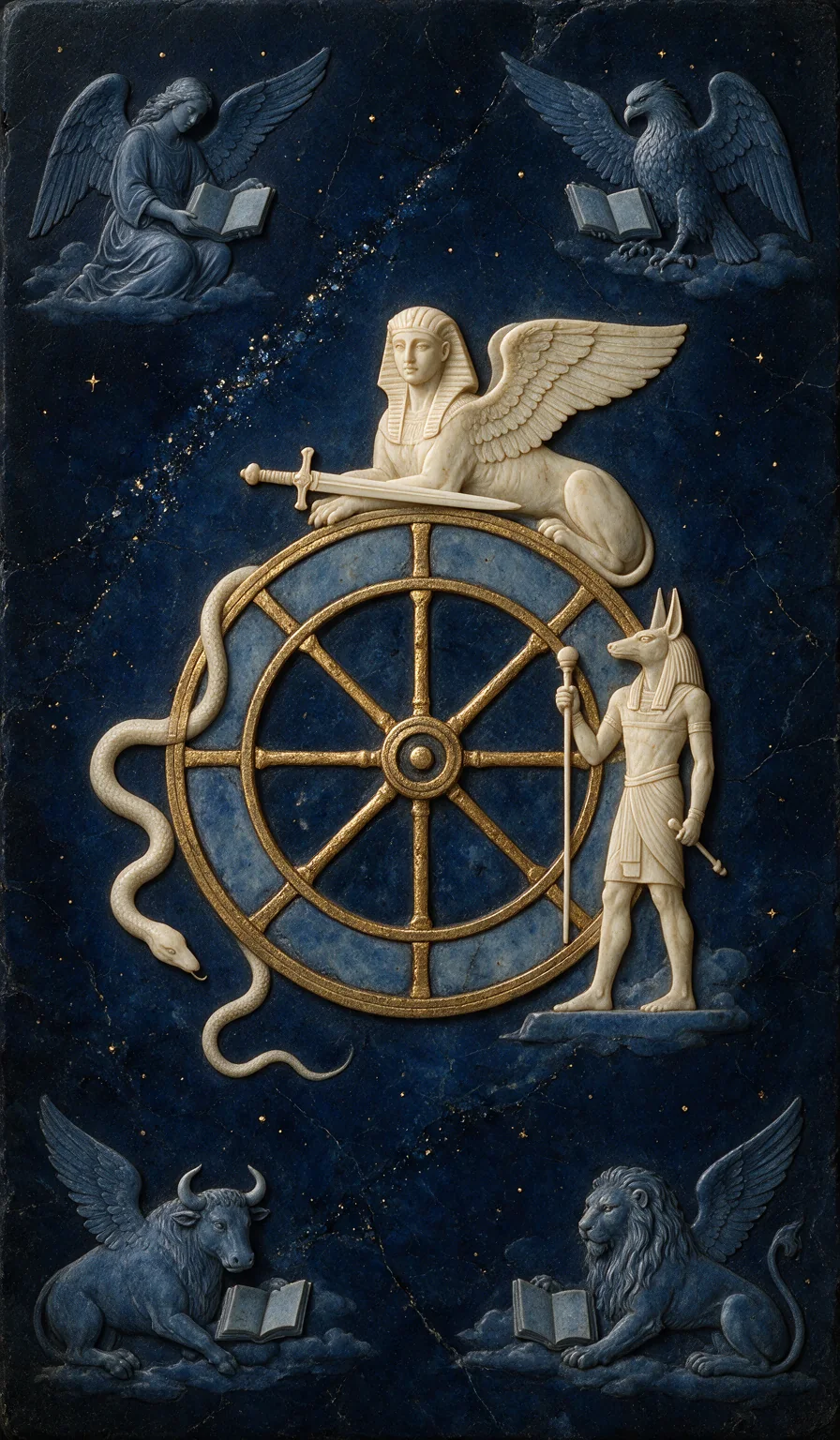
Major Arcana · X
Wheel of Fortune
Tarot card meaning: upright, reversed and the symbols of the Olivia image
The Wheel of Fortune is the turning of circumstances larger than you: cycles rise and fall, and your part is how you meet each turn.
- Upright
- cyclesturning pointchangetimingperspectiveadaptability
- Reversed
- resisting changerepeated patternsclinging ondelayed turnfeeling powerless
Upright
The Wheel of Fortune turns attention from a single moment to the cycle it belongs to. In Olivia’s carving a large gold wheel hangs in the lapis night, eight spokes meeting at a small ringed hub, while a band of stars runs down the sky above it. Nothing is written on its rim. Upright, the card draws attention to change that is already under way: a season ending, a pattern returning, circumstances moving in ways no single person set in motion.
Look at who surrounds the wheel. The serpent slides down the left side; the jackal-headed guardian stands at the right on its own small ledge, watching rather than riding; the sphinx rests on top, sword laid across its forelegs, unhurried. These are three ways of being inside a turning situation: carried down, keeping your footing, holding still enough to see. The card can point to a change of role, a move, a relationship finding a new rhythm, or the return of an old lesson in a new form.
In the four corners the angel, eagle, bull and lion each rest on a cloud with an open book. None of them tries to stop the wheel. The card asks you to separate what is turning from what you can steady: your attention, your preparation, the response you choose when the next spoke comes round.
Reversed
Wheel of Fortune reversed can point to a turn that is resisted, delayed or repeated. You may be holding on at the top, gripping the rim so it cannot carry you down, or feel caught at the bottom, circling the same difficulty with the same response. Sometimes the reversal is inward: a change has already happened around you, and the inner adjustment has not caught up.
Look at the serpent and the guardian again. One is carried by the motion; the other stands beside it on steady ground. Ask which part of the pattern is outside your reach, and which part is the response you keep choosing. Changing that response, even slightly, is often where a stuck cycle begins to move.
Read the image
Every element below is carved into this card. Scroll, hover or press a number to follow it on the image.
The reading angel
What you seeIn the upper left corner a winged figure is seated on a cloud, head bowed over an open book held in both hands. It is carved in the grey-blue of the lapis itself, not in ivory.
What it carriesThe four winged creatures come from Ezekiel’s vision and the Book of Revelation, and later stood for the four evangelists. Among the fixed signs the human face is linked with Aquarius. Here, as in the traditional image, the creature reads: steadiness found in study while the wheel turns below.
Follow this symbol through the deck ↗The eagle with its book
What you seeIn the upper right an eagle spreads both wings on a low cloud, talons planted, head turned to the left. An open book stands propped at its side, carved in paler blue stone.
What it carriesThe eagle stands for the fixed sign Scorpio in its highest form and is the emblem of John the evangelist. It adds a view from above: the ability to see a whole cycle at once, rather than only the stretch you are living through.
Follow this symbol through the deck ↗The river of stars
What you seeA diagonal band of pale blue and white glitter with gold flecks runs from the top centre down towards the left edge, passing above and left of the sphinx, far denser than the scattered gold flecks elsewhere in the night.
What it carriesThe traditional card sets its wheel among clouds; Olivia sets it beside a band that reads as the Milky Way, which wheels across the sky through the night and the year. It places the card’s cycle inside a larger, slower motion that no single turn can hurry.
Follow this symbol through the deck ↗The sphinx and sword
What you seeAn ivory sphinx with a striped headdress and a raised feathered wing lies along the top of the wheel, forepaws on the rim, a cross-hilted sword laid across its forelegs, point to the right.
What it carriesIn the Waite-Smith card a seated sphinx holding an upright sword crowns the wheel, commonly read as the still point of judgement above constant motion. Olivia’s sphinx reclines, calm rather than alert: the part of you that can watch a change without being spun by it.
Follow this symbol through the deck ↗The bare gold wheel
What you seeA large gold wheel fills the centre: a heavy outer rim around a band of paler lapis, an inner ring over a darker field, and a small ringed hub with a raised boss, joined by eight gold spokes.
What it carriesThe traditional wheel is written over with letters and alchemical signs; here it is left bare, with no inscription to decode. Gold is used sparingly in this deck, so the turning itself is what is precious: the cycle as a real force, not a riddle to solve.
Follow this symbol through the deck ↗The jackal-headed guardian
What you seeTo the right an ivory figure with a jackal’s head, striped headdress and pleated kilt stands on a small lapis ledge facing the wheel, gripping a tall knob-topped staff and holding a short rod low.
What it carriesTraditionally this is Hermanubis, the jackal-headed guide who rises with the wheel’s upward turn. Olivia’s figure does not ride the rim; it stands beside it on its own ground. It suggests the steady attention you keep while circumstances rise and fall.
The descending serpent
What you seeAn ivory serpent loops over the left side of the rim and slides downward, head low at the lower left with a forked tongue showing, tail curling away beneath the wheel.
What it carriesThe serpent on the descending side is usually named Typhon, a figure of destructive force: the downward pull of the wheel, loss, things coming apart. A serpent also sheds its skin, so the descent can be read as a necessary letting go.
Follow this symbol through the deck ↗The winged bull
What you seeIn the lower left corner a winged bull with curved horns lies on a cloud, head turned towards an open book set beside its forelegs. Like the other corner creatures, it is carved in lapis.
What it carriesThe bull is Taurus among the fixed signs and the emblem of Luke. It brings the earthy virtue a turning wheel needs: patience, stamina, the slow work of tending what matters while the season changes around it.
The winged lion
What you seeIn the lower right corner a winged lion with a thick mane lies on a cloud, one forepaw resting on the top of an open book, tail curled up behind its body.
What it carriesThe lion is Leo among the fixed signs and the emblem of Mark. With the angel, eagle and bull it completes the four fixed signs, the stable points of the zodiac. Their calm reading frames the whole card: the wheel turns, the corners hold.
Follow this symbol through the deck ↗
The number
The Wheel carries ten, the first number of two digits and the completion of a count from one. Reduced, ten becomes one again: the Magician’s single act, now seen as part of a larger cycle. In the Fool’s journey the Wheel follows the Hermit. After withdrawing to find an inner light, the Fool steps back into a world of time and circumstance, and learns that personal will moves inside forces it did not choose. Ten asks you to notice where one cycle closes and the next begins.
The tradition
In the Golden Dawn system the Wheel of Fortune bears the title “Lord of the Forces of Life”. It is attributed to Kaph, the Hebrew letter meaning the palm of the hand, and to the planet Jupiter, and it occupies the twenty-first path of the Tree of Life, joining Chesed and Netzach. The image is far older than these correspondences: in the fifteenth-century Visconti-Sforza cards a blindfolded Fortuna sits at the hub while small figures rise, reign and fall around the rim. For the 1909 Waite-Smith deck, Pamela Colman Smith drew on Éliphas Lévi’s wheel of sphinx, Hermanubis and Typhon, rendered Typhon as a serpent, and set the four living creatures in the corners.
Love, work and self
- Love
- In love and close bonds, the Wheel draws attention to rhythm. Every relationship, including the one with yourself, has seasons of closeness and distance, ease and effort, and a hard stretch is not proof that something is finished. Notice whether you are reading one turn of the wheel as the whole story. The sphinx’s calm is useful here: stay present with what is actually happening now, and let a pattern show itself over time before you name it.
- Work
- In work and study, the Wheel can point to shifting conditions: a team reorganised, a field changing, a project reaching the end of its cycle. The card favours preparation over prediction. Keep your skills, notes and working relationships in good order so you can meet the next turn from steady ground, as the guardian does on its ledge. In money matters, treat the Wheel as a reminder that conditions change, and base any decision on careful information rather than a feeling that the timing is right.
- Self
- For your own growth, the Wheel asks you to recognise your recurring cycles: the month when energy dips, the kind of situation that always unsettles you, the lesson that keeps returning in new clothes. Seeing a cycle is not the same as being trapped in it. The four creatures in the corners keep their books open while the wheel turns. Keep your own record, and notice what you do differently the next time the same spoke comes round.
In a spread
Read the card through each position before you look at Olivia’s version. A position is a question, and the same card answers each one differently.
The situation
What aspect of the situation deserves attention?
Olivia’s readingAt the heart of a question, the Wheel suggests you may be in the middle of a turn. If the situation is moving, understanding the cycle matters more than fixing one moment in place.
What complicates it
What tension or assumption deserves a closer look?
Olivia’s readingAs a challenge, the Wheel can point to change you did not choose, or to a pattern repeating because the response to it has stayed the same. Notice which of the two is operating.
A helpful next step
What small action could help you understand or respond?
Olivia’s readingAs advice, the Wheel invites you to meet the turn from steady ground: prepare what you can, loosen your grip on what you cannot, and watch for the moment to act.
In conversation with
- Wheel of Fortune + The Hermit
The Hermit at nine withdraws with a lamp; the Wheel at ten turns outward into a world of moving circumstances. Together they draw attention to how clarity found in quiet holds up once life starts turning again.
- Wheel of Fortune + Justice
Olivia’s sphinx rests a sword across its forelegs, and Justice traditionally holds one upright beside the scales. Together they draw attention to the difference between what circumstances hand you and what you are accountable for: chance meets consequence, and choice lives in between.
- Wheel of Fortune + The World
The angel, eagle, bull and lion in these corners traditionally frame the World as well. On the Wheel they watch a cycle turning; on the World they surround one completed. Together they trace the path from being carried by a cycle to understanding it whole.
Also read withThe ChariotTwo of PentaclesAll pairs ↗
Questions to keep
- What in your life is clearly turning right now, and what is holding steady beneath it?
- Which pattern keeps coming back to you, and what response do you usually bring to it?
- Where are you gripping the top of the wheel, or waiting at the bottom, instead of meeting the turn?
Ask them with three cards ↗A three-card reading in which each position asks one of these questions.
A small practice
Draw a simple wheel with eight spokes and write one recurring moment of your year on each; mark the ones you can prepare for.
Cards that share its symbols
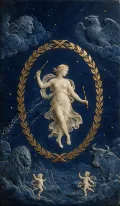 The WorldShares: The eagle with its book · The winged lion · The winged bull · The river of stars
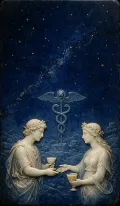 Two of CupsShares: The river of stars · The winged lion · The descending serpent
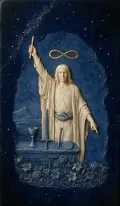 The MagicianShares: The river of stars · The descending serpent
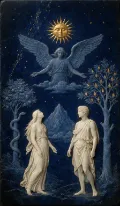 The LoversShares: The reading angel · The descending serpent