Minor Arcana · Cups
Two of Cups
Tarot card meaning: upright, reversed and the symbols of the Olivia image
The Two of Cups turns attention to a meeting of equals: mutual recognition, attraction and care that grow through a real exchange between two people.
- Upright
- mutual recognitionattractionpartnershipreciprocityreconciliationheartfelt exchange
- Reversed
- uneven exchangeassumed closenesshesitant offermisunderstandingself-connection
Upright
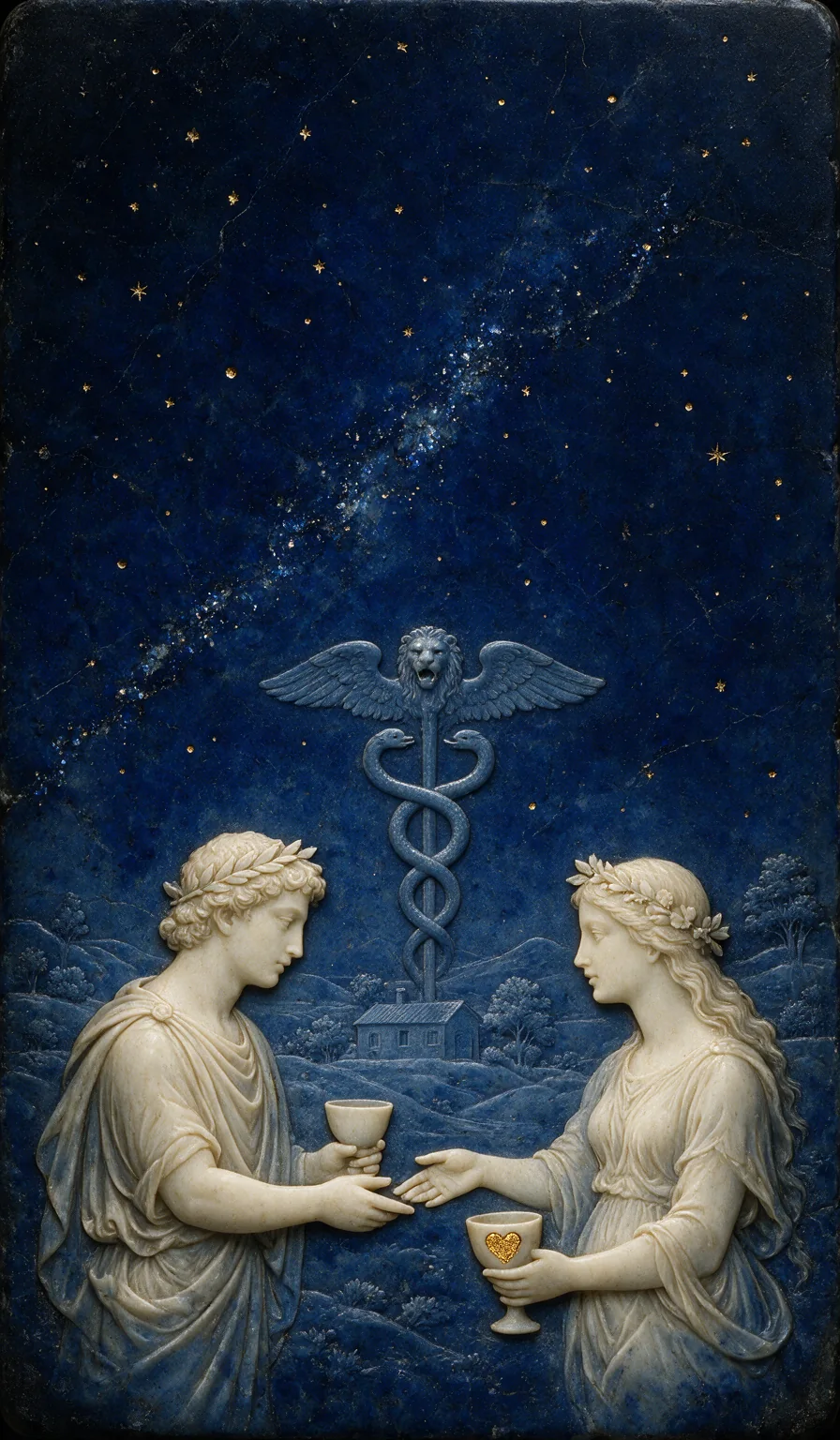
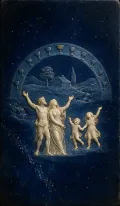
The Two of Cups is the card of two people meeting as equals. It draws attention to mutual recognition: the moment when you see someone clearly and feel seen in return, whether in a friendship, a partnership, a working alliance or a reconciliation after distance. In Olivia’s carving the two ivory figures face each other across the centre of the card, and their free hands reach toward each other over the blue lapis, fingertips almost meeting. It is an offer and an answer, not a grasp.
Look at the cups. In the traditional image they are pledged toward each other; here each figure keeps their own. One lifts a plain cup in front of the chest, the other holds a goblet low at the waist with a heart of gold set into its bowl. Connection, in this version, does not ask either person to pour themselves out. Each cup stays with its holder, and the meeting happens in the space between them.
Above the couple rises the caduceus, two serpents twining in balance beneath a winged lion’s head. Hermes’ staff speaks of messages and negotiation; the lion of warmth and desire. Upright, the card invites you to notice where attraction and honest conversation are working together, and to value a bond that is reciprocal: listened to, spoken to, and tended from both sides.
Reversed
Two of Cups reversed draws attention to an exchange that has lost its balance. One person may be doing most of the reaching, or closeness may have been assumed rather than checked, so that each side is guessing at the other. It can also point inward: the gold-hearted cup held so carefully that nothing is offered, or a hesitation to reach across the small gap between the hands.
The card cannot tell you what anyone else feels. It asks what you have actually said and heard, and what you have only imagined. Sometimes the first step is a clear, kind sentence about your own side; sometimes it is noticing that the connection you most need right now is with yourself.
Read the image
Every element below is carved into this card. Scroll, hover or press a number to follow it on the image.
Milky Way over the meeting
What you seeA glittering band of pale mineral runs diagonally across the upper card from lower left to upper right, among small gold star flecks scattered over the dark ultramarine sky.
What it carriesOlivia places the meeting under a wide night sky scattered with gold stars. The Milky Way, a road of light in many old traditions, crosses above the couple: a reminder that any bond between two people sits inside a larger life that neither person has to fill alone.
Follow this symbol through the deck ↗The winged lion’s head
What you seeAt the top of the central staff a lion’s head with open jaws and a full mane spreads two broad feathered wings, carved in the same pale greyish blue lapis as the distant hills.
What it carriesPamela Colman Smith also crowned this card with a winged lion’s head. The lion is commonly read as fire, desire and courage; the wings lift that heat toward something higher. Attraction is present here, but it hovers above the couple, shared rather than owned by either.
Follow this symbol through the deck ↗Twin serpents on the staff
What you seeTwo serpents wind around each other and around a straight staff beneath the lion, then raise their heads at the same height to face each other just under the wings.
What it carriesThis is the caduceus, the herald’s staff of Hermes, messenger and go-between, not the single-serpent rod of healing. Two forces twine without either winning, and the heads meet level: a picture of communication, negotiation and balance, the conditions in which two people can truly meet.
Follow this symbol through the deck ↗Laurel on the left
What you seeThe left-hand figure wears a close wreath of pointed laurel leaves over short curls, and a round clasp fastens the ivory cloak at the shoulder. The head is bowed, eyes lowered toward the hands.
What it carriesLaurel traditionally honours achievement and constancy, the garland of poets and victors. On this side of the card it gives the reaching gesture a quality of respect: the figure approaches the other as someone worth honouring, and looks down, attentive, rather than staring or claiming.
Follow this symbol through the deck ↗Flowering wreath on the right
What you seeThe right-hand figure wears a wreath of leaves opening into small flowers, with long wavy hair falling past the shoulders. This figure looks straight across, level, toward the other’s face.
What it carriesWhere the left wreath is laurel, this one blossoms. Flowers are commonly linked with Venus, the planet the Golden Dawn gave to this card, and with feeling that is still opening. Two different garlands suggest two people who meet as equals without having to be alike.
Follow this symbol through the deck ↗The cottage between them
What you seeFar behind the couple, carved into the blue lapis hills, stands a small single-storey house with a chimney, a door and small windows, framed by rounded trees. The caduceus staff rises from behind its roof.
What it carriesA house on a hill also sits in the background of the traditional image, often read as the home or shared life a bond may grow toward. Here it stands on the card’s central axis, directly beneath the caduceus, as if ordinary daily life were the ground that holds the meeting up.
Follow this symbol through the deck ↗The plain raised cup
What you seeThe left-hand figure lifts a plain, unadorned ivory cup in front of the chest, fingers wrapped around its stem just beneath the bowl, held upright above the other, reaching hand.
What it carriesCups belong to Water: feeling, receptivity and relationship. In the traditional image the two cups are pledged toward each other. Here each cup stays with its holder, so each person keeps their own feelings intact; connection happens alongside the cups, not by pouring one into the other.
Follow this symbol through the deck ↗Hands almost meeting
What you seeAt the centre of the lower card the two free hands reach toward each other: one extended with fingers pointing forward, the other open with the palm showing. A thin band of lapis still separates the fingertips.
What it carriesThe gesture is an offer and a response, not a grasp: one hand reaching, one ready to receive. This is Olivia’s own emphasis. The small gap matters: it keeps the moment one of choice, where either person can close the distance and nothing is taken for granted.
Follow this symbol through the deck ↗The gold heart on the cup
What you seeThe right-hand figure holds a stemmed goblet low at the waist, fingers curled beneath the bowl. Set into the ivory bowl is a heart of glittering gold, the only gold on the card besides the star flecks.
What it carriesThe heart does not appear on the traditional card. Gold in this deck is rare and marks what is precious. Placing it on one cup, held quietly at the waist and not yet offered, suggests that the most valuable feeling in a meeting is often the one still being held, waiting for a safe moment.
Follow this symbol through the deck ↗
The number
Two is the first relationship: after the single source of the Ace, something now stands opposite and answers back. In the suit of Cups, the suit of Water and feeling, that answer is emotional. The single cup of the Ace becomes two cups held by two people, and feeling turns into exchange. Among the Twos, the Two of Wands weighs a plan, the Two of Swords holds a stalemate and the Two of Pentacles balances demands; the Two of Cups is the one where the pair turn toward each other.
The tradition
In the Golden Dawn system the Two of Cups is titled the Lord of Love. It is assigned to Venus in Cancer, the first decan of that sign (0 to 10 degrees), and to Chokmah, Wisdom, the second Sephirah on the Tree of Life, expressed through the suit of Water. Venus, the planet of attraction and harmony, in the watery, protective sign of Cancer is commonly read as affection that nourishes. Aleister Crowley kept the single title Love. Marseille-pattern decks show only two cups beneath an ornate flowering design; Pamela Colman Smith’s 1909 card added the pledging couple and, above them, a caduceus crowned by a winged lion’s head.
Love, work and self
- Love
- In love and close friendship the Two of Cups draws attention to reciprocity: attraction that is returned, care that flows both ways, a conversation where each person is heard. It does not tell you how another person feels; the reaching hands in this image still have a gap between them. It asks what a mutual step would look like from your side, and whether you are offering your own cup honestly. With yourself, it invites the same courtesy: listening before judging.
- Work
- At work or in study the card can point to a fruitful partnership, a good collaborator, a mentor, or a repaired working relationship. The caduceus above the couple is the messenger’s staff, so the emphasis falls on clear agreements: who brings what, what each person needs, how you will check in with each other. Where money is shared, it can help to put the terms into plain words, rather than letting goodwill stand in for clarity.
- Self
- For your relationship with yourself, the two figures can stand for two sides of you that have drifted apart: the part that feels and the part that acts, or the one who gives and the one who needs. The card invites a meeting rather than a verdict. Notice which side has been holding its cup close, like the gold-hearted goblet kept at the waist, and what it would take for both to face each other with the same respect.
In a spread
Read the card through each position before you look at Olivia’s version. A position is a question, and the same card answers each one differently.
The situation
What aspect of the situation deserves attention?
Olivia’s readingAt the centre of a question, the Two of Cups points to a relationship or meeting that matters here, and to the quality of exchange within it: how openly each side gives and receives.
What complicates it
What tension or assumption deserves a closer look?
Olivia’s readingAs a challenge, the card can show closeness assumed rather than checked, an exchange that has become one-sided, or a fear of offering your own feelings first.
A helpful next step
What small action could help you understand or respond?
Olivia’s readingAs advice, it invites one honest, reciprocal step: say what you feel or need in plain words, then listen fully to the answer before deciding what it means.
In conversation with
- Two of Cups + The Lovers
The Lovers and the Two of Cups are often read together as the major and minor faces of relationship. The Lovers asks about a choice made from your values; the Two of Cups about the everyday exchange that keeps that choice alive.
- Two of Cups + Two of Swords
The Two of Swords holds feeling at a guarded distance; the Two of Cups opens toward another across a small gap. Together they draw attention to the moment between protection and openness, and to what would make it feel safe to reach.
- Two of Cups + Temperance
Temperance is traditionally shown pouring between two vessels with patience. Beside the Two of Cups it turns attention to the slow mixing of two lives, tastes and rhythms, and to the balance that lets a bond deepen without either person losing themselves.
Questions to keep
- Where in your life do you feel truly seen, and how do you show the other person that you see them too?
- Which cup are you holding close right now, and what would it mean to offer it?
- What small, honest exchange could make this connection feel more mutual this week?
Ask them with three cards ↗A three-card reading in which each position asks one of these questions.
A small practice
Tell one person something specific you appreciate about them, then ask one open question and listen to the whole answer without planning your reply.
Cards that share its symbols
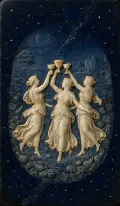 Three of CupsShares: The gold heart on the cup · The plain raised cup · Hands almost meeting · Milky Way over the meeting
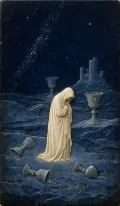 Five of CupsShares: Hands almost meeting · The plain raised cup · The gold heart on the cup · Milky Way over the meeting
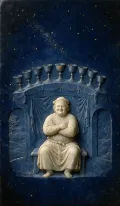 Nine of CupsShares: The plain raised cup · The gold heart on the cup · Hands almost meeting · Milky Way over the meeting
 Ten of CupsShares: The gold heart on the cup · The plain raised cup · The cottage between them · Milky Way over the meeting