Major Arcana · XXI
The World
Tarot card meaning: upright, reversed and the symbols of the Olivia image
The World marks a cycle brought to wholeness, where what you have learned comes together and you can move freely inside the life you have built.
- Upright
- completionintegrationwholenessfulfilmentcelebration
- Reversed
- loose endsdelayed closureperfectionismfear of finishingunacknowledged success
Upright
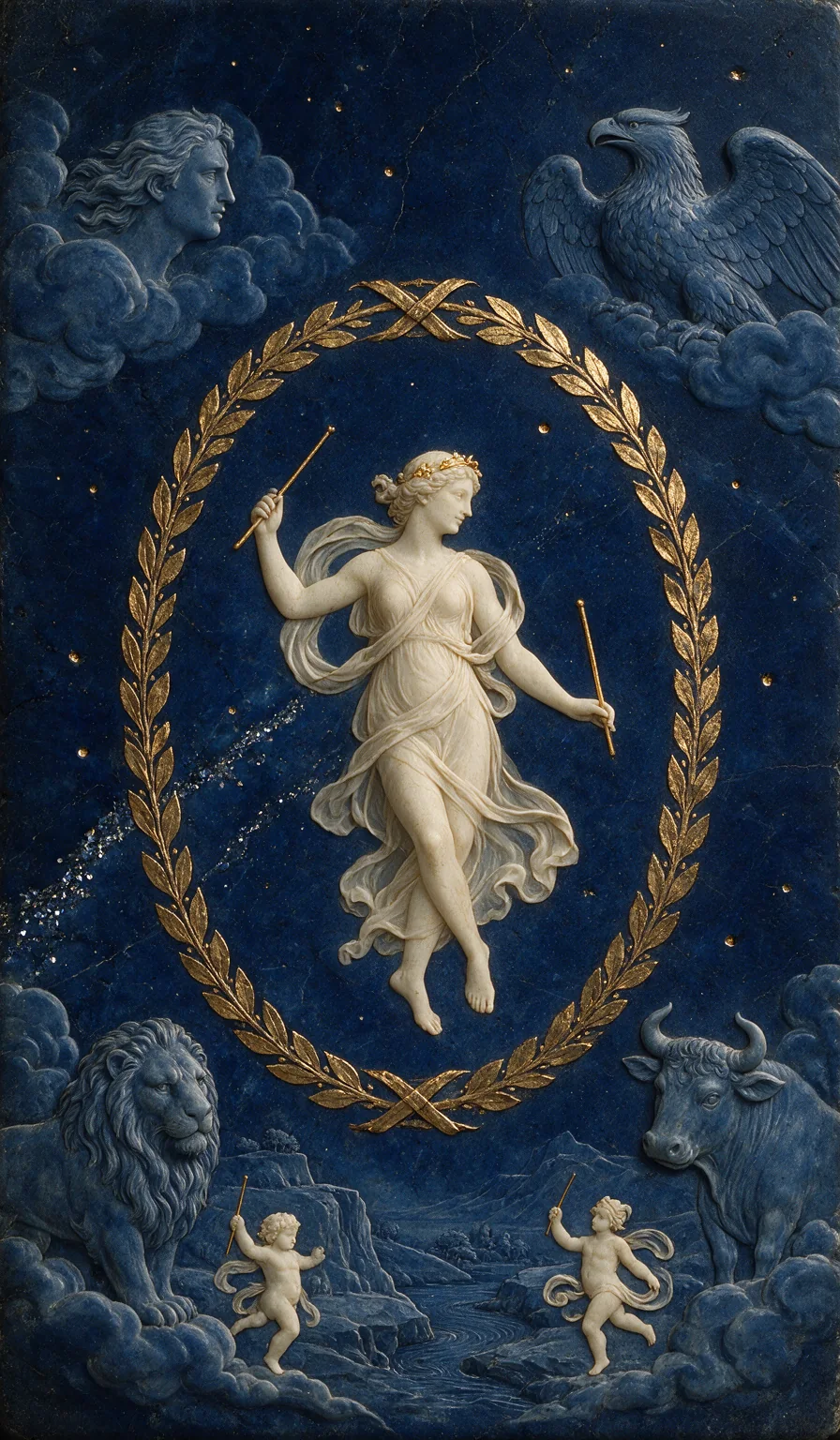
The World is the last card of the Major Arcana, and it draws attention to something that has come together. A stage of learning, a piece of work, a long season of effort or change may be complete, not because everything is perfect but because its parts now belong to one shape. Olivia pictures this as a tall oval of gold laurel around an ivory dancer. The wreath is closed, bound top and bottom with crossed gold ribbons, yet the figure inside is not still: the legs cross at the knee, the drapery lifts, and the bare feet touch nothing at all.
That combination is the card’s real teaching. Completion here is not a door you walk out through; it is a wholeness you can move within. The dancer holds a gold wand in each hand, one raised and one lowered, as if the effort of The Magician had turned into ease. Around the oval the head, the eagle, the lion and the bull keep their four corners, suggesting that thought, feeling, courage and patience have each played their part.
The card invites you to recognise what has been achieved before rushing into the next task. Below the wreath two small children dance on either side of a winding river, each holding a tiny wand of their own. Fulfilment does not stay up in the sky; it can be enjoyed in ordinary places, at the scale of an ordinary day.
Reversed
The World reversed points to completion that is delayed, unrecognised or held to an impossible standard. A cycle may be nearly finished while one loose end keeps you from calling it done, or it may be finished already without your having allowed yourself to notice. The wreath has not opened; you may simply be standing just outside it.
The reversed card can also describe the wish for perfect closure: waiting until every thread is tied before you let a chapter count. Ask what genuinely remains to do, and what only needs acknowledgement. Sometimes the kindest step is to finish one small task, then mark the whole stage as done, even if it feels slightly untidy.
Read the image
Every element below is carved into this card. Scroll, hover or press a number to follow it on the image.
The floating dancer
What you seeAn ivory figure in sheer, lifting drapery hangs at the centre of the oval, touching nothing. A gold leafy circlet sits in the hair, the head turns to the right, and the legs cross at the knee above bare, downward-pointing feet.
What it carriesThe dancer is the traveller of the Major Arcana arrived: fully present, in motion yet held. The crossed legs traditionally echo The Hanged Man’s posture turned upright, so suspension becomes free movement. Olivia keeps the figure wholly airborne, with no ground beneath the feet at all.
The bound laurel wreath
What you seeA tall oval of gold laurel leaves encloses the dancer. At the top and again at the bottom, the two branches meet under a gold ribbon binding whose bands cross in a clear X.
What it carriesThe oval wreath is the card’s oldest element, a victor’s crown made large enough to live inside. The Waite-Smith wreath is tied with red ribbons; here the bindings are gold and crossed, recalling the ancient form of Tau, the card’s Hebrew letter, once written as a simple cross mark.
Follow this symbol through the deck ↗Two slim gold wands
What you seeThe raised hand on the viewer’s left holds a slim gold wand diagonally, its knobbed upper end tilted towards the head. The lowered hand on the right grips a second wand almost upright, a small round knob at its top.
What it carriesA wand in each hand is commonly read as two forces held in balance: giving and receiving, action and rest. The Magician raises a single wand to draw power down; the World dancer holds two lightly, with the loose grip of someone who no longer needs to force anything.
Follow this symbol through the deck ↗The head in the clouds
What you seeIn the top left corner a human head carved in grey-blue lapis emerges from rounded clouds, seen in profile facing right, with long, wind-blown hair and no wings.
What it carriesThis is one of the four living creatures from Ezekiel’s vision and the Book of Revelation, later linked with Matthew and with fixed Air, Aquarius. Olivia carves it as a calm, wingless human profile with no book: the thinking mind turned towards the dancer.
The eagle with lifted wings
What you seeIn the top right corner a large lapis eagle perches on a bank of cloud, both wings lifted and half open, its hooked beak turned left towards the centre of the card.
What it carriesThe eagle is linked with John and, in the Golden Dawn lineage, with Scorpio, fixed Water. Its raised wings give this corner height: feeling that has risen above its own depths and can take in the whole scene below.
Follow this symbol through the deck ↗The lion on the clouds
What you seeAt lower left a heavily maned lion in grey-blue lapis rests its forepaws on a cloud beside the wreath, head in three-quarter view and turned towards the centre, above a rocky river valley.
What it carriesThe lion stands for Mark and for Leo, fixed Fire: courage and warmth held steady. In the Waite-Smith card the lion sits at lower right and the bull at lower left; Olivia has them change places, so the lion keeps watch on the side of the raised wand.
Follow this symbol through the deck ↗The horned bull
What you seeAt lower right a heavy lapis bull with curved horns and a curly brow rises out of clouds, its head turned towards the centre and its body fading into the card’s edge.
What it carriesThe bull belongs to Luke and to Taurus, fixed Earth: patience, the body, what grows slowly. Its calm weight answers the lion across the valley. Together the four creatures gather the whole of experience at the corners, with the dancer as the point where they meet.
Two children with wands
What you seeBelow the wreath two small ivory children, each trailing a ribbon of drapery, dance on rocky ledges either side of a winding river, and each holds up a tiny gold wand.
What it carriesThe children are not part of the Waite-Smith pattern, though some fifteenth-century Italian World cards show two putti holding up a globe with a walled city inside. Echoing the dancer’s wands in miniature, they bring the completion above down into play in the ordinary world below.
Follow this symbol through the deck ↗The glittering sky band
What you seeOn the left a diagonal band of pale, glinting chips runs up from the card’s edge across the lapis, passing behind the laurel and on into the oval towards the dancer’s drapery.
What it carriesThis band of light has no counterpart in the traditional World card; similar bands cross other night skies in this deck. On The World it enters the wreath itself, so the sky’s long road seems to arrive where the dancer is: a small, finished circle inside a larger movement.
Follow this symbol through the deck ↗
The number
The World is card XXI, the final number of the Major Arcana. Twenty-one is three times seven, and its digits add to three, the number of The Empress and of things coming to birth. In the Fool’s journey this is the arrival after Judgement’s call: the traveller who set out as card 0 now stands at the centre of a completed circle, free in time to begin again. The step asks you to let a whole cycle count before you look for the next one.
The tradition
In the Golden Dawn system this card is Atu XXI, named “Universe” in place of “World” and titled “The Great One of the Night of Time”. It carries Tau, the last letter of the Hebrew alphabet, meaning a mark or cross, and the planet Saturn, with Earth as a secondary attribution. Its path, the thirty-second, joins Malkuth and Yesod: the first step upward from the material world. Marseille decks show a dancing figure in an oval wreath with the four living creatures at the corners, and Pamela Colman Smith’s 1909 design kept that pattern, giving the dancer a wand in each hand. Some earlier fifteenth-century Italian cards showed two putti holding up a globe containing a city.
Love, work and self
- Love
- In close relationships The World draws attention to what you have already built together: a shared history, a way of understanding each other that took time to shape. It invites you to acknowledge that before asking for the next thing. With yourself, it can mean recognising that you have grown into a fuller version of who you were, like the dancer who has room to move inside the wreath without needing to leave it. Let what is whole be celebrated, small imperfections included.
- Work
- At work or in study, The World can point to a project, course or role reaching its natural completion. Before moving on, notice what you actually learned and what you can carry forward, the way the dancer carries two wands with an easy grip. It may be a good moment to document the work, thank the people who shared it and close the file properly. With money matters, it suggests reviewing a finished chapter calmly rather than hurrying into the next commitment.
- Self
- For your own growth, The World asks you to see the pattern in what you have lived through. The four creatures at the corners (the head, the eagle, the lion and the bull) can stand for thought, feeling, courage and steadiness. Which of them has served you most in this chapter, and which has stayed quiet? Wholeness here does not mean being finished as a person. It means the different parts of you are in conversation, with room left at the centre to dance.
In a spread
Read the card through each position before you look at Olivia’s version. A position is a question, and the same card answers each one differently.
The situation
What aspect of the situation deserves attention?
Olivia’s readingAt the centre of a question, The World suggests that something may be closer to complete than it feels. The real subject could be recognising and integrating whatever has already come together.
What complicates it
What tension or assumption deserves a closer look?
Olivia’s readingAs a challenge, The World can show difficulty letting a chapter be finished: chasing perfect closure, or moving on so quickly that the completion is never felt or named.
A helpful next step
What small action could help you understand or respond?
Olivia’s readingAs advice, The World invites you to mark an ending on purpose. Name what this stage has given you, then take one light step, as the dancer does, into the space it opens.
In conversation with
- The World + The Fool
With The Fool, the Major Arcana closes its circle. Card 0 steps towards the edge of the unknown; card XXI dances inside a finished whole. Together they ask what this completion makes possible to begin, and what beginner’s openness you want to keep.
- The World + Wheel of Fortune
With the Wheel of Fortune, the four living creatures appear in both cards. On Olivia’s Wheel they are winged and bent over open books; here the books are gone and they simply watch. Together they ask whether you are still studying a turning cycle or can now let it be complete.
- The World + The Hanged Man
With The Hanged Man, the traditional crossed-leg posture appears in both cards: upside down and bound in card XII, upright and free in card XXI. Together they suggest that a period of waiting or surrender has become the ground of easy movement.
Also read withJudgementAll pairs ↗
Questions to keep
- What in your life has quietly come to completion without being fully acknowledged?
- Which of the four creatures, head, eagle, lion or bull, has carried you furthest through this chapter?
- What would it feel like to move freely inside what you have already built?
Ask them with three cards ↗A three-card reading in which each position asks one of these questions.
A small practice
Draw a simple oval on a page, write inside it three things this chapter has completed, then add one word for how you want to move next.
Cards that share its symbols
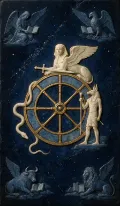 Wheel of FortuneShares: The eagle with lifted wings · The glittering sky band · The horned bull · The lion on the clouds
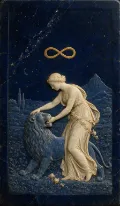 StrengthShares: The glittering sky band · The head in the clouds · The lion on the clouds
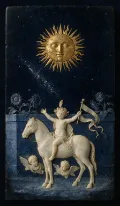 The SunShares: The glittering sky band · The bound laurel wreath · Two children with wands
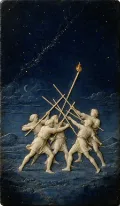 Five of WandsShares: The glittering sky band · Two slim gold wands · The head in the clouds