Minor Arcana · Swords
Two of Swords
Tarot card meaning: upright, reversed and the symbols of the Olivia image
The Two of Swords holds two options in careful balance, eyes covered and heart guarded, and asks whether this pause still serves you.
- Upright
- held decisionguarded balanceinner stillnessweighing optionstruce
- Reversed
- stalemate straininformation overloadavoidanceblindfold looseningchoosing a part
Upright
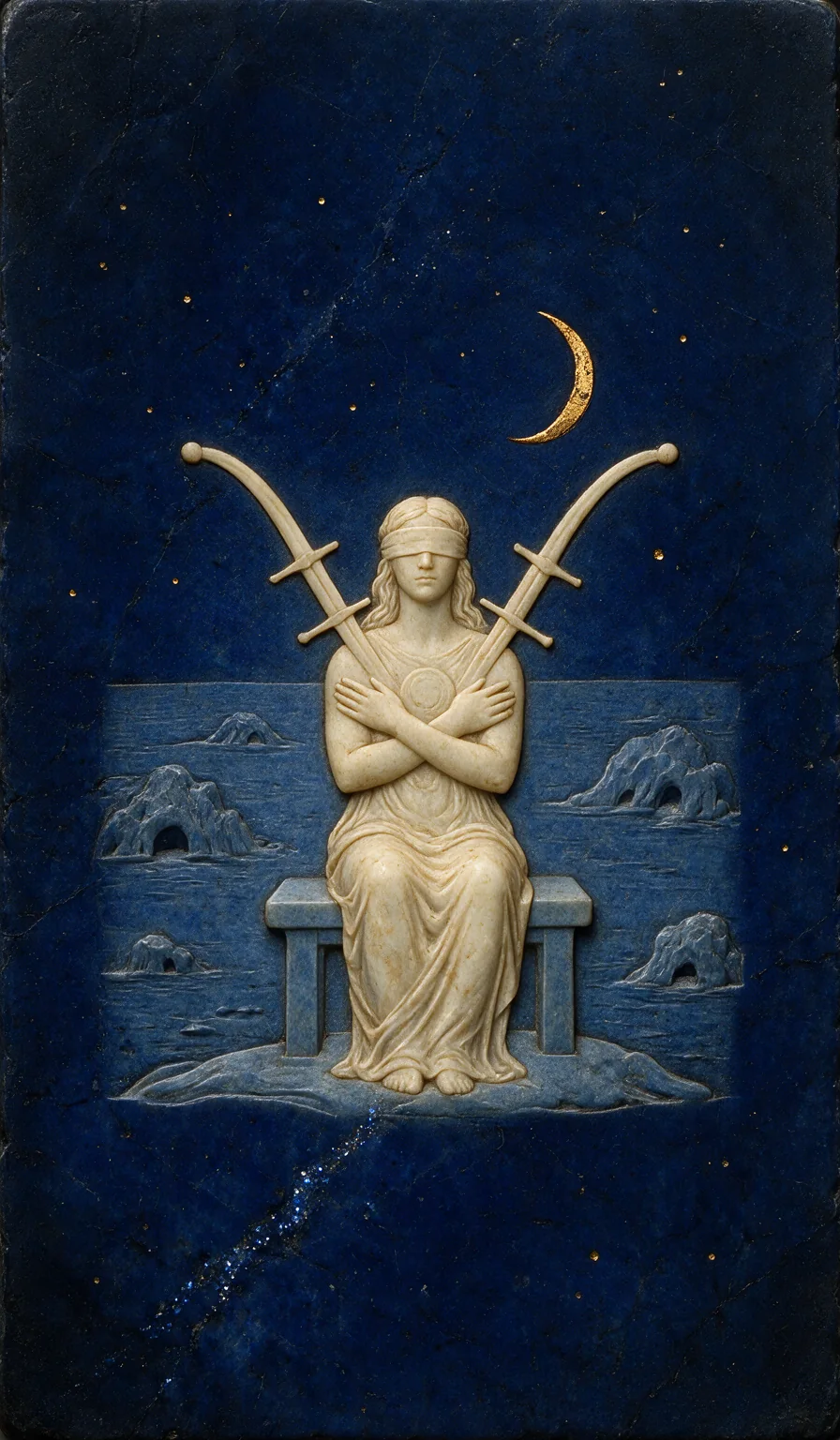
The Two of Swords draws attention to the work of holding a decision still. Two options, two loyalties or two lines of thought are kept in perfect balance, and nothing is allowed to tip. In Olivia’s carving the figure sits blindfolded on a plain bench, and the two ivory swords curve away from each other in a wide V around the head, each pointing in its own direction. Neither blade is favoured. The mind has made a careful truce.
What makes this version distinctive is how quiet it is. The crossed hands grip nothing; they rest flat on the upper arms while the swords slip beneath them, and a carved medallion sits over the heart where the blades converge. This is a pause chosen from a still centre, not a panic. Upright, the card can point to the protective side of not deciding yet: gathering information, letting pressure drop, refusing to be rushed.
The card also asks what the blindfold is keeping out. Behind the figure lies the sea, the element of feeling, and a gold crescent moon hangs over one shoulder. Something beyond logic is moving while the choice stays suspended. Ask what would make this pause useful, and what small sign would tell you it is time to look again.
Reversed
Two of Swords reversed draws attention to a balance that is getting harder to keep. The truce may have gone on longer than it can comfortably hold, or so much information has gathered that the choice feels more tangled than before. You might notice the arms tightening instead of resting, or the swords growing heavier in the waiting.
Reversed, the blindfold may also be loosening: something you preferred not to see is coming into view. This need not force the whole decision at once. Name the trade-off plainly, set aside details that do not change it, and choose which small part to settle first. Taking the blindfold off is a step, not a verdict.
Read the image
Every element below is carved into this card. Scroll, hover or press a number to follow it on the image.
The ivory blindfold
What you seeA broad band of ivory is wrapped flat across the seated figure’s eyes. Long wavy hair, parted in the centre, falls to the shoulders; the mouth is closed and the face is level and calm.
What it carriesThe blindfold is the card’s best-known sign: sight withheld, often read as a choice not to look yet. Here the face beneath it is composed rather than troubled, so the covered eyes suggest deliberate inward attention as much as avoidance: a mind turning away from outside noise to weigh something.
Follow this symbol through the deck ↗Two curving ivory swords
What you seeTwo long ivory swords rise from the shoulders and bend outward like sabres, each ending in a small round knob. Each lower shaft carries two short crossbars before slanting down beneath the hands.
What it carriesSwords belong to Air: thought, judgement and words. In the traditional image two straight blades stand upright above the shoulders. Olivia’s blades curve away from each other, forming a wide V around the head, two lines of thought held in perfect symmetry, each pointing somewhere different, neither yet chosen.
Follow this symbol through the deck ↗The gold crescent moon
What you seeA slender crescent of gold hangs in the upper right, above the right-hand sword, its horns opening to the left. Small gold flecks scatter through the dark lapis sky around it.
What it carriesA crescent moon also appears in the traditional image, and it echoes the card’s Golden Dawn attribution, the Moon in Libra. The Moon is linked with feeling, instinct and tides, so a decision that looks purely mental is still moved by something quieter. It is the only large shape worked in gold here.
Follow this symbol through the deck ↗Arms crossed at the breast
What you seeThe bare forearms cross over the chest, and each open hand lies flat against the opposite upper arm, fingers together. The hands grip nothing; the swords slip beneath them.
What it carriesCrossed arms are a gesture of guarding the heart and holding still. Traditionally the figure grips both hilts, so balance is effortful. Here the hands are empty and resting: the posture is closer to self-containment than to strain, a heart deliberately kept out of the argument for now.
Follow this symbol through the deck ↗The medallion over the heart
What you seeA round raised disc sits on the breast of the gown, its lower edge meeting the crossed wrists, its face carved with concentric rings. The two sword shafts converge toward it.
What it carriesThis medallion is not part of the traditional image; it is Olivia’s own detail. A circle is wholeness and a still centre. Placed at the point where both blades meet, it suggests that the two options are held from one place, and that the heart is present even while the mind keeps the choice open.
Follow this symbol through the deck ↗The sea behind the seat
What you seeBehind the figure a band of lighter blue lapis is carved as sea, its straight horizon at shoulder height and its surface scored with fine horizontal ripples from edge to edge of the scene.
What it carriesWater is the element of feeling. In the traditional image the sea lies at the figure’s back, and here too it stays out of view of the covered eyes. The calm, finely rippled surface can point to emotions that are present and moving, simply not being looked at yet.
Follow this symbol through the deck ↗Rocky islets with caves
What you seeSmall craggy islets of grey-blue lapis rise from the water on both sides, three on the left and two on the right, each hollowed at its base by one or two dark arched openings.
What it carriesRocks in the sea are commonly read as obstacles or hard facts that the tide of feeling moves around. Their hollowed arches are Olivia’s touch: even the solid facts have openings and passages in them, ways through that only become visible when the blindfold comes off.
Follow this symbol through the deck ↗The plain stone bench
What you seeThe figure sits upright on a simple bench of pale grey-blue lapis, a flat slab on square legs, set on a low pale ledge. Beneath the draped gown both bare feet rest side by side.
What it carriesIn the traditional image the bench also stands on the shore, with the sea behind. Its plainness matters: nothing ornate, nothing moving, just a firm place to sit. Both feet flat and together show a figure that is grounded, choosing stillness rather than being frozen by it.
A glittering vein below
What you seeFrom just beneath the ledge a diagonal vein of pale, sparkling mineral runs down toward the lower left across the dark lapis, catching light in tiny blue and white points.
What it carriesThis is the stone’s own marking rather than a traditional symbol. In a card about withheld sight, it adds a trail of light leading down and away from the seat, a quiet hint that there is a path out of the stillness once the figure is ready to take it.
Follow this symbol through the deck ↗
The number
Two is the first relationship: after the single point of the Ace, there is now something to compare, balance or choose between. In the suit of Swords, the suit of Air and thought, that doubling becomes two ideas held side by side. Where the Ace of Swords is one clear insight, the Two keeps two insights in equilibrium without yet committing to either. It is the stage of weighing, and it asks how long the weighing can stay honest before it turns into avoidance.
The tradition
In the Golden Dawn system the Two of Swords is titled the Lord of Peace Restored. It is assigned to the Moon in Libra, the first decan of that sign (0 to 10 degrees), and to Chokmah, Wisdom, the second Sephirah on the Tree of Life, expressed through the suit of Air. The Moon on Libra’s scales is commonly read as a balance kept by feeling as well as reason; Aleister Crowley shortened the title to Peace. Marseille decks show two curved blades crossing into an oval around a flower. The blindfolded, seated figure with crossed swords, a rocky sea and a crescent moon comes from Pamela Colman Smith’s 1909 design.
Love, work and self
- Love
- In close relationships the Two of Swords can reflect a conversation postponed, a truce kept to avoid conflict, or a choice between two people, places or ways of living. It cannot tell you what another person feels. It asks what you are protecting by keeping your arms crossed, and whether the calm is real peace or only quiet. With yourself, it invites honesty about which feelings sit behind you like the sea, unseen but present.
- Work
- At work or in study, this card can point to a decision between two paths, two offers or two approaches that look equally reasonable on paper. The balance may be wise while facts are still arriving. Write down what each option would actually change, and what you are waiting to learn. Where money or contracts are involved, a qualified adviser can supply the information that makes the pause productive rather than endless.
- Self
- For your relationship with yourself, the Two of Swords invites a look at how you handle inner disagreement. The figure in this carving is not agitated: the face is calm, the feet rest flat and together, the hands are open. You can hold two truths at once without forcing a winner. Notice, though, whether stillness has become a way of not feeling, and let the moon’s quieter knowing into the room.
In a spread
Read the card through each position before you look at Olivia’s version. A position is a question, and the same card answers each one differently.
The situation
What aspect of the situation deserves attention?
Olivia’s readingAt the centre of a question, the Two of Swords points to a decision held in suspension, with two sides kept in balance, and asks what the pause is protecting.
What complicates it
What tension or assumption deserves a closer look?
Olivia’s readingAs a challenge, the card can show a stalemate that has outlived its usefulness, or information and feelings kept out of view so the choice never has to be made.
A helpful next step
What small action could help you understand or respond?
Olivia’s readingAs advice, it invites a deliberate pause: quiet the noise, weigh both sides fairly, and set a simple point at which you will look again and choose.
In conversation with
- Two of Swords + Justice
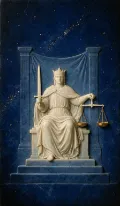
Justice belongs to Libra, the same sign as this card, and holds level scales and an upright sword. Beside the Two of Swords it draws attention to the difference between weighing a choice fairly and postponing it, and asks what a clear judgement would need.
- Two of Swords + The High Priestess
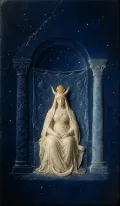
The High Priestess also sits still between two sides, eyes lowered and a crescent moon at the feet. Together they turn attention to inner knowing, and ask whether your silence is receptive listening or a way of not looking.
- Two of Swords + Eight of Swords
The Eight of Swords repeats the covered eyes, but there the figure stands hemmed in by nine blades. Next to the Two it shows how a chosen pause can come to feel like a trap, and invites you to notice which one you are in.
Also read withTwo of CupsAce of SwordsThree of SwordsAll pairs ↗
Questions to keep
- What are you trying to protect by leaving this undecided for now?
- If you took the blindfold off for one minute, what would you see first?
- Which feeling sits behind you, like the sea, while your mind weighs the two options?
Ask them with three cards ↗A three-card reading in which each position asks one of these questions.
A small practice
Draw a line down a page, write each option at the top of one side, and list only what each would change this week; then choose a date to decide.
Cards that share its symbols
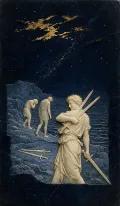 Five of SwordsShares: Two curving ivory swords · Arms crossed at the breast · The sea behind the seat · A glittering vein below
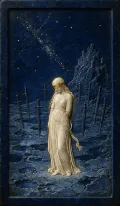 Eight of SwordsShares: The ivory blindfold · Two curving ivory swords · Arms crossed at the breast · A glittering vein below
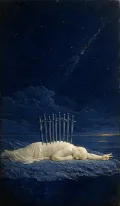 Ten of SwordsShares: Two curving ivory swords · Arms crossed at the breast · The sea behind the seat · A glittering vein below
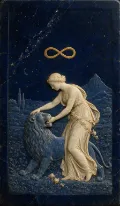 StrengthShares: A glittering vein below · The gold crescent moon · Arms crossed at the breast