Minor Arcana · Swords
Five of Swords
Tarot card meaning: upright, reversed and the symbols of the Olivia image
The Five of Swords asks what a win really costs: a quarrel ends, one side gathers the swords, and the others are left diminished.
- Upright
- conflicthollow victorycostly winpridescorekeeping
- Reversed
- making amendssetting swords downlingering resentmentwalking awayold grievances
Upright
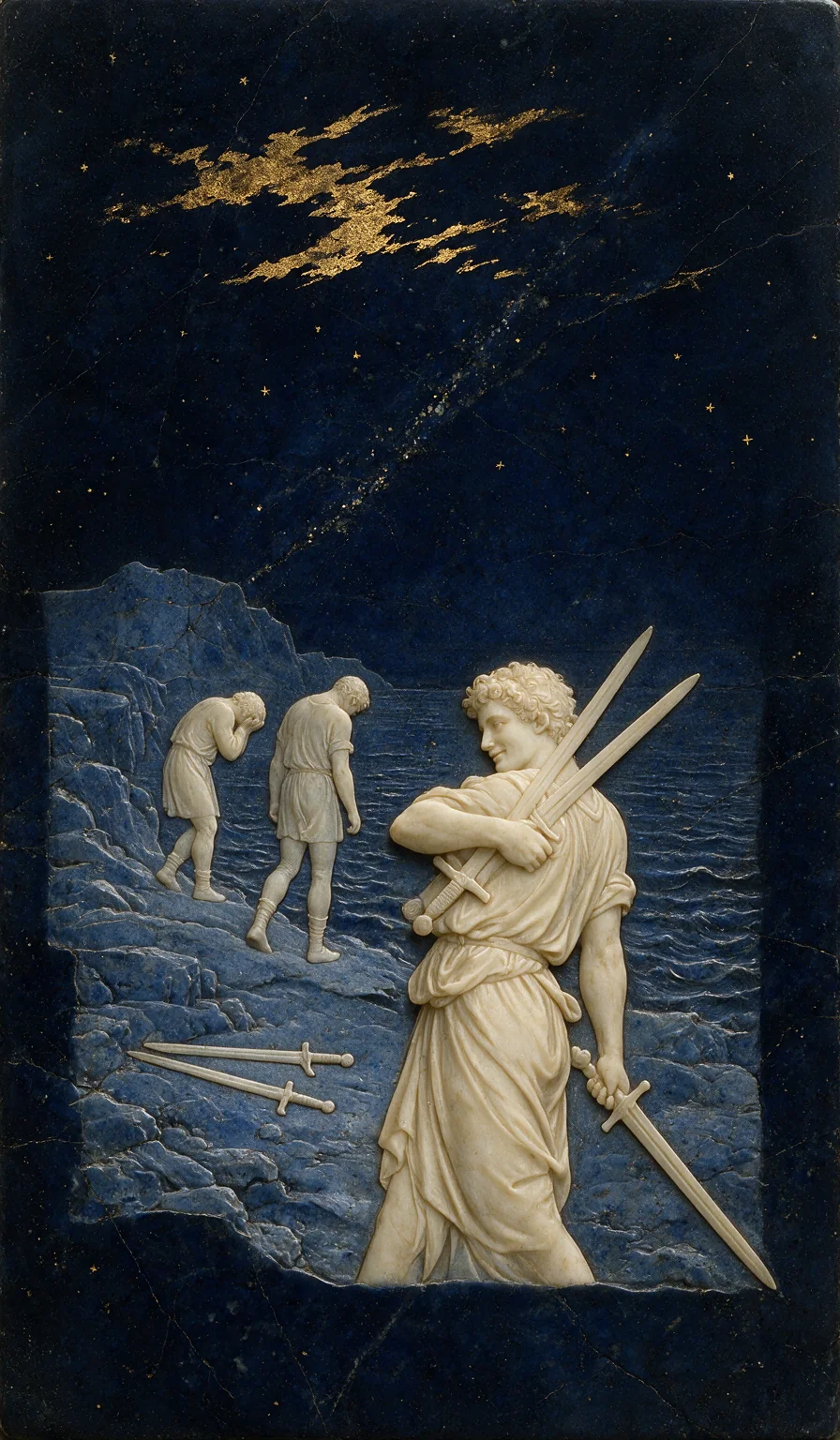
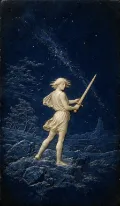
The Five of Swords shows the moment just after a conflict, when the result is clear but its meaning is not. In Olivia’s carving one ivory figure holds three of the five swords, two hugged against the chest and a third hanging point down, and looks back over a shoulder with a small, pleased smile. Behind, on the rocky shore, one figure bends forward with a hand pressed over the face and another walks with head bowed. Two swords lie on the stones, dropped or not yet gathered.
Swords are the suit of Air: words, reasoning, argument. Upright, this card draws attention to a contest of that kind, a debate won, a point proved, a position held, and asks honestly what the win has bought. Sometimes it describes standing up for yourself when that was needed. Often it points to a victory that leaves the room colder: the last word secured while trust quietly leaves.
The card can also show you on the other side of the picture, as one of the figures behind. It does not ask you to decide who was right. It invites you to notice where you stand in the scene, what each sword represents, and whether any of them is worth carrying further. Above it all the clouds are torn, but they are gold: even a bruising exchange can show you what you truly value.
Reversed
Five of Swords reversed turns attention to the aftermath. The swords may be coming down: a wish to make amends, to stop keeping score, or to step back from a contest that no longer serves anyone. Or the conflict may have gone underground, with resentment kept polished long after the argument ended, like the figure in the foreground still clutching blades nobody is fighting over.
Repair usually needs willingness on more than one side, and you cannot supply that for anyone else. What you can decide is what you are ready to own, what you need, and whether a respectful distance would serve better than another round. Laying down a single sword, a grudge or a rehearsed reply, is already a change.
Read the image
Every element below is carved into this card. Scroll, hover or press a number to follow it on the image.
The smile over the shoulder
What you seeThe ivory figure in the foreground has close curls and a calm profile. The head turns back toward the two figures behind, and the mouth lifts in a small, pleased smile.
What it carriesTraditionally the central figure of the Five of Swords wears a look of scorn or triumph. Olivia’s carving keeps it quieter: a satisfied half-smile. It asks what winning feels like from the inside, and what it costs to keep looking back at those who lost.
Two swords hugged close
What you seeTwo ivory swords are clasped diagonally against the chest by one crossed arm, blades rising past the shoulder to just above the horizon, hilts low on the chest at the viewer’s left: one crossguard and two round pommels.
What it carriesSwords belong to Air: thought, argument, the words you choose. Two blades hugged to the body suggest arguments collected and kept as proof. The grip is possessive rather than ready; these swords are not being used, only owned, and that is the card’s question about victory.
Follow this symbol through the deck ↗The sword held point down
What you seeIn the other hand, on the right of the card, a third sword with a lobed pommel hangs point down and outward, gripped just below the crossguard, its tip reaching almost to the lower corner of the relief.
What it carriesA lowered sword is commonly read as a contest that has ended: the point no longer threatens anyone. Yet it is still carried, not set aside. With the two at the shoulder, three of the card’s five swords now belong to one person.
Follow this symbol through the deck ↗Two blades on the stones
What you seeTwo ivory swords lie parallel on the blue lapis rocks at the lower left, points toward the card’s edge, crossguards and round pommels to the right, close to the hem of the foreground figure’s robe.
What it carriesIn the traditional image two swords lie on the ground, surrendered or not yet gathered. They mark what the losing side could not keep: arguments, standing, perhaps pride. The card leaves open whether the victor will pick these up as well, or let them lie.
Follow this symbol through the deck ↗The face hidden from view
What you seeThe farther of the two figures behind, in a short belted tunic and soft boots, bends forward on the rocky slope, one arm raised and a hand pressed over the face.
What it carriesCovering the face is one of the oldest gestures of grief and shame, and a figure with head in hand belongs to this card’s traditional image too. It is the other side of the smile in the foreground: the same event, felt as humiliation rather than success.
Follow this symbol through the deck ↗The bowed figure
What you seeNearer the foreground, a second figure in a matching tunic walks toward the cliffs with head sunk low, arms hanging loose and empty at the sides, the back heel lifted mid-step on the rocks.
What it carriesIn the traditional image the defeated pair walk away. Where one figure grieves, this one simply goes, unarmed and deflated. Many readers see here the choice to leave a fight that cannot be won fairly: walking away can be defeat, and also the first dignified act after one.
The carved sea
What you seeBehind all three figures a sea carved in rippled blue lapis stretches to a straight horizon, its small waves incised as fine pale lines across the middle of the card.
What it carriesIn the traditional image the quarrel also takes place beside water. Water is the element of feeling, which argument does not reach. The sea here stays wide and untroubled by who won, a reminder that emotions left over after a conflict still need somewhere to go.
Follow this symbol through the deck ↗Gold clouds torn apart
What you seeHigh in the dark lapis sky, ragged streaks of gold stretch sideways like clouds pulled apart by wind, with small gold four-pointed stars scattered around them.
What it carriesThe traditional card shows jagged clouds racing across the sky, the weather of a quarrel. Olivia turns them to gold: the storm of a conflict still holds something of value. What is torn apart can also show you what mattered enough to fight over.
Follow this symbol through the deck ↗A glittering diagonal vein
What you seeA pale vein of glittering mineral runs diagonally through the lapis, from beneath the right end of the gold clouds down toward the cliffs above the two figures behind, like a trail of fine stars.
What it carriesThis detail belongs to the stone, not to the traditional design, yet on this card it reads like a slanting path of light reaching toward those who lost. Even over defeat, the sky is not empty, and another direction is already drawn in.
Follow this symbol through the deck ↗
The number
Five breaks the balance that Four built. In every suit it brings disturbance: strife in Wands, loss in Cups, hardship in Pentacles. In Swords, the suit of Air and mind, the disturbance is a clash of ideas and words. The Four of Swords lay in stillness and recovery; the Five is what happens when that rest ends in contention and someone insists on winning. Halfway through the count from Ace to Ten, it asks how you meet difference, not whether difference arrives.
The tradition
In the Golden Dawn system the Five of Swords is titled the Lord of Defeat. It is assigned to Venus in Aquarius, the first decan of that sign (0 to 10 degrees), and to Geburah, Severity, the fifth Sephirah on the Tree of Life, expressed through the suit of Air. Venus, the planet of harmony and relating, placed in cool, detached Aquarius is often read as affection weakened by argument or pride. Aleister Crowley kept the single title Defeat. Marseille decks show only a pattern of curved blades around one straight sword; Pamela Colman Smith’s 1909 design gave the pip its now familiar scene of one figure gathering swords while two others turn away under a wind-torn sky.
Love, work and self
- Love
- In close relationships the Five of Swords often appears around an argument that someone won and nobody enjoyed. It does not tell you what another person feels or intends. It asks about your part: are you collecting proof, replaying the exchange in search of the winning line, or standing with your face in your hands? The card invites a simpler goal than victory. Name what you actually need, and consider whether being understood matters more than being right, including in the arguments you have with yourself.
- Work
- At work or in study, this card can reflect a meeting where a point was forced through, a rivalry, or a competitive setting where colleagues start to feel like opponents. Swords ask for clear thinking, so separate the issue itself from the scorekeeping around it. A win that costs cooperation can cost more than it first appears. Where a real dispute over pay, contracts or rights is involved, a qualified adviser serves better than another round of argument.
- Self
- For your relationship with yourself, notice the inner voice that keeps score. It is possible to be every figure on this card at once: the part that wins each internal argument, and the part that bows its head and says nothing. The two swords left on the stones can stand for things you have stopped trying to defend. Ask whether they need picking up again, or whether leaving them where they lie is its own quiet relief.
In a spread
Read the card through each position before you look at Olivia’s version. A position is a question, and the same card answers each one differently.
The situation
What aspect of the situation deserves attention?
Olivia’s readingAt the centre of a question, the Five of Swords can point to a conflict or recent quarrel whose outcome is known but whose cost has not yet been counted.
What complicates it
What tension or assumption deserves a closer look?
Olivia’s readingAs a challenge, it can show the need to win or to have the last word, or a grievance carried long after the argument itself has ended.
A helpful next step
What small action could help you understand or respond?
Olivia’s readingAs advice, it invites you to choose which sword is worth holding: stand firm where it truly matters, and set down the arguments that only feed pride.
In conversation with
- Five of Swords + Five of Wands
The Five of Wands shows a lively contest in which everyone is still playing. Beside the Five of Swords the pair contrasts friction that sharpens people with conflict that divides them, and asks which of the two you are in.
- Five of Swords + Six of Swords
The Six of Swords carries its figures across water toward calmer shores. After the Five, with its carved sea behind the defeated pair, it turns attention toward what follows leaving a fight: a quiet crossing, with the swords still aboard.
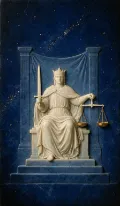
- Five of Swords + Justice
Justice holds a single upright sword and level scales. Next to the Five of Swords it asks whether a win was also fair, and what a just outcome would look like for everyone involved, including you.
Questions to keep
- What would you gain, and what would you lose, by winning this particular argument?
- Which of the swords you are carrying could you set down today?
- If you are one of the figures turning away, what do you need to take with you, and what can stay behind?
Ask them with three cards ↗A three-card reading in which each position asks one of these questions.
A small practice
After your next disagreement, write the one sentence you most wanted to win with, then write underneath it what you actually needed.
Cards that share its symbols
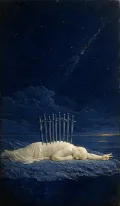 Ten of SwordsShares: Two swords hugged close · The smile over the shoulder · The face hidden from view · The carved sea · Gold clouds torn apart · A glittering diagonal vein
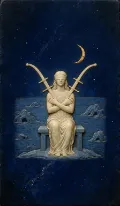 Two of SwordsShares: Two swords hugged close · The face hidden from view · The carved sea · A glittering diagonal vein
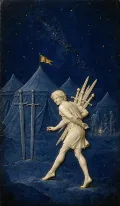 Seven of SwordsShares: The smile over the shoulder · Two swords hugged close · The face hidden from view · A glittering diagonal vein
 Page of SwordsShares: Two swords hugged close · The smile over the shoulder · A glittering diagonal vein · Gold clouds torn apart