Minor Arcana · Swords
Eight of Swords
Tarot card meaning: upright, reversed and the symbols of the Olivia image
The Eight of Swords shows a mind hemmed in by its own reading of a situation, and asks which limits are truly fixed and which are already loosening.
- Upright
- feeling trappedself-limiting thoughtsrestricted viewindecisionwaiting for rescue
- Reversed
- loosening bondsfresh perspectiveself-releaselingering inner criticfear of freedom
Upright
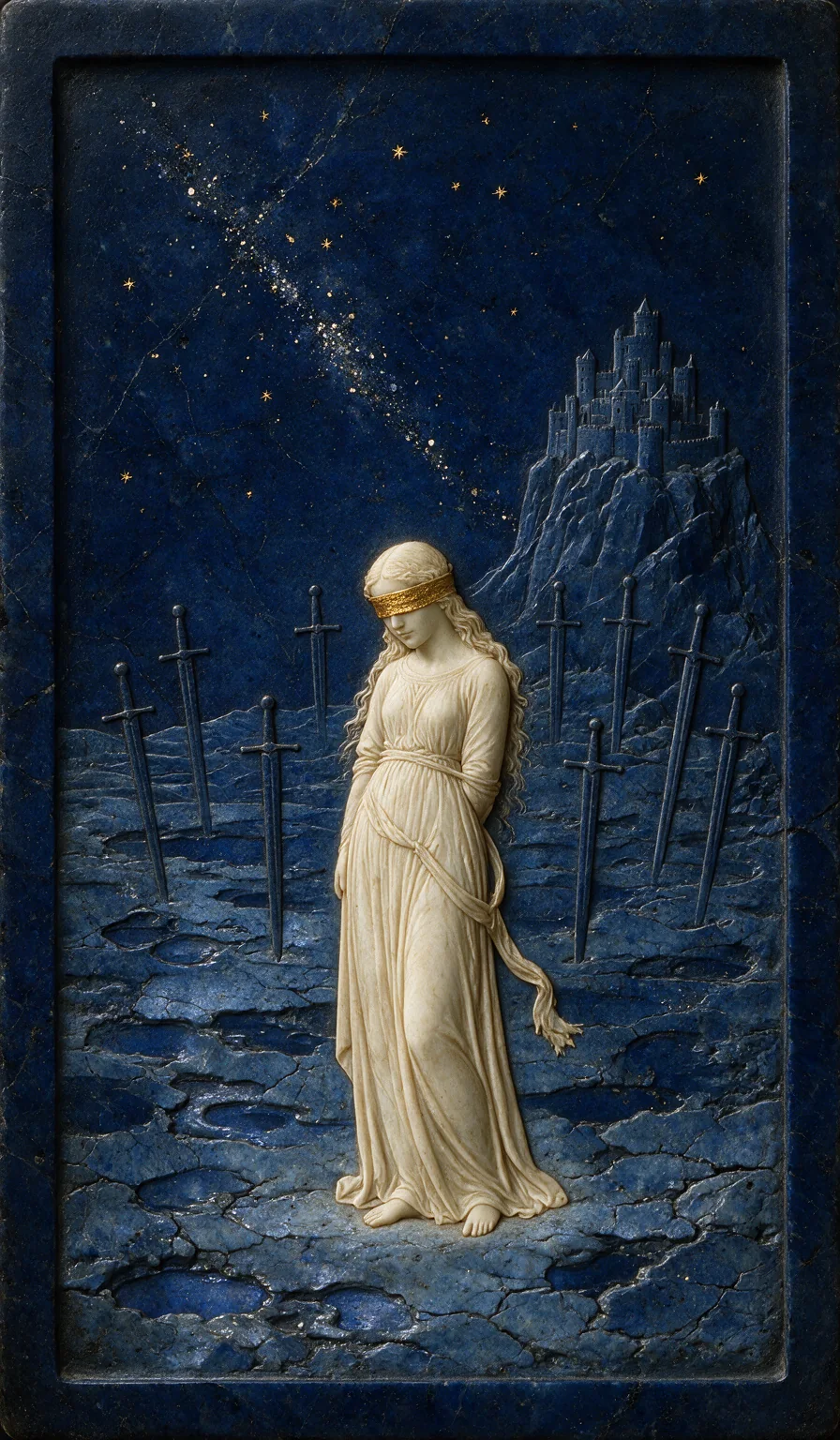
The Eight of Swords draws attention to a feeling of being hemmed in: a situation where every direction seems to carry a cost, and thinking about it only tightens the circle. In Olivia’s carving a barefoot figure stands in a gold blindfold, head bowed, with nine dark lapis swords planted in the ground behind and on either side. The picture is precise about what limits sight. It is not the swords but the band across the eyes.
Swords belong to Air, the suit of thought, and this card often points to constraints that are partly made of interpretation: the worst-case story, the rule never questioned, the fear of choosing wrongly. Yet the image is generous with evidence that the hold is looser than it feels. The sash that binds the figure is loosely knotted and trails a free end, one hand hangs open at the side, and the ground in front of the figure is clear of blades.
Upright, the card invites a patient kind of honesty. Some limits are real and ask to be respected, planned around or shared with someone who can help. Others soften when you name them, test them or gather one more piece of information. You do not need to see the whole way out; one step, taken with the hand that is already free, is enough to begin.
Reversed
Eight of Swords reversed draws attention to a restriction that is beginning to loosen, or to one that has moved inward. You may notice the knot giving way: a clearer view of the situation, a conversation that opens a door, a limit you realise can be renegotiated. The blindfold can slip before the whole landscape comes into focus, and partial sight is still progress.
The reversed card can also point to an inner critic that insists nothing can change even as outer conditions ease, or to hesitation about leaving a constraint that has become familiar. Move at a pace that feels safe. Freedom that arrives slowly is still freedom, and it asks for no self-blame about the time it has taken.
Read the image
Every element below is carved into this card. Scroll, hover or press a number to follow it on the image.
The gold blindfold
What you seeA wide band of textured gold covers the eyes and wraps around the head, set into the ivory like gold leaf. The head bows forward and a little to the viewer’s left; the mouth is calm.
What it carriesThe blindfold is this card’s oldest sign of limited sight: the situation is judged from inside, without the full view. Traditional versions use plain cloth. Olivia makes it gold, so what blocks the view is also something valued, a belief worth examining gently rather than tearing away.
Follow this symbol through the deck ↗Four blades on the left
What you seeFour dark blue swords carved in the lapis stand point-down in the ground on the viewer’s left, each with a round pommel and a straight crossguard, leaning at slightly different angles and heights.
What it carriesSwords are the suit of Air: thoughts, words and judgements. Planted around a figure, they are commonly read as the ideas that fence a person in. Here they are cut from the same dark stone as the sky and ground, part of the landscape rather than weapons anyone is holding.
Follow this symbol through the deck ↗Five blades on the right
What you seeFive more swords of the same dark lapis stand on the viewer’s right against the rocky slope, at staggered heights. Nine blades in all flank the figure; none touches it, and none stands in front.
What it carriesThe traditional card shows eight swords, matching its number. Olivia’s carving shows nine, while this deck’s Nine of Swords carves eight, as if the two cards had traded counts. What matters more is the open ground: every blade stands behind or beside the figure, and the way forward is clear.
Follow this symbol through the deck ↗The loosely knotted sash
What you seeA long ivory sash wraps under the chest and around the arm on the viewer’s right, crosses the gown diagonally, loops into a loose knot at the right hip and trails a frayed end.
What it carriesIn the traditional image the figure’s upper body and arms are wrapped tight in binding. Olivia’s binding is a single sash, loosely knotted, its end hanging free: a constraint real enough to feel, yet already slack, and one that could be worked loose from within.
The free hand
What you seeOn the viewer’s left the arm hangs down at the side, and the ivory hand rests against the gown at thigh level, fingers relaxed. The other arm bends back behind the body, wrapped by the sash.
What it carriesThis departs from the fully bound figure of the traditional card. One hand is free, simply not in use. It gives the image its quiet question: which limits are tied fast, and which stay in place only because the free hand has not yet moved?
Follow this symbol through the deck ↗The castle on the crag
What you seeHigh on the right, a many-towered castle carved in paler blue lapis crowns a steep, fissured crag whose slope falls away behind the swords on the viewer’s right.
What it carriesA castle on a height stands behind the figure in the traditional Eight of Swords too. It is commonly read as authority, home or the rules and expectations that shaped the situation. It is present in the picture, but distant: not the ground under the figure’s feet.
Follow this symbol through the deck ↗The river of stars
What you seeA diagonal drift of pale, glittering specks crosses the dark sky from the upper left down toward the crag and the bowed head, with small gold stars scattered separately across the sky.
What it carriesThe traditional card sets this scene under a plain grey sky. Olivia’s night is wide and lit, and its band of stars slants toward a head that cannot see it. The larger view has not gone; it is simply out of sight for now.
Follow this symbol through the deck ↗Pools in cracked ground
What you seeThe foreground is carved as cracked plates of lighter lapis broken by shallow, darker, polished hollows like standing water. The bare ivory feet stand on a paler patch between them.
What it carriesPools of water at the figure’s feet belong to the traditional image and are often read as feeling with nowhere to flow. Here they lie scattered and shallow; the figure stands upright and barefoot among them, in touch with the ground rather than sinking into it.
Follow this symbol through the deck ↗
The number
Eight is the number of pattern and movement after the upheaval of Seven: energy that has found a structure and now runs along it. In Swords, the suit of Air and mind, that structure is a pattern of thought. Where the Seven of Swords tries to slip past difficulty through strategy, the Eight shows the mind caught in its own design, each idea a fence post. The step this rank asks for is re-examination: seeing the pattern clearly enough to choose another way through it.
The tradition
In the Golden Dawn system the Eight of Swords is titled the Lord of Shortened Force. It is assigned to Jupiter in Gemini, the first decan of that sign (0 to 10 degrees), and to Hod, Splendour, the eighth Sephirah on the Tree of Life, expressed through the suit of Air. Jupiter’s expansiveness in quick, many-sided Gemini is often read as energy scattered across too many thoughts, so that force is cut short; Aleister Crowley titled the card Interference. Marseille decks show only a pattern of curved blades around a central flower. Pamela Colman Smith’s 1909 design gave the pip a scene: a bound, blindfolded figure among planted swords, with a castle on a distant height.
Love, work and self
- Love
- In close relationships the Eight of Swords can point to feeling stuck between options that each seem to cost too much: speaking or staying quiet, moving closer or stepping back. It does not tell you what anyone else feels or intends. It asks which rules you are following without having chosen them, and what you already know but have not let yourself see. With yourself, it invites the same gentleness: a knot to loosen, not a verdict on your worth.
- Work
- At work or in study, the card can reflect a sense that every route is blocked by a rule, a deadline or someone’s expectations. Swords ask for clear thinking, so separate the constraints that are written down from the ones that are assumed. Ask one question you have been avoiding, or look for one resource you have not yet used. Where money, contracts or legal matters are involved, a qualified person’s view can show which limits are fixed and which have room.
- Self
- For your relationship with yourself, the Eight of Swords turns attention to the stories that keep you still: “I can’t”, “I shouldn’t”, “it’s too late”. The figure in this image stands upright and barefoot, in contact with the ground, with one hand free. Notice where tension gathers in your own body when you think about the situation, and let one small, safe movement follow: a slower breath, a short walk, a sentence written down.
In a spread
Read the card through each position before you look at Olivia’s version. A position is a question, and the same card answers each one differently.
The situation
What aspect of the situation deserves attention?
Olivia’s readingAt the centre of a question, the Eight of Swords can point to a limit that is felt strongly but perhaps not yet examined. Seeing which parts are real and which are assumed may matter most.
What complicates it
What tension or assumption deserves a closer look?
Olivia’s readingAs a challenge, the card can show a habit of waiting for the whole way out to be visible before moving, or a worst-case story repeated until it feels like a wall.
A helpful next step
What small action could help you understand or respond?
Olivia’s readingAs advice, it invites one small test of a limit you have taken for granted: a question asked, a fact checked, a first step taken with the hand that is already free.
In conversation with
- Eight of Swords + Two of Swords
The Two of Swords also shows a blindfolded figure holding a decision at bay; in this deck its band is ivory, here gold. Beside the Eight, the pair asks whether putting off a choice has slowly turned into feeling unable to make one.
- Eight of Swords + Nine of Swords
The Nine of Swords follows the Eight: restriction turns into sleepless worry, and in this deck the two even trade counts, nine blades here and eight there. Together they draw attention to circling thoughts, and to how naming them in daylight can lighten them.
- Eight of Swords + The Devil
The Devil’s chains fall in slack loops around the necks of the pair; here the sash is loosely knotted, its end hanging free. Together the two cards ask which bonds are held in place more by belief and habit than by anything that truly cannot move.
Also read withEight of WandsSeven of SwordsAll pairs ↗
Questions to keep
- Which of the limits around you are fixed, and which have you simply never tested?
- How would you describe this situation if you left out its worst-case ending?
- Where is your free hand: what small movement is already within reach?
Ask them with three cards ↗A three-card reading in which each position asks one of these questions.
A small practice
List the limits you feel in this situation, mark each one “known” or “assumed”, and choose one assumed limit to check gently this week.
Cards that share its symbols
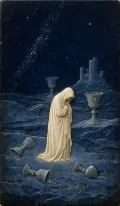 Five of CupsShares: The free hand · The castle on the crag · Pools in cracked ground · The river of stars
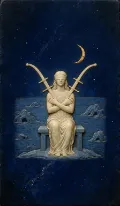 Two of SwordsShares: The gold blindfold · Four blades on the left · The free hand · The river of stars
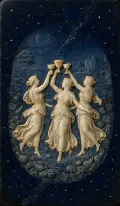 Three of CupsShares: The free hand · The river of stars · The castle on the crag
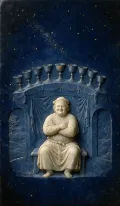 Nine of CupsShares: The free hand · The loosely knotted sash · The river of stars