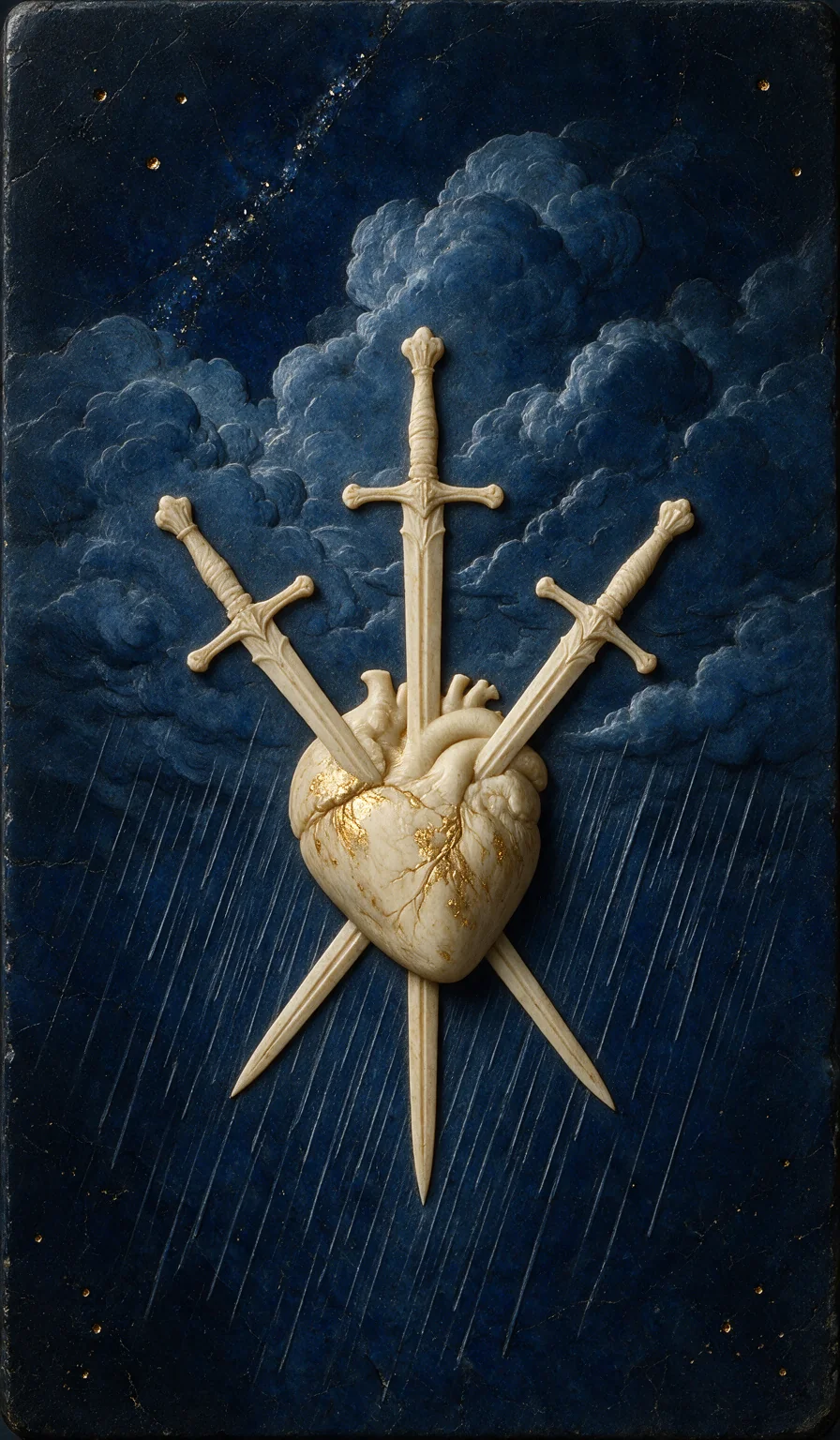
Minor Arcana · Swords
Three of Swords
Tarot card meaning: upright, reversed and the symbols of the Olivia image
The Three of Swords names a hurt plainly: a painful truth, a loss or a grief felt in the heart, and the first honest step toward tending it.
- Upright
- heartachepainful truthgriefrelease through tearshonest naming
- Reversed
- lingering hurtpain kept quietslow mendingreplaying the storyeasing sorrow
Upright
The Three of Swords is one of the most recognisable images in tarot, and one of the most honest. It draws attention to a hurt that has already arrived: a painful truth heard or understood, a separation, a disappointment, a grief that sits in the chest. In Olivia’s deck the heart is not a flat emblem but an anatomical heart carved in ivory, vessels and all, so the card speaks of pain as something your body knows, not only an idea you are thinking about.
Swords are the suit of Air, of words and understanding, and this card often turns attention to the moment when knowing something hurts. Three ivory blades meet inside the heart, yet their points come out clean below it and fan apart, while the rain slants steadily across the lower card. Nothing here is frozen; sorrow is moving through.
What makes this version distinctive is the gold. Fine gold seams run across the heart like mended cracks, the way broken pottery is repaired with gold in kintsugi. Upright, the card invites you to name the hurt plainly, without adding the harshest possible story about what it means for your worth. Let it be felt, let support in, and notice that tending a wound is already part of the picture. As always in Olivia’s practice, this is symbolic language for a feeling, not a forecast of events.
Reversed
Three of Swords reversed draws attention to hurt that is either slowly easing or being kept out of sight. The rain may be thinning: you may notice more room around an old sorrow, and the gold seams may matter more to you now than the blades. Or the pain may have turned inward, carried quietly because naming it feels like too much, or replayed until the story grows sharper than the event.
This position asks what the hurt still needs. Sometimes it is a conversation or a written page; sometimes it is simply permission to stop rehearsing the harshest explanation. Easing does not mean forgetting, and privacy does not mean failing to cope. Let support in at a pace that feels manageable.
Read the image
Every element below is carved into this card. Scroll, hover or press a number to follow it on the image.
The carved ivory heart
What you seeAn anatomical heart carved in ivory, not a stylised valentine: the great vessels rise from its top, its chambers swell in soft relief, and all three blades meet inside it.
What it carriesIn tarot the heart stands for feeling, attachment and whatever you hold dear. Pamela Colman Smith drew a flat red emblem; Olivia’s is a real organ, heavy and alive, so the hurt reads as something bodily and lived, not a symbol kept at a distance.
Follow this symbol through the deck ↗Gold seams across the heart
What you seeThin rivers of gold run over the ivory heart, pooling on its upper left shoulder and branching down through its centre like veins or mended cracks.
What it carriesClassic versions of this card carry no gold on the heart. Here it recalls kintsugi, the Japanese craft of joining broken pottery with gold. Repair is already part of the picture: a wound, once tended, can become a visible line of strength rather than something to hide.
The upright centre sword
What you seeThe central ivory sword stands exactly vertical, its flared, fluted pommel and bound grip high among the clouds, its crossguard ending in rounded knobs, its blade driving straight down into the heart.
What it carriesSwords belong to Air: thought, words and clear understanding. The straight middle blade is the plain fact of what happened, the one line that does not bend. Its symmetry keeps the image from chaos; the pain has a clear axis you can name.
Follow this symbol through the deck ↗Two slanting side swords
What you seeTwo matching ivory swords lean inward from left and right, their pommels roughly level with the centre sword’s crossguard, their blades entering the heart’s upper shoulders on either side of the vessels.
What it carriesThe side blades can stand for the explanations, memories and replayed words that gather around a hurt, each arriving from its own angle and meeting at one point. Three thoughts converge where one would have been bearable.
Follow this symbol through the deck ↗Three points below
What you seeBeneath the heart three clean, pale points fan out. The side blades cross inside the heart, so the left-hand sword’s point emerges lower right, the right-hand sword’s lower left; the centre point drops straight down.
What it carriesThe swords pass through rather than stopping inside, and, as in Smith’s 1909 card, there is no blood. The spreading points hint that thoughts which met in pain can leave in different directions: the moment of piercing is not the whole story.
Follow this symbol through the deck ↗Storm clouds in grey lapis
What you seeHeavy, billowing clouds carved in lighter greyish blue lapis bank behind the hilts across the upper half of the card, and reach down on both sides to the level of the heart.
What it carriesClouds in the Swords suit usually mark troubled or clouded thinking. Smith hung this card’s heart in a storm sky; here the clouds stay above and behind the blades, the weather of the mind that surrounds a sorrow without being the sorrow itself.
Follow this symbol through the deck ↗Slanting incised rain
What you seeFine pale lines are scratched into the lapis below the cloud line, slanting from upper right to lower left and filling both sides of the lower card around the blade points.
What it carriesRain is the classic weather of this card, often read as tears and as release. Rain also washes and waters. Its steady slant gives the image movement: grief falling through, not frozen in place, which is where the card’s quiet hope begins.
Follow this symbol through the deck ↗Glittering vein and gold flecks
What you seeIn the upper left a diagonal vein of pale, glittering mineral crosses the dark lapis like a thread of stars, while small gold flecks sit near all four corners of the card.
What it carriesThis detail is Olivia’s own. Swords belong to the sky, and above the storm the stone keeps its stars. It is a small reminder that clarity has not gone, only been covered for a while, and that the night is larger than the clouds.
Follow this symbol through the deck ↗
The number
Three is the first number that makes a shape: after the single point of the Ace and the held tension of the Two, something new takes form. In Swords, the suit of Air and mind, that new form is understanding, and understanding can hurt. Where the Two of Swords keeps a difficult choice in suspension, the Three is where the truth lands and is felt. It marks the point where thought becomes emotion, and where honest grieving can begin.
The tradition
In the Golden Dawn system the Three of Swords is titled the Lord of Sorrow. It is assigned to Saturn in Libra, the second decan of that sign (10 to 20 degrees), and to Binah, Understanding, the third Sephirah on the Tree of Life, expressed through the suit of Air. Saturn’s weight on the scales of Libra is often read as a hard truth that has to be accepted; Aleister Crowley kept the single title Sorrow. Marseille decks show only a pattern of curved and straight blades. The pierced heart appears in the Sola Busca tarot of about 1490, which Pamela Colman Smith is thought to have seen before her 1909 design, and it echoes devotional images of a heart pierced by swords.
Love, work and self
- Love
- In close relationships the Three of Swords can point to words that cut, a separation, or a disappointment that has not yet been spoken about. It does not tell you what another person feels or intends. It asks what you know about your own hurt, and whether you can say it simply, first to yourself and then, if it feels right, to someone you trust. The gold seams on the heart are a reminder that closeness, including with yourself, can be mended without pretending nothing broke.
- Work
- At work or in study, this card can reflect criticism that stung, a plan that fell through, or a hard truth about a project you cared about. Swords ask for clarity, so separate what was actually said or decided from the conclusions you have drawn about your ability. Give yourself a short pause before responding. Where money or practical matters are involved, the view of a qualified person serves better than rehearsing the worst case alone at night.
- Self
- For your relationship with yourself, the card invites grief to be felt instead of managed. The anatomical heart in this image is a reminder that sorrow lives in the body too: in the breath, in the chest, in tiredness. Notice where you hold it. The rain in the lower card keeps falling in one direction, and tears have their own movement. Give them room, then notice what small kindness, rest or company would help you tend what hurts.
In a spread
Read the card through each position before you look at Olivia’s version. A position is a question, and the same card answers each one differently.
The situation
What aspect of the situation deserves attention?
Olivia’s readingAt the centre of a question, the Three of Swords can point to a hurt or hard truth that may sit beneath everything else. Naming it plainly may matter more than solving it straight away.
What complicates it
What tension or assumption deserves a closer look?
Olivia’s readingAs a challenge, the card can show pain replayed until it hardens into a story about your worth, or sorrow pushed away so firmly that it cannot move through.
A helpful next step
What small action could help you understand or respond?
Olivia’s readingAs advice, it invites you to acknowledge the hurt in simple words, give it a little time, and let one trusted person or practice help you begin tending it.
In conversation with
- Three of Swords + Two of Swords
With the Two of Swords the pair traces a sequence: a truth held at a distance, then felt. Together they ask whether avoiding something has only delayed the moment it lands, and what honest attention would look like now.
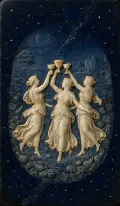
- Three of Swords + Three of Cups
The Three of Cups celebrates friendship and shared joy; beside the Three of Swords the two threes show both sides of connection. Together they draw attention to the people who can hold your sorrow as well as your gladness.
- Three of Swords + The Star
The Star is the card of renewal and quiet hope after upheaval. Next to the Three of Swords it turns attention toward healing after hurt, and toward the stars this card already keeps above its storm clouds.
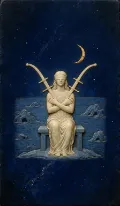
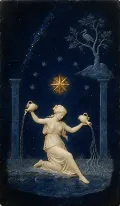
Also read withFour of SwordsQueen of SwordsAll pairs ↗
Questions to keep
- What hurt, named plainly in one sentence, is asking for your attention right now?
- Which part of this pain is what happened, and which part is the story you have added?
- If this crack were mended with gold, what would the mending look like for you?
Ask them with three cards ↗A three-card reading in which each position asks one of these questions.
A small practice
Write the hurt in one plain sentence, then underneath write one small thing that would tend it today, and do only that.
Cards that share its symbols
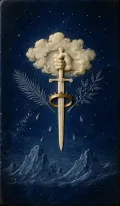 Ace of SwordsShares: The upright centre sword · Slanting incised rain · Glittering vein and gold flecks
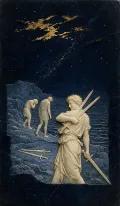 Five of SwordsShares: The upright centre sword · Storm clouds in grey lapis · Glittering vein and gold flecks
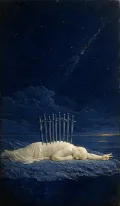 Ten of SwordsShares: The upright centre sword · Storm clouds in grey lapis · Glittering vein and gold flecks
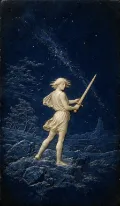 Page of SwordsShares: The upright centre sword · Glittering vein and gold flecks · Storm clouds in grey lapis