Major Arcana · XIX
The Sun
Tarot card meaning: upright, reversed and the symbols of the Olivia image
The Sun is the card of plain daylight joy: feeling alive, seen and open, and letting something good be simply and fully good.
- Upright
- joyvitalityclarityopennesswarmthconfidence
- Reversed
- muted joyforced cheeroverexposuredimmed confidencedelayed warmth
Upright
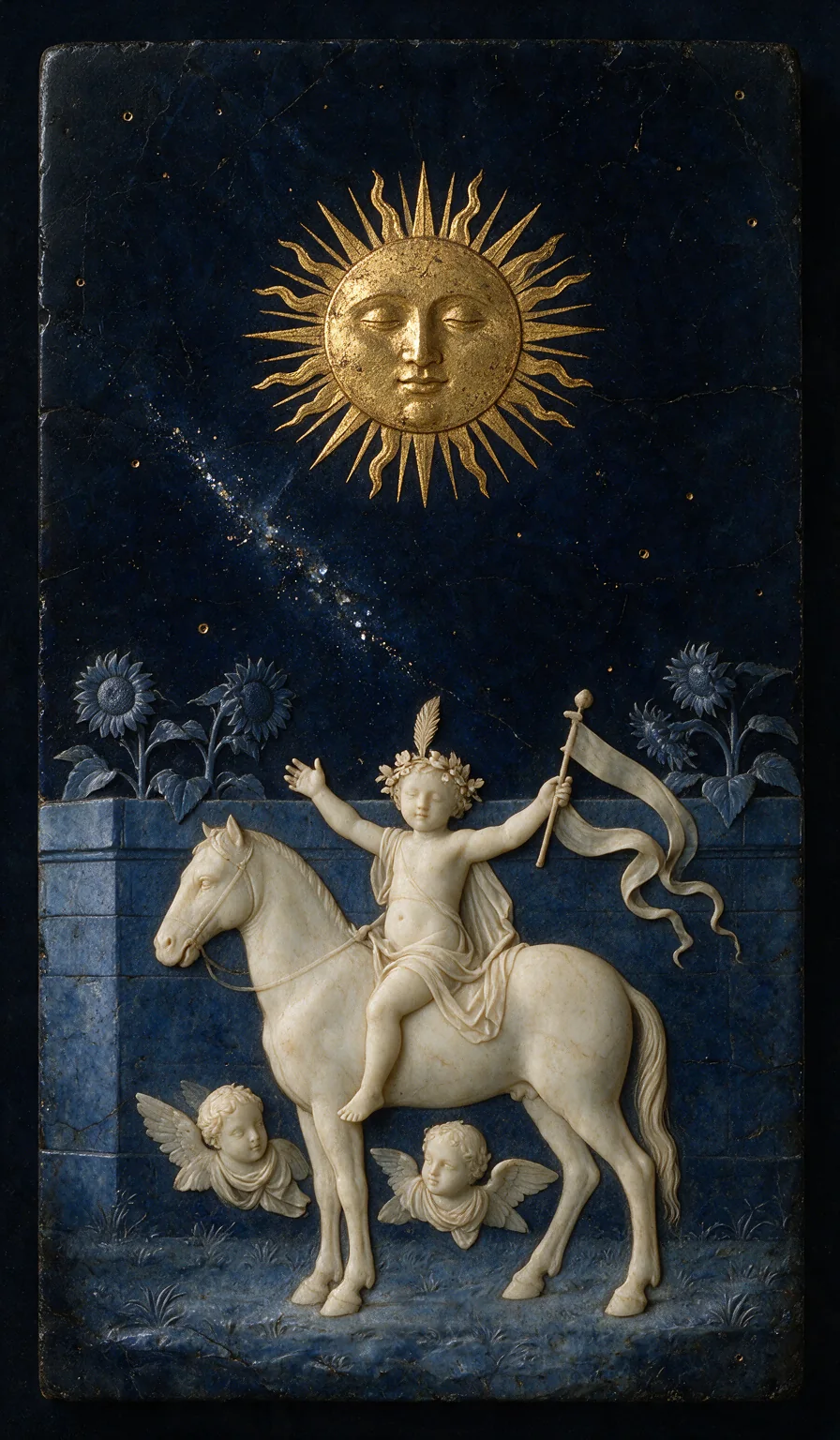
The Sun comes after the long night of The Moon, and it asks for very little: to be seen, to feel warm, to let a good thing be good. On Olivia’s card a gilded face fills the upper sky, eyes closed and calm, and below it an ivory child rides a white horse with one arm flung open and the other carrying a pale banner. Nothing is hidden and nothing is held back. The card turns your attention towards what is working, what feels alive and what you can enjoy without apology.
Look at what the child is not doing. The rein runs slack from the bridle to the waist, and neither hand holds it; the horse stands steady anyway. Upright, the Sun can point to energy that cooperates instead of needing to be forced, and to confidence that comes from being at ease rather than in control. The child’s closed eyes echo the sun’s own: this is a joy felt from the inside, not performed for anyone watching.
Olivia also sets this sun in a night sky crossed by a band of stars. Clarity here does not require every shadow to be gone. You can recognise real warmth, a finished task, an honest conversation, a morning that feels light, while other parts of life are still unresolved.
Reversed
The Sun reversed keeps its light but turns it down, or pushes it outward too hard. It can point to joy muted by tiredness or by a feeling that you have not earned it yet, so good news passes without being felt. It can also draw attention to the opposite: brightness worn as a performance, optimism that leaves no room for an honest tired day, or overexposure, when being seen all the time stops feeling warm.
On this card the banner flies freely and the rein hangs loose. Reversed, it asks whether you are gripping something that could be carried lightly, or holding back an open gesture until conditions are perfect. A smaller, private kind of enjoyment is still the Sun: one clear moment, noticed and allowed.
Read the image
Every element below is carved into this card. Scroll, hover or press a number to follow it on the image.
The gilded sun face
What you seeA large gold disc fills the upper sky, carved with a calm, frontal face whose eyes are closed. Broad straight rays, thin spikes and wavy, flame-like rays alternate all the way around it.
What it carriesThe sun with a human face appears on both Marseille and Waite-Smith cards as the source of warmth and plain sight. Here it is by far the largest area of gold on the card, and its closed eyes suggest a light that rests rather than stares.
Follow this symbol through the deck ↗The band of stars
What you seeA diagonal band of glittering, silvery chips crosses the lapis sky from beside the sun’s lower left rays down to the right, fading out above the child, among scattered gold star flecks.
What it carriesThe traditional Sun card shows a daylit sky; Olivia’s sun shines in a night full of stars. Day and night share one sky here, so the card’s light reads less as the end of darkness and more as clarity that can stand inside it.
Follow this symbol through the deck ↗Four lapis sunflowers
What you seeAbove the wall grow sunflowers carved in blue-grey lapis, not gold: two open blooms at the left, and at the right one open bloom beside a smaller head turned in towards the centre.
What it carriesSunflowers follow the sun, and the Waite-Smith card sets them above its wall as signs of growth that leans towards light. Carved here in cool lapis rather than yellow, they feel quieter: most face out towards you instead of up at the gilded face.
Follow this symbol through the deck ↗The wreath and feather
What you seeThe child’s head is circled by a wreath of small ivory leaves and blossoms, with a single upright feather rising from its front. Beneath it the child’s eyes are closed, like the sun’s.
What it carriesThe feather links the child to The Fool, who wears one in the Waite-Smith deck, and marks a return to simplicity near the end of the Major Arcana. Traditionally it is red; here it is ivory, part of the same pale figure, and the wreath adds a quiet sense of celebration.
Follow this symbol through the deck ↗The child with open arms
What you seeAn ivory child sits bareback on the horse, a light ivory cloth hanging from the shoulders and gathered across the lap. One arm is flung wide with the palm open; the other hand grips the banner staff.
What it carriesThe child is the Sun’s central image of trust: open to the light, unguarded, with nothing to prove. Where Marseille cards show two children beside a wall, the Waite-Smith card and Olivia’s carving focus on one child whose whole body turns outward in welcome.
Follow this symbol through the deck ↗The ivory banner
What you seeFrom a slender staff topped with a round knob, a long, plain ivory banner streams out to the right of the rider, twisting in loose folds into forked, ribbon-like ends. It carries no emblem.
What it carriesIn the Waite-Smith card the banner is red, the colour of vitality and action. Here it is the same ivory as the child, so it reads as an extension of the open gesture itself: energy made visible and carried lightly, not a flag of conquest.
The lapis garden wall
What you seeA low wall of squared lapis blocks, paler and brighter blue than the sky, runs the full width of the card behind the horse, its top edge close to the child’s shoulders.
What it carriesThe wall is commonly read as the edge of an enclosed garden: the child has come out beyond sheltered ground into open light. It can also suggest the safety that makes openness possible, a structure at your back rather than a barrier ahead.
Follow this symbol through the deck ↗The white horse
What you seeA large ivory horse stands calmly facing left, all four hooves on the grassy ground. It wears a simple bridle but no saddle, and a slack rein runs back to the child’s waist, held by neither hand.
What it carriesA white horse is commonly read as strength that is willing and well directed. The child rides without a saddle and without holding the rein, so the card points to energy that cooperates with you instead of needing to be forced or steered.
Follow this symbol through the deck ↗Two winged cherub heads
What you seeLevel with the horse’s legs, two ivory cherub heads with small feathered wings and draped collars float against the lapis, one in front of the forelegs and one under the belly, between fore and hind legs.
What it carriesCherub heads do not appear on the Waite-Smith card; they come from Renaissance art, where they mark a scene as blessed. Some early Italian Sun cards show a winged child holding up the sun. Here they suggest joy that is shared and quietly watched over.
Follow this symbol through the deck ↗
The number
The Sun is number nineteen, the last of the three celestial cards after The Star and The Moon, and the step just before Judgement and The World. In the Fool’s journey it is the moment of coming out into daylight: after hope and after uncertainty, the traveller simply sees clearly and feels alive. Nineteen reduces to ten and then to one, and some readers link it to Wheel of Fortune and The Magician: a completed cycle turning into a fresh, confident start. It asks you to let your own strength show.
The tradition
In the Golden Dawn system The Sun is Atu XIX, titled “The Lord of the Fire of the World”. It is attributed to the Hebrew letter Resh, meaning head, and to the Sun itself among the planets, and it occupies the thirtieth path of the Tree of Life, joining Hod and Yesod. The painted Visconti-Sforza card shows a winged child holding up the sun, while the Marseille pattern has two children before a low wall beneath a face-sun shedding falling drops. Pamela Colman Smith’s 1909 design kept the wall, added sunflowers above it and set a single child on a white horse with a red banner.
Love, work and self
- Love
- In love and close relationships the Sun draws attention to warmth that can be shown openly: affection said aloud, time together without an agenda, the ease of being liked as you are. Like the child riding with the rein slack, it can point to trust that does not need to check every step. With yourself, it invites plain appreciation of something you do well. If a relationship feels heavy, it asks where a little lightness, play or honest praise could return.
- Work
- At work or in study the Sun turns attention to visible effort: a project that is going well, a skill that is starting to show, credit you could accept instead of deflecting. The ivory banner carries no emblem, which can suggest confidence that does not need a title to feel real. In money matters it asks for clarity rather than wishful thinking: look at the actual figures in daylight, then notice what is genuinely steady.
- Self
- For your inner life the Sun invites vitality in simple forms: light, movement, rest that actually restores, laughter that surprises you. The child’s arm flung wide is a gesture of taking up space without shrinking. Notice where you have been waiting to feel glad until everything is sorted. Olivia’s sun shines in a starry night, so you can let one bright thing be true today, even while other questions stay open.
In a spread
Read the card through each position before you look at Olivia’s version. A position is a question, and the same card answers each one differently.
The situation
What aspect of the situation deserves attention?
Olivia’s readingAt the centre of your question, the Sun suggests that something here may already be clear, warm or working. Let yourself see it plainly before looking for the next problem.
What complicates it
What tension or assumption deserves a closer look?
Olivia’s readingAs a challenge, the Sun can point to pressure to stay cheerful, or to being so visible that there is no room to rest. Brightness itself may be what complicates things.
A helpful next step
What small action could help you understand or respond?
Olivia’s readingAs advice, the Sun invites openness: say the good thing out loud, show your work, loosen your grip on the rein, and let enjoyment be specific and unhurried.
In conversation with
- The Sun + The Moon
The Moon and The Sun sit side by side: uncertain night, then clear day. On Olivia’s card the sun already shines among stars. Together they draw attention to clarity that grows out of confusion rather than erasing it.
- The Sun + Death
Death and The Sun both show a white horse and a banner, and Olivia’s Death keeps a gold half-sun on its horizon. Together they can point to the renewed energy that follows a real release, the sun now fully risen.
- The Sun + The Fool
The Fool opens the Major Arcana as an open-hearted beginner; the Sun’s child shows that openness again near the end, now after experience. Together they ask how you can stay trusting and light without forgetting what you have learned.
Also read withJudgementThree of WandsQueen of WandsSix of CupsTen of CupsAll pairs ↗
Questions to keep
- What is going well right now that you have not yet let yourself enjoy?
- Where are you gripping the rein when the horse would walk steadily on its own?
- What would it look like to be seen as you are, without performing brightness?
Ask them with three cards ↗A three-card reading in which each position asks one of these questions.
A small practice
Step into daylight for five minutes today and name, aloud or on paper, one specific thing that is going well, without adding a “but”.
Cards that share its symbols
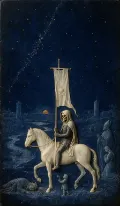 DeathShares: The white horse · The gilded sun face · The child with open arms · The band of stars
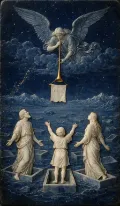 JudgementShares: The ivory banner · The band of stars · The child with open arms
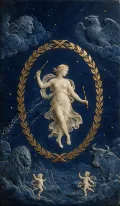 The WorldShares: The wreath and feather · The child with open arms · The band of stars
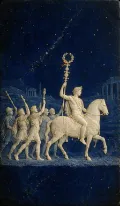 Six of WandsShares: The wreath and feather · The white horse · The band of stars