Major Arcana · XX
Judgement
Tarot card meaning: upright, reversed and the symbols of the Olivia image
Judgement is the moment a call reaches you clearly enough to answer: an honest reckoning with the past that frees you to rise into what comes next.
- Upright
- awakeningreckoninga clear callrenewalhonest reviewanswering
- Reversed
- self-criticismunanswered callhesitationreopening the pastinner reckoning
Upright
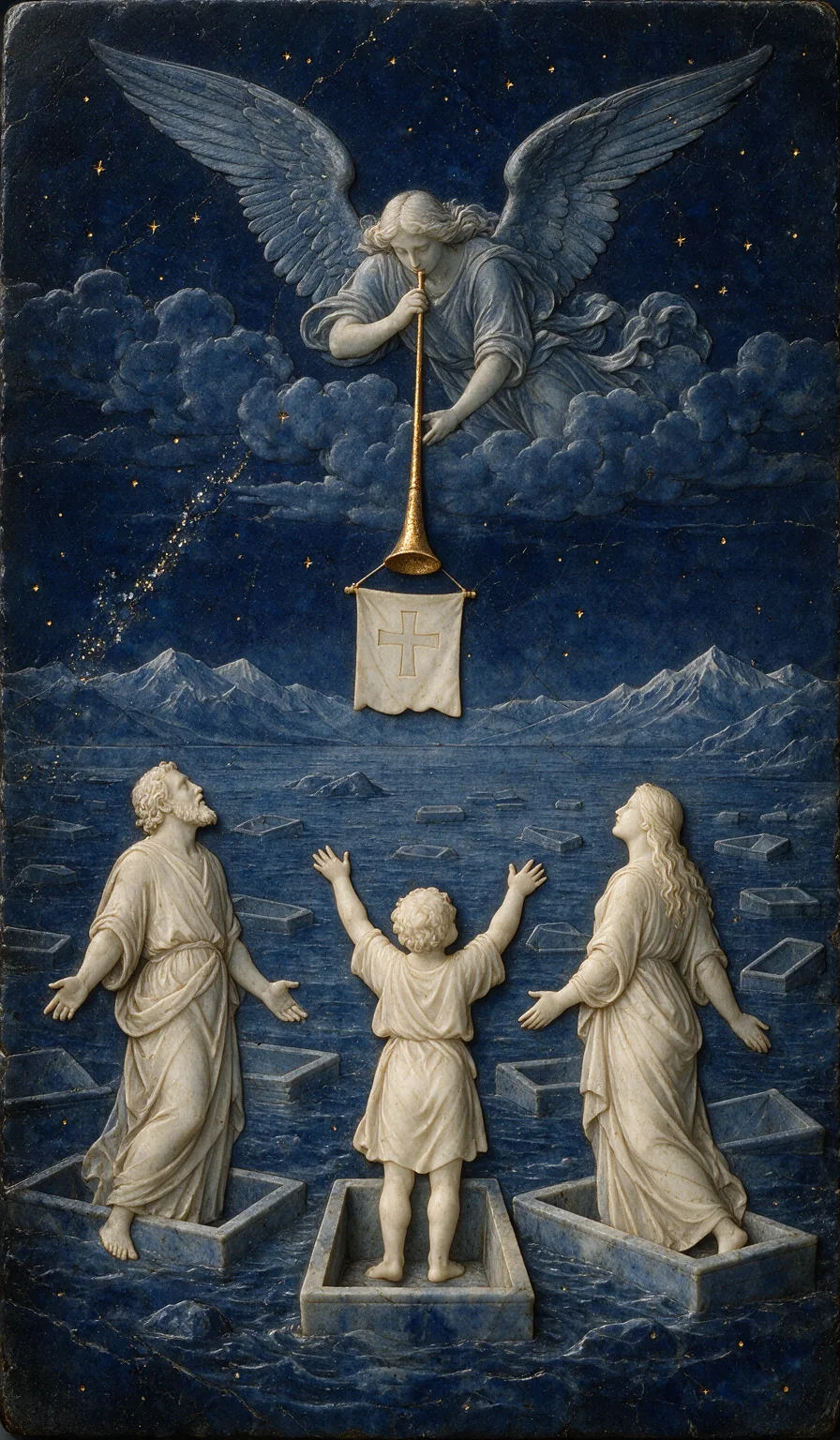
Judgement is a card about being called awake. Above a sea of open coffins, a blue angel leans out of the clouds and sounds a long gold trumpet, its bell turned straight down at the figures below. Nothing here is a verdict handed down from a bench. The card draws attention to something you can no longer sleep through: a truth about your life, a value you have neglected, a direction that keeps returning until you answer it.
Look at how the three figures respond. None of them is dragged out. The bearded figure on the left already has one bare foot over the rim; the long-haired figure on the right turns the face upward with hands open; the child in the centre, seen from behind, raises both arms high. Judgement invites this kind of response: not anxious self-examination, but a whole-hearted yes to what you now recognise.
The reckoning is honest but not punitive. You look back clearly, take in what the past has taught you, and let it shape your next choice rather than define who you are. The coffins are open and emptying for a reason: this card asks what you are ready to climb out of, and what you would like to rise into.
Reversed
Judgement reversed points to a call you can hear but are not yet answering. You may be replaying old decisions as if in a courtroom, reviewing the past so thoroughly that you never step out of the coffin, or waiting for certainty before you respond. Sometimes the reversed card turns the trumpet inward, into a harsh inner voice that judges rather than wakes.
It can also describe a quieter, private reckoning that is not ready to be shared. The card invites you to separate the call from the criticism: keep the part that asks you to grow, and set down the verdict you keep passing on yourself. One small answering step is enough to begin.
Read the image
Every element below is carved into this card. Scroll, hover or press a number to follow it on the image.
The trumpeting angel
What you seeCarved in pale grey-blue lapis rather than ivory, the angel leans out of the clouds with wings spread towards both upper corners, head bowed, eyes lowered, one hand at the mouthpiece and the other lower on the shaft.
What it carriesThe angel of Judgement is commonly identified as Gabriel, the messenger whose call wakes the sleeping. Olivia carves it from the same blue stone as the night rather than from ivory, so the call reads as part of the sky itself, sounded with lowered eyes towards the figures below.
Follow this symbol through the deck ↗The gold trumpet
What you seeA long, straight gold trumpet runs from the angel’s lips down through the clouds and ends in a wide flared bell turned straight down towards the three figures, the broadest stretch of gold in the scene.
What it carriesThe trumpet is the call itself: a sound that does not need to be understood before it is answered. In a deck that uses gold sparingly, it draws the eye down the whole card, commonly read as the moment a half-known truth becomes impossible to sleep through.
The banner with the cross
What you seeTwo fine cords hang from the rim of the bell and hold a short rod with gold ends. From it hangs a small ivory banner with a wavy lower edge, marked with a simple cross outlined in gold.
What it carriesIn the traditional image a banner with a cross hangs from the trumpet, echoing the pennant of the risen Christ in Resurrection paintings and commonly read as life that has passed through death. Here the cross is a gold outline on ivory: quieter, more a mark of consecration than a flag.
The falling trail of light
What you seeLeft of the trumpet, a narrow diagonal stream of silver and gold chips runs from beneath the clouds down towards the mountain peaks on the left, denser and brighter than the scattered star flecks around it.
What it carriesThis glittering band is Olivia’s addition, not part of the traditional card. It reads like a shooting star or a stretch of the Milky Way pouring towards the earth, echoing the trumpet: a line of light joining the sounding sky to the waiting ground.
Follow this symbol through the deck ↗The pale mountain range
What you seeBeyond the sea, a range of pale grey-blue peaks carved in the lapis stretches across the whole horizon, rising highest near each side of the card and dipping low behind the banner.
What it carriesMountains in tarot are commonly read as height, abstract thought and the long view. On Judgement they belong to the traditional scene as the horizon that waking reveals: once the call is heard, the view reaches much further than it did from inside the coffin.
Follow this symbol through the deck ↗The bearded figure stepping out
What you seeOn the left, an ivory figure with curly hair and a full beard looks up towards the angel. Both arms hang open with palms turned upward, and one bare foot steps forward over the coffin’s front rim.
What it carriesIn the traditional image the risen figures are naked and grey. Olivia robes them in warm, draped ivory, so the waking looks less like an escape from death and more like a return to life. This gesture is receptive rather than pleading: palms open, already half out.
The child with raised arms
What you seeAt the centre, a curly-haired child in a short ivory tunic stands with back to the viewer, both arms raised high in a wide V, fingers spread, bare feet planted on the floor of the coffin.
What it carriesThe child seen from behind is a traditional detail, and it places you where the child stands: facing the call. Raised arms are the plainest answer to it, open and unguarded. The child is not stepping anywhere yet, only saying yes with the whole body.
Follow this symbol through the deck ↗The long-haired figure turning upward
What you seeOn the right, an ivory figure with long wavy hair, seen in profile, lifts the face towards the angel. The arms open low and wide, and the robe falls to one bare foot inside the coffin.
What it carriesWith the figure on the left and the child, this one completes the card’s traditional trio, commonly read as different parts of one person answering a single call. Both adults look up but neither reaches: the waking asks for attention before it asks for effort.
Open coffins on the sea
What you seeThe sea is scattered with many open, lidless coffins of pale grey-blue lapis, floating out to the horizon. The three nearest are larger and each holds a standing figure; the child’s sits squarely at the centre.
What it carriesThe Marseille card shows a single tomb in the ground; Pamela Colman Smith’s card sets many coffins adrift on water, commonly read as feeling and the unconscious. Every coffin here is open and empty or being left: the card is about what you climb out of.
Follow this symbol through the deck ↗
The number
Judgement is card XX, the second to last of the Major Arcana. Twenty doubles the completion of ten, and in the Fool’s journey this is where the clear light of The Sun, card XIX, becomes a summons: what has been seen now asks to be answered. It is the last step before The World, card XXI, where the cycle becomes whole. The step asks you to gather everything the journey has taught you and rise with it, rather than start again from nothing.
The tradition
In the Golden Dawn system Judgement is Atu XX, titled “The Spirit of the Primal Fire”. It is assigned the Hebrew letter Shin, meaning tooth, whose three strokes the order read as tongues of flame; its element is Fire, and it also stands for Spirit. It lies on the path joining Hod and Malkuth on the Tree of Life. Some modern readers link it with Pluto. The image comes from Last Judgement art: the Tarot de Marseille shows an angel sounding a trumpet over figures rising from a tomb. Pamela Colman Smith’s 1909 design set grey figures in coffins floating on water beneath mountains, with a cross-marked banner on the trumpet. Aleister Crowley later renamed the card The Aeon.
Love, work and self
- Love
- In close relationships Judgement draws attention to an honest review of how you have been loving and being loved. It may ask you to stop re-arguing an old grievance and hear what it is really calling for: an apology, a boundary, a new agreement. Like the figures rising in their open coffins, you can leave behind a version of the bond that no longer fits without condemning who you were then. With yourself, it asks for fairness rather than a verdict.
- Work
- At work or in study, Judgement can point to a clear call about direction: a vocation you keep circling, feedback you finally understand, a role you have outgrown. It invites a proper review of what your experience adds up to, the kind you might write before a new application or a changed plan. With money matters, it invites looking honestly at past choices to learn from them, rather than making a sudden move to escape them.
- Self
- For your own growth, Judgement asks you to listen for what keeps returning: the interest you never dropped, the regret that still teaches, the quiet sense that another way of living is possible. The child at the centre answers with raised arms before taking a single step. Notice whether your inner review sounds more like a trumpet that wakes you or a judge that keeps you lying down, and give more room to the first.
In a spread
Read the card through each position before you look at Olivia’s version. A position is a question, and the same card answers each one differently.
The situation
What aspect of the situation deserves attention?
Olivia’s readingAt the centre of a question, Judgement can point to a call as the real subject, perhaps one you already hear. The question may be less about what to decide and more about whether you are ready to answer.
What complicates it
What tension or assumption deserves a closer look?
Olivia’s readingAs a challenge, Judgement can show a review that has turned into self-condemnation, or a call you keep postponing. Circling the past can keep you standing inside the coffin.
A helpful next step
What small action could help you understand or respond?
Olivia’s readingAs advice, Judgement invites you to name what you have learned, forgive what needs forgiving, and take one visible step that shows you have heard the call.
In conversation with
- Judgement + Death
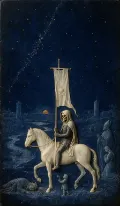
With Death, the two halves of a passage appear: first the ending, then the waking. Here both carry an ivory banner marked in gold, a rose and a cross. Together they draw attention to what you have already let go of, and what now asks to rise in its place.
- Judgement + The Sun
With The Sun, the card before it, clarity meets response; both cards centre an ivory child with arms lifted high. Together they suggest that what you now see plainly is asking you to act on it.
- Judgement + The World
With The World, the card that follows, Judgement’s call leads into completion. Together they ask whether you are answering something new or finishing a cycle begun long ago, and invite you to gather its lessons before stepping into the whole.
Also read withJusticeAll pairs ↗
Questions to keep
- What call keeps returning to you, however often you set it aside?
- Which old decision are you still judging, and what did it actually teach you?
- What would it look like to step out of your coffin with open hands, as these figures do?
Ask them with three cards ↗A three-card reading in which each position asks one of these questions.
A small practice
Write a short letter from your future self naming one lesson from the past year, then choose one small action this week that answers it.
Cards that share its symbols
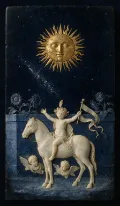 The SunShares: The falling trail of light · The child with raised arms · The banner with the cross
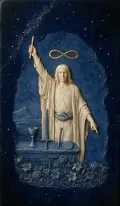 The MagicianShares: The falling trail of light · The pale mountain range
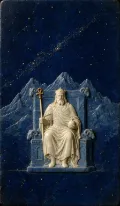 The EmperorShares: The falling trail of light · The pale mountain range
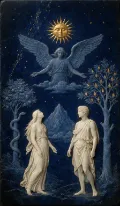 The LoversShares: The trumpeting angel · The pale mountain range