Major Arcana · XIII
Death
Tarot card meaning: upright, reversed and the symbols of the Olivia image
Death marks the natural end of a form, a role or a chapter, and the steady, unhurried passage that clears room for what can follow.
- Upright
- endingtransformationreleasetransitionclearing space
- Reversed
- resistancelingeringstagnationdelayed releaseinner change
Upright
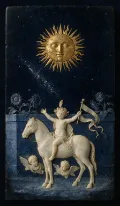
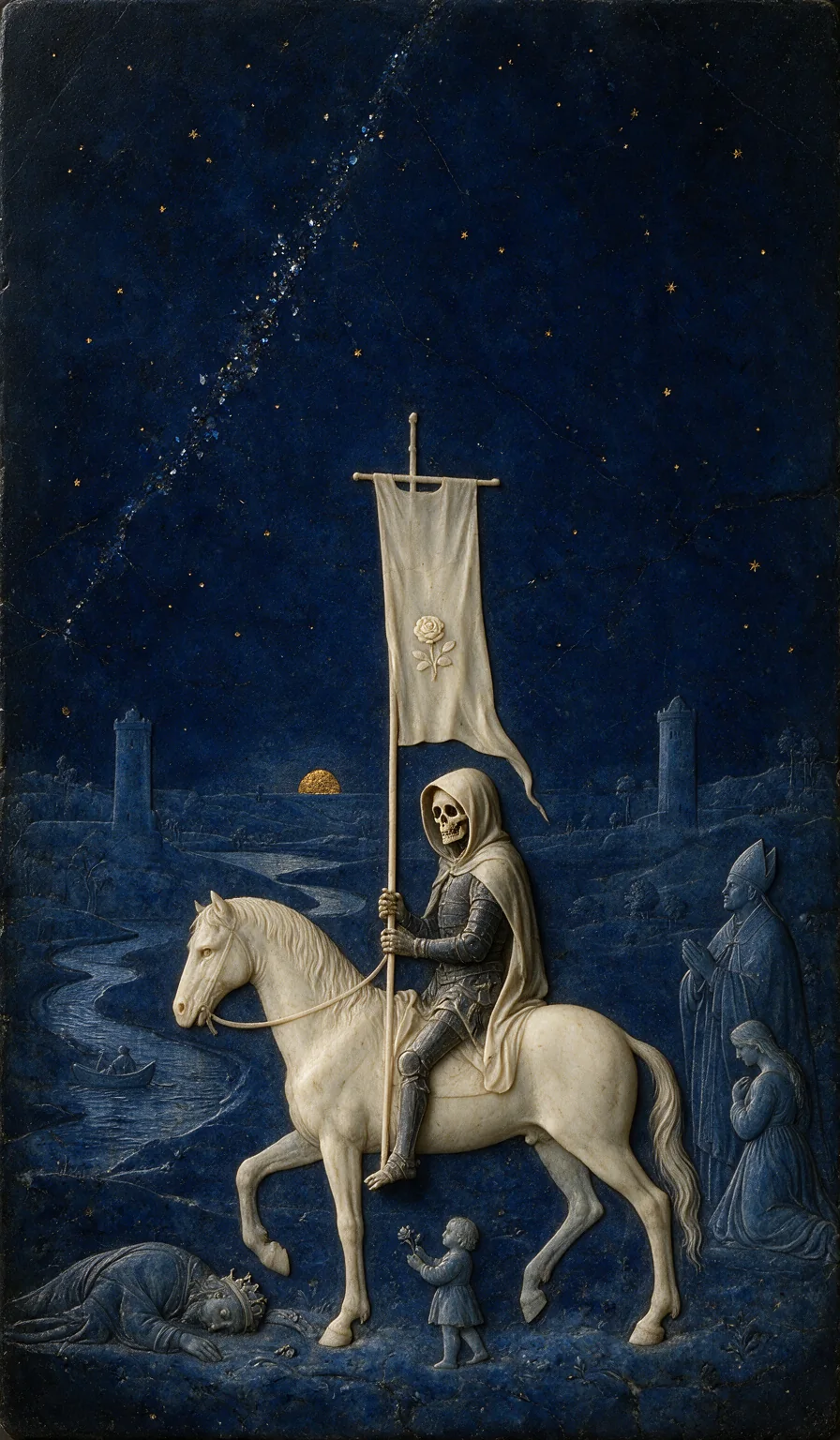
Death is a symbolic card about change, not a forecast of anyone’s death. It draws attention to something that has reached the end of its current form: a habit, a role, a way of relating, a story you have been telling about yourself. Look at how Olivia pictures that ending. The ivory horse walks with a loose rein, one foreleg lifted, and the armoured rider carries a banner, not a weapon. The change here is not violent; it is simply unstoppable, moving at the pace of a walk.
Around the rider, each figure meets the same moment differently. The King lies full length on the ground with the crown still on, as if authority had quietly stopped holding anything up. The bishop faces the rider with folded hands, a second figure kneels with head bowed, and a small child walks alongside holding a flower. The card asks which of these postures is closest to yours right now, and whether another one might serve you better.
Above them hangs the banner with its single ivory rose, and on the horizon a gold half-sun rests between two towers. Endings in this card are thresholds. The card invites you to honour what is finishing, including any grief or relief it brings, while turning some attention toward the light that is already on the horizon.
Reversed
Death reversed points to change that is slowed, resisted or happening mostly inside. You may be holding on to a form that has already finished its work, like a crown kept on after the reign is over, or pushing an ending faster than you can absorb it. Neither is a failure; both suggest the transition wants more honesty or more time.
The reversed card can also describe a quiet inner shedding that nobody else can see yet. Ask what you are still carrying out of habit, and what small step would let the rider keep walking at a pace you can bear.
Read the image
Every element below is carved into this card. Scroll, hover or press a number to follow it on the image.
The rose on the banner
What you seeA long ivory banner hangs from a crossbar on a staff whose tip rises above it like a cross. In its lower half a single full-blown rose is carved in relief, with four leaves on its stem.
What it carriesDeath’s banner traditionally carries a white rose, commonly read as purity and life that continues through change. Smith set it on a black flag; here banner and rose are the same pale ivory, so the flag reads less as mourning and more as a standard of quiet renewal.
Follow this symbol through the deck ↗The hooded skeleton rider
What you seeAn ivory skull looks out from a deep ivory hood whose cloak falls over the horse’s back. Beneath it the body is armoured in grey plate; both ivory hands grip the banner staff, one above the other.
What it carriesThe skeleton is what remains when everything changeable has gone: the structure beneath appearances. Armour makes the rider steady rather than cruel. Olivia gives it a soft hood instead of a plumed helmet, which lends the figure the stillness of a pilgrim more than a conqueror.
The pale walking horse
What you seeA large ivory horse walks towards the left at an even pace, the near foreleg lifted. The bridle is plain, the rein runs in a slack curve from the bit up to the rider’s hands, and the eye is calm.
What it carriesA white horse is traditionally a carrier of purity and strength, and here it walks rather than charges. The loose rein matters: nothing is being driven or forced. Change in this card moves at the pace of a steady walk, which is why it cannot be hurried or outrun.
Follow this symbol through the deck ↗The gold half-sun
What you seeOn the far horizon, left of the banner staff, a gold half-disc rests on the line of the hills. Two slim lapis towers stand on the skyline, one near each side of the card.
What it carriesThe sun on the horizon between two towers is a classic detail of this card, read as a threshold: light that is either leaving or arriving. It is the largest piece of gold on this card, set in the distance on the side the horse is walking towards.
Follow this symbol through the deck ↗The fallen King
What you seeAt lower left a figure carved in grey-blue lapis lies full length, cheek to the earth and eyes open, one hand resting before the face. The pale crown is still on, just below the horse’s lifted hoof.
What it carriesThe fallen King is the traditional sign that no rank or authority stands outside change. The crown has not been taken off; it simply no longer holds anything up. It invites a gentle question about which of your own titles and roles have finished their work.
Follow this symbol through the deck ↗The figures at prayer
What you seeAt the right edge, carved in blue lapis, a tall mitred bishop stands with palms pressed together, facing the rider. Below, a long-haired figure kneels with hands clasped at the chest and head bowed.
What it carriesThe bishop meeting Death with folded hands is a traditional image of acceptance through faith or ritual; the kneeling figure turns inward instead. Together they show two ways of standing before an ending: facing it directly, or quietly bowing to what cannot be argued with.
The child with a flower
What you seeBeneath the horse’s belly, between its front and hind legs, a small barefoot child in a short tunic, carved in pale grey-blue, steps forward and holds up a small flower in both hands.
What it carriesA child is part of the traditional crowd around Death, commonly read as innocence that meets change without fear. Here the child is on foot beneath the horse, walking the same way it goes, and the small flower held up answers the rose on the banner above.
Follow this symbol through the deck ↗The river and boat
What you seeA river winds from the horizon down the left side of the card in pale, rippled lapis. Near the lower bend a small boat carries one seated figure holding an oar.
What it carriesThe river and boat of the traditional image are often compared with the crossing to the far shore in older myths. Water keeps moving without losing itself, and the lone rower suggests that every passage through change is made one stroke at a time.
Follow this symbol through the deck ↗The glittering sky band
What you seeA diagonal band of bright, pale blue and silvery chips runs from the top edge down towards the left, passing to the upper left of the banner among small gold star flecks.
What it carriesThis band of light is Olivia’s addition, not part of the traditional card. Several cultures pictured the Milky Way as a road for souls, so it lifts the scene beyond one ending: the passage below mirrors a much larger, continuous movement overhead.
Follow this symbol through the deck ↗
The number
Death is card XIII, arriving directly after The Hanged Man. Twelve completes a cycle, like months in a year or signs of the zodiac; thirteen steps beyond it into what cannot be counted in the old way. In the Fool’s journey this is the point where the surrender practised in suspension becomes actual release: something is let go so that Temperance, card XIV, can begin mixing a new balance. The step asks you to stop negotiating with what has already ended.
The tradition
In the Golden Dawn system Death is Atu XIII, titled “The Child of the Great Transformers, Lord of the Gate of Death”. It is assigned the Hebrew letter Nun, meaning fish, and the sign Scorpio, fixed Water, on the path joining Tiphareth and Netzach on the Tree of Life. Many older Marseille decks printed the number with no name, showing a skeleton mowing a field of heads and hands with a scythe. Pamela Colman Smith’s 1909 design replaced the reaper with an armoured rider on a white horse carrying a banner with a white rose, meeting a fallen king, a bishop, a kneeling figure and a child.
Love, work and self
- Love
- In close relationships Death draws attention to a pattern that has run its course: an old argument, a role you keep playing, a version of the bond that no longer fits. It does not say a relationship is over. It asks what form is ending, so that something more honest can take its place. With yourself, it can mean letting go of an old self-image, as gently as the rider’s loose rein.
- Work
- At work or in study, Death can point to a project, method or identity that has quietly finished. You might notice that effort goes into maintaining a structure rather than the actual task. The card invites a clear look at what to close, archive or hand over, and what to keep. With money matters, it suggests reviewing old commitments and habits calmly, rather than making sudden moves.
- Self
- For your own growth, Death asks where you are carrying something past its natural end: a grievance, a label, a rule you set for yourself years ago. The figures around the rider offer choices: lie still like the fallen King, pray like the bishop, bow like the kneeling figure, or walk forward with a flower like the child. Notice which comes naturally, and which you would like to practise.
In a spread
Read the card through each position before you look at Olivia’s version. A position is a question, and the same card answers each one differently.
The situation
What aspect of the situation deserves attention?
Olivia’s readingAt the centre of a question, Death can point to an ending as the real subject, perhaps one already under way. The question may be less about what to start and more about what to let finish.
What complicates it
What tension or assumption deserves a closer look?
Olivia’s readingAs a challenge, Death can show resistance to a change that may already be moving, or grief that has not yet been given room. Holding the old form in place may be taking energy.
A helpful next step
What small action could help you understand or respond?
Olivia’s readingAs advice, Death invites you to name one thing that has finished and close it deliberately: a conversation, a file, a habit. Clearing a little space lets the next step become visible.
In conversation with
- Death + The Hanged Man
With The Hanged Man, the sequence becomes clear: first a pause and a change of view, then the actual release. Together they ask whether you are still waiting, or whether the letting go has quietly begun.
- Death + Temperance
With Temperance, the card that follows it, Death’s clearing is followed by patient mixing and repair. Together they suggest giving an ending time to settle before blending old and new into a steadier balance.
- Death + The Tower
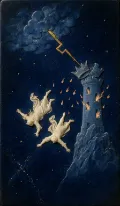
With The Tower, two kinds of change meet: Death’s slow, walking transition and the Tower’s sudden break. Together they invite you to notice whether something is ending gradually or all at once, and how to meet each pace.
Also read withThe SunJudgementKing of CupsTen of SwordsAll pairs ↗
Questions to keep
- What in your life has already ended, even if you are still acting as though it continues?
- Which figure around the rider is closest to how you are meeting this change right now?
- What would you like to carry through this transition, like the rose on the banner?
Ask them with three cards ↗A three-card reading in which each position asks one of these questions.
A small practice
Write down one role, habit or belief that has finished its work, thank it for one thing it gave you, then fold the paper away.