Minor Arcana · Wands
Six of Wands
Tarot card meaning: upright, reversed and the symbols of the Olivia image
The Six of Wands lets a good result be seen: it asks you to receive recognition fully, share its credit, and keep moving forward.
- Upright
- recognitionpublic successconfidenceshared creditmomentum
- Reversed
- unseen effortapproval-seekingfear of visibilityhollow applausestalled pride
Upright
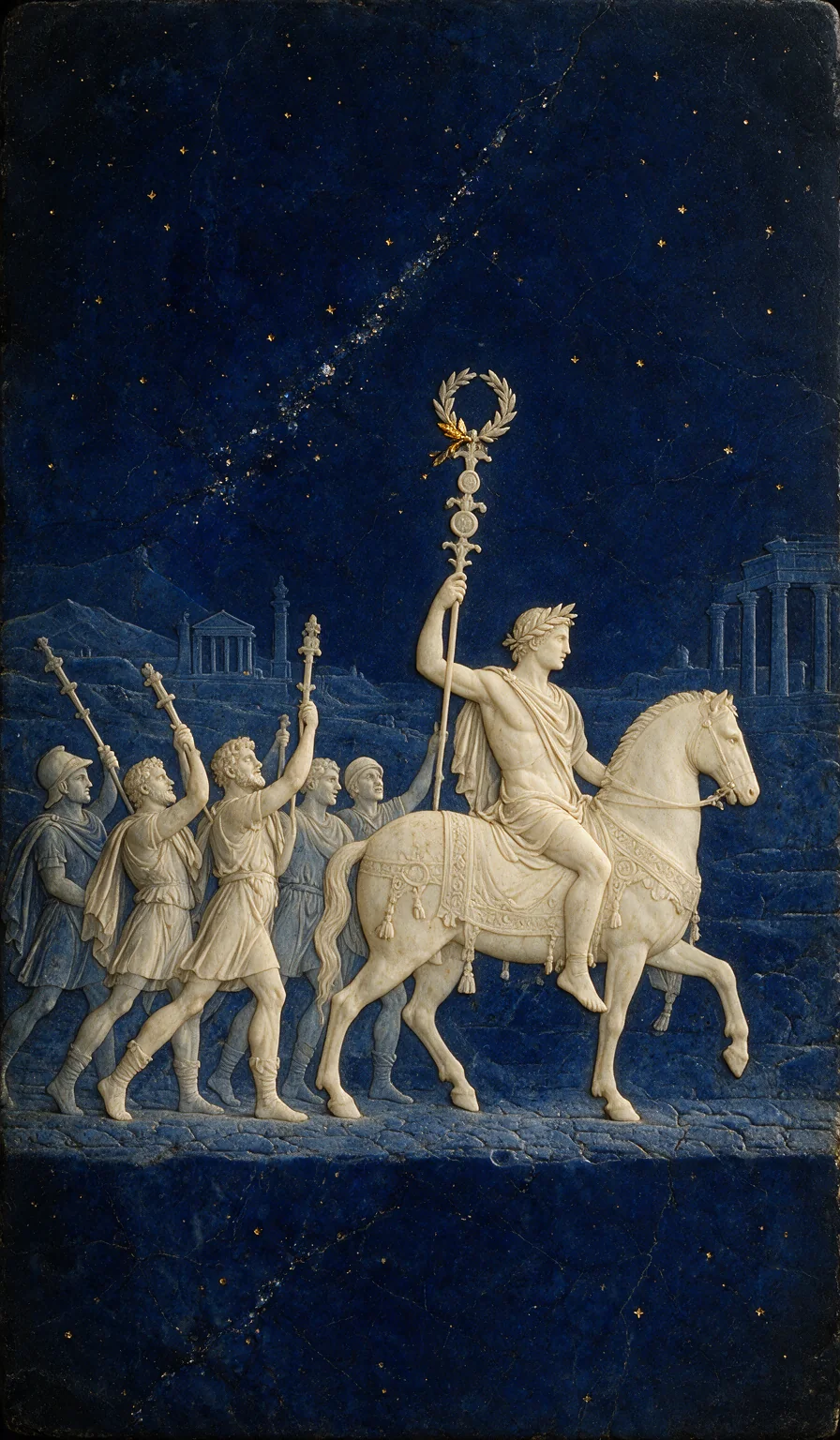
The Six of Wands draws attention to a moment when effort becomes visible. Something you have worked for reaches a point where others can see it, and the card asks you to let that be true. In Olivia’s image the rider sits easily on a white horse, a laurel crown on the curled head, holding up a staff topped by a wreath. The walkers lift staves and hands and look up. This is recognition in its simplest form: the work is done, and it is witnessed.
Look at where the rider’s eyes go. They do not turn down towards the cheering but stay level, facing the road ahead. The card invites a similar balance in you: to take in appreciation without shrinking it, and without letting it become the only reason to continue. The single sprig of gold at the base of the wreath marks what is precious here, and it is small. What this success means to you may matter more than how loudly it is praised.
Notice, too, how many hands carry staves. Success in this card is rarely solitary. It can point to a good moment to name the people, conditions and earlier attempts that made it possible, and to let shared credit steady your confidence.
Reversed
Six of Wands reversed can point to recognition that is blocked, delayed or out of proportion. Perhaps real progress has gone unnoticed, and the quiet leaves you doubting it. Perhaps praise has begun to matter more than the work, so that each result needs an audience before it feels real. Sometimes it is the opposite: you step back from visibility because being seen feels exposing.
The reversed card turns attention inward. Your progress is no less real without the parade. Ask what the effort taught you, who helped it happen, and what you would continue even if nobody were watching. From there, a smaller, steadier confidence can grow, one that rests on the road rather than on the crowd.
Read the image
Every element below is carved into this card. Scroll, hover or press a number to follow it on the image.
The wreath on the staff
What you seeAt the top of the rider’s staff an open ring of pale, silvery laurel leaves rises against the night. A small sprig of gold leaves is tied where the ring meets the staff, on its left.
What it carriesThe wreath on the staff is the card’s classic sign of victory: the prize lifted where everyone can see it. Olivia adds a single sprig of gold, the only gold in the carving, so the eye lands on one precious point of worth inside the public display.
Follow this symbol through the deck ↗The laurel crown
What you seeA carved ivory crown of laurel leaves sits on the rider’s curled hair. The rider’s head is in profile, facing right and level, looking ahead rather than down at the crowd.
What it carriesLaurel was the ancient crown of victors and poets, and the traditional rider wears it too. Here the crowned head faces forward, past the applause. Recognition is worn, but the attention stays on the road ahead rather than on the people cheering.
Follow this symbol through the deck ↗Wands raised by the crowd
What you seeFour staves rise among the walkers: two knotted staves slant back from the raised hands of the two rearmost walkers, one stands upright in a bearded walker’s fist, and a shorter one lifts behind it.
What it carriesWands are the suit of Fire: will, drive and creative effort. The traditional card shows six staves, one of them the rider’s. Here five are visible, counting the rider’s, which suggests the effort being honoured was shared, carried by many hands and not only by the one in the saddle.
Follow this symbol through the deck ↗The walking companions
What you seeFive walkers follow on foot, stepping towards the right. Two are carved in ivory; the helmeted, capped and bare-headed figures set back are in grey-blue lapis. Faces turn up towards the rider; one raises an empty hand.
What it carriesThe attendants are traditionally read as supporters and witnesses: victory needs someone to see it. By carving three walkers in the background stone, Olivia’s image can suggest how quickly helpers fade from view, and invites you to remember who walked beside your success.
The white horse
What you seeAn ivory horse, larger than any walker, carries the rider to the right. Its neck arches, a bridle and reins run to the rider’s lowered hand, and the front leg at the far right is lifted high.
What it carriesThe white horse is traditional for this card: strength, momentum and a pure, clear success. Its raised foreleg shows a parade step, energy under control. The rider holds the reins lightly with one hand, guiding power rather than fighting it.
Follow this symbol through the deck ↗The rider’s bare foot
What you seeBelow the tasselled saddle-cloth, with its embroidered border and roundel, the rider’s leg hangs relaxed and the foot is bare, toes pointing down towards the road, with no stirrup or boot.
What it carriesThis is Olivia’s own detail rather than a fixed part of the tradition. The walkers wear soft boots, yet the honoured figure rides barefoot. It keeps the victor close to the ground and humanly vulnerable: the triumph is real, but the person inside it is unarmoured.
Temples on the skyline
What you seeCarved in paler lapis behind the procession: on the left, low hills and a small pedimented temple between two columns; on the right, a larger colonnade with a broken roofline at the card’s edge.
What it carriesThe traditional card has no fixed setting; this deck places the parade in a classical city of temples. A procession through a city can be read as a homecoming, a triumph witnessed by a community. The weathered colonnade adds that every public glory joins a longer history.
Follow this symbol through the deck ↗The cracked road
What you seeEvery foot and hoof rests on one narrow road of pale, greyish lapis, crazed with cracks like old paving. Below it the deep blue stone continues to the card’s bottom edge, flecked with gold.
What it carriesThe road turns the victory into a movement rather than a monument: the procession is passing through, not standing still. Its cracked surface suggests that success travels over ground worn by earlier efforts, and that the parade, too, moves on.
Follow this symbol through the deck ↗The glittering vein
What you seeA long band of glittering pale mineral crosses the sky diagonally from upper right to lower left, above the procession, among scattered gold flecks shaped like tiny stars.
What it carriesThis is a feature of the stone, not of tarot tradition. Above the parade the night keeps a wider, older order. It quietly places the moment of applause inside a much larger sky, where one success is bright but not the whole picture.
Follow this symbol through the deck ↗
The number
Six in the Minor Arcana is the point of balance after Five’s disruption: harmony restored, generosity, a moment of equilibrium. In Wands, the suit of Fire, will and creative drive, that balance takes the form of recognition. The contest of the Five of Wands resolves, and the energy that was spent in struggle is now seen and honoured. Six stands just past the middle of the count from Ace to Ten, so the victory is real but not final; the road continues towards the Seven’s need to defend what has been won.
The tradition
In the Golden Dawn system the Six of Wands is titled the Lord of Victory. It is attributed to Jupiter in Leo, the second decan of that fixed Fire sign, and to Tiphareth, the sixth and central sephira of the Tree of Life, associated with harmony and beauty. Jupiter’s expansiveness in Leo’s pride and warmth fits the card’s theme of honour and public success. In older Marseille-pattern decks the Six of Batons shows only crossed staves with ornament and no scene. The mounted, laurel-crowned rider with a wreathed staff and attendants on foot comes from Pamela Colman Smith’s 1909 design for the Rider-Waite-Smith deck, which Olivia’s image follows in composition.
Love, work and self
- Love
- In close relationships the Six of Wands invites you to let good things be seen and said. Perhaps a partner, friend or family member has done something that deserves open appreciation, or perhaps you are the one hoping to be noticed. The card turns attention towards how recognition flows between you. With yourself, it can point to acknowledging a change you have made, instead of moving straight on to the next thing to fix.
- Work
- At work or in study, this card can point to a finished project, a good result or a moment of visible progress. It invites you to accept acknowledgement plainly and to name who contributed, as the walkers with their own staves remind you. It also asks what the success means beyond approval: what you learned, what you now do better, and what you would like to build next from this footing.
- Self
- For your inner life, the Six of Wands asks where your confidence rests. If it rests only on applause, it tends to rise and fall with other people’s attention. If it rests on specific effort and learning, it can hold steady. Take a moment to recognise one thing you did well, in plain words, and notice whether you can let it stand without adding a qualification or a new demand.
In a spread
Read the card through each position before you look at Olivia’s version. A position is a question, and the same card answers each one differently.
The situation
What aspect of the situation deserves attention?
Olivia’s readingAt the centre of a question, the Six of Wands can point to recognition: a result, or a wish to be seen, that may sit at the core of what you are asking.
What complicates it
What tension or assumption deserves a closer look?
Olivia’s readingAs a challenge, it can point to dependence on approval, or to discomfort with being visible, which makes it hard to value progress on its own terms.
A helpful next step
What small action could help you understand or respond?
Olivia’s readingAs advice, it invites you to acknowledge a real achievement openly, thank those who helped, and choose your next step from that steady footing.
In conversation with
- Six of Wands + Five of Wands
With the Five of Wands, the sequence is clear: scattered struggle, then recognition. Together they draw attention to how a period of friction or competition can resolve into a result that others acknowledge.
- Six of Wands + The Chariot
With The Chariot, two images of forward movement and triumph meet. Together they ask how you steer your own energy, and whether the success rests on direction and discipline or on the crowd’s momentum.
- Six of Wands + Seven of Wands
With the Seven of Wands, the victory is followed by a stand. Together they draw attention to what visibility brings: once your work is seen, you may also need to hold your ground for it.
Questions to keep
- Which recent achievement have you not yet allowed yourself to fully acknowledge?
- Who carried part of this success with you, and how might you name their contribution?
- What would you keep doing here even if nobody noticed or applauded?
Ask them with three cards ↗A three-card reading in which each position asks one of these questions.
A small practice
Write one sentence naming something you did well this week, then list two people or conditions that helped it happen, and read both aloud once.
Cards that share its symbols
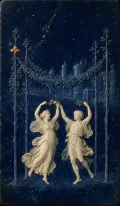 Four of WandsShares: Wands raised by the crowd · The wreath on the staff · The walking companions · The laurel crown
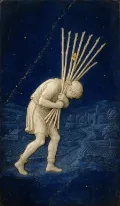 Ten of WandsShares: Wands raised by the crowd · Temples on the skyline · The cracked road · The glittering vein
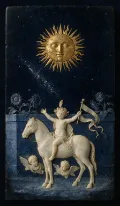 The SunShares: The glittering vein · The wreath on the staff · The white horse
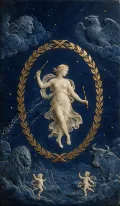 The WorldShares: The wreath on the staff · Wands raised by the crowd · The glittering vein