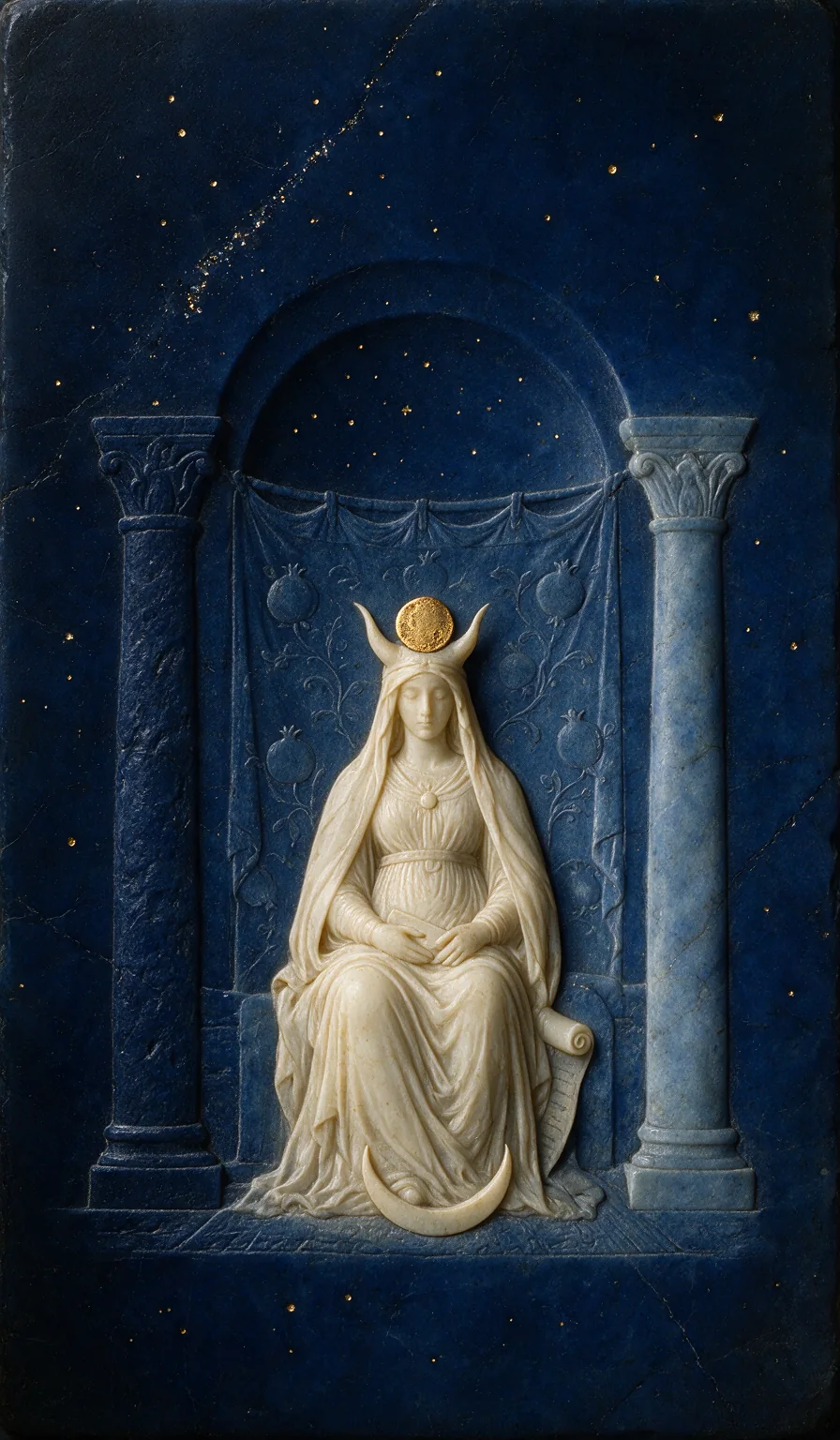
Major Arcana · II
The High Priestess
Tarot card meaning: upright, reversed and the symbols of the Olivia image
The High Priestess is knowledge that arrives in stillness: closed-eyed listening between two pillars, letting an answer form before you try to speak it.
- Upright
- intuitioninner knowingstillnessdiscretionreceptivitypatience
- Reversed
- ignored intuitionguarded silencewithdrawalinner noiseoverinterpreting
Upright
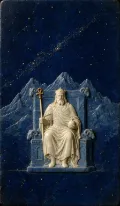
The High Priestess sits at the threshold between what is known and what is not yet ready to be said. In Olivia’s carving the figure is enthroned between a rough dark pillar and a polished pale one, eyes closed, hands resting on a closed tablet, with a veil of pomegranates hanging behind. Nothing moves. Upright, the card draws attention to a kind of knowing that does not come from gathering more information, but from staying still long enough for what you already sense to surface.
Look at what the carving withholds. The scroll beside the figure is inscribed, yet its lines cannot be read; the tablet in the lap stays shut. The traditional card lets a strip of water show past the veil; here the only opening is the arch of starry night above it. This is not secrecy for its own sake. It is discretion: the recognition that some impressions need time before they can bear the weight of words, or of other people’s opinions.
The High Priestess can point to a hunch worth writing down, a dream that keeps returning, a pause before replying to a message. It asks you to trust the quiet layer of your perception, and then to set it gently beside what you can actually observe.
Reversed
The High Priestess reversed can point to an inner voice that is being talked over, or one that has been left alone too long. On one side, the closed eyes open too early: you keep collecting opinions, checking and scrolling, until the quieter impression has no room to form. On the other, the veil is drawn so tightly that nothing passes through; a private sense hardens into certainty that is never tested against what you can see or ask.
Both are forms of the same listening, crowded out or sealed in. Ask which fits. If it is noise, find ten minutes of real silence before deciding. If it is secrecy, choose one trusted person, or one page of a notebook, and let the unread scroll be read aloud.
Read the image
Every element below is carved into this card. Scroll, hover or press a number to follow it on the image.
The horned crown and gold disc
What you seeTwo smooth ivory horns curve upward from a band across the veiled brow and cradle a round disc of textured gold, the only gold on the figure itself; elsewhere gold appears only as scattered flecks in the stone.
What it carriesThe horned crown recalls the headdress of Isis and Hathor, where the disc between the horns was the sun; tarot readers usually see a full moon held between waxing and waning crescents. Olivia’s gold disc keeps both readings: lunar horns cradling a light that looks almost solar.
Follow this symbol through the deck ↗The closed eyes
What you seeBeneath the crown the ivory face is calm and slightly lowered, eyelids closed, mouth at rest. A plain veil falls from the head band over both shoulders and down past the elbows.
What it carriesThe traditional High Priestess looks straight out at the viewer. Olivia closes the eyes, turning a guardian who watches into a listener who attends inward. The knowledge of this card is not gathered by looking harder; it comes when outward looking is allowed to rest.
The pomegranate veil
What you seeBehind the figure hangs a lapis cloth gathered in swags along its upper rod, carved in low relief with round, crowned pomegranates and curling vines. Above it, a recessed arch opens onto gold-flecked night.
What it carriesThe Waite-Smith veil is embroidered with palms and pomegranates; here pomegranates and vines remain. The pomegranate belongs to Persephone, who ate its seeds and so spent part of each year below: fertile knowledge that stays partly hidden, kept for whoever is ready to cross the threshold.
Follow this symbol through the deck ↗The dark pillar
What you seeOn the viewer’s left stands a column of deep ultramarine lapis with a rough, pitted shaft, a leafy capital with curled corner volutes and a stepped base. No letter is carved on it.
What it carriesIn the Waite-Smith card this is Boaz, marked B, one of the two bronze pillars before Solomon’s Temple. It is commonly read as the receptive, unseen side of any polarity: night, rest, what has not yet been spoken. Olivia leaves it unlettered, so texture alone carries the contrast.
Follow this symbol through the deck ↗The pale pillar
What you seeOn the viewer’s right rises its twin in pale, cloudy blue lapis, polished smooth and faintly veined, with the same leafy capital and stepped base, in clearly lighter stone than its partner.
What it carriesThis is Jachin, marked J in the Waite-Smith card: the light, active, visible side. The High Priestess sits exactly between the two, which is the card’s teaching in architecture: neither pole is chosen, and understanding lives in the space that holds both at once.
Follow this symbol through the deck ↗The round clasp
What you seeAt the gathered neckline of the ivory gown, where fine pleats radiate outward, sits a small, smooth round boss like a clasp or a pearl. A narrow sash circles the high waist below.
What it carriesThe Waite-Smith Priestess wears an equal-armed solar cross on the breast, often read as the balance of the four elements. Olivia replaces it with a plain circle: a quieter emblem of wholeness, the full moon repeated in miniature, a seal on what the heart keeps.
Follow this symbol through the deck ↗The closed tablet in the lap
What you seeBoth ivory hands lie flat and relaxed in the lap, fingers loose, resting on a small closed rectangle like a book or tablet whose edge shows beneath the hand on the viewer’s left.
What it carriesThe Marseille Papesse holds an open book; the Waite-Smith figure holds a half-hidden scroll. Here the hands rest on something shut. Nothing is being read aloud or taught. The gesture suggests knowledge already received and held in trust, not yet opened for anyone else.
The scroll set aside
What you seeBeside the knee on the viewer’s right, an ivory scroll rests upright against the gown and seat, its top rolled into a tight curl, its open length hanging towards the floor, faintly incised with lines of indistinct script.
What it carriesThe Waite-Smith figure holds a scroll lettered TORA, partly covered by the mantle: the law only partly shown. Olivia moves it out of the hands and lets the writing show, yet the lines cannot be read. The teaching is present and close, but not given in words.
The crescent at the feet
What you seeAt the hem of the pooled gown lies a large ivory crescent, horns turned upward, with the rounded tip of a foot resting inside its curve on the carved lapis floor.
What it carriesKept from the Waite-Smith card, the crescent ties the High Priestess to the Moon, its Golden Dawn attribution, and is often compared with the figure in Revelation who has the moon underfoot. Resting on it, the figure is steadied by the cycle rather than ruled by it: tides, sleep, waxing and waning.
Follow this symbol through the deck ↗
The number
The High Priestess carries the number two. After the Magician’s one, the single deliberate act, two brings the first pair: inner and outer, question and answer, the dark pillar and the pale. In the Fool’s journey this is the traveller’s first meeting with silence, the lesson that not every truth is reached by doing. Two is also the number of reflection, like the moon returning the sun’s light. It asks you to receive before you respond, and to let a question stay open for a while.
The tradition
In the Golden Dawn system the High Priestess bears the title “The Priestess of the Silver Star”. It is attributed to Gimel, the Hebrew letter whose name means camel, and to the Moon, and it occupies the thirteenth path of the Tree of Life, the central path running from Kether down to Tiphareth across the Abyss. The older Marseille pattern calls the card La Papesse, a papal figure with an open book, often linked with the legend of Pope Joan. In 1909 Pamela Colman Smith seated the Priestess between pillars lettered B and J, with a TORA scroll, a horned crown and a crescent underfoot. Olivia keeps crown and crescent, leaves the pillars unlettered and closes the eyes.
Love, work and self
- Love
- In love and close bonds, the High Priestess asks for attention that listens more than it interprets. It can point to a connection where much is felt and little is said, or to feelings of your own that are still forming. Leave room for that. You cannot read another person’s closed tablet, and the card does not ask you to; it asks what you notice in yourself once you stop rehearsing the conversation. With yourself, it favours privacy: a feeling can be honoured before it is shared.
- Work
- In work and study, the High Priestess favours depth over display. It can point to research, patient reading, careful listening in a meeting, or a draft left overnight before it is sent. The scroll set beside the figure suggests expertise you already hold but have not yet voiced. With money matters, let an uneasy impression be a reason to look more closely at the figures and ask questions, never a substitute for them: intuition notices, evidence decides.
- Self
- For your own growth, the High Priestess invites a practice of quiet: time without input, where the mind can settle like still water. Look at the carved face: the eyes are closed, not in sleep but in attention. Dreams, bodily responses and recurring images can all be treated as information worth noting, without being taken as verdicts. The card asks you to become someone who can hold a question without rushing to close it.
In a spread
Read the card through each position before you look at Olivia’s version. A position is a question, and the same card answers each one differently.
The situation
What aspect of the situation deserves attention?
Olivia’s readingAt the heart of a question, the High Priestess suggests that part of the answer may already be known to you but not yet in words. What matters may be the quiet impression beneath the obvious facts.
What complicates it
What tension or assumption deserves a closer look?
Olivia’s readingAs a challenge, the High Priestess can point to something unspoken that complicates things: information held back, a hunch you keep overruling, or a silence that has lasted longer than it serves you.
A helpful next step
What small action could help you understand or respond?
Olivia’s readingAs advice, the High Priestess invites a pause before acting: sleep on it, write down what you sense, and let the question rest between the two pillars a little longer.
In conversation with
- The High Priestess + The Magician
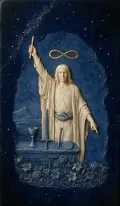
The Magician at one and the High Priestess at two are the first pair of the Major Arcana: the raised wand and the resting hands. Together they draw attention to the balance between acting on what you know and listening for what you do not yet know.
- The High Priestess + The Hierophant
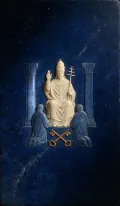
The High Priestess and the Hierophant both sit between two pillars, and their Marseille names, Popess and Pope, make them a pair. Together they draw attention to inner knowing and outer teaching, and to how each can test and deepen the other.
- The High Priestess + The Moon
The crescent at the Priestess’s feet grows into the whole sky of the Moon card, where a path runs between two towers. Together they draw attention to intuition and imagination: calm, attentive listening beside the vivid, uncertain images of the night.
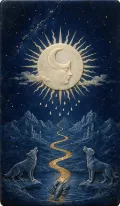
Also read withThe EmpressJusticeQueen of CupsTwo of SwordsAll pairs ↗
Questions to keep
- What do you already sense about this situation that you have not yet put into words?
- Whose opinions are you gathering right now, and what might you hear if you paused them for a day?
- Which private impression would benefit from being shared, and which would benefit from more time?
Ask them with three cards ↗A three-card reading in which each position asks one of these questions.
A small practice
Tonight, before sleep, write one question on a slip of paper; in the morning, before checking your phone, write the first sentence that comes to you.
Cards that share its symbols
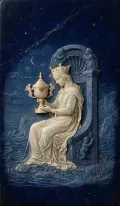 Queen of CupsShares: The closed eyes · The horned crown and gold disc · The crescent at the feet
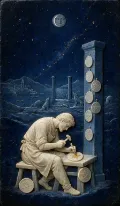 Eight of PentaclesShares: The closed eyes · The crescent at the feet · The dark pillar
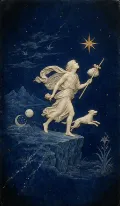 The FoolShares: The closed eyes · The crescent at the feet
 The EmperorShares: The horned crown and gold disc · The closed eyes