Minor Arcana · Cups
Queen of Cups
Tarot card meaning: upright, reversed and the symbols of the Olivia image
The Queen of Cups is feeling held with care: patient, intuitive attention to emotion, your own and other people’s, kept close without being spilled or sealed away.
- Upright
- compassionintuitionemotional safetyattentive listeningcalm care
- Reversed
- blurred boundariesabsorbed moodsover-givingsealed feelingsself-neglect
Upright
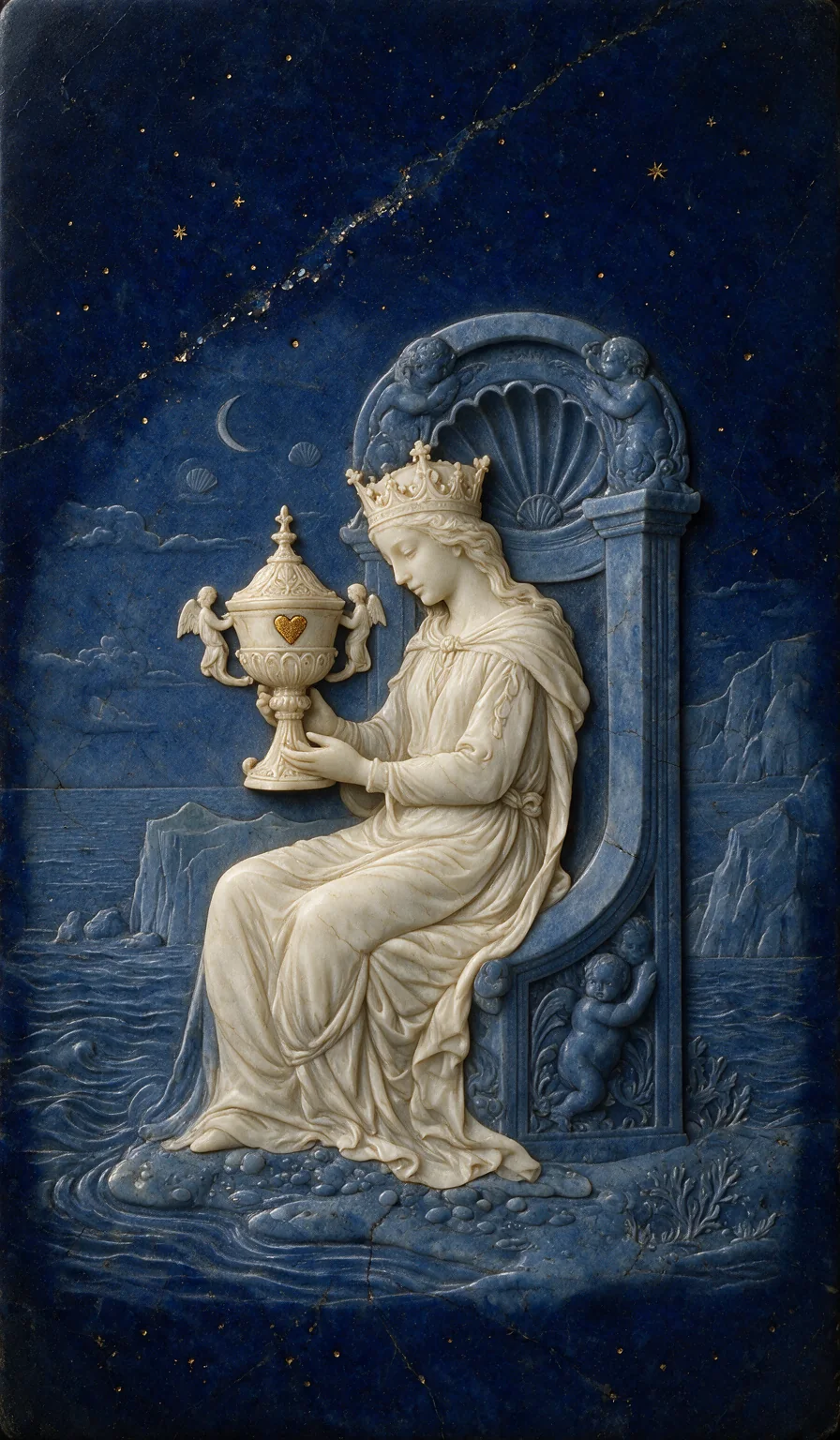
The Queen of Cups draws attention to feeling that has been given a place to rest. In Olivia’s card the Queen sits at the very edge of the sea, bowed over a lidded cup held in both hands: one hand closes around the stem, the other supports the foot from below. The whole figure turns toward that vessel. This is the suit of Water at its most inward, the capacity to stay with an emotion, yours or someone else’s, long enough to understand its shape before doing anything with it.
The cup is closed, and that matters. Its contents are not on display, and the Queen attends to them without prising the lid open. The gold heart on the bowl, the only gold on the card beyond the stars, marks what the image values: care that is real but held, not poured out for everyone who asks. Behind the Queen a scallop shell crowns the throne, and the water curls right up to the pebbles beneath a bare foot. Feeling surrounds this figure; it does not sweep the figure away.
Upright, the card can point to compassionate listening, trustworthy intuition and emotional steadiness, including the steadiness to hear another person without deciding what they feel for them. It invites you to notice what your own cup holds today, and to treat that with the same quiet respect.
Reversed
Queen of Cups reversed draws attention to empathy that has lost its edges. The lid comes off too far: other people’s moods begin to set your own, and the patient attention the Queen gives to feeling turns into absorbing it, fixing it or reading more into it than is there. Sometimes the movement runs the other way, and the lid stays shut on your own emotions while you keep caring for everyone else.
Either form asks for some of that listening to turn inward. Sensitivity does not oblige you to carry what others feel or to interpret it for them. Notice where you end and another person begins, and let the cup hold what is actually yours.
Read the image
Every element below is carved into this card. Scroll, hover or press a number to follow it on the image.
The covered cup
What you seeAn ivory cup with a domed, leaf-carved lid, a spired finial and a fluted lower bowl; two winged figures form its handles, their bodies tapering into curled tails. One hand grips the stem, the other cradles the foot.
What it carriesIn the traditional image this is often noted as the only closed cup of the suit, commonly read as feeling and imagination kept within rather than spilled. Olivia keeps the lid and the winged handle figures, whose bodies curl away into tail-like scrolls, as if the vessel belonged half to the air and half to the water.
Follow this symbol through the deck ↗The gold heart
What you seeA small heart of gold is set into the smooth upper band of the bowl, just below the lid and facing the viewer; apart from the flecks in the sky, it is the only gold on the card.
What it carriesThe traditional card has no heart on the cup; this is Olivia’s own addition. It names what the closed vessel protects: love and care that are real and precious, kept safe rather than displayed. Gold, used sparingly in this deck, marks the heart as the point of value.
Follow this symbol through the deck ↗The bowed head
What you seeThe Queen’s head bends toward the cup, eyelids lowered and mouth closed; long wavy hair falls over the shoulders, and a mantle is knotted at the throat above a gown tied at the waist.
What it carriesTraditionally the Queen of Cups gazes into the cup, commonly read as reverie, intuition and imagination at work. Here the lowered eyes make that attention inward and unhurried: this Queen is listening rather than searching, and gives feeling the time it needs to become clear.
The cross-tipped crown
What you seeAn open ivory crown rests on the Queen’s hair, its band edged with small beads and its tall points tipped with little trefoil crosses, carved in the same pale material as the figure and the cup.
What it carriesA crown marks authority that has been accepted rather than seized. Carved in the same ivory as the cup, it suggests that this Queen’s rule and this Queen’s feeling are one substance: authority grounded in the depth and reliability of care, not in command over others.
Follow this symbol through the deck ↗The scallop-shell throne
What you seeBehind the Queen, a tall throne carved in lighter blue lapis rises to a rounded arch filled by a large scallop shell, with a smaller shell at its base and two small cherubs perched on the arch.
What it carriesShells tie the throne to the sea, and the scallop is an old emblem of Venus, born from the waves. The traditional throne is also decorated with a shell and small sea-children. Carved in the blue of the water rather than in ivory, Olivia’s throne makes the sea itself the Queen’s seat.
Follow this symbol through the deck ↗Cherubs on the throne base
What you seeOn the lower panel of the throne, carved in blue lapis, a plump winged cherub faces the viewer and reaches one arm up the frame, while a second small head peeps out behind it; leafy scrolls fill the panel.
What it carriesThe small childlike figures on this Queen’s throne are commonly read as undines, spirits of water, and as the playful, imaginative side of feeling. Olivia carves them as cherubs that echo the winged handles of the cup, so tenderness appears in the seat as well as in the Queen’s hands.
Follow this symbol through the deck ↗Crescent and sky shells
What you seeAt upper left, a thin crescent moon is carved in pale lapis, with small scallop shells floating beside and below it in the sky, above low carved clouds and the flat line of the sea.
What it carriesThe traditional Queen of Cups sits under a pale daytime sky. Olivia moves the card into night and adds a crescent, the moon of tides, commonly linked with intuition and the rhythms of feeling. Shells drifting among the stars make sea and sky read as one element.
Follow this symbol through the deck ↗Gold stars in the night
What you seeGold flecks are scattered across the deep ultramarine sky, a few larger ones rayed like small stars; a glittering diagonal vein crosses the upper sky from the top right down toward the left edge.
What it carriesStars are commonly read as guidance and hope that show best in the dark. Here they share their gold only with the heart on the cup, so the night sky and the Queen’s care are made of one precious material: a quiet light, not dazzling, but enough to see by.
Follow this symbol through the deck ↗The pebbled shore
What you seeThe Queen sits on a low shelf of rounded, polished pebbles; water curls around its left edge in carved ripples, a bare foot shows beneath the hem, and sea plants grow at lower right.
What it carriesThe traditional Queen sits at the water’s edge, touched by the sea yet on land. Olivia keeps that meeting point and makes it tactile: bare foot, wet stones, moving water. The card’s balance lives here, close enough to feel every current, grounded enough not to be carried off.
Follow this symbol through the deck ↗
The number
Queens are the third court rank, the rank of inward mastery: they hold their suit’s element from within, while Kings direct it outward. In Cups, the suit of Water, feeling, relationship and intuition, inward mastery is the ability to stay with emotion without being carried off by it. The Page brings a feeling as a surprising message and the Knight follows it as a quest; the Queen sits down beside it and listens, so that sensitivity becomes a steady source of care.
The tradition
In the Golden Dawn system the Queen of Cups is titled the Queen of the Thrones of the Waters. Queens carry the Water aspect of their suit, so this card is Water of Water, the element doubled, and it rules from 20 degrees Gemini to 20 degrees Cancer, the last decan of Gemini and the first two of Cancer. The Golden Dawn description gives this Queen a cup from which a crayfish rises and an ibis as crest, details Crowley’s Thoth deck keeps. Pamela Colman Smith’s 1909 card shows instead an ornate covered cup with angel handles, and Waite’s note describes the Queen as dreamy, one who sees visions in the cup, yet also one who acts.
As a temperament
- Temperament
- As a temperament, the Queen of Cups describes a way of acting anyone can have: receptive, patient and quietly perceptive, more at home listening than speaking. The Queen bows toward the cup instead of lifting it high; this temperament meets feeling up close, slowly, and gives it time to settle before naming it.
- Gifts
- The gifts are compassion that does not rush, an ear people trust, and intuition grounded in careful attention. This temperament notices mood and nuance, makes a room feel safer, and can hold a difficult conversation without needing to win it or end it too soon. Imagination and artistic sensitivity often belong here too.
- Shadow
- In shadow, receptivity can blur into absorbing everyone else’s weather, or into rescuing, mind-reading and quiet self-sacrifice. It can also withdraw behind the lid: feelings kept so private that no one is let in, or moods left to drift like water with no shore to meet.
Love, work and self
- Love
- In love and close relationships, the Queen of Cups asks for presence more than solutions. It can point to a moment for listening fully, asking before assuming, and letting someone’s feelings be theirs rather than something you must fix or decode. The closed cup is also a reminder that intimacy includes privacy, yours and theirs. In your relationship with yourself, the card invites the same gentleness you offer others, especially toward feelings you usually hurry past.
- Work
- At work or in study, the Queen of Cups draws attention to emotional intelligence as a real skill: reading the mood of a meeting, mentoring, caring for clients, or creative work that depends on sensitivity. It can also ask whether you have become the person everyone brings their feelings to, without that labour being seen or shared. In money matters, it suggests noticing the feelings attached to a decision before you act on it.
- Self
- For your own practice, this card turns attention toward inner listening. The Queen sits at the water’s edge, near enough to feel the tide, yet seated on solid, pebbled ground. That is the balance it invites: contact with emotion and intuition without drowning in either. Journalling, a slow walk by water, or naming what you feel in one honest sentence can all be ways of lifting your own cup to look at it.
In a spread
Read the card through each position before you look at Olivia’s version. A position is a question, and the same card answers each one differently.
The situation
What aspect of the situation deserves attention?
Olivia’s readingAt the centre of a question, the Queen of Cups points to feeling as the real subject: what you sense, what you care about, and how carefully you are holding it.
What complicates it
What tension or assumption deserves a closer look?
Olivia’s readingAs a challenge, the card can show empathy stretched too thin, other people’s moods setting your own, or your own feelings kept under a lid while you look after everyone else.
A helpful next step
What small action could help you understand or respond?
Olivia’s readingAs advice, it invites you to listen before acting: to someone else without deciding for them, and to yourself with the same patience, then to respond from that calmer place.
In conversation with
- Queen of Cups + Ace of Cups
The Ace of Cups offers feeling as an overflowing gift; the Queen of Cups shows what mastery of that gift looks like. In Olivia’s deck both cups carry a small gold mark on the bowl. Together they show openness maturing into care that is steady and chosen.
- Queen of Cups + The High Priestess
Olivia’s High Priestess sits with a crescent moon at the feet; this Queen has one in the sky. Together they turn attention toward intuition: the Priestess keeps that knowing still and private, while the Queen carries it into relationship and everyday care.
- Queen of Cups + King of Cups
The King of Cups holds the same element outwardly, guiding feeling rather than receiving it. Together the two rulers of Cups ask how you balance listening with steering, and whether the calm you show outside matches the care you hold within.
Also read withQueen of WandsQueen of SwordsAll pairs ↗
Questions to keep
- What is my own cup holding right now, beneath the feelings I pick up from others?
- Where could I listen more fully, without deciding what someone else feels?
- Which feelings do I keep under a lid, and with whom might I safely share them?
Ask them with three cards ↗A three-card reading in which each position asks one of these questions.
A small practice
Before you answer someone today, take three slow breaths and name silently what you feel, and what you sense belongs to them rather than to you.
Cards that share its symbols
 King of CupsShares: The covered cup · The cross-tipped crown · The scallop-shell throne · The pebbled shore
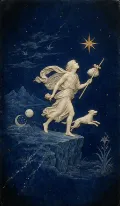 The FoolShares: Gold stars in the night · The bowed head · Crescent and sky shells
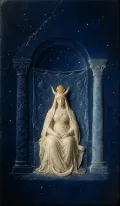 The High PriestessShares: The cross-tipped crown · The bowed head · Crescent and sky shells
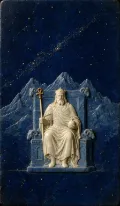 The EmperorShares: The cross-tipped crown · The bowed head · The scallop-shell throne