Major Arcana · XII
The Hanged Man
Tarot card meaning: upright, reversed and the symbols of the Olivia image
The Hanged Man invites a chosen pause: stop pushing, let the whole frame turn upside down, and see what the old angle kept hidden.
- Upright
- chosen pausenew perspectivesurrenderletting gopatience
- Reversed
- stallingempty sacrificeresisting changerestless waitingmartyrdom
Upright
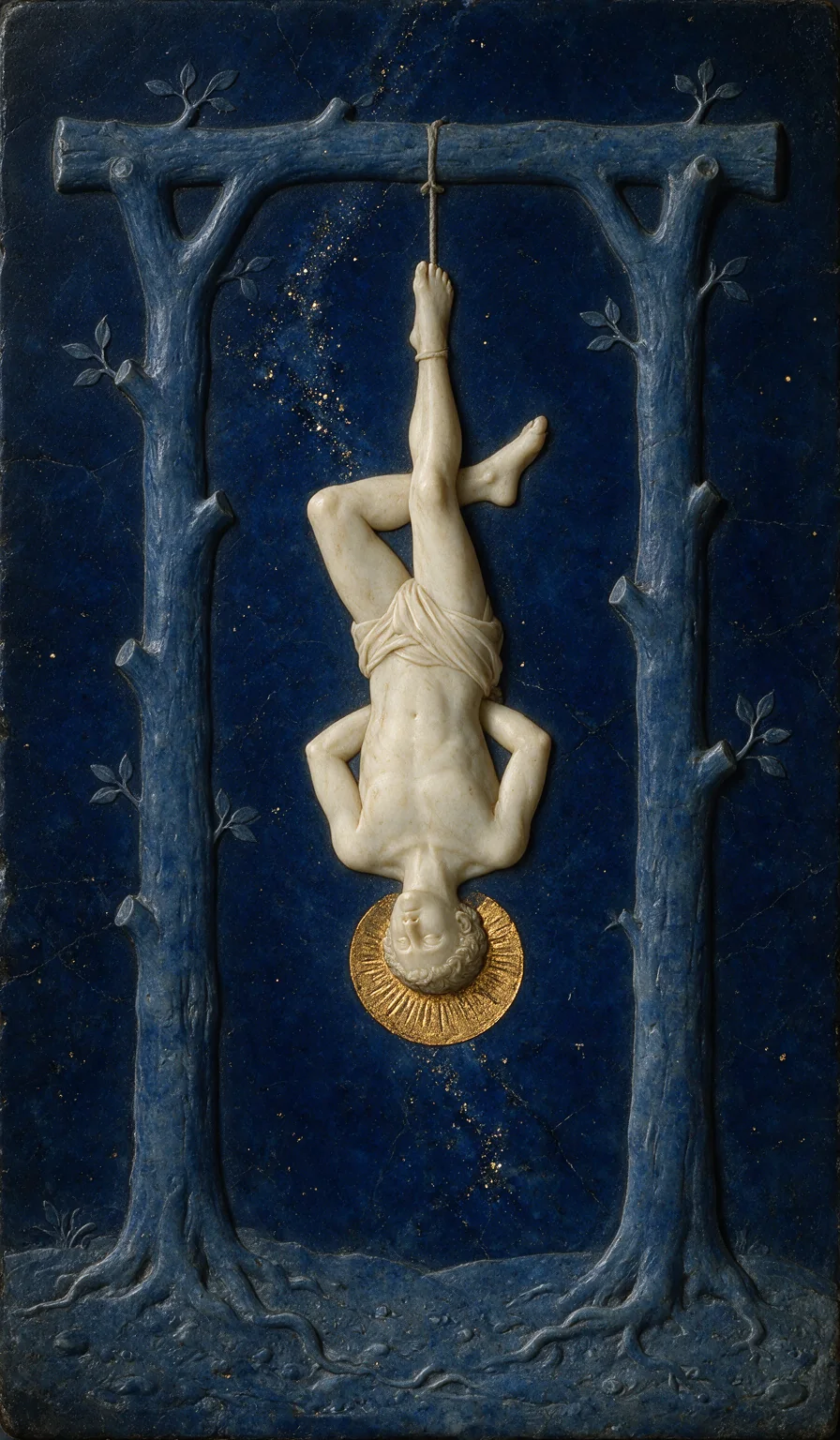
The Hanged Man is the card of the deliberate stop. In Olivia’s image the figure hangs from one pale cord tied around a single ankle, with nothing else holding it: no chains, no guard, no struggle. The face set against the gold halo is calm, eyes lowered, as though the strangeness of being upside down has already been accepted. This is not a capture. It is an agreement to stay still long enough to see differently.
Upright, the card draws attention to what shifts when you stop pushing. Effort repeated from the same angle tends to return the same result; turning the whole frame around lets another reading of the situation appear. Here a river of gold stars runs on behind the hanging figure, a reminder that the larger order has not gone anywhere. Only the viewpoint has changed, and that change is the gift.
The card can also point to an exchange: setting down something small, such as speed, certainty or the need to be right, in return for understanding. The two trees are pruned, their branches sawn to stubs, yet leaves still sprout from the cut wood. Something is set aside so that something else can grow. The Hanged Man asks you to make that exchange on purpose, and to know what your pause is for.
Reversed
The Hanged Man reversed turns the figure the right way up, and the pause can lose its purpose. It can point to waiting that has become a habit, a sacrifice made so often that nobody, including you, remembers why, or a quiet refusal to look at the question from any other side. The cord is still tied, but no new view is arriving.
It can also show the opposite strain: restlessness, forcing a decision because stillness feels unbearable. Ask what you are waiting to learn. If you can name it, the pause may still be useful. If you cannot, a small experiment or a changed routine may offer the fresh view that hanging on has not.
Read the image
Every element below is carved into this card. Scroll, hover or press a number to follow it on the image.
Two pruned living trees
What you seeTwo lapis trunks rise on either side of the figure, their side branches sawn back to round stubs. At the top each trunk forks into a Y that holds the beam, one arm ending in a ringed, cut stump.
What it carriesMarseille decks hang the figure between two trees with lopped branches; the Waite-Smith card uses a single T-shaped tree in leaf. Olivia returns to the pair. Cut back yet still alive, the trees suggest pruning: something taken away so that growth can go elsewhere.
Follow this symbol through the deck ↗Leaves on sawn wood
What you seeSmall sprigs of pale grey-blue leaves grow from the top of the beam above each trunk and from the sides of both trees, carved lighter than the dark lapis around them.
What it carriesThe Hanged Man’s gallows is traditionally living wood, commonly read as a sign that this suspension belongs to life rather than to punishment. Here leaves sprout even from the cut beam: a pause that looks like dead time can still be quietly growing.
Follow this symbol through the deck ↗The single cord
What you seeA thin pale cord is wrapped around the middle of the beam, knotted just below it, and drops straight down to a narrow loop tied around the ankle of the raised leg.
What it carriesNothing else holds the figure: one cord, one foot, no chains or guard. The light binding is commonly read as a hanging accepted rather than imposed, a stop agreed to rather than a capture. The knot asks what is really keeping you in place, and who tied it.
The river of stars
What you seeA band of gold flecks enters at the top edge, slants down to the left towards the bent knee, and reappears below the halo, trailing away towards the lower right.
What it carriesThe traditional image sets the figure against a plain ground; Olivia hangs it across the Milky Way. Upside down, the figure sees the stars inverted, yet the band still runs on behind the body: the larger order is still there, simply seen from a new angle.
Follow this symbol through the deck ↗Legs in a figure four
What you seeThe tied leg stays straight. The other bends at the knee, which points to the left, and its shin passes behind the straight leg so that the bare foot emerges on the right.
What it carriesThe crossed legs make the shape of a 4, or a cross turned over, long read as the fourfold world of the elements set upside down. The dancer of The World traditionally crosses the legs the same way, upright and free: a hint of where this stillness leads.
The draped loincloth
What you seeAn ivory cloth wraps the hips in soft, heavy folds, gathered and tucked at the waist. It is the only covering on an otherwise bare ivory body.
What it carriesThe traditional figure is fully dressed in tunic and hose, often in red and blue. Olivia strips the figure almost bare, closer to images of saints and martyrs. Little is left to protect or display: the surrender is plain, and so is the vulnerability it takes.
Arms folded behind
What you seeThe elbows bend outward at the sides of the torso and the forearms turn in behind the back. The hands stay out of sight; nothing is held or reached for.
What it carriesHere, as in the traditional image, the two elbows and the lowered head make a point-down triangle beneath the crossed legs, often read as spirit descending into matter. Hands out of sight also mean that doing has stopped.
The gold halo
What you seeBehind the head, which hangs lowest of all, a gold disc is incised with short radiating rays. The face is calm, eyes lowered and almost closed, hair in close ivory curls.
What it carriesThe halo in Pamela Colman Smith’s 1909 design is commonly read as illumination rather than suffering. Here it is the only solid gold on the card, set at the head, the lowest point of the body: understanding gathers where you might least think to look.
Follow this symbol through the deck ↗Roots reaching inward
What you seeAt the foot of each trunk long roots spread across a pebbled lapis ground. The longest of them snake towards the centre from both sides, almost meeting beneath the figure.
What it carriesOlivia’s frame shows the roots of the gallows trees, and they suggest that the stillness above is anchored: the two posts draw from one ground and reach for each other below. A pause holds when it is rooted in something steady rather than left hanging on nerves alone.
Follow this symbol through the deck ↗
The number
Twelve is a number of full cycles: twelve months, twelve signs of the zodiac, twelve hours on the face of a clock. In the Waite-Smith order The Hanged Man follows Justice, where a matter is weighed, and comes just before Death, where something ends. Between verdict and ending sits this suspension. The step it asks is strange for a traveller who has walked since The Fool: stop on purpose, let the world turn over, and wait for the new angle before choosing again.
The tradition
In the Golden Dawn system The Hanged Man is titled the Spirit of the Mighty Waters. It carries the Hebrew letter Mem, meaning water, one of the three mother letters, and is attributed to the element of Water, on the path joining Geburah to Hod on the Tree of Life. Some modern readers assign Neptune instead. Early Italian sources call the card the Traitor, echoing the shame paintings that showed traitors hung by one foot. Marseille decks hang Le Pendu between two lopped trees; Pamela Colman Smith’s 1909 design gave the figure a halo and a single living tree. Olivia’s frame returns to the two trees.
Love, work and self
- Love
- In close relationships The Hanged Man invites you to stop arguing your side for a while and look at the pattern from another place: the other person’s view, or no one’s in particular. It does not ask you to give way on what matters. It asks what a pause would show you: a repeated quarrel, a role you keep playing, a need left unspoken. With yourself, it can mean resting from self-improvement long enough to notice what already works.
- Work
- At work or in study the card can point to a project that has stalled, and to the chance that the stall holds information. Before adding more hours, turn the problem over: explain it to someone outside the field, read the brief backwards, question the assumption everyone shares. A delay in a money matter or a decision can be a time to gather facts rather than force an outcome. The Hanged Man favours the patient review over the heroic push.
- Self
- For your inner life this card is permission to be unproductive on purpose. The figure’s hands are folded out of sight; nothing is held or reached for. Try the same: a stretch of time with no goal, no screen and no plan, to see what surfaces when you stop managing. The card also asks you to notice where you give things up too readily, and whether that giving still reflects your values or has simply become routine.
In a spread
Read the card through each position before you look at Olivia’s version. A position is a question, and the same card answers each one differently.
The situation
What aspect of the situation deserves attention?
Olivia’s readingAt the centre of your question The Hanged Man suggests the next insight lies not in more effort but in a changed angle. Something here may ask to be looked at upside down before you act.
What complicates it
What tension or assumption deserves a closer look?
Olivia’s readingAs what complicates the question, the card can point to a pause that has gone on too long, or a sacrifice that no longer serves anyone. Waiting may have become a place to hide from choosing.
A helpful next step
What small action could help you understand or respond?
Olivia’s readingAs a next step, stop for a set time, drop your preferred outcome for a moment, and write the situation as a stranger would describe it. Decide once the new view has arrived.
In conversation with
- The Hanged Man + Death
The Hanged Man and Death sit side by side in the sequence. Together they draw attention to a two-step change: first the voluntary pause that loosens your grip, then the ending that becomes possible once you have stopped holding on.
- The Hanged Man + The World
The dancer of The World traditionally crosses the legs in the same figure four, but upright and free. Together the two cards trace one posture from suspension to completion: the same shape, first held in stillness, then danced.
- The Hanged Man + Four of Swords
The Four of Swords is rest taken to recover; The Hanged Man is rest taken to see. Paired, they ask whether your pause is for healing or for insight, and invite you to give it the conditions that purpose needs.
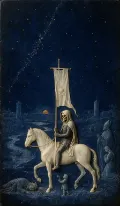
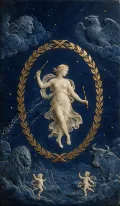
Also read withFour of CupsSeven of PentaclesAll pairs ↗
Questions to keep
- What might you see if you set aside your preferred outcome for one week?
- Which effort have you repeated from the same angle, hoping for a different result?
- What are you actually waiting to learn, and how will you know when you have learned it?
Ask them with three cards ↗A three-card reading in which each position asks one of these questions.
A small practice
Write your question at the top of a page, turn the page upside down, and describe the situation from the viewpoint of whoever or whatever you have been overlooking.