Major Arcana · III
The Empress
Tarot card meaning: upright, reversed and the symbols of the Olivia image
The Empress is the care that lets things grow: patient nourishment, pleasure in the senses, and the willingness to let what you tend ripen in its own season.
- Upright
- nurtureabundancecreativitysensual pleasuregrowthrest
- Reversed
- depletionovergivingcreative blockself-neglectsmothering care
Upright
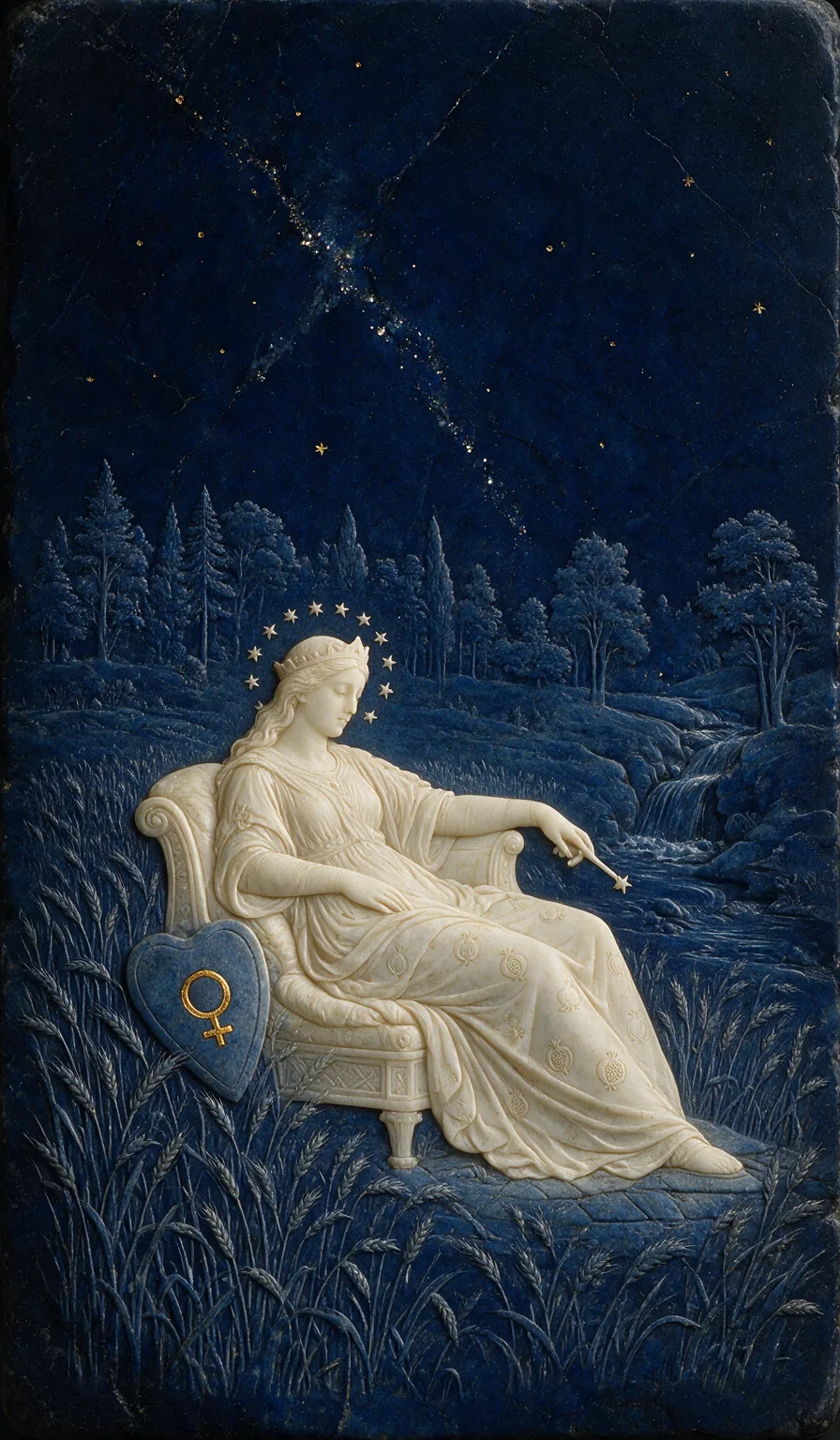
The Empress sits at the point where care becomes growth. Olivia carves the figure at rest on a cushioned couch in a field of ripe wheat, eyes lowered, one hand in the lap and the other letting a star-tipped rod dip towards a stream. Nothing in the scene is being pushed. Upright, the card draws attention to the conditions that let something flourish: nourishment, time, a welcoming space, and your own willingness to enjoy what is growing rather than only manage it.
The details are generous in a quiet way. Pomegranates, each full of seeds, are scattered across the gown; twelve ivory stars ring the head like a year gathered around one person; the heart-shaped shield at the side carries the sign of Venus in gold. Together they point to creativity in the widest sense: a project, a garden, a friendship, a body cared for, a home made warm.
The Empress also gives pleasure a proper place. Beauty, touch, taste and good rest are not rewards for finishing; they are part of what keeps any growing thing alive, including you.
Reversed
The Empress reversed can point to care that has run dry or run over. On one side the well is empty: you have been giving attention, energy and warmth to everything but yourself, and creativity feels thin or stuck. On the other, care tightens into control, tending so closely that nothing has room to grow on its own terms. Both are the card’s nourishing quality, blocked or overextended.
Look at the figure in the carving: at rest, one hand open in the lap, the rod held lightly. Ask where you could loosen a grip or refill your own reserves. One ordinary comfort, taken without guilt, is often a better next step than working harder.
Read the image
Every element below is carved into this card. Scroll, hover or press a number to follow it on the image.
The glittering sky band
What you seeAcross the upper half, a pale band of glittering mineral runs diagonally from the top left down towards the treetops, set in dark lapis among scattered pinpoints and tiny carved stars of gold.
What it carriesThe traditional Empress sits under a bright daytime sky; Olivia moves the scene into night, beneath a band like the Milky Way. It sets the card’s earthly abundance inside larger, slower cycles: seasons, nights and the long turning of the year, which no one can hurry.
Follow this symbol through the deck ↗Twelve stars and a crown
What you seeAround the bowed head, twelve small five-pointed ivory stars stand in a ring against the lapis, framing a pointed ivory crown worn over long, wavy hair that falls past the shoulder.
What it carriesIn the Waite-Smith card the twelve stars sit on the crown itself and are commonly read as the twelve months or the twelve signs of the zodiac: the whole turning year. Olivia lifts them off the crown into a halo, so the year surrounds the figure rather than being worn as a jewel.
Follow this symbol through the deck ↗The moonlit wood
What you seeBehind the figure a wood rises along the horizon: tall, narrow conifers on the left and in the centre, rounder broadleaf trees to the right, all carved in shades of blue within the lapis.
What it carriesThe Waite-Smith Empress sits before a grove of tall cypresses, a green enclosure for the scene. Olivia’s wood mixes evergreen spires with leafy trees: growth at different speeds, some constant through winter, some changing with the season, all rooted in the same ground.
Follow this symbol through the deck ↗The waterfall and stream
What you seeAt the right, a small waterfall spills between carved lapis rocks into a stream that runs forward across the middle ground, passing just beyond the tip of the outstretched rod.
What it carriesRunning water flows through the Waite-Smith Empress too, commonly read as the life of feeling that keeps growth alive. Here the rod points straight at the stream, as though the Empress’s attention rests on what nourishes the field rather than on the harvest itself.
Follow this symbol through the deck ↗The star-tipped rod
What you seeThe outstretched arm rests along the scrolled arm of the couch, its fingers loosely holding a slender ivory rod that ends in a small five-pointed star, angled down towards the water.
What it carriesTraditionally the Empress holds a sceptre topped with a globe, a sign of rule over the living world. Olivia gives a slender rod tipped with a star instead, held lightly, almost idly: authority exercised through attention and gentle direction, not through grip or command.
Follow this symbol through the deck ↗Pomegranates on the gown
What you seeThe loose ivory gown pools over the knees and down to one foot on the paving; across its folds are scattered small raised pomegranates, each with a crowned top and a surface dotted with seeds.
What it carriesThe Waite-Smith Empress also wears a robe patterned with pomegranates, the fruit carved on the veil behind Olivia’s High Priestess. There it hangs at the figure’s back; here it is worn on the body itself. Hundreds of seeds in one fruit: fertility, abundance and creative potential made visible.
Follow this symbol through the deck ↗The cushioned couch
What you seeThe Empress reclines on an ivory couch with deep cushions, a scrolled arm at each end, a lattice-carved base and a turned leg, set on a low platform of lapis paving stones.
What it carriesWhere the Emperor sits upright on a stone throne, the Empress is traditionally shown on soft cushions in the open air. Olivia makes the seat almost a daybed: rest is not a pause from this power but part of it, the stillness in which things are allowed to ripen.
Follow this symbol through the deck ↗The heart with Venus’s sign
What you seeLeaning against the side of the couch is a heart-shaped shield of paler grey-blue lapis with a raised rim, bearing the circle-and-cross sign of Venus inlaid in gold.
What it carriesThe Waite-Smith Empress rests a heart-shaped shield bearing the Venus symbol against the throne, naming the card’s planet. Olivia uses gold sparingly, and here it marks this sign: love, beauty and pleasure set down as a shield, protection that works through warmth rather than force.
Follow this symbol through the deck ↗The field of wheat
What you seeThe whole lower third is filled with tall, ripe wheat carved in blue-grey relief, heavy ears bending in different directions, rising around the couch leg and the edge of the paving.
What it carriesRipe grain grows before the Waite-Smith Empress as well, and wheat is the plant of Demeter and Ceres, goddesses of the harvest. It shows abundance as something grown over a season, not conjured: tended, waited for, then gathered. Here the field reaches right to the viewer’s edge.
Follow this symbol through the deck ↗
The number
The Empress carries three, the number that appears when two meet and something new is born. After the Magician’s one, the act of will, and the High Priestess’s two, the inner knowing, the Fool arrives in the Empress’s field: the world of the senses, of bodies, seasons and making. Three is growth and fertile combination. This step asks you to let an idea take form and to feed it patiently, before the Emperor at four gives it structure.
The tradition
In the Golden Dawn system the Empress bears the title “Daughter of the Mighty Ones”. The card is attributed to Daleth, the Hebrew letter whose name means “door”, and to the planet Venus, and it occupies the fourteenth path of the Tree of Life, joining Chokmah and Binah, wisdom and understanding. Some modern readers also connect the card with the element of Earth. The Marseille L’Impératrice sits facing forward with a sceptre and a shield bearing an eagle. In 1909 Pamela Colman Smith moved the figure outdoors among wheat, trees and falling water, with a heart-shaped Venus shield, a crown of twelve stars and a pomegranate robe; the stars are often compared with the crowned woman of Revelation 12.
Love, work and self
- Love
- In love and close bonds, the Empress turns attention to how care actually moves between you. It can point to affection shown through ordinary things: food, touch, time, a room made comfortable. Notice whether care flows both ways, and whether you let yourself receive it as easily as you give it. With yourself, the card asks for the same generosity: the rest and pleasure you would offer someone you love. The loose hand in the carving is the model: holding, not gripping.
- Work
- In work and study, the Empress favours cultivation over pressure. It can point to creative projects, teaching, care work, anything that grows through steady tending, and to a pace that lets ideas mature. Like the wheat, results come from seasons of attention rather than a single push. With money matters, the card speaks of stewardship: noticing what sustains you and what drains you, keeping your own practical judgement, and asking whether your way of working could last.
- Self
- For your own growth, the Empress asks whether you treat yourself as ground worth tending. The figure in the carving rests in the middle of abundance, eyes lowered, in no hurry to harvest anything. Where have you made rest conditional on achievement? Pleasure, beauty and the body belong to self-knowledge too. Try noticing what restores you physically, and give it a place in your week as seriously as any task on your list.
In a spread
Read the card through each position before you look at Olivia’s version. A position is a question, and the same card answers each one differently.
The situation
What aspect of the situation deserves attention?
Olivia’s readingAt the heart of a question, the Empress suggests that what matters most is nourishment: what this situation, relationship or project needs in order to grow, and whether it is being fed.
What complicates it
What tension or assumption deserves a closer look?
Olivia’s readingAs a challenge, the Empress can point to care out of balance: giving until you are depleted, or tending so closely that something cannot grow on its own terms.
A helpful next step
What small action could help you understand or respond?
Olivia’s readingAs advice, the Empress invites you to feed what you want to grow, slowly and with some pleasure: one nourishing act and a little rest, rather than more effort.
In conversation with
- The Empress + The Emperor
The Empress and the Emperor sit at three and four: the living field and the walls that protect it. Together they draw attention to the balance between growth and structure, care and boundaries, what flourishes and what keeps it safe.
- The Empress + The High Priestess
Pomegranates link the Empress with the High Priestess: carved on the veil behind one figure, worn on the gown of the other. Together they draw attention to inner knowing becoming visible, a quiet idea ripening into something others can see.
- The Empress + Nine of Pentacles
The Nine of Pentacles shows a figure at ease among laden vines, much as the Empress rests in the wheat. Together they draw attention to abundance you have grown yourself, and to the permission to enjoy it without apology.
Also read withThree of CupsQueen of PentaclesAll pairs ↗
Questions to keep
- What in your life is growing right now, and what does it need from you to keep growing?
- Where do you give care freely but find it difficult to receive it in return?
- What ordinary pleasure restores you, and when did you last allow yourself to enjoy it fully?
Ask them with three cards ↗A three-card reading in which each position asks one of these questions.
A small practice
Choose one thing you are tending, such as a plant, a project or a friendship, and give it ten unhurried minutes today; afterwards, write down one thing it seems to need.
Cards that share its symbols
 Ten of CupsShares: The heart with Venus’s sign · The moonlit wood · The waterfall and stream · The glittering sky band
 The EmperorShares: The glittering sky band · The cushioned couch
 JusticeShares: The glittering sky band · The cushioned couch
 The Hanged ManShares: The moonlit wood · The glittering sky band