Minor Arcana · Pentacles
Ten of Pentacles
Tarot card meaning: upright, reversed and the symbols of the Olivia image
The Ten of Pentacles is what lasts beyond one lifetime: a home, a way of living and a set of values, shared across generations and chosen again.
- Upright
- legacyfamily rootslasting securitybelongingtraditionlong view
- Reversed
- inherited burdenfamily tensionrigid customshort-term thinkingdisconnection
Upright
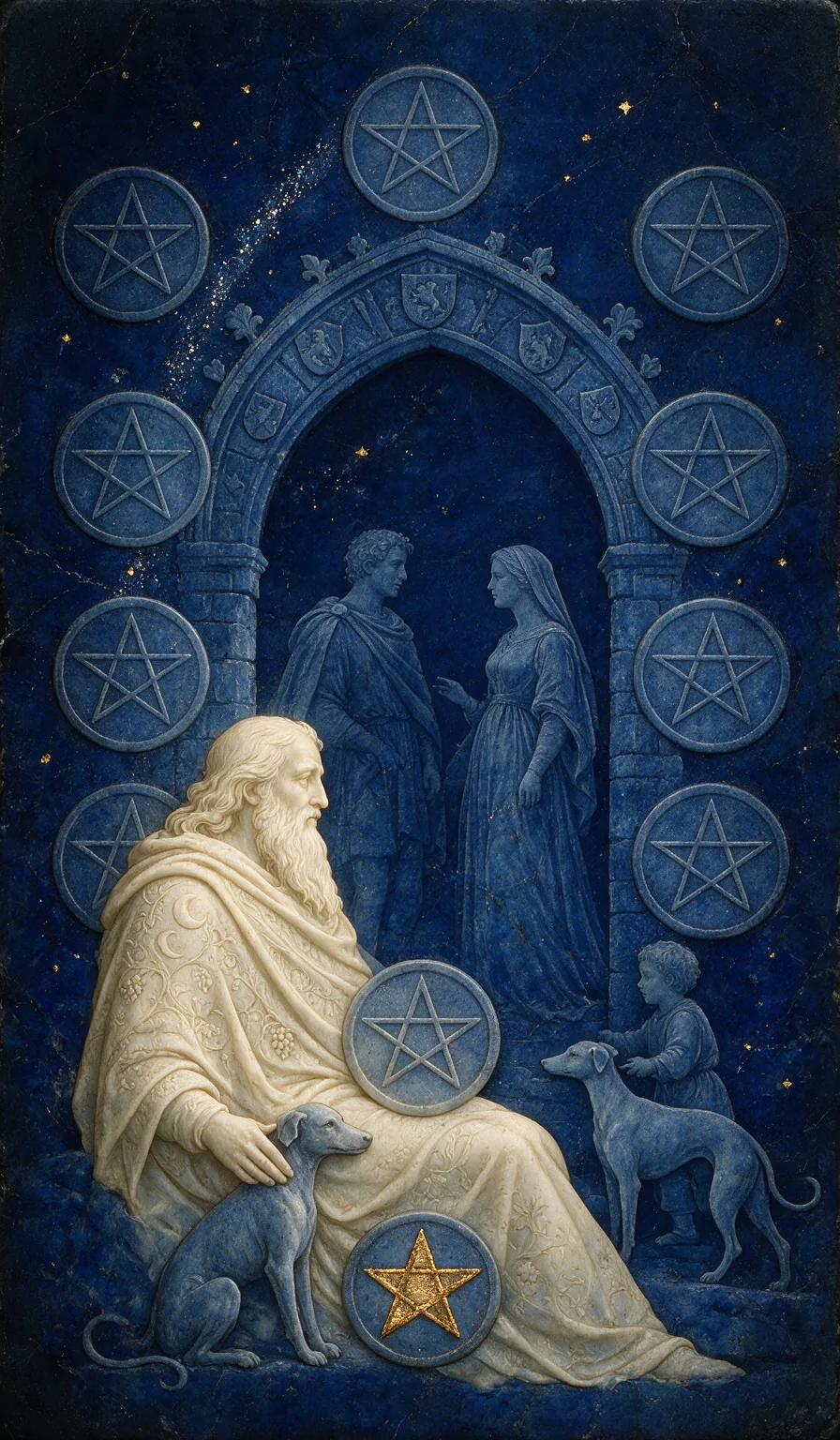
The Ten of Pentacles turns attention to what outlasts a single season: a household, a set of skills, a way of doing things, the resources and habits that pass from one pair of hands to the next. In Olivia’s carving three generations share one scene. An elder in ivory sits at the lower left, watching a couple talk beneath a Gothic arch while a child at the right reaches for a slender dog. The arch is set with heraldic shields, a rampant lion at its centre: a name, a house, a place to belong.
Look at what the elder’s visible hand is doing: it rests on the head of a seated greyhound; nothing is being counted or guarded. The discs are already built into the stone around the arch, and the only golden one lies low at the hem of the robe, close to the ground. This is wealth in the older sense: not a windfall but continuity, the slow gathering of care, work and memory that makes a life feel held.
Upright, the card invites you to take the long view. What are you building that could support people beyond yourself, and what have you received that deserves thanks? It can point to steady roots, family or chosen, a secure base, and the quiet satisfaction of belonging to something larger than one generation.
Reversed
Ten of Pentacles reversed draws attention to an inheritance that has become heavy or tangled. The arch that shelters can also confine: expectations about how things are done, who owns what, or who is allowed to change it. Old arrangements may no longer fit the people living inside them, or short-term pressures may be crowding out the long view.
It can also point to a feeling of distance from your roots, as if you were watching the family scene from the edge, like the elder, without quite being part of it. Consider which traditions still earn their place, which conversations are overdue, and what you would keep if you were choosing freely.
Read the image
Every element below is carved into this card. Scroll, hover or press a number to follow it on the image.
Discs framing the arch
What you seeNine grey-blue discs, each carved with a line-drawn pentagram, frame the archway: one above its point and four stacked down each side, the lowest left one half hidden by the elder. Two more sit against the robe, eleven in all.
What it carriesPentacles are the suit of earth: body, home, work and what can be kept. The traditional card floats ten discs in the pattern of the Tree of Life. Olivia’s card carries eleven, nine set into the stone like coins built into a family’s walls, a border that holds the household together.
Follow this symbol through the deck ↗The glittering starry band
What you seeA diagonal band of fine sparkling flecks runs from beside the top disc down to the left, between the upper discs and past the left shoulder of the arch; small gold stars dot the surrounding blue.
What it carriesThe Milky Way is Olivia’s addition, not part of the traditional image. On a card about lineage it reads as a long line of lights, one after another: the generations before and after you, each small alone, together forming a road across the dark.
Follow this symbol through the deck ↗The arch of shields
What you seeA pointed Gothic arch carved in paler grey-blue lapis rises over the couple on two masonry pillars. Five heraldic shields are set into its band, a rampant lion on the central one, with fleur-de-lis finials along the outer edge.
What it carriesAn archway bearing a coat of arms belongs to the traditional card too: the threshold of a house and the name a family carries. The shields make belonging visible. Standing beneath them, the couple is literally inside an inheritance, sheltered by it and framed by it.
Follow this symbol through the deck ↗The couple under the arch
What you seeTwo standing figures carved in blue lapis face each other beneath the arch: one curly-haired, a cloak pinned at the shoulder; one veiled, in a long gown, an open hand raised mid-gesture.
What it carriesThe traditional image places a couple in the gateway as the present generation, busy with the life of the household. Carved in the same blue as the walls and absorbed in conversation, they are the ones who currently hold what was handed down, and who hold it for the next.
The ivory elder
What you seeThe only ivory figure on the card sits at the lower left in profile, long wavy hair falling over the shoulders and a full beard down the chest, gazing right towards the couple.
What it carriesThe old figure seated at the edge is the elder of the traditional card, often read as the ancestor or founder of the house. Carved in ivory while everyone else is blue stone, the elder becomes the one looking on: long experience watching what continues.
Moons and grapes on the robe
What you seeThe elder’s ivory mantle is covered in fine relief: crescent moons near the shoulder, clusters of grapes and winding vine scrollwork across drapery that pools down to the ground.
What it carriesIn the traditional card the elder’s robe is patterned with grapes and other signs. Grapes stand for harvest and abundance ripened slowly; the crescent moons add the turning of months and years. The robe becomes a record worn on the body: seasons lived through, fruit gathered.
The child and the dog
What you seeAt the right, beside the arch’s right pillar, a curly-haired child in a tunic, carved in lapis, rests one hand on the head of a slender standing dog and raises the other; the dog faces left, towards the elder.
What it carriesA child reaching for a dog appears in the traditional card as the youngest generation, curious and unhurried. Here the child stands at the far side from the elder, and the dog turns back across the scene, a thread of attention running from youngest to oldest.
Follow this symbol through the deck ↗The seated greyhound
What you seeA greyhound-like dog carved in blue lapis sits at the elder’s knee, facing right, head raised beneath a resting ivory hand, its long tail curling on the ground; a second dog stands at the right beside the child.
What it carriesDogs traditionally stand for loyalty, guardianship and domestic trust, and the traditional card shows them gathered near the elder. Here one receives the elder’s hand while the other receives the child’s, so the animals quietly join the two ends of the family through touch.
The gold pentacle
What you seeLow against the robe, near the hem, a lapis disc bears a solid five-pointed star of worked gold, the only gilded emblem on the card; a grey disc with a line-drawn pentagram rests higher, against the elder’s lap.
What it carriesGold is rare in Olivia’s deck and marks what matters. Of all eleven discs, only the one at the hem of the elder’s robe is golden, and its star is solid rather than drawn in line. It sits low, near the ground, as if what lasts is often humble and close at hand.
Follow this symbol through the deck ↗
The number
Ten completes the count, and with completion comes fullness, sometimes overload: the point where a cycle can go no further and hands over to a new one. In Pentacles, the suit of earth, body, work and home, that completion is material and generational. The seed of the Ace has grown into a house, a trade, a family story. Ten asks what happens to everything that has been gathered: whether it is kept, shared, renewed or passed on.
The tradition
In the Golden Dawn system the Ten of Pentacles, or Disks, is titled the Lord of Wealth. It is attributed to Mercury in Virgo, the third decan of that earth sign, and like every Ten it corresponds to Malkuth, the Kingdom, the sphere of the material world at the foot of the Tree of Life. Older Marseille-pattern decks show ten coins among foliage, with no scene. Pamela Colman Smith’s 1909 design for A. E. Waite’s deck arranges the ten pentacles in the pattern of the Tree of Life over an elder, a couple, a child and dogs at the gateway of a house, the scene Olivia’s carving follows.
Love, work and self
- Love
- In close relationships the Ten of Pentacles asks what you are building together that could last: shared routines, a home, traditions of your own making. It can also bring family patterns into view, the ways of loving you learned under an older roof. Like the couple talking beneath the arch, notice which inherited habits shelter you both and which you have never actually chosen. With yourself, it invites the patience of someone tending a whole life, not a single season.
- Work
- At work or in study the card turns attention to durable foundations: skills passed on by mentors, institutions with long memories, knowledge that builds over years. It can point to the value of stability, good records, sound systems and craft that someone else could continue. In money matters it speaks of stewardship and plain planning, not speculation; where decisions involve other people’s shares or an inheritance, a qualified adviser can help with the practical detail.
- Self
- For your own growth the Ten of Pentacles invites a look at your roots without idealising them. The elder in ivory sits slightly apart, watching the others; you might take that seat for a moment and look at your life from its far end. What has been given to you in talent, place, language or example? And what do you want your ordinary daily choices to leave behind for others?
In a spread
Read the card through each position before you look at Olivia’s version. A position is a question, and the same card answers each one differently.
The situation
What aspect of the situation deserves attention?
Olivia’s readingAt the centre of your question, the Ten of Pentacles points to the long view: family, home, lasting resources, or what you are building for others. Ask how this situation fits into a larger story.
What complicates it
What tension or assumption deserves a closer look?
Olivia’s readingAs a challenge, it can show the weight of inherited expectations: a family’s or an institution’s way of doing things that makes change feel disloyal, or long-term security crowding out present life.
A helpful next step
What small action could help you understand or respond?
Olivia’s readingAs advice, it invites you to think in generations: make the choice that someone later could build on, and talk openly with the people who share the house, literal or figurative.
In conversation with
- Ten of Pentacles + Ten of Cups
The two Tens complete the picture of home: the Ten of Cups offers emotional fulfilment, the Ten of Pentacles the practical structure that keeps it standing. Together they ask whether feeling and foundation are both being tended.
- Ten of Pentacles + Nine of Pentacles
The Nine of Pentacles enjoys a garden won by personal effort; the Ten widens it into a household of many people. Together they draw attention to the step from self-sufficiency to sharing, from what you have made to what you hand on.
- Ten of Pentacles + The Hierophant
The Hierophant keeps the traditions of a community; the Ten of Pentacles lives them at home. Side by side they turn attention to inherited rules and customs, asking which still carry meaning and which are kept only out of habit.
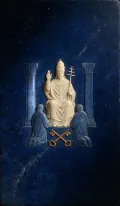
Also read withAce of PentaclesKing of PentaclesAll pairs ↗
Questions to keep
- What have you received from those before you that you have never fully thanked them for?
- Which inherited habit or expectation shapes your choices most, and would you choose it again today?
- What would you like your everyday choices to make possible for someone who comes after you?
Ask them with three cards ↗A three-card reading in which each position asks one of these questions.
A small practice
Choose one object, recipe or skill you inherited, and write three lines about where it came from and what you would like to add to it.
Cards that share its symbols
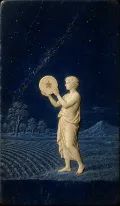 Page of PentaclesShares: The glittering starry band · Discs framing the arch · The ivory elder · Moons and grapes on the robe
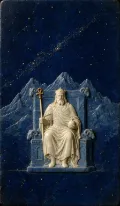 The EmperorShares: The glittering starry band · The ivory elder · Moons and grapes on the robe
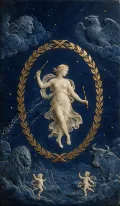 The WorldShares: The ivory elder · The child and the dog · The glittering starry band
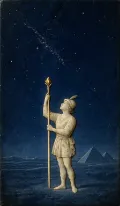 Page of WandsShares: The ivory elder · The glittering starry band · Moons and grapes on the robe