Minor Arcana · Wands
Four of Wands
Tarot card meaning: upright, reversed and the symbols of the Olivia image
The Four of Wands invites you to pause inside something you have built, and to celebrate it with the people and places that made it possible.
- Upright
- celebrationhomecomingshared milestonebelongingstable foundationgratitude
- Reversed
- unmarked milestonefeeling outsideunsettled homepostponed joyperformed festivity
Upright
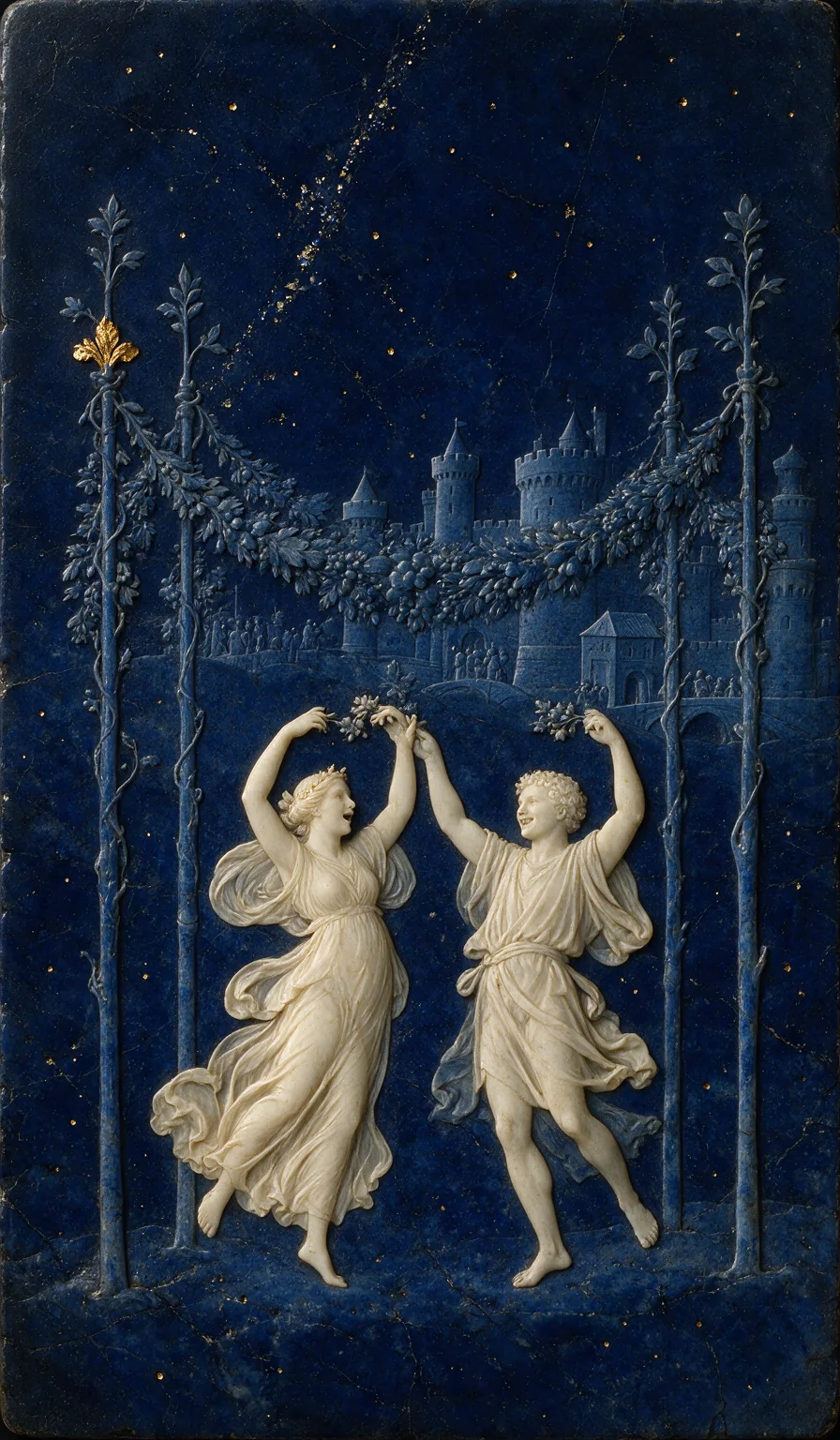
The Four of Wands is the card of a structure that finally holds. Four wands stand planted in the ground, a fruited garland is tied between them, and two figures dance barefoot beneath it. Something has been raised by effort, and now it is sturdy enough to gather under. In Olivia’s image the wands are still alive, wound with vines and sprouting leaves at the tips, so this is not an ending. It is a threshold: a moment to stop, look at what you have made, and let it be enough for today.
The card turns attention toward recognition, especially the kind that is shared. The dancers’ inner hands meet overhead and each lifts a small sprig of blossom, not a grand bouquet. Behind them the castle sits back in pale stone and the crowd is barely sketched. The emphasis falls on the ones who are dancing, not on status or spectators. A finished draft, a settled home, a repaired friendship, a term completed: the Four asks you to mark it in some modest, bodily way.
It also draws attention to foundations. Four is the number of the square and the frame, and a frame that is honoured tends to be tended. Notice the single gold ornament on one post. It asks who or what quietly held the whole structure up, and whether they have been thanked.
Reversed
Four of Wands reversed can point to a milestone that passes without being marked, because the next task arrived too fast or the moment did not feel big enough. It can also turn attention toward a gathering that looks festive while you feel at its edge, closer to the tiny figures by the castle wall than to the dancers. During a move, a change of role or a shift in a relationship, the sense of home may feel unsettled for a while.
Nothing here has to be fixed at once. The reversed Four invites you to lower the bar for celebration: one sprig rather than a bouquet. Name what has been reached, even privately, and ask where a small sense of belonging is already present.
Read the image
Every element below is carved into this card. Scroll, hover or press a number to follow it on the image.
Four living wands
What you seeFour slender wands carved in blue lapis relief stand planted in the ground, two on each side of the dancers. Carved vines twist up every shaft, and each tip breaks into sprouting leaves against the night.
What it carriesWands are the suit of Fire: will, drive and creative spark. In the traditional image four budding staves hold up a garland. Olivia winds each one with carved vine and lets its tip branch into leaves, so the structure built by effort stays alive rather than finished and fixed.
Follow this symbol through the deck ↗The golden leaf finial
What you seeHigh on the far-left wand, just above the knot that ties the garland, sits a three-lobed leaf ornament in gold. Apart from star flecks and a diagonal trail of pyrite in the sky, it is the only gold on the card.
What it carriesThis detail is Olivia’s own rather than part of the traditional image. Gold in this deck is rare and marks what matters. Set on a single post of the frame, it suggests that one support, one person or one effort, deserves to be named and honoured when the work is celebrated.
Follow this symbol through the deck ↗The fruited garland
What you seeA heavy garland of leaves and clustered round fruits, carved in lighter blue, is tied to the wands with knotted cords high on the posts and swags low across the middle, in front of the castle.
What it carriesThe garland is the card’s central sign: the traditional Four shows greenery slung across four staves, like a canopy raised for a harvest home or a wedding. Heavy with fruit here, it marks something that has ripened through work and is now ready to be shared.
Follow this symbol through the deck ↗The castle behind the canopy
What you seeBeyond the garland rises a walled castle carved low in greyish-blue lapis: round crenellated towers, some with pointed roofs, and in front, a small gabled house with an arched doorway beside an arched bridge.
What it carriesIn the traditional image a castle stands behind the celebrants, the settled place the festivity belongs to. Here it sits back in pale stone, not gold: security as the backdrop that makes celebration possible, not the prize itself. The Four is homecoming as much as achievement.
Follow this symbol through the deck ↗The gathering by the walls
What you seeTiny carved figures stand in groups on the ground before the castle walls, beneath the left swag of the garland, with more near the bridge on the right; none is clearly detailed.
What it carriesThe traditional image includes people gathered near the castle, often read as the community that recognises a milestone. Olivia keeps them small and indistinct in the background stone. Belonging here is a wider circle that holds the dancers without crowding them; recognition does not need an audience to be real.
Two sprigs of blossom
What you seeThe dancers lift two small sprigs of ivory blossom and leaves above their heads: one in the left dancer’s outer hand, stretching toward the joined hands, the other raised high in the right dancer’s outer hand.
What it carriesThe traditional figures raise bouquets overhead. Olivia shrinks them to sprigs, the kind picked on the way rather than bought for an occasion. Held aloft, they turn a private gladness into a gesture others can see, and they echo the leaves sprouting from the wands.
Follow this symbol through the deck ↗Hands meeting overhead
What you seeBoth dancers raise both arms. At the top of the arc their inner hands meet and touch, the dancer on the right reaching across, while each outer hand holds a sprig aloft.
What it carriesIn the traditional image the bouquets are raised separately. Here the two celebrants also make contact, forming an arch of arms that repeats the garland above and the frame of wands. The Four’s stability becomes relational: a shape made by people meeting, not by one person arriving.
Follow this symbol through the deck ↗The leafy circlet
What you seeThe dancer on the left wears a small circlet of leaves over hair gathered up at the back; the dancer on the right has short, dense curls and no wreath. The two faces turn toward each other, smiling.
What it carriesA wreath of leaves is an ancient sign of festival and honour, from harvest rites to victors’ crowns. Worn by one dancer and not the other, it suggests recognition that can be passed around: today one is crowned, and both share the joy.
Follow this symbol through the deck ↗Two barefoot dancers
What you seeTwo ivory figures dance barefoot on rough lapis ground in the foreground, one in a long flowing gown, one in a short tunic tied with a sash, light drapes and hems lifting with the movement.
What it carriesThe traditional figures stand and wave in greeting. Olivia sets them in motion, weight on the toes, cloth swinging. Celebration here is something done, not only watched. Bare feet on the ground keep it earthy: joy rooted in a real place and body rather than performed on a stage.
The number
Four is the rank of structure. After the spark of the Ace, the choice of the Two and the widening view of the Three, the Four gives Fire a frame to burn in: four corners, a hearth, walls around the flame. In other suits a Four can feel static or withdrawn; in Wands the frame turns festive, because enthusiasm that has found a stable form can finally rest and be enjoyed. On the Tree of Life the Fours sit in Chesed, the sphere of mercy and generous order.
The tradition
In the Golden Dawn system the Four of Wands is titled “Lord of Perfected Work” and assigned to Venus in Aries, the third decan of that sign (20° to 30°), with all the Fours placed in Chesed on the Tree of Life. Venus softens the Martian fire of Aries into pleasure, grace and harmony, one reason this Four is among the gentlest cards of its suit. Crowley later retitled it “Completion”. Older Marseille-pattern decks show only four crossed batons with a flowering ornament; Pamela Colman Smith’s 1909 design for the Waite-Smith deck gave it the garland on four staves, two figures raising bouquets and a castle behind, the scene Olivia’s card follows.
Love, work and self
- Love
- In love and close bonds, the Four of Wands draws attention to the relationship as a place you share rather than a problem to solve. It can point to a milestone worth marking: moving in, a year together, a reconciliation, a friendship that has lasted. Like the dancers whose hands meet overhead, it asks what you make together, not only what each of you gives. With yourself, it invites you to treat your own life as a home you are allowed to enjoy.
- Work
- At work or in study, the Four of Wands points to a stage that is genuinely complete: a launch, a submitted project, a team that has found its rhythm. It invites you to mark it before moving on, and to name the people whose effort held the frame up, like the single gold ornament on one post. With money matters, it turns attention toward what already feels secure enough to rest on, without passing any verdict on decisions.
- Self
- For your inner life, the Four of Wands asks where you feel at home: in a room, a routine, a body, a small circle of people. The wands in this image keep growing while they hold the garland, so stability and change are not opposites here. Notice what supports you that you have stopped seeing, and allow yourself a pause of plain gladness without first earning it by finishing everything else.
In a spread
Read the card through each position before you look at Olivia’s version. A position is a question, and the same card answers each one differently.
The situation
What aspect of the situation deserves attention?
Olivia’s readingAt the centre of your question, the Four of Wands can point to something that may already hold: a shared foundation or a stage completed. It invites you to recognise it before asking what comes next.
What complicates it
What tension or assumption deserves a closer look?
Olivia’s readingAs a challenge, the Four can point to celebration postponed until everything feels perfect, or to belonging that depends on keeping up appearances. It asks what would still be worth marking now.
A helpful next step
What small action could help you understand or respond?
Olivia’s readingAs advice, the Four of Wands suggests a modest ritual: thank someone who helped, share a meal, or pause in a place that feels like home before starting the next task.
In conversation with
- Four of Wands + Three of Wands
With the Three of Wands, attention goes out toward distant horizons; with the Four, it returns to a garland and a home. Together they draw attention to the rhythm between reaching outward and coming back to where you are held.
- Four of Wands + Three of Cups
With the Three of Cups, both cards celebrate, but differently: the Cups honour feeling and friendship, while the Wands raise a structure and dance beneath it. Together they point to joy that is both heartfelt and built to last.
- Four of Wands + Four of Pentacles
With the Four of Pentacles, the same number shows two ways of holding what you have built. The Pentacles keep it close and guarded; the Wands open it up and share it. Together they ask whether your security feels like a fortress or a home.
Also read withTen of WandsAll pairs ↗
Questions to keep
- What have you built recently that deserves to be marked before you move on?
- Who helped hold up the frame of what you have now, and do they know it?
- Where do you feel most at home, and what keeps that feeling alive?
Ask them with three cards ↗A three-card reading in which each position asks one of these questions.
A small practice
Choose one thing you have finished this month and mark it with a small ritual: a shared meal, a note of thanks, or ten minutes of music and movement.
Cards that share its symbols
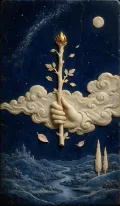 Ace of WandsShares: Four living wands · Hands meeting overhead · The golden leaf finial · The castle behind the canopy
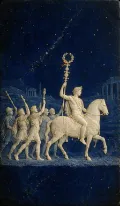 Six of WandsShares: The fruited garland · The leafy circlet · Four living wands · The gathering by the walls
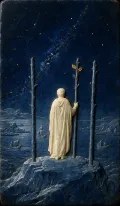 Three of WandsShares: The golden leaf finial · Four living wands · Hands meeting overhead
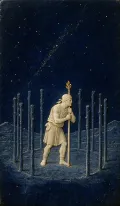 Nine of WandsShares: The golden leaf finial · Hands meeting overhead · Four living wands