Major Arcana · XVIII
The Moon
Tarot card meaning: upright, reversed and the symbols of the Olivia image
The Moon lights a night path by shifting, partial light, asking you to move carefully through fears, dreams and half-formed feelings without mistaking them for facts.
- Upright
- intuitiondreamsuncertaintyimaginationdeep feelingthe unknown
- Reversed
- fear taking overconfusion liftingignored instinctunchecked storieshidden worry
Upright
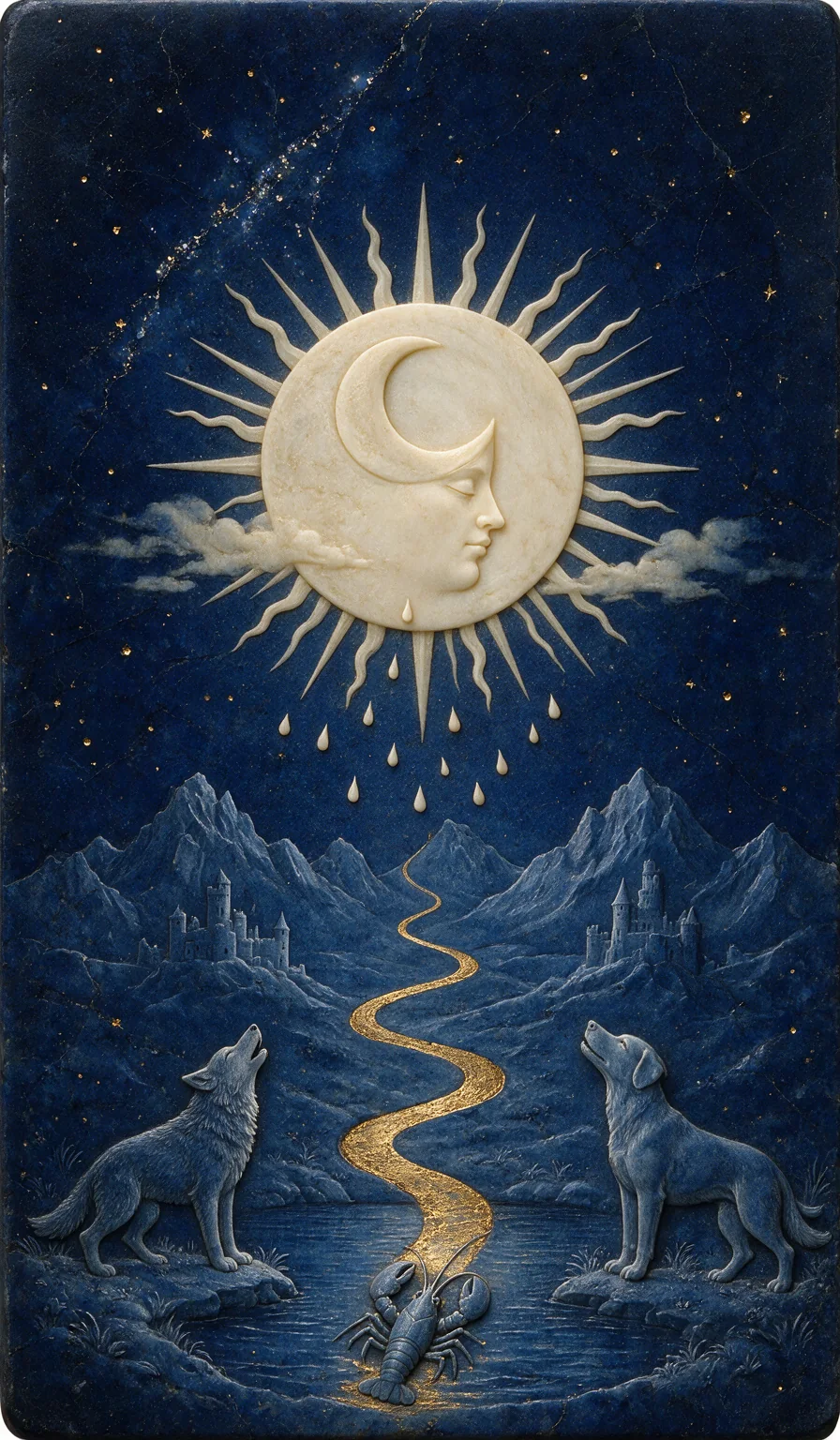
The Moon is the card of the night crossing: the stretch of a question where you cannot see far, and feeling, memory and imagination move faster than facts. In Olivia’s carving the great ivory disc holds a crescent and a sleeping face at once, eyes closed, a single tear carved just below. Clouds drift across its edge. This is light you can travel by, but it is partial, changing and full of mood.
Below, thirteen teardrops fall toward the land, and the scene divides into pairs: a wolf howling on the left, a dog gazing up on the right, a castle on each far hill. Between them runs the only carved element laid in gold, a narrow path that climbs from the pool into the mountains and vanishes into a gap. At its foot a crayfish rests in the dark water, claws raised, as if something from the depths has only just surfaced.
Upright, the card invites you to respect what you sense without treating it as proof. It can point to vivid dreams, strong intuition, anxiety that grows after dark, or a situation that is simply not clear yet. Keep to the part of the path you can see, one step at a time, and let the rest stay unresolved until more light arrives.
Reversed
The Moon reversed draws attention to the night in one of two forms. It can be confusion beginning to lift: a fear looked at in daylight turns out smaller, or a story you had been telling yourself no longer fits the facts. It can also be the Moon’s quality pressed inward, where worry is kept private for so long that it colours everything, or intuition is set aside because it cannot be explained.
In either form the crayfish is still in the pool. Ask what has been trying to surface, and give it a safe place to land: a page of writing, a conversation with someone you trust, a night of proper sleep. The path does not need to be seen to its end to be walked.
Read the image
Every element below is carved into this card. Scroll, hover or press a number to follow it on the image.
The crescent in the disc
What you seeA large ivory disc fills the upper centre, ringed by alternating straight and wavy rays. Carved in raised relief inside it, a crescent curves around the upper left, its lower horn ending at the brow of a face.
What it carriesThe traditional Moon shows full disc, crescent and face at once, ringed by rays: a light that is borrowed and always changing phase. Olivia keeps all three in one ivory disc. The alternating straight and wavy rays can be read as two kinds of light mixed together here, steady fact and moving feeling.
Follow this symbol through the deck ↗The sleeping face
What you seeWithin the disc a calm face is carved in profile, turned toward the right, the one visible eye closed, lips together. Just below it, on the lower edge of the disc, sits a single raised teardrop.
What it carriesThe face of the Moon is traditionally shown in profile, half turned away: a light that shows only part of itself. Here the eye is closed, as in sleep or dreaming, and Olivia adds a tear beneath it. The light of this card belongs to the inner, feeling world rather than to plain sight.
The clouds across the disc
What you seeTwo soft ivory clouds drift at either side of the disc. The left one crosses the lower edge of the disc and its rays; the right one lies over the rays at the lower right.
What it carriesClouds are Olivia’s addition; the traditional Moon hangs in a clear sky. They build partial cover into the image itself: some of the light is hidden, and nothing is wrong because of it. The card works with half-seen things, and the clouds make that literal.
Follow this symbol through the deck ↗Thirteen falling drops
What you seeBelow the disc, thirteen small ivory teardrops hang in loose rows between the lowest rays and the mountain tops, pointed end up, rounded end down, shaped like the single tear carved on the disc.
What it carriesIn the traditional image these drops are commonly drawn as Yods, small flame-shaped Hebrew letters, read as dew or light passing between moon and earth. Olivia shapes them as tears, matching the one beneath the sleeping face, so what falls on this landscape is feeling.
Follow this symbol through the deck ↗The two castles
What you seeOn far hills to left and right stand two small castles carved in grey-blue lapis, each a cluster of towers with pointed roofs and battlements, facing each other across the winding path.
What it carriesThe traditional card shows two plain towers, often read as a gateway at the edge of the known, cultivated world. Olivia turns them into two full castles, places of shelter and custom set well apart. The path runs between them and beyond: the familiar marks the threshold, not the destination.
Follow this symbol through the deck ↗The gold path
What you seeA winding road of gold leaf starts in the pool, its gold spilling across the water, climbs between the two animals and the castles, narrows, and disappears into a gap in the mountains.
What it carriesThe path between the towers is constant in the traditional Moon, commonly read as the way through uncertainty toward what cannot yet be seen. Olivia gilds it, the only carved element laid in gold, while the moon itself stays ivory. The route is clear even where its end is not.
Follow this symbol through the deck ↗The howling wolf
What you seeOn a grassy ledge at the left edge of the water, a shaggy-coated wolf in grey-blue lapis stands with its head thrown back, muzzle raised to the moon, mouth open in a howl.
What it carriesThe Waite-Smith Moon pairs a wolf with a dog, commonly read as the untamed and the domesticated sides of the animal self, both stirred by the same light. The wolf is instinct without a lead: old fears, hungers and alarms that rise at night and sound urgent.
The upward-gazing dog
What you seeOpposite the wolf, on a rocky bank at the right edge of the water, a smooth-coated dog with a drooping ear lifts its face to the moon, mouth only slightly open.
What it carriesThe dog is the tamed partner of the wolf: habit, loyalty, the part of you that has learned the rules. Here it looks up rather than howls. The gold path runs between the two animals, as if the way forward passes between both kinds of response.
The crayfish in the pool
What you seeAt the bottom centre, a crayfish carved in grey-blue lapis rests in the dark pool, both claws raised, its long feelers curving up along the gold where the path begins.
What it carriesThe creature in the pool is one of the oldest features of the card, commonly read as something from the deep mind rising toward awareness: an early, half-formed feeling or memory. Olivia sets it at the very foot of the gold path, so the way through the night begins with what surfaces.
Follow this symbol through the deck ↗
The number
Eighteen is the Moon’s place in the Fool’s journey, the middle of three celestial cards, after the Star and before the Sun. Having found hope again under the Star, the traveller now walks through a long night where that hope has to survive doubt and imagination. Eighteen reduces to nine, linking the card to the Hermit: both move through darkness by a limited light. This step asks for patience with not knowing, and trust in the ground underfoot.
The tradition
In the Golden Dawn system the Moon is trump XVIII, titled “Ruler of Flux and Reflux” and “Child of the Sons of the Mighty”. It carries the Hebrew letter Qoph, commonly glossed as the back of the head, and the sign Pisces, mutable water; on the Tree of Life it is the path joining Netzach and Malkuth. Some modern readers also link it to Neptune, the modern ruler of Pisces. The core image is old: Marseille-pattern decks already show the moon with drops, two dogs, two towers and a crayfish in a pool, while the fifteenth-century Visconti-Sforza card shows a single figure holding up a crescent. Where Marseille decks show two dogs, the 1909 Waite-Smith card shows a dog and a wolf.
Love, work and self
- Love
- In close relationships the Moon draws attention to what is being imagined rather than known. When a message is late or a silence is hard to read, the mind can fill the gap with its oldest fears, the wolf’s howl. Notice the story you are telling, and check it gently before acting on it. With yourself, the card asks for tenderness toward feelings that arrive without clear reasons; they still deserve a hearing.
- Work
- At work or in study the Moon can describe a project where the brief is vague, information is missing or the direction keeps shifting. Separate what you have been told from what you are assuming, and ask the plain question that would clear one doubt. Creative work suits this card well: drafts, sketches and ideas that arrive half-formed. In money matters it suggests waiting for clear figures before any decision rather than acting on unease.
- Self
- For your own practice the Moon is a card of dreams, moods and the stories the mind tells at night. The crayfish at the foot of the gold path suggests that insight often starts as something small and awkward rising from below. Keep a notebook by the bed, notice what recurs, and treat strong night-time feelings as information to revisit in daylight, not as verdicts.
In a spread
Read the card through each position before you look at Olivia’s version. A position is a question, and the same card answers each one differently.
The situation
What aspect of the situation deserves attention?
Olivia’s readingAt the centre of a question, the Moon suggests the situation may not yet be clear, and that feelings, fears or imagination may be shaping how it looks. The first task is telling impressions from evidence.
What complicates it
What tension or assumption deserves a closer look?
Olivia’s readingAs the challenge, the card can point to anxiety filling in missing facts, a story you have not checked, or intuition being dismissed because it cannot yet be put into words.
A helpful next step
What small action could help you understand or respond?
Olivia’s readingAs advice, take only the next visible step. Write down what you know and what you fear as two separate lists, and let the rest wait for more light.
In conversation with
- The Moon + The Star
The Star is hope renewed under an open sky; the Moon is the night that follows, where hope meets doubt. In sequence they draw attention to what you trusted in clear light and now have to carry through the dark.
- The Moon + The Sun
Olivia’s Moon already wears a sun’s rays. The Sun is the morning after the long night, when what was half-seen becomes plain and simple. Together they ask what might change if you waited for daylight before deciding what something means.
- The Moon + The High Priestess
The High Priestess keeps the moon’s knowledge quietly, seated between two pillars with a crescent at the feet; the Moon lets that same knowledge loose across a whole landscape. Together they draw attention to the difference between calm intuition and anxious imagination, which can feel alike.
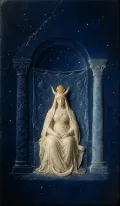
Also read withSeven of CupsEight of CupsPage of CupsSix of SwordsSeven of SwordsNine of SwordsEight of PentaclesAll pairs ↗
Questions to keep
- What do you actually know here, and what are you filling in because the picture is incomplete?
- Which fear sounds loudest at night, and how does it look when you revisit it in daylight?
- What small feeling or memory has been trying to surface lately, and where could it safely land?
Ask them with three cards ↗A three-card reading in which each position asks one of these questions.
A small practice
Before sleep, write one worry on the left side of a page and the facts you are sure of on the right, then reread both in the morning.
Cards that share its symbols
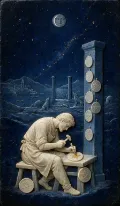 Eight of PentaclesShares: The sleeping face · The crescent in the disc · The howling wolf · The crayfish in the pool
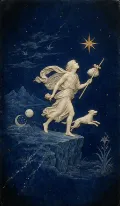 The FoolShares: The sleeping face · The crescent in the disc · The upward-gazing dog
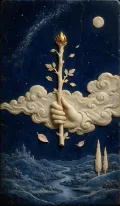 Ace of WandsShares: The clouds across the disc · The crescent in the disc · The two castles
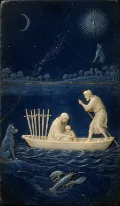 Six of SwordsShares: The howling wolf · The upward-gazing dog · The crayfish in the pool