Minor Arcana · Pentacles
Six of Pentacles
Tarot card meaning: upright, reversed and the symbols of the Olivia image
The Six of Pentacles is about the terms of an exchange: giving and receiving help in a way that stays fair, proportionate and respectful to everyone involved.
- Upright
- generosityfair exchangesharing resourcesreceiving helpproportion
- Reversed
- strings attachedovergivinguneven powerdifficulty receivingdebt and obligation
Upright
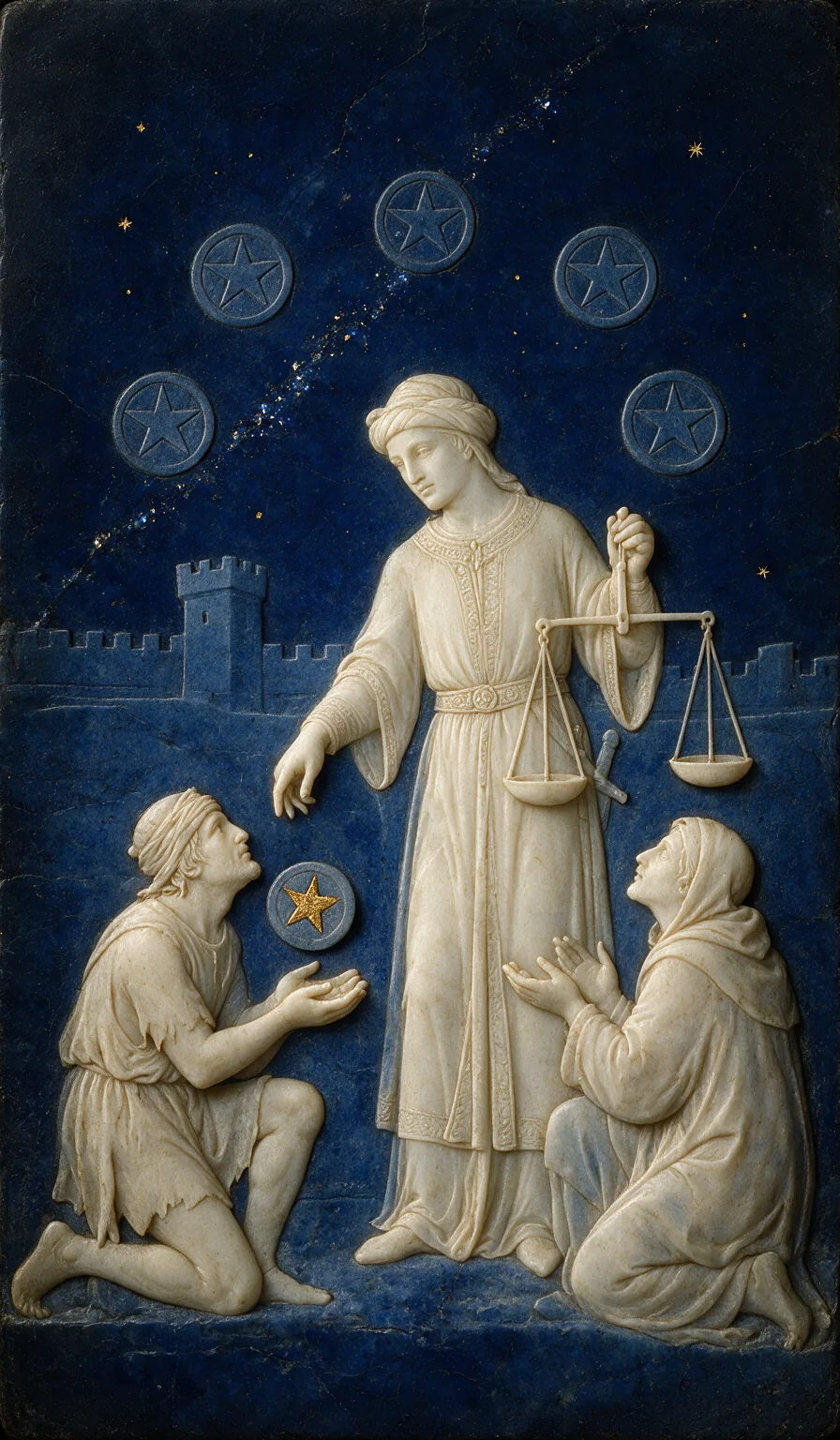
The Six of Pentacles draws attention to the moment a resource changes hands. In Olivia’s carving a robed figure stands between two kneeling people, head wrapped in folded cloth, gaze lowered. One hand hangs open, fingers pointing down; just beneath it a single pentacle with a gold star hangs in the air above a pair of cupped palms. Five more pentacles are carved into the blue stone of the sky above. Only the one in motion is gold.
In the giver’s other hand hangs a pair of scales, pans empty, beam close to level. This is the card’s quiet argument: generosity works best when it is weighed. What is actually needed here? What can you give without emptying yourself? Is the help offered in a way that leaves the other person their dignity? The scales measure judgement, not coins.
Upright, the card can point to support you are offering, support you are receiving, or both at once. It honours the fact that people move between these positions across a life, and that accepting help can be as meaningful as giving it. You are invited to look at one exchange in your life, of time, money, care or attention, and to ask whether its terms are clear, kind and fair.
Reversed
Six of Pentacles reversed can show an exchange that has lost its balance. Help may come with conditions nobody has named, or giving may have gone beyond what you can sustain, so that generosity starts to feel like depletion or resentment. The scales tip when one side holds all the power and the other feels only gratitude or debt.
The reversal can also point inward: difficulty accepting what is offered, or a habit of always being the giver because receiving feels exposed. Look at the second kneeler, hands raised and still empty. Notice where you are waiting without asking, where you are keeping score, and what a fairer arrangement might look like for everyone involved.
Read the image
Every element below is carved into this card. Scroll, hover or press a number to follow it on the image.
Five pentacles in the sky
What you seeFive round lapis discs, each with a raised rim and a carved five-pointed star, form an arch over the giver’s head: one at the top, two higher at the sides, two lower.
What it carriesPentacles are the suit of earth: money, work, the body and everything that can be held and shared. Five of the six stay here in the stone of the sky, carved in plain blue without gold. Resources exist before anyone hands them on; what the card watches is how they move.
Follow this symbol through the deck ↗The glittering diagonal band
What you seeA band of fine pale sparkling flecks runs diagonally across the dark lapis from the lower left towards the upper right, passing between the carved pentacles; small gold stars are scattered around it.
What it carriesThe Milky Way is not part of the traditional image; Olivia adds it to this card. A river of stars passing through the pentacles suggests circulation on a scale larger than one gift: what reaches you has come from somewhere, and can travel on.
Follow this symbol through the deck ↗Crenellated walls and tower
What you seeBehind the figures, a battlemented town wall is carved in paler lapis across the card; on the left it rises into a square tower with a small window, and the wall continues on the right.
What it carriesWalled towns recur through the suit of Pentacles as the settled, built world: property, community, the structures that decide who is inside. Here the giving happens outside the wall, on open ground, where help has to cross a boundary to reach the one who needs it.
Follow this symbol through the deck ↗The raised balance scales
What you seeThe giver’s left hand holds a pair of scales by the top of its upright pointer, at shoulder height; two shallow, empty ivory pans hang on cords from a beam that is close to level.
What it carriesThe scales belong to the traditional design and are the key to the card: generosity that is measured, fair and proportionate. The pans here are empty, so the weighing is not of coins but of judgement itself: what is needed, what can be given, and on what terms.
Follow this symbol through the deck ↗The sword at the hip
What you seeA sword hilt carved in grey-blue stone, with a round pommel and a slanted crossguard, shows at the giver’s left hip beside the nearer scale pan; a short length of blade runs down along the robe.
What it carriesA sword is not usually part of this card’s traditional image. At rest and half hidden, it adds a quiet note about power: the one who gives also holds the means to refuse or to protect. Generosity here comes from someone who has authority, and the card asks how it is used.
Follow this symbol through the deck ↗The giver’s lowered hand
What you seeThe giver’s right hand reaches down and outwards from a wide sleeve with an embroidered cuff, fingers pointing down and loosely curled, directly above the gold pentacle; the giver’s gaze is lowered towards it.
What it carriesIn the traditional image coins drop from the giver’s hand into waiting palms. Here the hand has already let go and stays open and relaxed, neither grasping nor pushing. It shows giving as release: the gift leaves the giver’s control the moment it is offered.
Follow this symbol through the deck ↗The gold-starred pentacle
What you seeA sixth disc, paler grey-blue with a raised rim, carries a five-pointed star inlaid in gold; it hangs in the air between the giver’s hand and the upturned palms below.
What it carriesGold is rare in this deck, and of the six pentacles only the one in motion carries it. The value is shown at the moment of exchange, not while it sits in the sky. What makes a resource precious, the carving suggests, is that it reaches someone who needs it.
Follow this symbol through the deck ↗The hooded kneeler
What you seeOn the right, a figure in a hooded cloak kneels with face turned up towards the giver; both hands are raised, fingers spread and empty, close to the giver’s robe; a bare foot shows behind.
What it carriesThe traditional image also shows two people in need, with only one receiving at that moment, so one of them waits. This figure’s empty, raised hands keep the card honest: no single gift reaches everyone, and choosing whom to help is part of what the scales weigh.
Follow this symbol through the deck ↗The cupped, upturned palms
What you seeOn the left, a barefoot figure in a ragged tunic with a torn hem, head bound with a cloth band, kneels on one knee and holds both palms cupped together beneath the gold pentacle.
What it carriesThe receiver’s cupped hands are as important as the giver’s open one: receiving takes readiness and some humility. Looking up rather than at the coin, this figure points to the relationship in any exchange, where dignity matters as much as what changes hands.
Follow this symbol through the deck ↗
The number
Six is the number of harmony regained after disruption. In the suit of Pentacles, the element of earth, money, work and the body, the Five shows loss and exclusion. The Six answers it with circulation: resources flow again, and the question becomes how they are shared. It is balance in practice rather than in theory, the point in the suit where having something and passing it on become a matter of relationship.
The tradition
In the Golden Dawn system the Six of Pentacles is titled the Lord of Material Success and is attributed to the Moon in Taurus, the second decan of the sign, where the Moon was traditionally considered exalted. Book T describes a hand holding a rose branch among six pentacles and speaks of success and gain in material undertakings. Earlier Marseille decks show only six coins arranged with flowering stems and no scene. Pamela Colman Smith’s 1909 design shows a figure with scales giving to two kneeling people in need, and this scene is a large part of why modern readers treat the card as one of generosity and fair exchange.
Love, work and self
- Love
- In love and close relationships, the Six of Pentacles turns attention to balance: who gives time, care and attention, and who receives it. A relationship can hold uneven seasons, but it helps when the imbalance is visible and chosen. This card may invite you to offer something freely, or to let someone support you without apologising. It also asks how generous you are with yourself: whether you let yourself receive rest, praise or help.
- Work
- At work, in study and with money matters, this card can point to mentoring, sharing knowledge, asking for support, or arrangements such as loans, grants or fees where terms need to be clear. The scales suggest writing down what is being exchanged and why. Consider where you are giving unpaid effort that has gone unnoticed, or where accepting help would let a project move. Fairness includes fairness to your own capacity.
- Self
- For your own life, the Six of Pentacles asks how you relate to having and needing. Some people find it easier to be the one standing, others the one kneeling. Both positions are human and temporary. You might notice which role feels familiar and which feels uncomfortable, and what that says about your sense of worth. The gold pentacle in mid-air is a reminder that value lives in the passing on.
In a spread
Read the card through each position before you look at Olivia’s version. A position is a question, and the same card answers each one differently.
The situation
What aspect of the situation deserves attention?
Olivia’s readingAt the heart of a question, this card suggests the matter turns on an exchange: what is being given or received, on what terms, and whether both sides can keep their dignity.
What complicates it
What tension or assumption deserves a closer look?
Olivia’s readingAs a challenge, it can show help with hidden conditions, a power imbalance in who gives and who receives, or giving that has gone beyond your capacity.
A helpful next step
What small action could help you understand or respond?
Olivia’s readingAs advice, it invites you to weigh one exchange honestly: offer what you can sustain, ask for what you need, and make the terms visible.
In conversation with
- Six of Pentacles + Five of Pentacles
The Five of Pentacles shows need and exclusion; the Six answers with help. Together they draw attention to the step between hardship and support, and to how asking and offering can open a door that seemed closed.
- Six of Pentacles + Justice
Justice also holds scales. Beside the Six of Pentacles, the pair turns attention to fairness in material life: whether an arrangement is balanced, and whether generosity and accountability can live in the same decision.
- Six of Pentacles + Four of Pentacles
The Four of Pentacles holds its coins close; the Six lets one go. Together they ask about the line between healthy security and holding on, and what becomes possible when a resource is allowed to circulate.
Also read withSix of CupsAll pairs ↗
Questions to keep
- In which exchange in your life are the terms unclear, and what would make them visible?
- Where is it easier for you to give than to receive, and why?
- What could you offer this week that you can genuinely sustain?
Ask them with three cards ↗A three-card reading in which each position asks one of these questions.
A small practice
List three things you gave and three things you received this week, of time, care or money, then notice which list was easier to write.
Cards that share its symbols
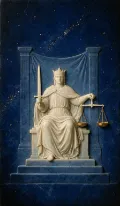 JusticeShares: The glittering diagonal band · The sword at the hip · The raised balance scales
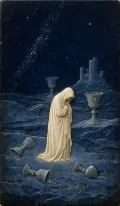 Five of CupsShares: The hooded kneeler · The giver’s lowered hand · The glittering diagonal band
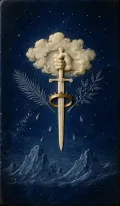 Ace of SwordsShares: The giver’s lowered hand · The sword at the hip · The glittering diagonal band
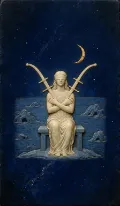 Two of SwordsShares: The sword at the hip · The giver’s lowered hand · The glittering diagonal band