Minor Arcana · Wands
Seven of Wands
Tarot card meaning: upright, reversed and the symbols of the Olivia image
The Seven of Wands asks you to hold your ground for something that matters, and to choose which challenges truly deserve your strength.
- Upright
- standing firmconvictioncourage under pressuredefending a boundaryperseverance
- Reversed
- worn-down resolveconstant guardednessyielding too soonfighting every battledoubted position
Upright
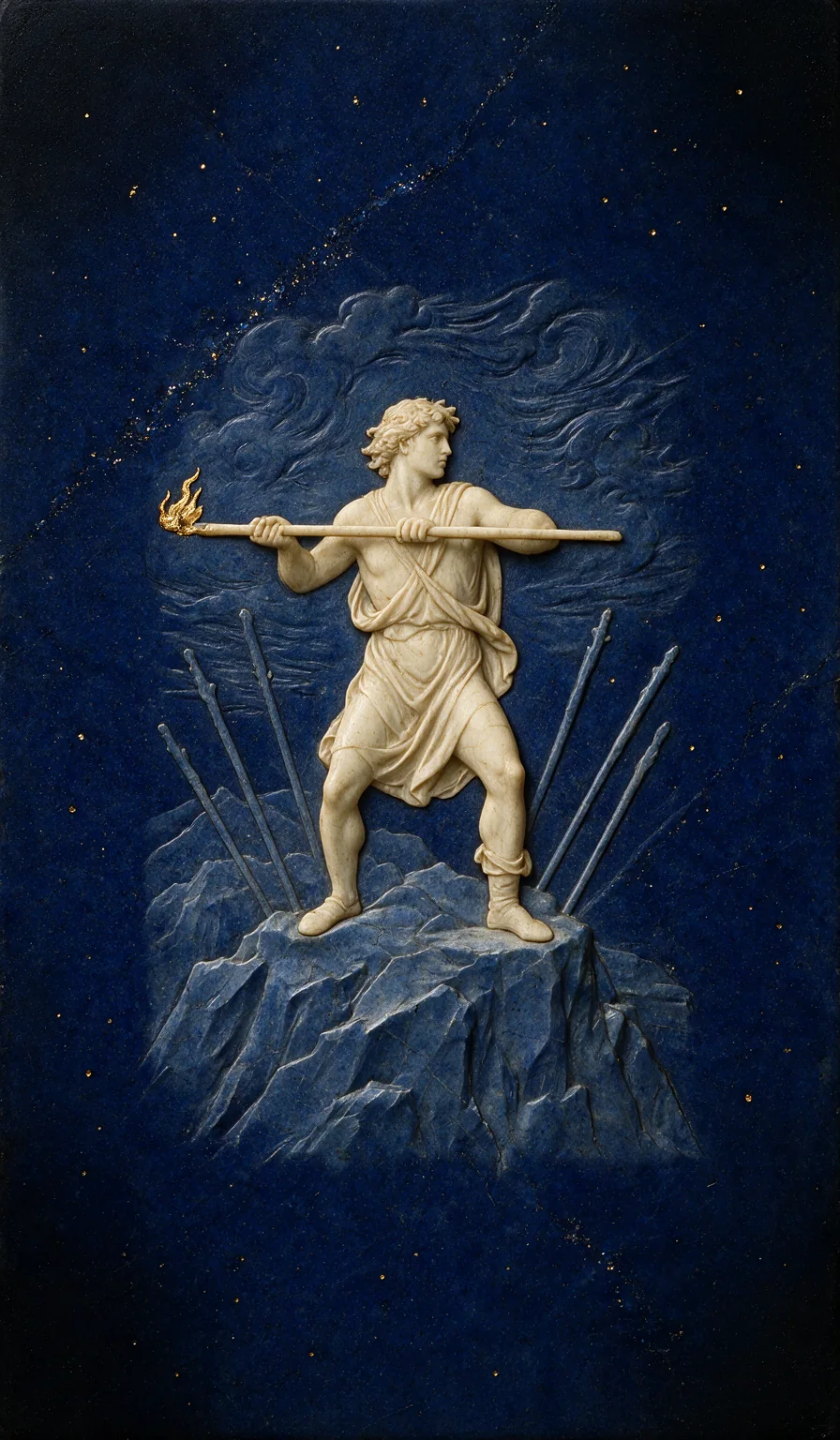
The Seven of Wands is the card of a stand. One figure holds higher ground while six other wands rise around it, and the question is no longer whether you care about something but whether you will keep hold of it when it is questioned. In Olivia’s deck the defender is carved in ivory on a cracked crag of blue lapis, legs braced wide and knees bent, gripping a single staff level across the chest.
Look at what that staff carries. At its left-hand end a small gold flame burns, the only gold on the figure, so what is being defended here is a fire of your own: a conviction, a piece of work, a boundary, a way of living. The six surrounding wands are carved in grey stone and fanned outward, and all six lean away from the figure rather than toward it. The pressure is real, yet much of it stays at a distance.
Upright, the card invites steady courage rather than aggression. The figure’s head is turned in profile to the right, gaze level and above the wand tips rather than down at them. You do not need to answer every objection; name what you are protecting, hold it with both hands, and let the rest be weather. The mismatched shoe and boot suggest you may not feel ready. Readiness is not the test here; steadiness is.
Reversed
Seven of Wands reversed draws attention to a stand that has become tiring, or one that has hardened into habit. You may be gripping the staff so tightly that every question sounds like an attack, spending strength on positions that no longer need defending. Or the pressure may have worn you down until giving way feels easier than explaining yourself once more.
This position asks you to sort the six wands. Which of them actually reaches you, and which are part of the landscape? Keep the flame, and set down the arguments that do not protect it. Rest is not surrender, and changing your mind after honest thought is not defeat.
Read the image
Every element below is carved into this card. Scroll, hover or press a number to follow it on the image.
The turned head
What you seeThe ivory figure’s head, crowned with short, tousled curls, turns in sharp profile toward the right edge of the card, jaw set, while chest and hips still face you.
What it carriesIn the traditional image the defender looks down toward the staves rising from below. Here the gaze goes past them, level and out to the right. It reads as attention held on what matters, rather than locked on every challenger.
Gold flame on the staff
What you seeAt the staff’s left-hand end, just beyond the left fist, a small crown of gold flame curls upward in several tongues. It is the only gold on the figure or the rock.
What it carriesWands are the suit of Fire: will, conviction and creative drive. Traditional Wands are living wood, often sprouting leaves; this staff ends in a flame instead. What is being defended is not only ground but a fire of your own, kept close to the hand and behind the guard.
Follow this symbol through the deck ↗The staff held crosswise
What you seeOne long, smooth ivory staff is gripped overhand in both fists and held level across the chest, its plain far end reaching well past the shoulder on the right.
What it carriesThe seventh wand is the one you actually hold. Held level, it works as a barrier and a balance bar at once, less a weapon than a line drawn. Its ivory matches the figure and sets it apart from the six stone wands around it.
Follow this symbol through the deck ↗Six wands of grey lapis
What you seeSix rough wands, three on each side, rise from behind the crag near the figure’s feet and fan outward. Carved in grey-blue lapis with knotted, twig-stubbed tips, all six lean away from the figure.
What it carriesTraditionally the six staves are pressures rising against one person: rivals, objections, demands. Olivia splits them evenly and carves them in the background stone, set back behind the ivory figure and below the held staff. Pressure surrounds but does not strike; some of it may be landscape rather than attack.
Follow this symbol through the deck ↗A shoe and a boot
What you seeThe legs are planted wide with knees bent and weight low. The foot on the left wears a soft, low slipper; the foot on the right wears a calf boot beneath a rolled cuff of cloth.
What it carriesMismatched footwear is a well-known detail of this card’s traditional image, often read as a stand taken in a hurry, before everything was ready. Olivia keeps it. Readiness is not the condition for courage; the braced, low stance does the work.
The cracked crag
What you seeThe figure stands on the uneven top of a crag carved in mid-blue lapis with pale, worn edges, faceted and split by dark fissures, falling away steeply below; lower ridges show behind it on the left.
What it carriesHigh ground is the card’s oldest advantage: the defender is hard to reach. This rock is fractured rather than smooth, so the position is real but not permanent. It invites you to value your footing and to notice where it has begun to crack.
Follow this symbol through the deck ↗Wind-driven clouds
What you seeBehind the head and shoulders, clouds carved in lighter blue lapis curl and stream sideways, and fine wind lines run horizontally behind the figure’s arms and torso on both sides.
What it carriesIn the Wands suit, air feeds fire as much as it tests it. These clouds add a headwind of opinion, noise and strain. The figure does not rise above the weather but stands inside it and keeps position anyway.
Follow this symbol through the deck ↗Glittering vein across the sky
What you seeA long diagonal vein of glittering pale mineral crosses the dark lapis from the top edge down toward the left edge, passing just left of the clouds; small gold flecks are scattered across the whole sky.
What it carriesThis is Olivia’s own detail, a feature of the stone rather than of tarot tradition. Above the contest the sky keeps its wider pattern: a quiet reminder that the stand you are taking is one moment within a much larger night.
Follow this symbol through the deck ↗
The number
Seven follows the balance of the Six with a test. In the Minor Arcana it often marks the point where something already gained has to be held, assessed or defended, and where you stand a little apart from the group. In Wands, the suit of Fire, will and conviction, the test is one of nerve: after the Six’s public victory, the Seven asks whether your fire holds when applause turns into challenge.
The tradition
In the Golden Dawn system the Seven of Wands is titled the Lord of Valour. It is assigned to Mars in Leo, the third decan of that sign (20 to 30 degrees), and to Netzach, Victory, the seventh Sephirah on the Tree of Life, expressed through the suit of Fire. Mars brings combative drive and Leo the heart of a fixed Fire sign, a pairing often read as courage under strain. Aleister Crowley kept the single title Valour. Marseille decks show only a pattern of crossed batons with one straight baton through the centre. Pamela Colman Smith’s 1909 design gave the card its familiar scene: a figure on a height, holding a staff against six raised from below.
Love, work and self
- Love
- In close relationships the Seven of Wands can point to a boundary that keeps being tested, or a need you have had to restate more than once. It cannot tell you why anyone pushes against it. It asks what your flame is here, the value or need you are protecting, and whether you can state it calmly instead of defending it against every glance. With yourself, it can mean keeping a commitment you made to yourself when others find it inconvenient.
- Work
- At work or in study, this card often appears when an idea, a standard or a role you have earned is questioned by several people at once. Separate the challenges that raise real points from those that are simply noise; the six wands are not all the same wand. Answer the first kind carefully and let the second pass. Where money or contracts are involved, a qualified person’s view serves you better than holding out alone.
- Self
- For your relationship with yourself, notice where you hold your staff. The figure’s knees are bent and weight is low, a stance that can hold for a while but not indefinitely. The card invites you to check whether your guard is protecting something alive, like the gold flame, or has become a posture your body keeps out of habit. Let your shoulders drop once today and see what still feels worth defending.
In a spread
Read the card through each position before you look at Olivia’s version. A position is a question, and the same card answers each one differently.
The situation
What aspect of the situation deserves attention?
Olivia’s readingAt the centre of a question, the Seven of Wands points to something you care about enough to defend. The real matter may be less the opposition than naming clearly what you are standing for.
What complicates it
What tension or assumption deserves a closer look?
Olivia’s readingAs a challenge, the card can show a guard held so long that every question feels like an attack, or pressure from several directions spreading your energy thin across too many small fights.
A helpful next step
What small action could help you understand or respond?
Olivia’s readingAs advice, the card invites you to choose your ground: keep hold of what matters with both hands, answer the challenges that deserve it, and let the rest remain part of the landscape.
In conversation with
- Seven of Wands + Six of Wands
With the Six of Wands, this card shows the turn from recognition to responsibility. The Six rides in to acclaim; the Seven stands alone on the rise, asked to keep what was won when attention turns into questions.
- Seven of Wands + Nine of Wands
Paired with the Nine of Wands, the stand becomes a longer story. The Seven defends with fresh energy; the Nine leans on a gold-tipped staff after long strain. Together they draw attention to pacing your defence so it can last.
- Seven of Wands + Strength
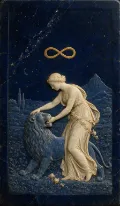
With Strength, the Major Arcana card of Leo in the Golden Dawn system, the Seven’s courage is asked to soften into steadiness. Strength meets the lion with a calm hand; together they suggest that holding your ground rarely needs force, only presence.
Questions to keep
- What is the flame you are protecting, and can you name it in one sentence?
- Which of the challenges around you raise real points, and which are only noise?
- Where are you holding your guard out of habit rather than need?
Ask them with three cards ↗A three-card reading in which each position asks one of these questions.
A small practice
Write down the one thing you are standing for this week, then list the challenges to it and cross out every one you can let pass without answering.
Cards that share its symbols
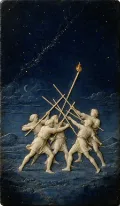 Five of WandsShares: Glittering vein across the sky · Gold flame on the staff · Six wands of grey lapis · The turned head
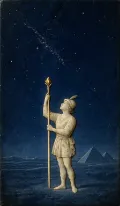 Page of WandsShares: Gold flame on the staff · The turned head · Glittering vein across the sky · Six wands of grey lapis
 Ten of SwordsShares: The turned head · Wind-driven clouds · Glittering vein across the sky · The cracked crag
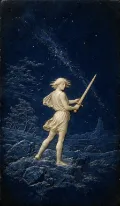 Page of SwordsShares: The turned head · Glittering vein across the sky · Wind-driven clouds · The cracked crag